
Search results for embed


In this video, sociologist Andrew Cherlin describes how marriage is still here, and still embraced, but much less stable and compulsory.

Lisa Wade, PhD is an Associate Professor at Tulane University. She is the author of American Hookup, a book about college sexual culture; a textbook about gender; and a forthcoming introductory text: Terrible Magnificent Sociology. You can follow her on Twitter and Instagram.


Prolific sender-inner Dmitriy T.M. found a fascinating PSA from the New York State Department of Health aimed at encouraging women to breastfeed (via the NYT). What’s their angle? Why, breastfeeding as a diet plan, of course! See for yourself:

They certainly  manage to get the tone of a diet commercial down perfectly. And don’t ever forget, ladies: one of your main responsibilities as a new mom is to lose the weight as quickly as possible.

As Lauren Feeney points out at The Daily Need, getting women to increase rates of breastfeeding will likely require more than efforts to change individual behaviors — it requires changes in the workplace and family leave policies that make it possible for women to realistically combine breastfeeding with the demands of their jobs.

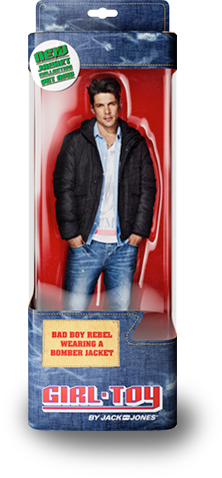
Doris G. sent in this commercial for Jack & Jones jeans, in which a man laments the way that women just want to use him for sex:

The website indicates that if you go to a store and buy a jacket, you can get a pair of headphones that come in packages that show different versions of Girl Toys. Here’s the “bad boy rebel wearing a bomber jacket”:

You can also choose from the “outdoor living macho dude wearing a wool coat,” “casual cool big-city guy wearing a peacoat,” and “urban sports hunk wearing a soft-shell jacket.”

Of course, the reason this works — the reason it’s supposed to be funny instead of disturbing — is because of gendered ideas about sex (masculine) and romance (feminine). Men are generally assumed to want sex any time they can get it, and to be able to completely separate it from emotions and love and such. Truly masculine sex is no-strings-attached sex for physical pleasure. The idea that a guy would be disturbed because hordes of conventionally attractive women want to have wild sex with him but require no greater commitment, is laughable if you accept an ideology in which that’s how girls act.

This ideology obscures the reality that men do want to make emotional connections with their partners. Michael Kimmel summarizes the research on gender and relationships in his textbook, The Gendered Society (2nd edition, 2004):

Men, it seems, are more likely to believe myths about love at first sight, tend to fall in love more quickly than women, are more likely to enter relationships out of a desire to fall in love, and yet also tend to fall out of love more quickly. Romantic love, to men, is irrational, spontaneous, and compelling emotion that demands action… (p. 227)

But the masculinization of sex discourages men from thinking about sex in terms of emotional (as opposed to primarily physical) satisfaction and prevents us from acknowledging that boys and men can, in fact, be uncomfortable with women’s advances, or even be sexually victimized by women (see our posts here and here).

Please welcome Guest Blogger Ashley Mears.  Mears is a model-turned-sociologist who is doing fantastic work on the modeling industry.  In her forthcoming book, Pricing Beauty: Value in the Fashion Modeling World (UC Berkeley Press), she examines the production of value in fashion modeling markets.  When Osocio‘s Tom Megginson forwarded us a link to a trailer for a new documentary on the topic, Picture Me, we turned immediately to our resident expert.  We’re so pleased that she agreed to share her thoughts.

———————————


Picture Me documents ex-model Sara Ziff’s 4-year rise and exit through the fashion modeling industry.  It sets out to expose the grit behind the glamour, chronicling models’ exhausting work and travel schedules, warped body images (include hints of anorexic and bulimic practices), debt to agencies, innocent youth and the attendant vulnerability to sexual predatory clients.  It is a long, wandering complaint of the industry, and in the end, Ziff equates all bodywork with exploitation and dismisses modelling work as cheap thrills—albeit emotionally costly ones.

While critical of the industry, the film glamorizes what it supposedly condemns, most insidiously by portraying Ziff’s meteoric success as normal for a model.  Twice the camera zooms in on the many digits of her paychecks.  As her co-filmmaker/boyfriend Ole Schell wryly notes, “It’s not everyday you see a check for $112,000.”  This is especially the case, they should add, for most working fashion models.  As a winner-take-all market, modelling is extremely unequal; very few women reach this kind of success.  At any given modelling agency, in fact, dozens of women owe significant debt, an issue far more complex—and exploitive—than the moments it gets in Picture Me.  Models accrue debt for start-up costs advanced by their agencies, from plane tickets and visas to pocket money and apartment rent in an agency-owned apartment (to the tune of about $250 per week to stay regardless of how full or vacant its state).  They are charged anywhere from $5 to $50 for bike messengers to deliver their portfolios across town daily.  These costs are not negotiable or traceable; they are deducted automatically from her future earnings.  And they add up; at one New York agency I studied, a model was in the hole up to $18,000 even before stepping foot into her first casting audition.  To recoup their losses, agencies count on the top 5% of their models who bill more than $100,000 annually, people like Ziff who are statistical anomalies in their field.

A model who leaves an agency with a debt is legally bound by contract to repay it, though accountants will tell you that they don’t bother to pursue these debts, since indebted models are an unlikely source from whom to recoup losses.  Instead, agencies write off negative accounts as business expenses.  However, models’ negative accounts will by law transfer to their next agencies should they attempt to work elsewhere, which is unlikely as agencies are hesitant to represent models with existing negative balances from prior agencies.  In other words, once in debt, everywhere in debt.  It is an independent contractor status designed to alleviate the organization’s responsibility for its worker, pushing all market risks onto the freelancer in a work relationship that can resemble indentured servitude.  Thus, Ziff sits at the top of the pile, nonchalantly waving a wad of cash in her hand that masks a precarious career structure in which, for every Sara Ziff, there are thousands of women struggling to make ends meet.

———————————

Another telling omission in the film is men.  Ziff’s accusations of systemic sexual abuse are distressing, and something I heard all too commonly in interviews with models—male models, that is.  I found women were far less likely than men to recount ordeals of sexual advances by clients.  There are a couple of explanations for this discrepancy.  First, it is likely that female models may not report or even recognize as report-worthy sexual advances by men, given the ubiquity of sexual harassment women are likely to face on any job.  Second, the filmmakers seem to have encouraged their subjects to recount their ordeals in confessional-style video diaries, a technique quite different from open-ended interviewing.

Also likely, I think male models do experience more unwanted come-ons than female models.  In an industry over-represented with gay men in decision-making positions, male models report feeling pressure to flirt with men in order to book jobs.  Male models earn considerably less than their female peers, making each job more important to them, and their agents often instruct them to charm important clients.  It’s referred to jokingly in the industry as going “gay for pay,” similar to male porn actors who do gay sex scenes to boost their earnings.  Male models do not as a population identify as gay, but it’s widespread and openly acknowledged that straight men must flirt shamelessly with gay clients to get work.  As one male model told me, “Everyone has to play his cards.”

But it’s not a game to the men I interviewed who told horror stories of such performances turning into threatening situations.  Men reported being “felt up” by stylists while dressing, told to wear revealing clothes, or no clothes at all, and being kissed and hugged by prestigious clients at parties.  One model described how, on a shoot with a male photographer, he was asked to make himself semi-erect.  This is not to downplay women’s encounters with sexual harassment in the industry, but to note that all models are relatively powerless in this market, and given the sex composition of those in power, male models are especially vulnerable.

Picture Me revolves around shocking personal narratives, and as a biting (and I think unfair) NY Times review notes, the filmmakers go straight for the easy critiques at the expense of their social context.  It’s hard to contextualize economics, gender and sexuality, and a complicated career structure in a 75-minute documentary, especially when stomach-turning confessionals and eye-catching runway pictures are so readily available.  And this is what sociologists are for anyway.

For more of Mear’s insights on the modeling industry, see our posts on the contrasting aesthetics of high end and commercial modeling, the ugly other side of the model search, and control and thinness.

Lisa Wade, PhD is an Associate Professor at Tulane University. She is the author of American Hookup, a book about college sexual culture; a textbook about gender; and a forthcoming introductory text: Terrible Magnificent Sociology. You can follow her on Twitter and Instagram.

An anonymous reader sent in a segment (found at Taking it Day by Day) from a Seattle TV program called New Day. The segment focuses on Dyson Kilodavis, a young boy who likes to dress up like a princess, and how his family and school has reacted to his gender non-conformity, and does so in a way that seems quite thoughtful (sorry for the short ad intro):

I think it’s an interesting example of how gender non-conformity among kids affects families. At 4 years old, Dyson seemed pretty comfortable dressing up openly in “girls'” clothes; it was his mom who initially had some concerns and tried to channel his interest in dressing up into more “boyish” forms. Parents often express concern about gender non-conformity among children (and as the host says, much more when it comes from sons than from daughters) for a range of reasons — concern that they somehow failed as parents, that others will judge their parenting skills, or fears that their child will be harassed or threatened as a result.

The video also highlights how much the social environment can affect how gender non-conformity impacts families. In this case, Dyson appears to have the great luck to go to a school where the staff actively took on the role of normalizing Dyson’s behavior and attempted, as much as they could, to ensure that he wasn’t mocked. Contrast the experience of Dyson’s family with the family of a 4-year-old boy kicked out of school in Texas because of the length of his hair.


Lest you think that rape culture is confined to simply excellent institutions of higher education, Salon reports that Yale students pledging the Delta Kappa Epsilon fraternity were marched by women’s dorms marching “no means yes, yes means anal.”  Salon’s Tracy Clark-Flory writes:

Now, DKE President Jordan Forney has been forced to apologize for this blatant sexual intimidation by calling it “a serious lapse in judgment by the fraternity and in very poor taste.” But this sort of hateful crap isn’t a “lapse in judgment.” It doesn’t innocently happen that you’re guiding male pledges by young women’s dorms in the dark of night chanting about anal rape. It isn’t a forehead-slapping slip-up, it’s a sign that you need major reprogramming as a human being.

UPDATE: Sociologist Michael Kimmel has a fantastic analysis of the second half of the chant:

This chant assumes that anal sex is not pleasurable for women; that if she says yes to intercourse, you have to go further to an activity that you experience as degrading to her, dominating to her, not pleasurable to her. This second chant is a necessary corollary to the first.

Thanks to feminism, women have claimed the ability to say both “no” and “yes.” Not only have women come to believe that “No Means No,” that they have a right to not be assaulted and raped, but also that they have a right to say “yes” to their own desires, their own sexual agency. Feminism enabled women to find their own sexual voice.

This is confusing to many men, who see sex not as mutual pleasuring, but about the “girl hunt,” a chase, a conquest. She says no, he breaks down her resistance. Sex is a zero-sum game. He wins if she puts out; she loses.

That women can like sex, and especially like good sex, and are capable of evaluating their partners changes the landscape. If women say “yes,” where’s the conquest, where’s the chase, where’s the pleasure? And where’s the feeling that your victory is her defeat? What if she is doing the scoring, not you?

Thus the “Yes Means Anal” part of the chant. Sex has become unsafe for men–women are agentic and evaluate our performances. So if “No Means Yes” attempts to make what is safe for women unsafe, then “Yes Means Anal” makes what is experienced as unsafe for men again safe–back in that comfort zone of conquest and victory. Back to something that is assumed could not possibly be pleasurable for her. It makes the unsafe safe–for men.

In this way, we can see the men of DKE at Yale not as a bunch of angry predators, asserting their dominance, but as a more pathetic bunch of guys who see themselves as powerless losers, trying to re-establish a sexual landscape which they feel has been thrown terribly off its axis.

For more indications that we live in a rape culture, see our posts on media coverage of a rape video game and the George Sodini murders, rapists as hyperconformists to ideal masculinity, the rape scene in Observe and Report, t-shirts endorsing sex with “drunk girls”, and, of course, the Purdue Exponent’s sex position of the week.

Lisa Wade, PhD is an Associate Professor at Tulane University. She is the author of American Hookup, a book about college sexual culture; a textbook about gender; and a forthcoming introductory text: Terrible Magnificent Sociology. You can follow her on Twitter and Instagram.


Anita Sarkeesian, creator of the fun Bechdel Test video we link to frequently (and blogger at Feminist Frequency), emailed to let us know about Jonathan McIntosh’s most recent video. McIntosh, who posts at rebellious pixels, has a knack for remixing elements of pop culture to make larger social points. He made the Buffy vs. Edward remix we posted last year.

His newest video, Right Wing Radio Duck, mixes scenes from 50 different Donald Duck cartoons with audio of Glenn Beck:

Glenn Beck actually responded to it. Here’s the audio:

When I read part of the transcript first, I honestly thought Beck was joking and playing along. But after listening to it, I think he’s serious.

Of course, he’s also making some accurate points: Walt Disney was extremely anti-union and anti-Communist. He served as a friendly witness before the House Un-American Activities Committee in 1947 (transcript here). Others have accused Disney of being a Nazi sympathizer — swastikas and other symbols show up in some Disney cartoons — though The Straight Dope says Disney’s politics weren’t easy to pin down (for instance, the cartoon where Donald Duck is a Nazi eventually shows it to have been a nightmare; is that pro-Nazi or not?).

But back to Beck’s fascinating response, and how seriously he takes this “unbelievable attack.” He seems to imply the Fair Use doctrine allows propaganda, but also that Disney is somehow in on it (“apparently Disney doesn’t have a problem with Donald Duck cartoons now being remixed and politicized for the progressive left”). Of course, that’s the point of the Fair Use doctrine: whether or not Disney is ok with it isn’t relevant, because Fair Use protects the right to use otherwise copyrighted material. Specifically, according to the U.S. Copyright Office, “Section 107 contains a list of the various purposes for which the reproduction of a particular work may be considered fair, such as criticism, comment, news reporting, teaching, scholarship, and research.” It’s hard for me to imagine that Beck doesn’t know that; I’m sure he’s used material on his program at some point — say, news footage or historical photographs — and was able to do so specifically because of the fair use doctrine.

His response also reminds me of an episode of Fresh Air I heard earlier this week. Historian Sean Wilentz discusses how often Beck draws on 1950s Cold War-era ideologies, and that he has made them resonant again. Five years, saying “communists” and “socialists” in an ominous tone and implying that communism is in danger of spreading across America would have made you ultra-fringe, and I don’t think it would have had much cultural resonance. Now throwing around accusations of socialism and conspiracy theories isn’t at all out of the ordinary.

Given that resurgence in ideas that arose from the right during the Cold War, combined with Disney’s anti-Communist and anti-labor stance from that period, I think actually makes McIntosh’s use of old Disney cartoons even more effective as social commentary.

And just for fun, ikat381 remixed part of Beck’s response with an old Mickey Mouse cartoon:


In this Zócalo video, sociologist Jennifer Lee discusses the social construction of race and the history of the U.S. census with NALEO’s Arturo Vargas and the L.A. Times‘ Steve Padilla:

For more on the social construction of race, see our post on race and ethnicity in censuses around the world.

Lisa Wade, PhD is an Associate Professor at Tulane University. She is the author of American Hookup, a book about college sexual culture; a textbook about gender; and a forthcoming introductory text: Terrible Magnificent Sociology. You can follow her on Twitter and Instagram.