Search results for The

Last week, John Kerry made a joke about John McCain’s age, implying that he wears Depends (that is, adult diapers). I have searched everywhere and haven’t been able to find any video of Kerry telling the joke; all the discussions I’ve been able to find of it seem to lead back to an original story at PolitickerMA.com. It brought up something that has bugged me throughout this campaign: the cheap shots about McCain’s age. For example (thanks to Burk for finding me all these images):
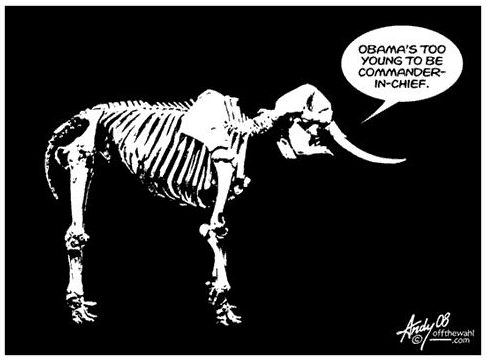
Found here.
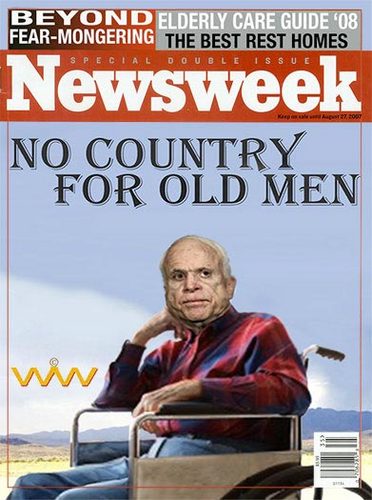
Found here.

The Baltimore Sun posted this photo and asked readers to provide captions for it:
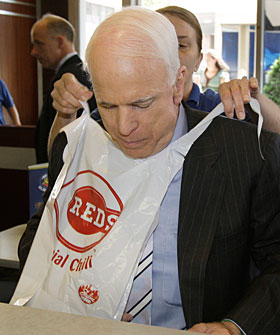
Suggested captions included jabs about Ensure, reaching out to senior citizens, nursing homes, forgetfulness, and so on.

While I’ve heard a lot of people talking about racism in depictions of Barack Obama, and sexism in portrayals of Sarah Palin and Hillary Clinton, I have heard very few people discuss the very negative depictions of the the “old” being used to ridicule McCain. Depictions of older people range from out-of-touch, doddering fools to crazed racists to pathetic invalids. Although Kerry’s joke drew some criticism, jokes or comments about McCain’s age have generally been given a pass–they’ve been declared fair game. You might get in trouble in our culture for being sexist or racist, but apparently ridiculing people for being old is fine.

I don’t know about you, but I know some old people, and they are healthy, coherent, mentally competent people who appear to have complete control of their bladders and bowels. My grandmother is 70 and runs a 110-cow ranch on her own in Oklahoma, doing all of the labor herself (except that she hires someone to come in and bale the hay each year). Just as I thought it must be awful to be an Arab American and hear accusations that Obama is secretly Arab or Muslim used as a slur against him, I’ve wondered how my grandma feels, hearing McCain’s age ridiculed. My guess is that she finds it mortifying, but I haven’t gotten up the courage to ask.

I have also on more than one occasion heard people mock John McCain’s physical appearance, particularly the fact that one side of his face is swollen because he had a patch of skin removed due to skin cancer. The times I overheard this, they weren’t expressing concern that he might have a serious form of cancer that could kill him or force him to leave office; they were just laughing at how he looked.

If McCain showed evidence of dementia or osteoporosis or some other condition that you could maybe directly relate to his age, then ok, fine, I could see people commenting on it. But that’s not what’s going on here. This is just making fun of his age for the sake of it–it’s funny that he’s old, because old people are laughable. It’s an interesting statement about the value we place on older people in this culture.
I’ve posted about the phenomenon of what I’ve called leftist balkanization or the way in which leftist causes tend to be narrowly focused such that they undermine other leftist causes (see here for my original post and here and here for two follow-ups).  Perhaps the opposite of such balkanization is social movements that try to bring together issues that find themselves on opposite sides of the political spectrum.  Below are two advertisements for the pro-environment anti-immigration movement.  The argument is that restricting immigration is good for the environment.

This first commercial from the Californians for Population Stabilization makes exactly this point:

You might be asking yourself whether this pro-environment anti-immigration message is really just an anti-immigration message shrouded in leftist rhetoric.   In this case, at least based on the commercial below from the same organization, the answer appears to be “yes.”

Of course, it’s not necessarily true that all anti-immigrant pro-environment messages are secretly simply xenophobic. For a great discussion of this troubled movement, see Leslie King’s great article that shows how challenging it is to mobilize a grass roots movement when one half of your message offends one half of the population and the other half of your message offends the other.

Via copyranter.

Cross-posted at Love Isn’t Enough.

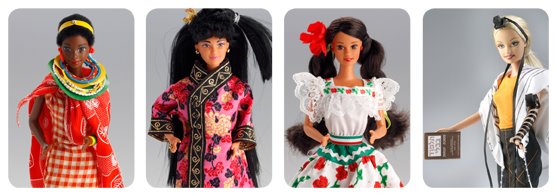
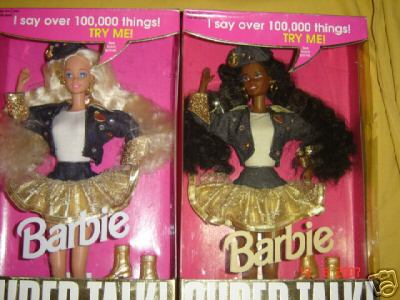
Ann DuCille, in her book Skin Trade, takes two issues with “ethnic” Barbies. 

First, she takes issue with the fact that “ethnic” Barbies are made from the same mold as “real” Barbies (though sometimes with different paint on their faces).  This reifies a white standard of beauty as THE standard of beauty.  Black women are beautiful only insofar as they look like white women (see also this post).  DuCille writes:

…today Barbie dolls come in a rainbow coalition of colors, races, ethnicities, and nationalities, [but] all of those dolls look remarkably like the stereotypical white Barbie, modified only by a dash of color and a change of clothes.

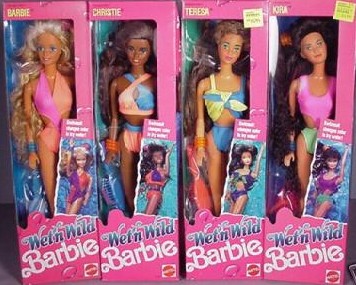
Consider:

But, second, DuCille also takes takes issue with the idea that Mattell would try to make ethnic Barbies more “authentic.”  Trying to agree on one ideal form for a racial or ethnic group is no more freeing than trying to get everyone to accord to one ideal based in whiteness.  DuCille writes:

…it reifies race.  You can’t make an ‘authentic’ Black, Hispanic, Asian, or white doll.  You just can’t.  It will always be artificially constraining…

And also:

Just what are we saying when we claim that a doll does or does not look… black?  How does black look? …What would make a doll look authentically African American or realistically Nigerian or Jamaican?  What prescriptive ideals of blackness are inscribed in such claims of authenticity?  …The fact that skin color and other ‘ethnic features’ …are used by toymakers to denote blackness raises critical questions about how we manufacture difference.

Indeed, difference is, literally, manufactured through the production of “ethnic” Barbies and this is done, largely, for a white audience. 

To be profitable, racial and cultural diversity… must be reducible to such common, reproducible denominators as color and costume.

The majority of American Barbie buyers are only interested in “ethnicity” so long as it is made into cute and harmless variety.  This reminds us that, when toy makers (and others) manufacture difference, they are doing so for money.  DuCille writes:

…capitalism has appropriated what it sees as certain signifiers of blackness and made them marketable… Mattel… mass market[s] the discursively familiar–by reproducing stereotyped forms and visible signs of racial and ethnic difference.

Consider:

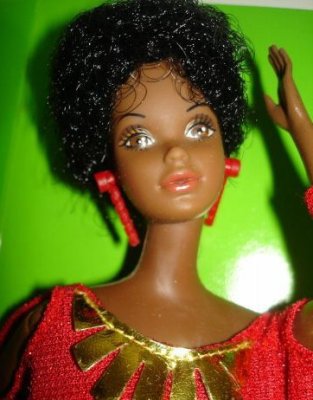
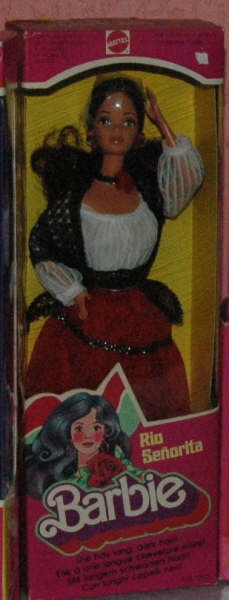
Black Barbie and Hispanic Barbie, 1980

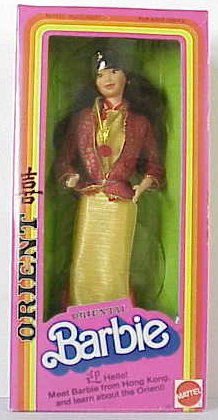
Oriental Barbie, date unknown

A later “Asian” Barbie (Kira)

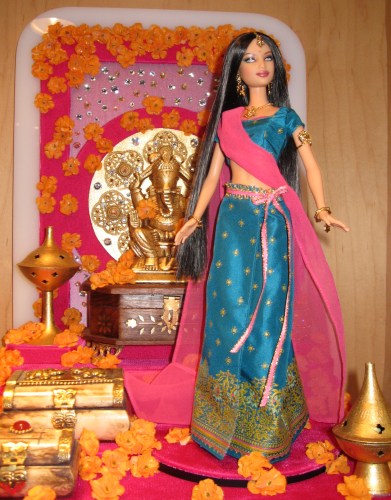
Diwali Barbie (India)

Hula Honey Barbie

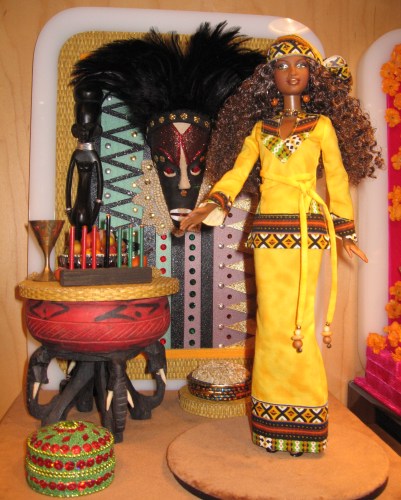
Kwanzaa Barbie

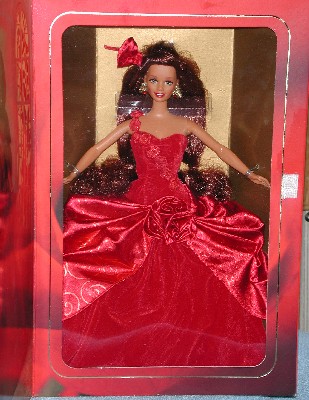
Radiant Rose Ethnic Barbie, 1996

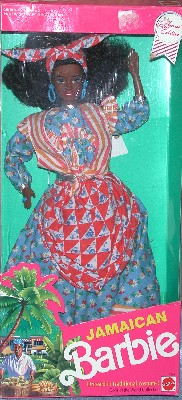
There are many reasons to find this problematic.  DuCille turns to the Jamaican Barbie as an example. 

The back of Jamaican Barbie’s box tells us:

How-you-du (Hello) from the land of Jamaica, a tropical paradise known for its exotic fruit, sugar cane, breath-taking beaches, and reggae beat!  …most Jamaicans have ancestors from Africa, so even though our official language is English, we speak patois, a kind of ‘Jamaica Talk,’ filled with English and African words.  For example, when I’m filled with boonoonoonoos, I’m filled with much happiness!

Notice how Jamaica is reduced to cutesy things like exotic fruit and sugar cane and Jamaican people are characterized as happy-go-lucky and barely literate while the history of colonialism is completely erased.

So DuCille doesn’t like it when Black Barbies, for example, look like White Barbies and she doesn’t like it when Black Barbies look like Black Barbies either.  What’s the solution?  The solution simply may not lie in representation, so much as in actually correcting the injustice in which representation occurs.

(Images found here, here, here, here, here, and here.) 

For a related post on race and friendship, see here.

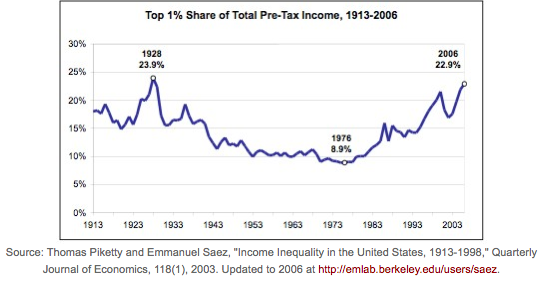
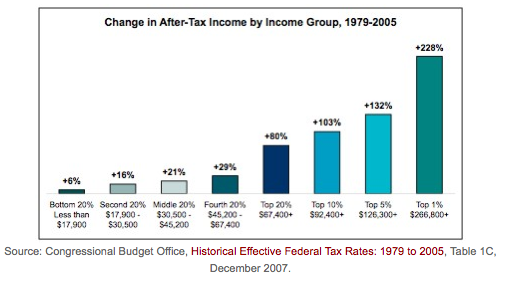
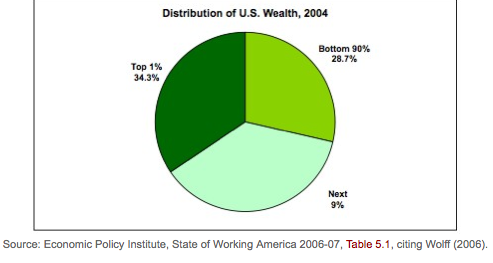
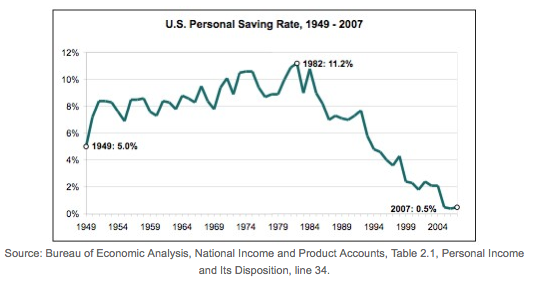
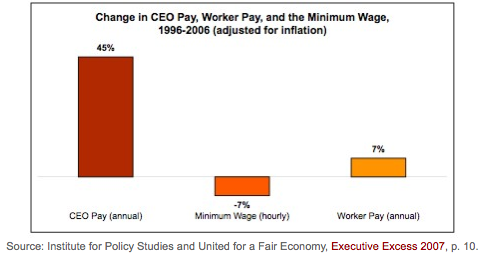
Here are some graphs about income inequality over time:

From the Working Group on Extreme Poverty.

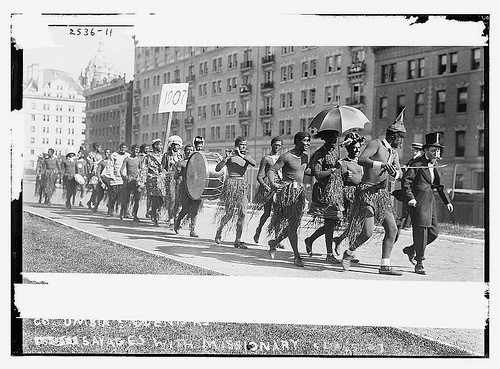
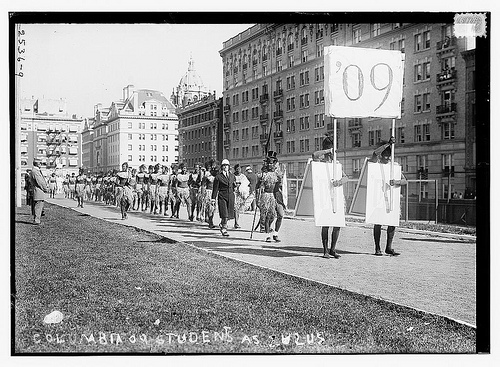
These images capture the Columbia University class of 1909 posing as “Zulu Savages” (found here thanks to Penny R.)  We may not be so surprised to see such mimickry of blacks in 1909, but I think that when compared to these pictures of college students at race-themed parties in 2007, it might make for some interesting discussion of humor, mimickry, racism, and the notion of progress… especially as Halloween approaches.

Beth T. sent us this picture of some books for sale at the NASA John Glenn Research Center in Cleveland.  I found some more at the website. They nicely illustrate the gendering of jobs.  Only because we implicitly think that zoologists, oceanographers, paleontologists, and architects are men, is it necessary to modify the term with “woman.”

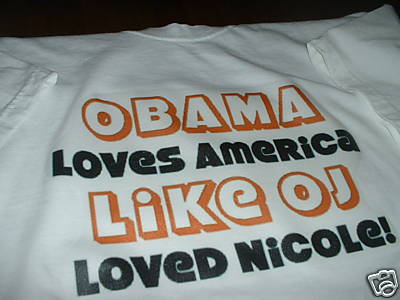
The trivialization of domestic violence + Obama is going to destroy America + the stereotype of black men as violent.  Sigh.  Buy it here.

Thanks to Tim C. for the tip!

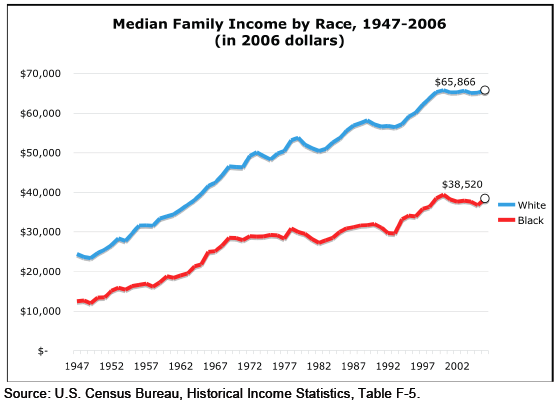
Here are some graphs on the income and wealth gap between Whites and Blacks in the U.S.

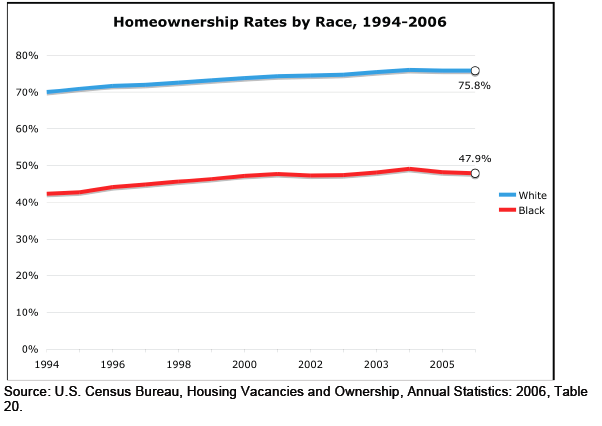
This next one shows homeownership rates. I know some people are going to point out that Blacks are more concentrated in urban areas than Whites are, and so it might make more sense to break down homeownership by area (rural, urban, suburban). While that might be a legitimately useful comparison, it also brings up the question of why African Americans would be more concentrated in urban areas, which could lead to a discussion of government programs that encourage Whites to buy homes in the suburbs after WWII while denying those opportunities to Blacks.

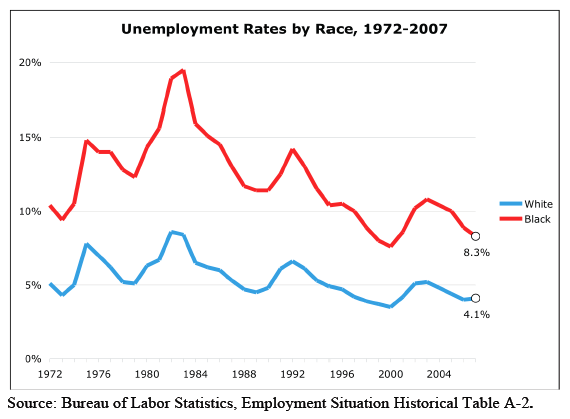
One way of explaining higher unemployment rates among Blacks is that there is some individual or cultural deficiency–African Americans are lazy, or want a hand-out, or don’t look for work, etc. etc. I like to show trend comparisons like these because they undermine those types of explanations. If African American unemployment was due to laziness, a “culture of poverty,” or other deficiencies, it would be unlikely for Black and White unemployment rates to show the same pattern (or, for that matter, any pattern–unless you believe African Americans just got a lot lazier in, say, 1982). What we see here is that Black and White unemployment rates follow a very similar pattern, but that during hard economic times, sugh as the early 1980s and around 1992, African Americans suffer disproportionately.

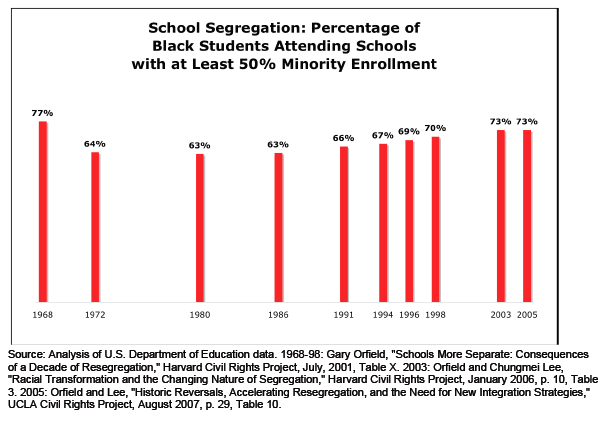
This one shows the slow but steady trend toward resegregation of our schools:

All of these were found at the Working Group on Extreme Inequality website.