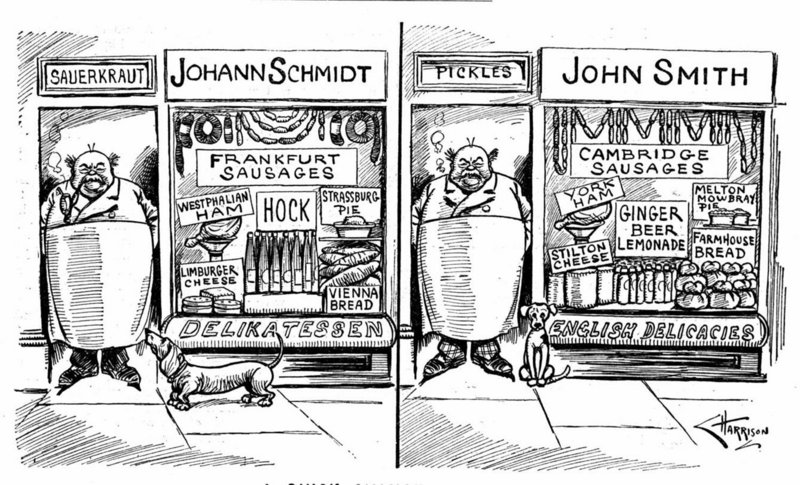
During World War I and World War II, being German-American in the U.S. became less-than-agreeable. At that time, due to interpersonal and institutionalized discrimination, many German-Americans actively tried to assimilate into a still-very British America by downplaying their ethnic characteristics. This cartoon, published in 1921, illustrates how German-Americans attempted to do this and how well-aware the larger society was of their efforts:
(I have long since lost the source on this, but if someone sends one in, I will gladly link to it.)
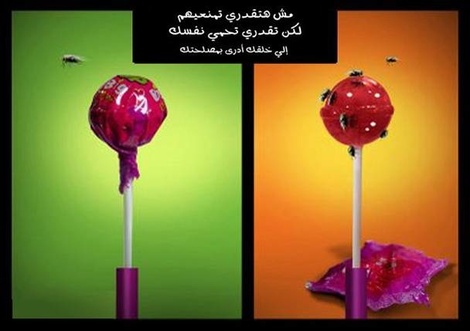
According to Sullivan, the text says, “You won’t be able to stop them (i.e. guys), but you can protect yourself. He who created you knows what’s best for you!”
Neither Z. nor I have been able to track down the origin of this image, which is supposedly a pro-hijab PSA, beyond what Sullivan provides as a source–I can’t find any evidence online of any first-hand accounts of people seeing it displayed anywhere or of what groups might be displaying it (the online references I’ve found make vague statements about it being from Egypt). I was really hesitant to post it, but it is available on the website of a major U.S. magazine, and I’m hoping maybe some of our readers might have information about the image–who put it out, if it’s actually on display anywhere, etc. If it is a real pro-hijab PSA (or even just a proposed one), it’s a great example of the way women are often portrayed as having responsibility for controlling and preventing men’s sexual advances, since men are believed to be incapable of controlling their own sexual desires. Whoever made it clearly uses that discourse about men, women, and sexual attraction; the question is, who created it?
While I was doing some online searching for it, I came upon the site Protect Hijab, a site dedicated to “the protection of every Muslim woman’s right to wear the Hijab in accordance with her beliefs and for the protection of every woman’s right to dress as modestly and as comfortably as she pleases.” Among other things, the site provides links to news stories about laws regarding hijab, including the interesting situations that come up when, say, the city of Antwerp (in Belgium) outlaws employees from wearing hijab (or any other symbol of religious or political affiliation) but then allows them to wear bandannas.
Then I came upon this video, which has the description, “A PSA Parody/Satire intended to protest the use of the veil by women. Ban the veil and ban the berqa. A Hijab is okay, however. Free Arab and Muslim women from male religious oppression.”
I’m always interested in things like this video because there is a tendency for groups with no connection to Islam to protest the hijab as a symbol of women’s oppression. This often occurs while the voices of Muslim women who argue that they don’t find the practice of hijab to be oppressive OR they have many other issues that are higher priorities are ignored or silenced. The statement “Ban the veil and ban the berqa. A Hijab is okay, however” also brings up some of the interesting aspects of attitudes toward hijab–who gets to decide what is oppressive? Why would, say, a veil be immediately and always oppressive but hijab (however the author was defining hijab) is “okay”?
Finally, I ran across this video, called “Top 10 Funniest Things a Muslim Woman Hears,” which presents 10 questions Muslim women often get about hijab/veils/scarves/etc.:
I like some aspects of this video–I’ve had Muslim students tell me they are asked these types of questions, some of which are clearly due to simply curiosity and lack of knowledge and others of which are rude. On the other hand, just like the previous video, this video is also constructing the practice of hijab, and the women who wear it, in a particular way–as something “obligatory” for Muslim women once they hit puberty. Clearly not all Muslims agree with this interpretation.
These could be really useful for a discussion of attitudes (both pro and con) toward the practice of hijab and the way it (or the version different groups portray of it) has become a symbol of Muslim (often defined as the equivalent of Arab) women’s oppression to some and of religious freedom and devout Muslim faith to others.
It could also be useful for a general discussion of whose voices are powerful in cultural conflicts. Who is speaking out against the presumed oppression of “Arab and Muslim women”? What is their interest in the issue–that is, is there a genuine concern about sexism and gender inequality, or is the issue of hijab a convenient avenue to express anti-Islamic sentiments? Which Arab/Muslim women are they claiming to speak for? Similarly, who is behind the pro-hijab activism? Are the voices of actual Muslim women represented? Do they play a role in the content of the message? To what degree do they represent the voices of (some groups of) Muslim women expressing their personal preferences and interests and to what degree is it an effort to pressure women to adopt hijab? Again, which Muslim women are they speaking for/to?
For other posts about hijab and other issues concerning Muslim women’s clothing, see here, here, here, here, and here. Also see these images of advice on modest clothing at Brigham Young University for a comparison.
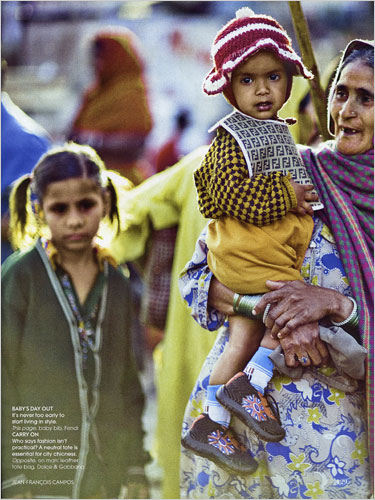
Abby K. sent me a link to this New York Times article about the August issue of Vogue India. The issue has sparked controversy because of a fashion spread that shows poor Indians modeling extremely expensive brand-name accessories, such as this child modeling a Fendi bib that costs around $100 while being held by a woman prominently missing teeth:
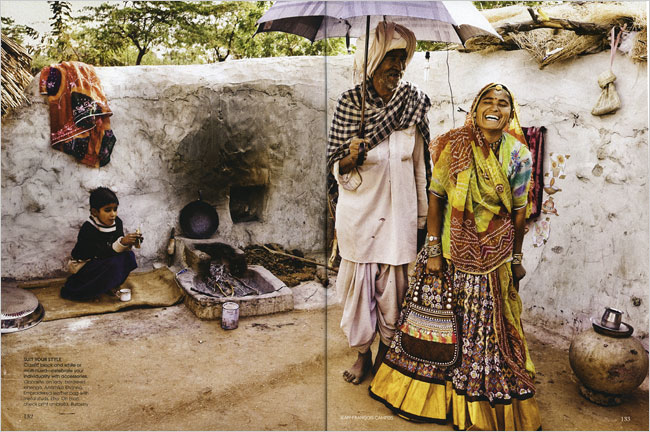
Or this one of a barefoot man, also missing teeth, holding a Burberry umbrella that costs about $200:
From the article:
Vogue India editor Priya Tanna’s message to critics of the August shoot: “Lighten up,” she said in a telephone interview. Vogue is about realizing the “power of fashion” she said, and the shoot was saying that “fashion is no longer a rich man’s privilege. Anyone can carry it off and make it look beautiful,” she said.
I’m not sure where to even begin with this one. The objectification of the poor, who are used as props in a fashion magazine aimed at people very different from them? The oblivious discussion of the “power of fashion,” while ignoring the issue of how much these luxury items cost relative to average incomes in India? I’m especially struck by the way that the inability to spend $200 on an umbrella is no longer seen as a privilege because “anyone” can “carry it off”; it’s not about having $200 extra dollars, it’s about having the mindset to know you can carry these items and won’t make them look ugly or tacky, apparently. There’s a complete denial of privilege and power having anything to do with wealth, social stratification, or any inequality more consequential than some people maybe worrying that they won’t “make” fashion “look beautiful” (which in and of itself is an interesting idea–it’s not whether the fashion items make you look beautiful, it’s what you do for them).
Gwen Sharp is an associate professor of sociology at Nevada State College. You can follow her on Twitter at @gwensharpnv.
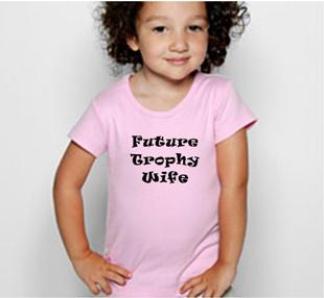
Brenda V.P. sent in this girls’ t-shirt, available here:
It hurts me, dear readers! It hurts!
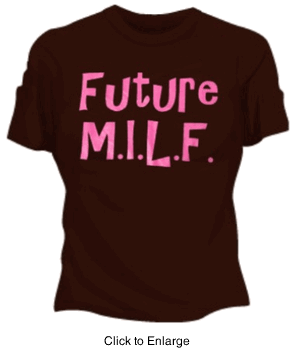
Oh, holy hell. I was about to publish this and thought to myself, “at least there’s not a ‘future MILF’ shirt.” And then I thought, “Um…is there?” Oh, yes, there is (found here):
Why do we think these kinds of messages–hey, girls! You can grow up to be an objectified accessory!–are cute?
Thanks, Brenda. Thanks.
Gwen Sharp is an associate professor of sociology at Nevada State College. You can follow her on Twitter at @gwensharpnv.
In the U.S. today, when infants are born with ambiguous genitalia, surgeons often operate in order to bring the child’s body into accordance with our expectations for “correct” male or female genitalia, even when the actual morphology of their bodies causes no dysfunction or harm.
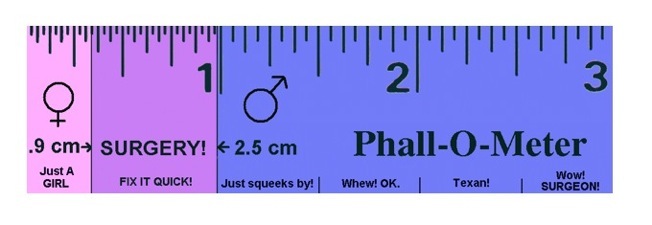
Some activists, such as those involved with the Intersex Society of North America, are trying to stop these surgeries. The Phallo-O-Meter (found here) is a satirical ruler designed to draw attention to the way in which the surgeries force bodies existing in nature into social categories of our own invention (it is attributed to Kiira Triea here). Here it is:
The ruler is satirical (as you can tell by the tongue-in-cheek “just squeeks by” etc.), but the measurements are based on the kind of decisions doctors actually make. Indeed, if doctors decide that a penis is “too small” or a clitoris is “too big,” an infant is in danger of having corrective cosmetic surgery. The point here is: When bodies don’t fit into our pre-existing notions of male and female, we will force them to, even if it involves a knife. Clitorises that are longer than .9 cm and penises that are shorter than 2.5 must be fixed. As Martha Coventry says in Making the Cut:
The strict division between female and male bodies and behavior is our most cherished and comforting truth. Mess with that bedrock belief, and the ground beneath our feet starts to tremble.
In Creating Good-Looking Genitals in the Service of Gender, Suzanne Kessler found that clitorises that were seen as “too big” were often described by doctors in moral terms. They were “defective,” “anatomic derangements,” “obtrusive,” “embarrassing,” “offensive,” and “troublesome.”
Surgery on intersex infants reflects a taboo on gender similarity; a moral objection to gender sameness. We must be separated… by at least .6 cm.
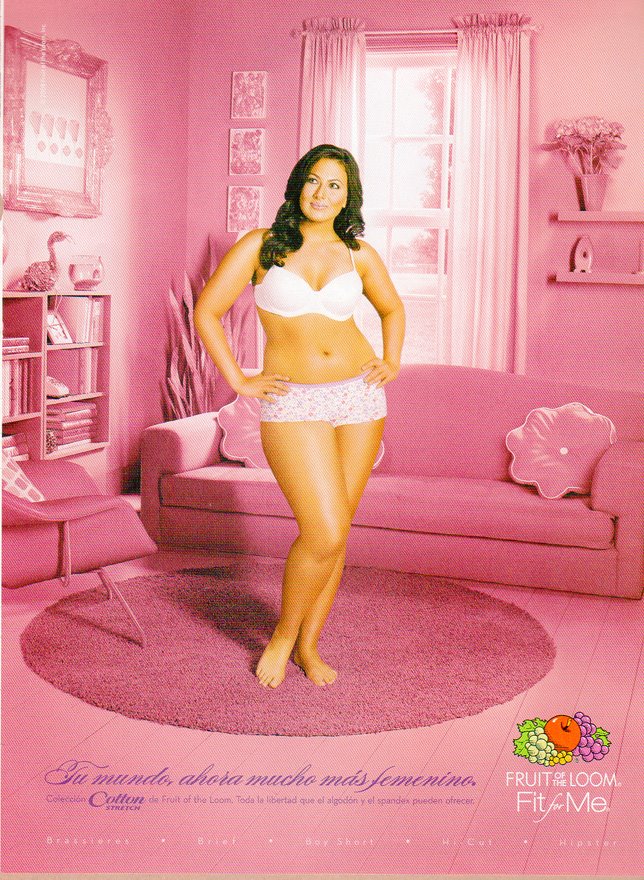
Multicult Classics posted these two Spanish-language Fruit of the Loom ads. They are an extra nice example of the way that color is used to communicate gender:
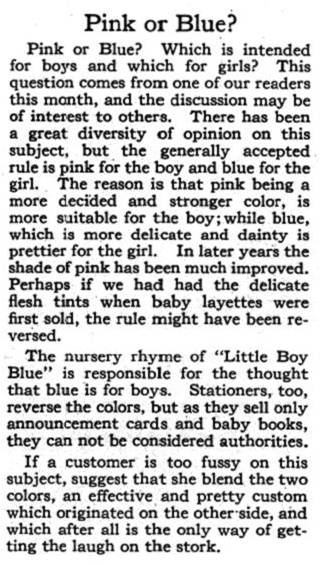
It’s obvious to us, today, that pink is for girls. But it wasn’t until about the 1950s that our current gendered color scheme became widely accepted. Before that, the colors were reversed. In this excerpt for a vintage advice column (found here), we learn that:
“…the generally accepted rule is pink for the boy and blue for the girl. The reason is that pink being a more decided and stronger color, is more suitable for the boy; while blue, which is more delicate and dainty is prettier for the girl.”
This commercial I recently saw on Comedy Central for Progene male enhancement supplement warns men who are “not 20 anymore” that, without their product, they won’t be able to satisfy a woman.
Here’s a screenshot of a graph from the video which purports to show how men’s sexual performance declines with age:
Of course, we women “know it’s not your fault,” “it’s natural.”
Obviously you could could use this for a discussion of the increasing scrutiny men’s bodies are put under (much as women’s long have). But it’s also a good example of the way sex is often discussed; the implication here is that the only way to satisfy a woman sexually is to be able to have sex like a 20-year-old man, and the emphasis is clearly on penile-vaginal intercourse as the main source of sexual pleasure (though it does come with the handy DVD about the female orgasm). I might also use it when I talk about the ways we construct biology and treat some “natural” processes as inevitable and unalterable while attempting to change others.
For the unbelievers, I know this ad may very well look fake, but I swear to you I saw it on TV. Multiple times, because it was during a show I’d recorded, so I had the opportunity to rewatch it to my heart’s content.
Gwen Sharp is an associate professor of sociology at Nevada State College. You can follow her on Twitter at @gwensharpnv.
About Sociological Images
Sociological Images encourages people to exercise and develop their sociological imaginations with discussions of compelling visuals that span the breadth of sociological inquiry. Read more…