Nora H. sent in this excellent example of how advertisers gender chores. The ad goes through how generations and generations of women have done laundry.
During November we divvied up the massive gender tag into 18 sub-categories to make it easier to search for specific types of gender posts. For example, you can now browse all of our posts about masculinity by going to the “gender: masculinity” tag. We hope this makes it easier to navigate the site.
In other words, we worked our asses off for you over Thanksgiving break, so go browse a gender tag right now!
And, your monthly reminder: we’re on Facebook and Twitter, if that floats your boat.
Tim McC. sent in a link to a Volvo concept car aimed specifically at women. We added it to our post on the Dodge La Femme. It’s really interesting to compare how cars were marketed to women in the 1950s and today.
Do you feel you have a truly special relationship with your cleaning products? If so, check out the Lysol commercial we added to our post about Sarah Haskins’s “Target: Women” segment on household cleaners marketed as women’s special, special friend.
I don’t get a chance to watch the many dance shows out there, but I’ve seen a bit and I have a question for those of you who’ve been watching them more carefully.
The video below is of Sébastien Soldevila and Mimi Bonnavaud dancing at the Cirque de Demain festival (thanks for the info, netrus). In the dance, a woman is torn between rejecting a man and being powerfully drawn to him. I’ve noticed that this theme crops up frequently in even just the little bit of dance programming I’ve watched. In this video, you get the idea in just the first few seconds, though you might want to watch the rest because it’s awesome. (Video title, btw, is not mine.)
I can see why choreographers return to this theme again and again. I think this is a common human experience (lord knows I’ve been there) and great fodder for art.
My question is: Is this theme gendered? That is, is it usually the woman who is desperately trying to escape the man and her attraction to him, and not vice versa?
I ask because, if it is, what we’re really seeing is not just a drama about a conflict between attraction and repulsion, we’re seeing a drama in which men are allowed to be deaf to women’s insistence that they want to be left alone, released. Really, deep down, this narrative tells us, she wants him. Therefore, it’s perfectly ok for him to ignore her “no.” If he just follows her for long enough, grabs her to make her look at him one more time, forces her up against his body enough, then she will relent.
From a different perspective, this is a man who is stalking and harassing her, but the narrative (which almost always ends in her giving in to him/her desire) suggests that this is perfectly reasonable, even passionate, loving, devoted behavior.
Do we sometimes (or ever) see women doing the stalking and harassing in these choreographies? Or is it usually the man?
When we consider how well we are doing financially, we must choose a referent. That is, when we ask the question (“How well am I doing?”), we are also, simultaneously choosing a comparison group (e.g., people in our profession, people of our same sex, people our age, etc).
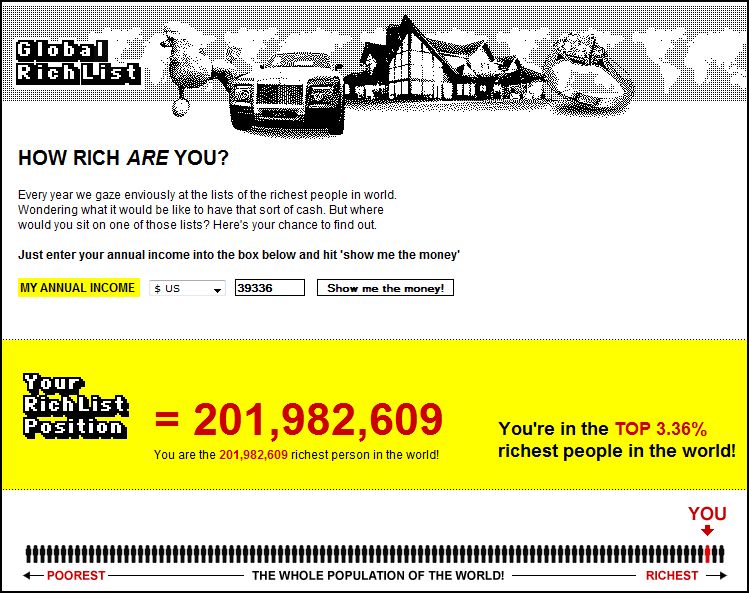
Most of us probably also restrict our considerations to people in the same country. We usually don’t think about how well we are doing compared to all human beings in the world, but this website allows us to do just that. If you put in your yearly income, it will show you where you rank on a global scale (Yen, Canadian dollars, U.S. dollars, Euros, and Pounds only, unfortunately).
I put in the median yearly income for a full time worker in the U.S. and this was the calculation:
This, of course, doesn’t consider the cost of living differences, but it still offers an interesting perspective.
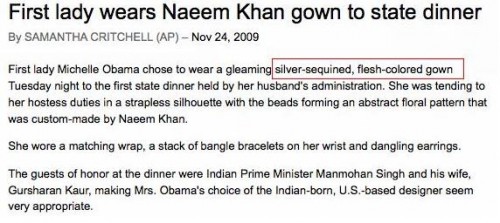
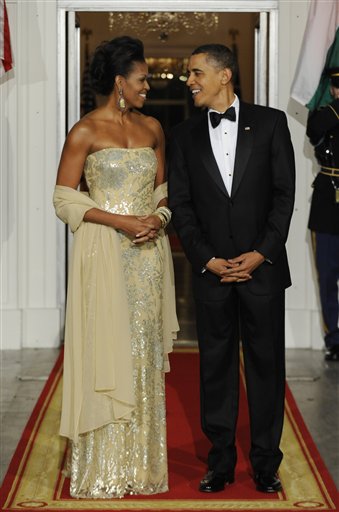
The Associated Press, a news service subscribed to by news outlets all over the world, distributed a story about the first Obama Administration State Dinner. In the story, sent in by Elisabeth R., Samantha Critchell describes Michelle Obama’s dress as “flesh-colored.”
[Thanks to Madeline T., Anne Marie, Therese S., and Drugmnky for the screencap!]
Gee, what could possibly be wrong with calling this dress “flesh-colored”?
This is what happens when white people are considered people and black people are considered a special kind of people, black people. “Flesh-colored” becomes the skin color associated with whites and darker-skinned peoples are left out of the picture altogether. We see this all the time. Bandaids, for example, are typically light beige (though they rarely call them “flesh-colored” anymore), as are things like ace bandages.
At first I thought that this vintage Honda ad was aimed at women who wanted to do lots of “things.” And then I realized, no, despite the fact that all the women look alike, the ad is actually aimed at men who get to have “things,” like “Michelle and Tammy and Alison.”
Selected text:
But what would you rather have? Automatic transmission, air conditioning, and a 400-horse-power engine?
Sociological Images encourages people to exercise and develop their sociological imaginations with discussions of compelling visuals that span the breadth of sociological inquiry. Read more…