Andi M. sent in a video created by J.C. Penney called “The Doghouse.” The ad tells the story of men sent to the doghouse by their wives for various bad behaviors, but mostly for giving bad Christmas gifts. A bad gift is a non-romantic gift, or a gift that is related to housework, or that implies a woman needs to lose weight or change her appearance:

As Andi points out, the ad portrays men as idiots or even actively mean-spirited. But I’m also interested in the way we define what are appropriate gifts for women. We often see “practical” gifts as perfectly acceptable to give to men. But increasingly, gifts for women are supposed to be essentially romantic, a symbol of love, not usefulness, a cultural trend the jewelry industry, in particular, has encouraged and benefited from.

In this ad, we have several “bad” gifts — more computer memory, a vacuum cleaner, facial hair remover, and a work-out accessory. All are presented as equally idiotic choices for men to make. So getting a woman something that might significantly improve her computer is just the same as giving her something to work out with, while actively mocking her body and eating habits. Any non-romantic gift is risky, even if accompanied by an attempt to be sweet (see the poor computer memory guy).

I’ve discussed before research on low-income women who complain when they feel that men waste money on romantic but non-essential gifts rather than stuff they actually need. On the other hand, I asked one of my classes about what they would consider an acceptable gifts, and I was (probably stupidly) surprised that many of the women in the class were adamant that useful or helpful items were nice to get, but only in addition to a romantic gift, never as the “main” gift itself. A couple said they’d feel bad if their female friends were showing off jewelry they got for Valentine’s Day or Christmas and they didn’t have anything to show, because their friends would assume their boyfriends/husbands weren’t romantic or didn’t love them very much. So it was less about whether they wanted jewelry than that they knew other women did, and thus feared their friends would judge their relationships if they didn’t get the right gift to “prove” they had good partners.

I think ads like this both reflect and reinforce this social pressure to buy the “right” kind of gifts for women. J.C. Penney tapped into an existing cultural norm about what kinds of gifts women want, and then reinforces it by presenting jewelry as the only means available to men to get out of the doghouse, and shows all women as being in complete agreement about what an acceptable gift is.

UPDATE: Reader Josh Leo pointed out that the ad also portrays the doghouse as a place men are tortured by having to do feminine things:

…all they are fed in “the doghouse” is Quiche and Chai Latte’s. This is clearly a statement that these foods are feminine an almost a form of torture for “Real Men.”


In this six-minute video from the New York Times, past residents and developers describe how Times Square was transformed from “the sleaziest block in America” to the corporate palace that it is today.  Thanks to Dmitriy T.M. for the submission!

Lisa Wade, PhD is an Associate Professor at Tulane University. She is the author of American Hookup, a book about college sexual culture; a textbook about gender; and a forthcoming introductory text: Terrible Magnificent Sociology. You can follow her on Twitter and Instagram.


This one-minute video exposes how one person is made to look his worst and his best for a sequential photo shoot. He is both a “before” and an “after” version of himself on a single day. It is as you have always suspected:

Borrowed from Body Impolitic.

Lisa Wade, PhD is an Associate Professor at Tulane University. She is the author of American Hookup, a book about college sexual culture; a textbook about gender; and a forthcoming introductory text: Terrible Magnificent Sociology. You can follow her on Twitter and Instagram.

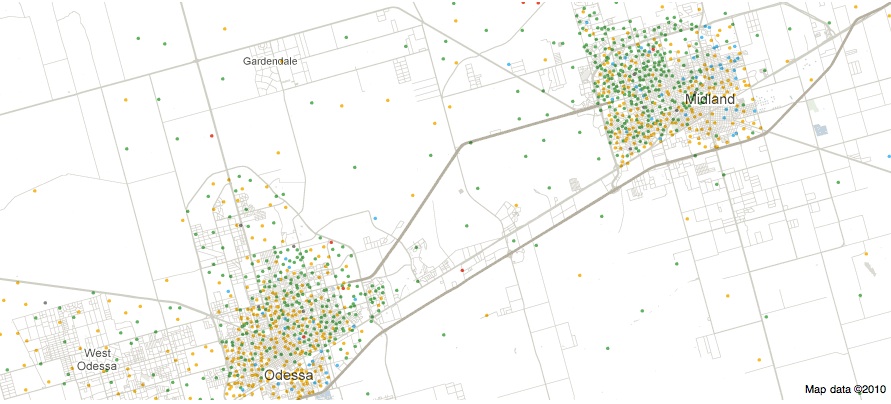
Back in September, I posted about some maps put together by Eric Fischer, using 2000 Census data, showing the racial/ethnic makeup of selected cities. As Jeff H., Eluned J., and Dmitriy T.M. pointed out, the NYT now has up an interactive map where you can see the racial/ethnic composition of any Census tract, using more updated Census Bureau data from 2005 to 2009. For instance, here’s a map of the neighboring cities of Midland and Odessa, Texas, which I picked for no reason other than that I just watched an episode of Friday Night Lights, which is set in a fictionalized version:

Color key:

You can zoom in to get quite detailed information about individual neighborhoods. I zoomed in as far as I could on Miami (each dot now represents 50 people):

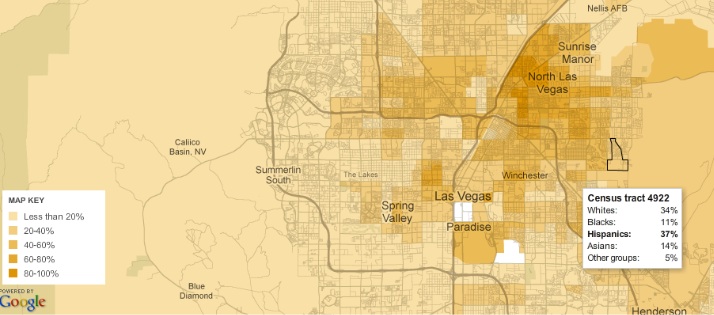
There’s also a tab that says “View More Maps.” It allows you to select to see just the distribution of Whites, Blacks, Hispanics, Asians, or the foreign-born population. Here’s the map of the Hispanic population of Las Vegas:

As you can see, if you hover over a Census tract, you can get specific data on its racial/ethnic makeup.

The foreign-born population of Seattle (if you hover over a tract, it will tell you the % foreign-born, as well as the % increase in the foreign-born population since 2000):

A great resource. Although I tried to look up my home town, and even zooming in to the smallest scale, it’s too small to have any data available.


This fascinating three-and-a-half-minute excerpt from the BBC’s Horizon illustrates the McGurk Effect. What does your brain do when the information it is receiving from different senses doesn’t match? It’s solution is an example of just how much interpretive work our brain is doing all the time.

Via Blame it on the Voices.

Lisa Wade, PhD is an Associate Professor at Tulane University. She is the author of American Hookup, a book about college sexual culture; a textbook about gender; and a forthcoming introductory text: Terrible Magnificent Sociology. You can follow her on Twitter and Instagram.

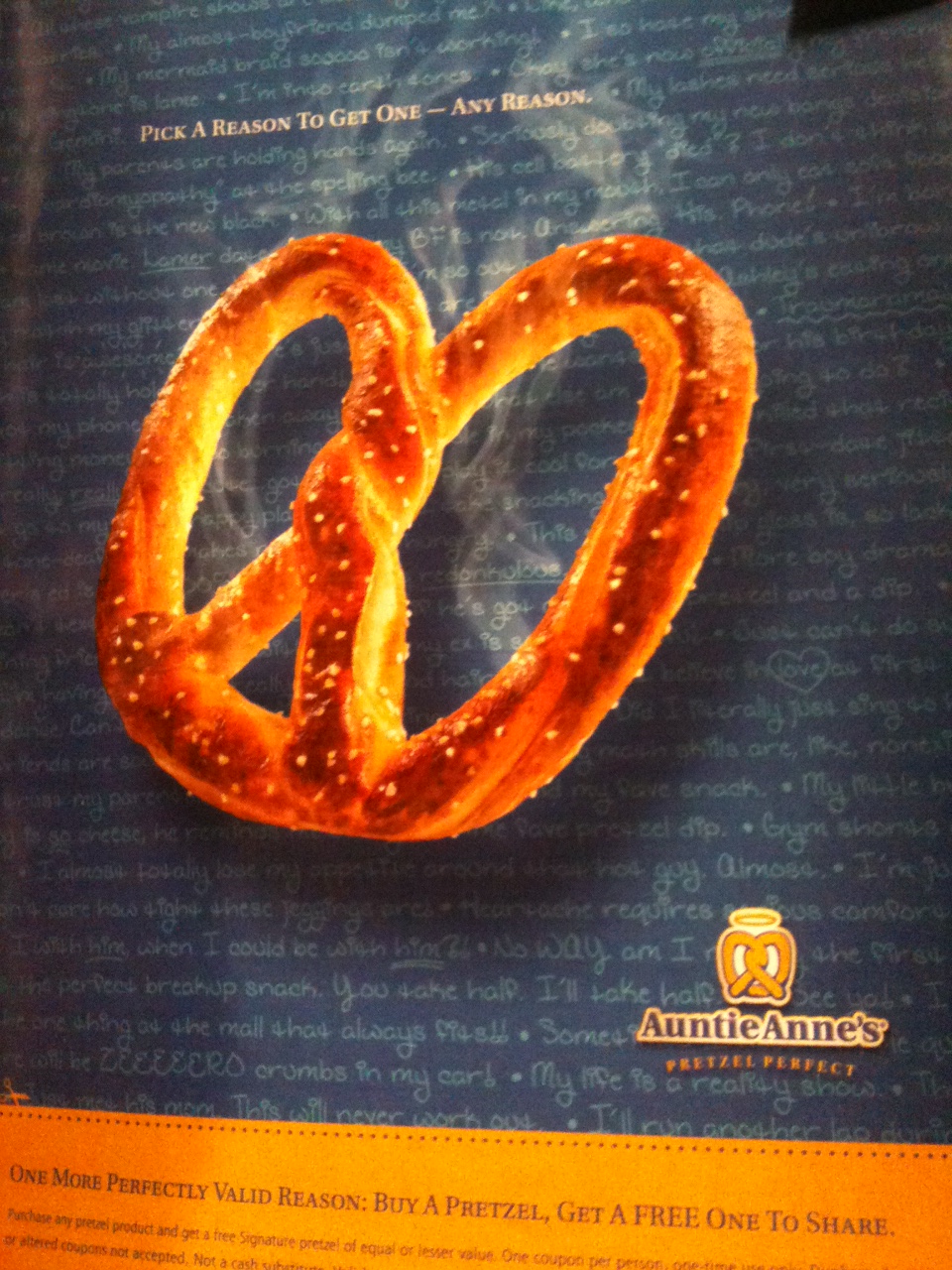
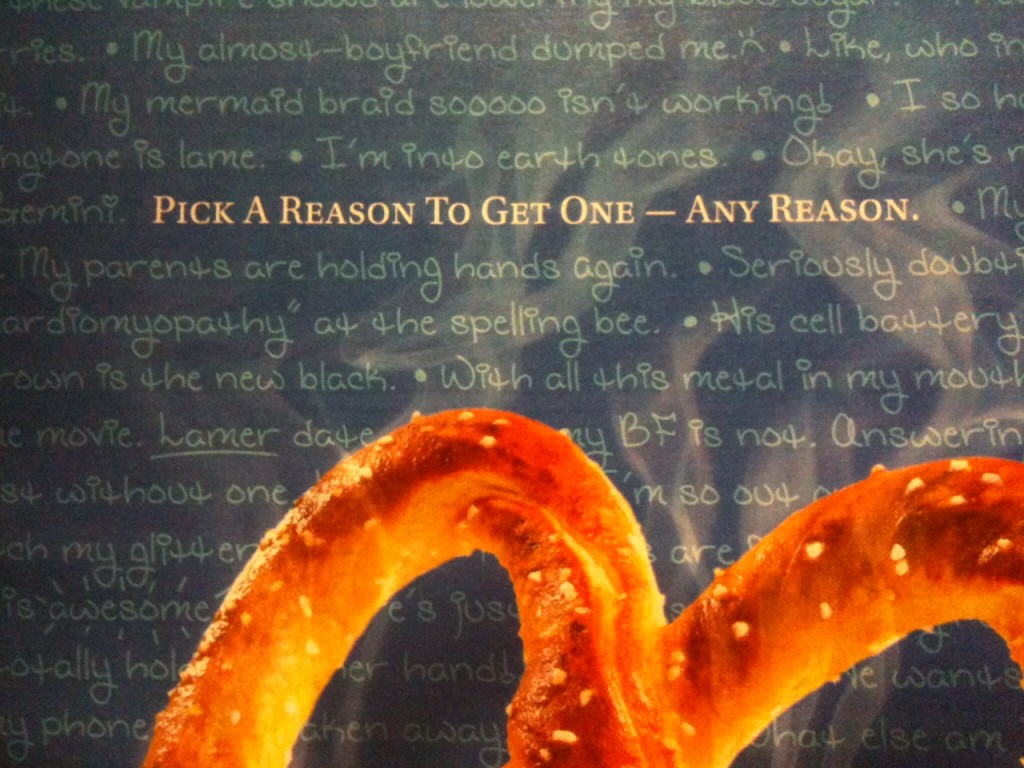
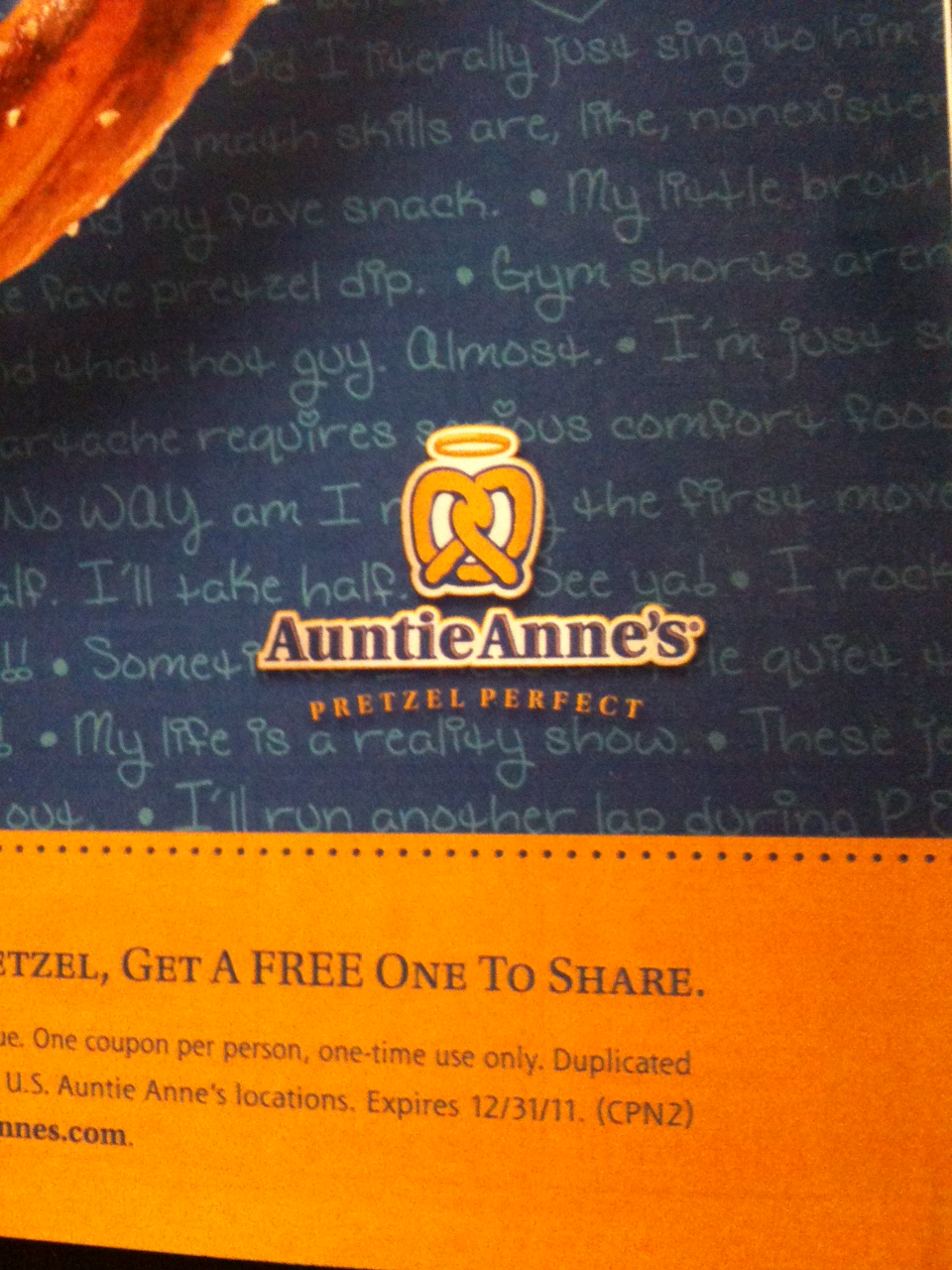
Alyssa M. sent in an ad that gives us a window into the advertising aimed at tween and teen girls.  The ad, for Auntie Anne’s pretzels (an American chain that appears mostly in shopping malls) appeared in Seventeen magazine.  The copy reads “Pick A Reason to Get One — Any Reason” and, in the background, is a long list of reasons.

The ad:

I’ll let Alyssa take it from here:

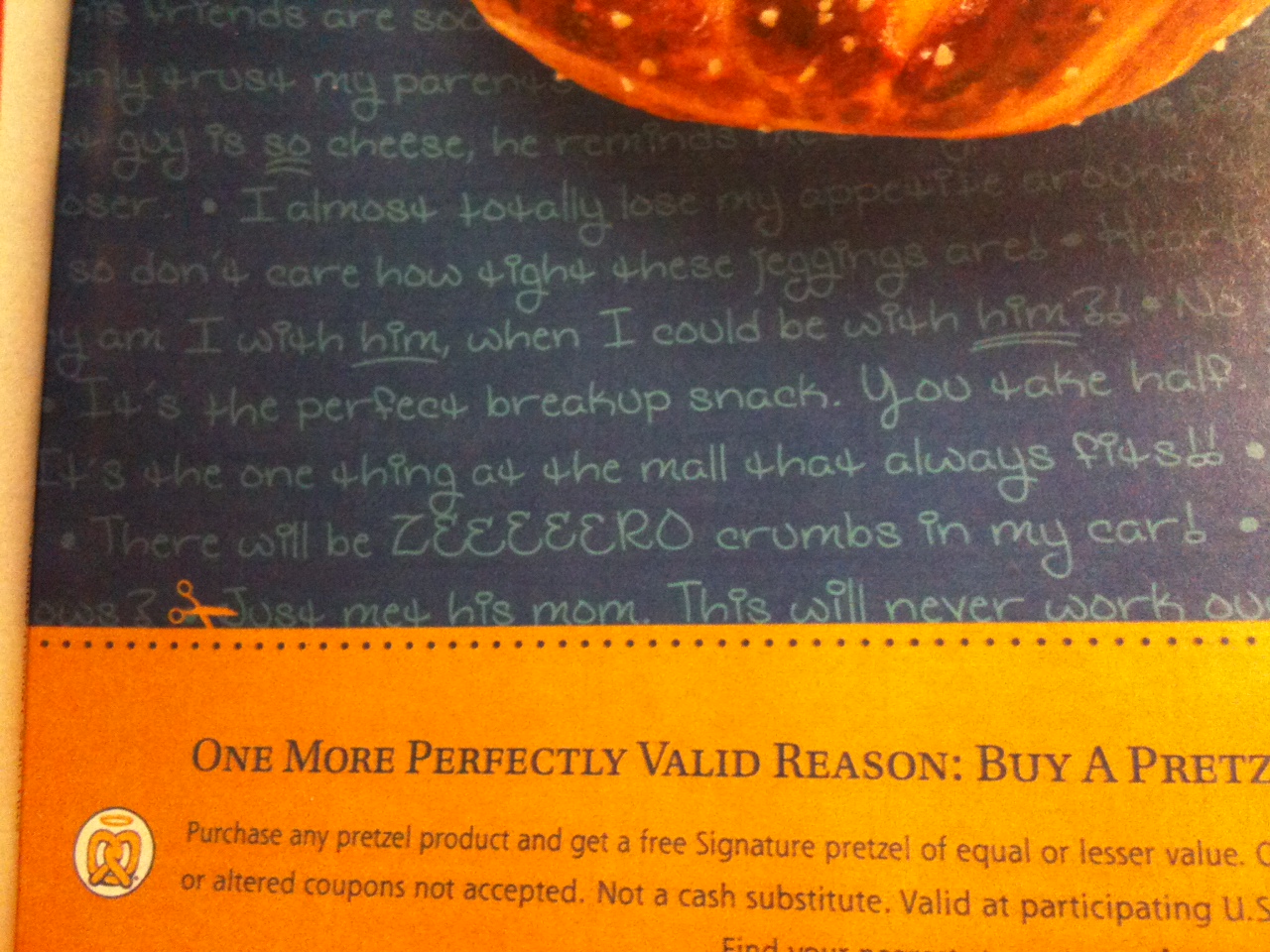
..the reasons in the background reflect gendered expectations that are placed on [teen girls]. One of the reasons, for example, is “I’ll run another lap during P.E.”  This reflects the idea that women should feel guilty about eating food, and that they should make up for eating a salty pretzel by exercising more. It also illustrates that women must justify eating by promising themselves that they will prevent any weight gain, which would stray from the type of woman that society deems best (the thin woman).  Another reason provided is that “It’s the one thing at the mall that always fits!!”  This again reflects the social necessity for women to be thin, as it implies that women are concerned with the fact that clothes at the mall are often too small, which implies that the women are too large. This ad very much focuses on girls’ size and waistlines and illustrates that a thin girl is the best girl, and that to be accepted by society, teen girls must act in accordance with this expectation.

Another theme seen throughout the ad is that food can be consumed in order to ease the emotional pain of a traumatic event such as a breakup. For example, two other reasons given are that “My almost-boyfriend dumped me” and “It’s the perfect breakup snack.” Both suggest that a breakup warrants an unhealthy indulgence like a pretzel, but this also implies that unhealthy foods like this are only acceptable during a bad experience like a breakup. Eating is okay when you need it to comfort yourself, but if you are not going through such an experience, then you need to watch your weight and “run another lap during P.E.” Those who break this rule are at risk of being policed by others and losing the body type that society appreciates most. This ad therefore supports the expectation placed on teen girls to be thin and concerned with their weights.

Close ups:


Alyssa’s analysis reminds me of Jamal Fahim’s argument for how chocolatiers convince women to indulge in their product.

Lisa Wade, PhD is an Associate Professor at Tulane University. She is the author of American Hookup, a book about college sexual culture; a textbook about gender; and a forthcoming introductory text: Terrible Magnificent Sociology. You can follow her on Twitter and Instagram.

Larry Harnisch, of The Daily Mirror, sent in a link to a story at the NYT regarding study released by the Geena Davis Institute on Gender in Media about the under-representation of women and girls in “family” movies — that is, movies rated G, PG, and PG-13. The authors looked at all English-language fictional G-rated films released in the U.S. or Canada between September 2006 and September 2009 (a total of 22 movies). They also looked at the 50 highest-grossing films for both PG- and PG-13-ratings, meaning a total of 122 movies is included in the analysis. They focused on characters that were either mentioned by name or spoke at least one word in the movie, leading to a sample of 5,554 characters. Of those, 70.8% were male and 29.2% were female.

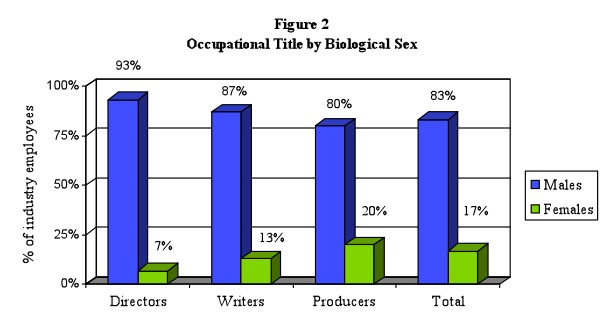
Consistent with patterns in Hollywood in general, women made up a small proportion of directors, writers, and producers in the movies studied:

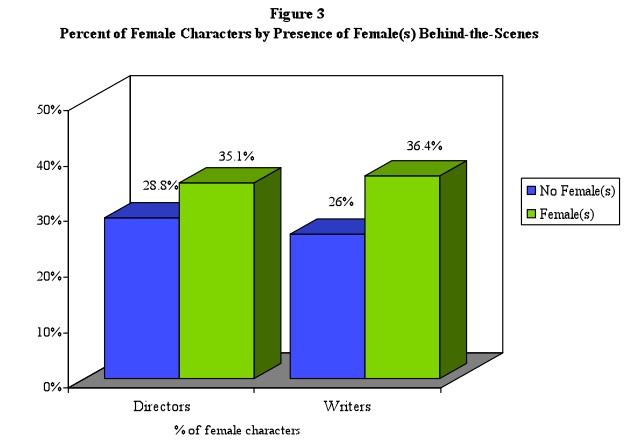
The authors found that movies with female directors and/or writers had more female characters than those with male directors/writers, with writers seeming to have a stronger effect than directors:

Of course, this could be because female directors/writers actively try to incorporate female characters into movies or because studios are simply more comfortable hiring female directors/writers to work on movies with female characters than they are other types of films, leading to a concentration of women working on such projects.

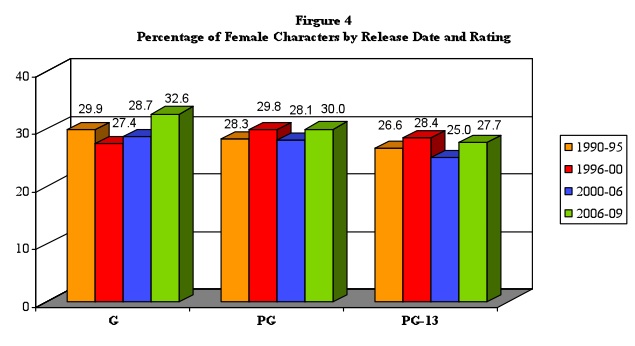
Comparing the results of this study to an earlier analysis of films from 1990-2006, we see that the gender imbalance isn’t improving over time (though since the methodologies differed slightly, the data aren’t absolutely comparable and so are more indicative of a general trend; the authors did make statistical adjustments for the methodological differences):

Of course, none of this gets at the content of the films. The study found that female characters were generally younger than male characters, made up only 17% of group or crowd scenes, and often had plotlines that centered entirely around interests in romance.

In the late 1800s, one suffering from impotence, addiction to morphine, or belly aches might be prescribed John Pemberton’s French Wine of Coca.   The wine concoction contained caffeine and 8 1/2 milligrams of cocaine (equivalent to snorting about 1/2 line).

(source)

(source)

Prohibition’s arrival in Atlanta in 1886 led Pemberton to re-write his recipe to exclude the alcohol.  Pemberton advertised it as the “great national temperance beverage.”  In 1903, when cocaine was outlawed, Pemberton had to rework his recipe again.  Coca Cola, as we know it, was born.

See The Digital Deli Online for more.

Lisa Wade, PhD is an Associate Professor at Tulane University. She is the author of American Hookup, a book about college sexual culture; a textbook about gender; and a forthcoming introductory text: Terrible Magnificent Sociology. You can follow her on Twitter and Instagram.