Forbes magazine recently ranked Stockton California as the most miserable city in the US, a dubious award that comes as little surprise to the city’s struggling residents. Home prices have declined 67% since 2005, unemployment averaged a whopping 17.2% in 2010, and Stockton has the second highest crime rate in California.

In response, Gregory Basso, a retired Stockton businessman, created a video disputing Forbes’ findings. This clip went viral, at least locally, and was discussed by many Stockton residents. In his video, Basso highlights the attributes of Stockton he believes contribute to his high quality of life. These include “debating whether to wear my sun glasses or not in February,” and the many nearby opportunities for golfing, biking and hiking. He speaks of the seven professional sports teams found within a 2-hour radius, and the ability to sail from the yacht-lined downtown marina, along the Sacramento Delta, all the way to the San Francisco Bay. He ends by describing how Stockton has a great first time homebuyers market, and is a cheap central location for large businesses to come and set up shop.

But Basso’s lifestyle represents only a small minority of Stockton’s residents. The color of Mr. Basso’s skin, wealth, and class standing afford him privileges that most residents do not have access to. In a city with a median per capita income of $19,000, few residents have the opportunity to spend their days playing golf and yachting. Neither can they afford to live in the exclusive gated community where the beginning of the video was filmed. And Basso’s excitement about Stockton’s “first time home buyers market” might seem less compelling to the 58% of Stockton homeowners who owe more on their mortgages than their houses are worth.

It’s also worth noting that nearly all of the people depicted in Basso’s video (with the exception of University of the Pacific students) appear to be white. This is striking in a city where 32% of residents identify as Hispanic or Latino/a, 11% as African American and 20% as Asian (source). Because people of color tend to be less well off economically than whites, it stands to reason that many of these people are experiencing the misery that Basso claims that Forbes magazine “got all wrong” are people of color. And although Basso highlights many positive things about Stockton, he mentions neither its rich diversity nor its wide variety of ethnic cuisine.

Sociologist Ruth Frankenberg writes that “privilege is the (non) experience of not being slapped in the face.”*  What she means by this is not only that that white and middle class individuals have advantages over working class people and people of color, but that those of us with privilege often don’t see just how much these differences matter. She argues that race and class disparities are reproduced when those with more privileges do not look, and therefore do not see, just how different our circumstances can be.

Clearly, the goal of this video’s creator is not to erase the experiences of other Stockton residents. To the contrary, it seems he wants to diminish the stigma attached to being named the most miserable city in the US, and to cast it as a place that businesses might want to locate. This could even help generate opportunities for the very people experiencing hardships. However, in this video, Basso chooses not to see the real problems that affect many Stockton citizens. Without an understanding of these problems, Stockton residents are less prepared to address them.

* Frankenberg, Ruth. 1996. “When we are capable of stoppoing we begin to see” in Thompson and Tyagi (eds), Names We Call Home. NY: Routledge. p. 4

——————————

Brianna Gall is a senior sociology major at the University of the Pacific and was born and raised in Stockton, CA. Dr. Alison Hope Alko is Assistant Professor of Sociology at University of the Pacific, where she teaches a seminar in public sociology. Her research interests include inequality, environment, food and the social construction of place.

If you would like to write a post for Sociological Images, please see our Guidelines for Guest Bloggers.
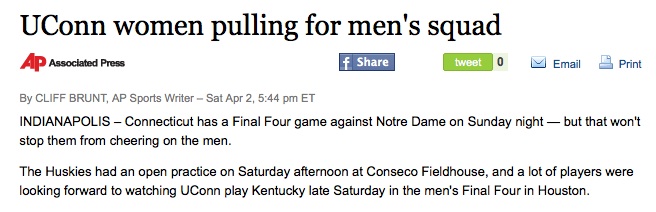
Well, I’m very late posting today, obviously. It was a long day. Anyway, Elliott J. sent in an AP news story that ran on Yahoo news. The article about the University of Connecticut women’s basketball team — which was in the Final Four of the women’s tournament — focuses not on their physical prowess, skill, or competitive spirit, but rather on the fact that they’re super excited to cheer on the UConn men’s team: Of course, there’s nothing shocking about the fact that one team from a school might want other teams from the same school to win. But there’s a tendency to feminize female athletes and to highlight their relationships with and appreciation for men, to reassure audiences that they’re still appropriately feminine despite their interest in sports and amazing athletic abilities. In this case, we learn that these female athletes still support and cheer for their male colleagues…and though the women in the article say the teams support each other, only examples of the women rooting for the men are included, and despite my googling, I couldn’t find any stories about how much the UConn men’s team was pulling for the women’s team.

UPDATE: Reader twostatesystem was able to find an article about the men of UConn cheering on the women that I didn’t find in my quick googling (I tried variations on “UConn men cheer/support/pull for women” and couldn’t find anything at the time).

Cross-posted at Ms.

Growing up in America, we learn that sweets and junk food are “guilty pleasures.” Women, especially, are supposed to refrain from such indulgences.  And, if they cannot — if they, for example, desire more than that modest slice of cake served to each birthday guest — then they should feel not only guilt, but shame.  For overindulging is grotesque and it, accordingly, should be hidden and kept secret.

This is the cultural background to Lee Price‘s realist paintings of women (mostly her) eating sweets and junk food.  She draws two contrasts.  First, she makes very public something we are supposed to do only in private.  Not only do the paintings literally display the transgression, the birds eye view and frequent nudity exaggerates the sheer display of the indulgence.  And, second, she takes something that is supposedly disgusting and shameful and presents it in a medium associated with (high) art, challenging the association of indulgence with poor character and a lack of refinement.  Fascinating.


Visit Lee Price’s website.
Via BoingBoing.

Lisa Wade, PhD is an Associate Professor at Tulane University. She is the author of American Hookup, a book about college sexual culture; a textbook about gender; and a forthcoming introductory text: Terrible Magnificent Sociology. You can follow her on Twitter and Instagram.

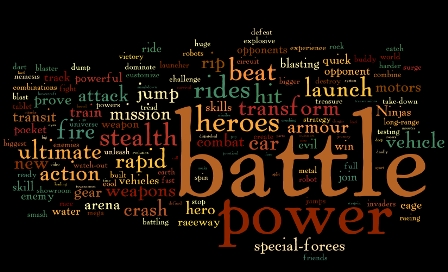
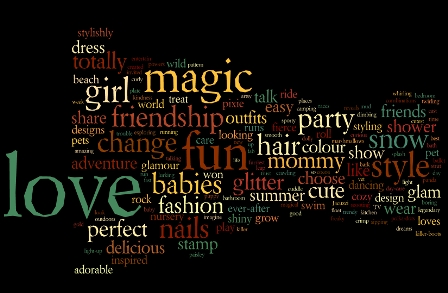
Alli, YetAnotherGirl, Molly W., and Laurence D. all sent in links (via The Mary Sue and Feminist Law Professors) to a post at The Achilles Effect on gendered language in children’s toy commercials. Crystal Smith created word clouds based on 658 words in 27 TV commercials generally aimed at boys (products included “Hot Wheels, Matchbox, Kung Zhu, Nerf, Transformers, Beyblades, and Bakugan”) and 432 words from 32 TV commercials generally aimed at girls (products: “Zhu Zhu Pets, Zhu Zhu Babies, Bratz Dolls, Barbie, Moxie Girls, Easy Bake Ovens, Monster High Dolls, My Little Pony, Littlest Pet Shop, Polly Pocket, and FURREAL Friends”).

This clearly isn’t a random sample of all toy commercials on all TV channels to all age groups; as Smith points out, it ignores toy companies that can’t afford TV ads, and it’s not a huge sample. However, given that these are popular toys that were being marketed during shows (such as cartoons) that are aimed at children, the word clouds provide a basic overview of gendered language in toy ads.

The word cloud for the boys’ list shows the emphasis on action and violence, with others depicted as opponents, a nemesis, or enemies:

For girls, the words are much more about appearance/fashion, relationships (friends, friendship, etc.), and playing mommy:

You can see larger versions at Wordle (girls and boys) and Smith says she has a reference list of all the commercials she a reference list of all the commercials available, which I requested. I’ll update the post with the list when I get it.

UPDATE: In response to my email, Crystal Smith cautioned, “This is a very small sample of brands that tend to appear frequently during kids’ cartoon blocks on TV. They are highly gendered toys, which explains the incredible contrast between the two lists.” She sent along the references; the girls’ list is available here, the boys’ list here.

Christine sent us a link to some fabulous photos coming out of Toronto. In January a member of the Toronto Police force, Const. Michael Sanguinetti, suggested to students at York University that “women should avoid dressing like sluts in order not to be victimized” (source).  In response, SlutWalk was born.  The SlutWalk, which strode just yesterday, was a march designed to draw attention to the way in which the term “slut” is used to stigmatize and invalidate women.

As Leora Tanenbaum argues in Slut! Growing Up Female with a Bad Reputation, the term is used to control all women, not just women who want to have sex, because it can be applied to girls and women regardless of their sexual activity (as any virgin with a slut reputation can tell you).  Young girls grow up using, and fearing, the slut label.  And that label continues to be used against them as adults, even when it comes to sexual assault, as the police officer’s comment makes clear.

In an effort to bring attention to word and  its use as a mechanism of control girls, women and men of all sexual activity levels came together on Sunday, re-claiming and diffusing the “slut” label.

Lisa Wade, PhD is an Associate Professor at Tulane University. She is the author of American Hookup, a book about college sexual culture; a textbook about gender; and a forthcoming introductory text: Terrible Magnificent Sociology. You can follow her on Twitter and Instagram.

When Alexandra Wallace’s video – the epiphanus interruptus* complaint about Asians at UCLA using their cell phones in the library – went viral, most of the reactions were accusations of racism. I’m not sure where the line between racism and ethnocentrism lies, but I was struck more by the underlying ethnocentric assumptions about family, assumptions that are widely shared here and by people who would never be accused of racism.

We Americans all agree that we value family. When I begin the unit on culture, I ask students to jot down three American values. The one that appears most frequently is family. If I asked students what things they themselves value, I’m sure many of them would say family. So, I suspect, would Ms. Wallace.

But here’s how she begins her rant, after a brief disclaimer:

It used to really bug me but it doesn’t bother me anymore the fact that all the Asian people that live in all the apartments around me – their moms and their brothers and their sisters and their grandmas and their grandpas and their cousins and everybody that they know that they’ve brought along from Asia with them – comes here on the weekends to do their laundry, buy their groceries, and cook their food for the week. It’s seriously, without fail. You will always see old Asian people running around this apartment complex every weekend. That’s what they do.

These Asian families, in Ms. Wallace’s view, include too many peripheral members (grandparents, cousins). And family members spend too much time together and do entirely too much for one another.

The trouble apparently is that Asians really do value family.

The too-much-family motif runs through her objections about cell phones as well.  She obviously doesn’t know what the callers are saying or who they’re talking to, but she suspects that it’s family back in Asia:

I swear they’re going through their whole families, just checking on everybody from the tsunami thing.**

Many international students in the US have noted this same contradiction between Americans’ proclaimed value on family in the abstract and what to the international students seems like a fairly thin and compartmentalized connection to family in the real world. As Rebekah Nathan says in My Freshman Year,

Americans, they felt, sharply distinguished their family from their friends and schoolmates; more than one international student remarked about the dearth of family photos on student doors,*** as if family didn’t exist at school. . . .Peter [a student from Germany] told me . . . “No one here says, “come on and meet my family.”

Do, do Americans value family? Yes, but. . . . The ‘but’ is a competing value that pervades American culture, including the family – Independence.**** As Ms. Wallace says in the conclusion to her complaint about Asian families, “They don’t teach their kids to fend for themselves.”

————————————-

* “I’ll be in like deep into my studying . . . getting it all down, like typing away furiously, blah blah, blah, and then all of a sudden when I’m about to like reach an epiphany… Over here from somewhere, ‘Ooooh Ching Chong Ling Long Ting Tong, Ooohhhhh.’”

** Adding “thing” to “the tsunami” makes Wallace seem especially callous. Linguists must have looked into this, but for some reason, “thing” here implies, “I don’t know or care much about this because it’s not very important.”  I vividly recall a scene in the 1993 film “Searching for Bobby Fischer,” where Joe Mantegna, as the competitive chess father, is at a parent-teacher conference. The teacher is concerned that Mantegna’s chess-prodigy son (age 8 or so) is falling behind academically and socially. She adds, “I’m sure he’s very good at this chess thing, but that isn’t really the issue.” Mantegna loses it. “My son has a gift. He has a gift, and once you acknowledge that, then maybe we’ll have something to talk about. Chess is what it’s called. Not the ‘chess thing.'”

*** If you watch the Wallace video, look at the board of photos behind her and try to find parents.

**** See my earlier post on the family-vs-independence conflict as it appears on American television, especially in sitcoms that have pretensions of seriousness.

To great acclaim, we previously featured the work of Adriel Luis after Occidental student Samantha Figueroa illustrated his poem “Slip of the Tongue” with clips from Pocahontas.  Luis is back with a touching spoken word performance inspired by the Watts riots in Los Angeles.

Visit Luis at Ill-literacy.

Lisa Wade, PhD is an Associate Professor at Tulane University. She is the author of American Hookup, a book about college sexual culture; a textbook about gender; and a forthcoming introductory text: Terrible Magnificent Sociology. You can follow her on Twitter and Instagram.

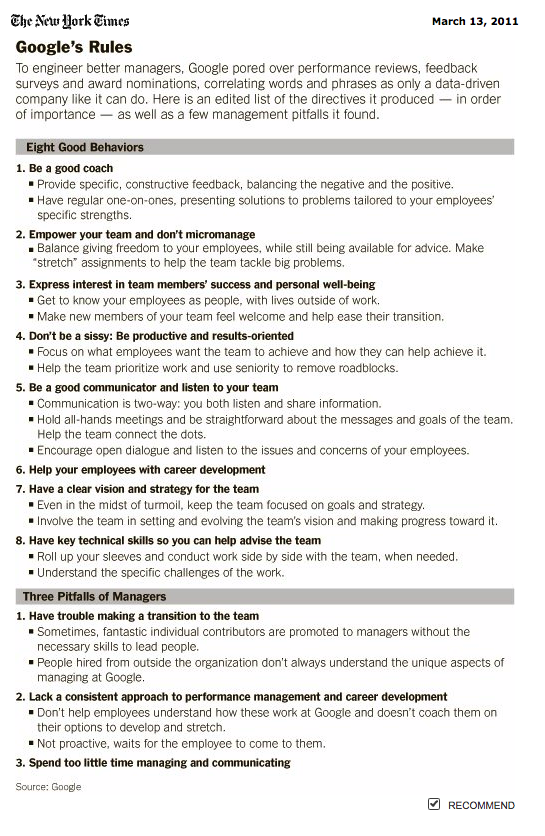
Men and women are told, in a myriad of daily ways, that being masculine is good and feminine bad. It sneaks into our daily language in ways that are so common that we fail to even see it anymore. For example, a recent New York Times article about Google’s effort to determine what makes managers successful featured a list, written by Google, of what makes a good boss.

I noticed that they added The New York Times added the phrase “Don’t be a sissy” to “Good Behavior” #4.  It reads “Don’t be a sissy: Be productive and results-oriented.”   It’s the only Good Behavior that includes a derisive slur. And while I’m accustomed to seeing terms like “sissy” thrown around as insults, it occurred to me that the very next rule #5, “Be a good communicator and listen to your team,” could easily have been prefaced with “Don’t be a man.”

But being a “sissy” (that is, feminine) is something that we can all agree is bad, while being a man is good.  So, even when the rules suggest that men take on feminized traits, they’re unlikely to adorn the suggestion with a denigration of masculinity.

Via Teppo at OrgTheory.

Lisa Wade, PhD is an Associate Professor at Tulane University. She is the author of American Hookup, a book about college sexual culture; a textbook about gender; and a forthcoming introductory text: Terrible Magnificent Sociology. You can follow her on Twitter and Instagram.