The struggles in Madison have understandably focused attention on the wages and working conditions of public sector workers.  Thankfully, it appears that these struggles have helped to promote greater solidarity between public and private sector workers.  Now, we must build on this new solidarity to focus our collective energies on the bigger challenge: transforming a system that demands that workers (in both the public and private sector) accept ever worsening living and working conditions.

As many involved in the Wisconsin struggles have pointed out, there is plenty of wealth being produced—the problem is that those who are doing the producing are being increasingly denied access to it, both collectively and individually.  For example, as the Economic Policy Institute points out:

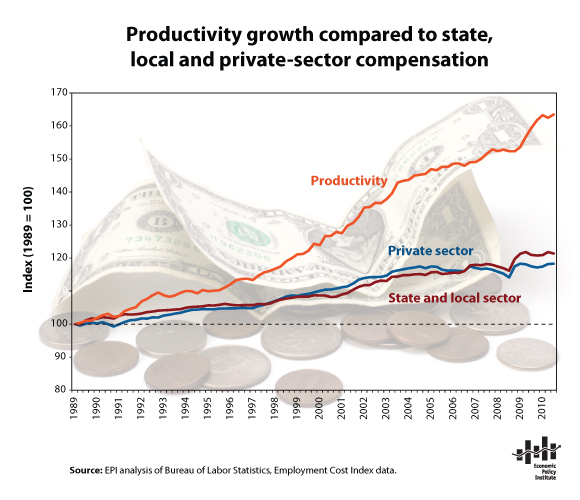
U.S. productivity grew by 62.5% from 1989 to 2010, far more than real hourly wages for both private-sector and state/local government workers, which grew 12% in the same period. Real hourly compensation grew a bit more (20.5% for state/local workers and 17.9% for private-sector workers) but still lagged far behind productivity growth.

The chart below highlights this development.  As one can see, the real issue isn’t whether public sector workers make more or less than private sector workers (and the chart covers compensation which includes pay and benefits).  Rather it is that workers together have been increasingly productive but receving an increasingly smaller share of the fruits of their labor.    Those who are well place to benefit, those at the very top of the income scale, have of course done quite well.  For example, the richest 1% received 56% of all the income growth between 1989 and 2007 (before the start of the recession).  By contrast the bottom 90% got only 16%.

If we want to change this we are going to have to build a powerful political movement, one that is prepared to take on the powerful interests that are determined to keep spending on the military; privatizing our educational, health, and retirement systems; promoting corporate mobility; weakening labor laws; and confusing us all about the causes of existing trends.
 

——————————

If you would like to write a post for Sociological Images, please see our Guidelines for Guest Bloggers.
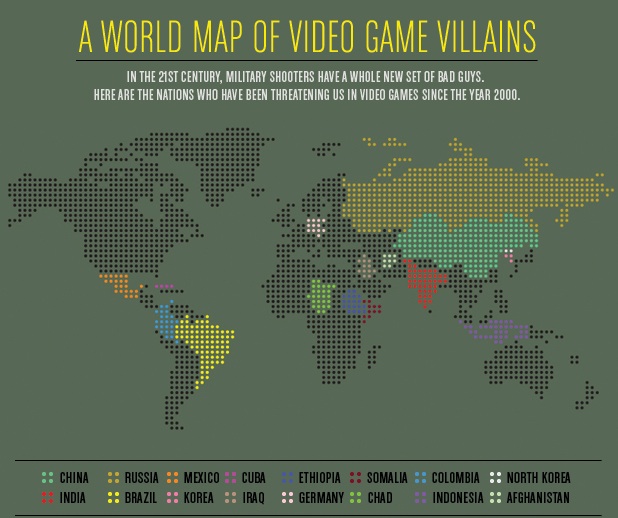
Katrin sent us a link to a image at GOOD that illustrates the geopolitics of first-person shooter video games. The image was created by a group at Complex to illustrate the way that the changing actual political landscape can be seen in the nationality of villains in video games. Peter Rubin, of Complex, explains, “Gone are the days of all FPSes being either World War II or sci-fi; in the new milennium, developers are on the hunt for enemies that are speculative but still plausible.”

They looked at 20 FPS games from the past decade (unfortunately, they give no details about how those 20 games were chosen

The selected titles:

Return to Castle Wolfenstein (2001): Germany
Tom Clancy’s Ghost Recon: Desert Siege (2002): Ethiopia
Tom Clancy’s Ghost Recon: Island Thunder (2003): Cuba
Delta Force: Black Hawk Down (2003): Somalia
Tom Clancy’s Ghost Recon: Jungle Storm (2004): Colombia
Tom Clancy’s Ghost Recon 2 (2004): North Korea
Joint Operations: Typhoon Rising (2004): Indonesia
Tom Clancy’s Ghost Recon 2: Summit Strike (2005): Afghanistan
Delta Force Xtreme (2005): Chad
Tom Clancy’s Ghost Recon: Advanced Warfighter (2006): Mexico
Call of Duty 4: Modern Warfare (2007): Russia/Afghanistan
Army of Two (2008): Somalia/Afghanistan/China/Iraq
Frontlines: Fuel of War (2008): Russia/China
Call of Duty: Modern Warfare 2 (2009): Russia/Afghanistan/Brazil
Operation Flashpoint: Dragon Rising (2009): China/Russia
Singularity (2010): Russia
MAG (2010): Russia/China/India
Army of Two: The 40th Day (2010): China
Homefront (2011): Korea (They don’t specify if it’s North or South Korea)
Operation Flashpoint: Red River (2011): China

Anyway, it provides a nice little illustration of the way that global politics seeps into this element of pop culture, as well as a snapshot of nations currently perceived as rivals or even enemies of the U.S. — a mixture of old tensions (Russia, Germany), ongoing anxiety about China, and emerging focal points.

Lisa recently posted about Abercrombie Kids selling push-up bikini tops (though I just went to the website and they seem to have removed the “push-up” description). In another example of encouraging pre-teens to sexualize their bodies, Meghan L. sent in the clip “You’ve Got Snooki” from AOL Video in which Snooki, from Jersey Shore, does a makeover on an 11-year-old girl, since you’re “never too young to look bangin'” or to start thinking about how you look to boys:


In neither of the two videos below, collected by Nathan Palmer at Sociology Source, does Jon Stewart use the phrase “class war.” But when sociologists use this phrase, this is part of what we mean:

Lisa Wade, PhD is an Associate Professor at Tulane University. She is the author of American Hookup, a book about college sexual culture; a textbook about gender; and a forthcoming introductory text: Terrible Magnificent Sociology. You can follow her on Twitter and Instagram.

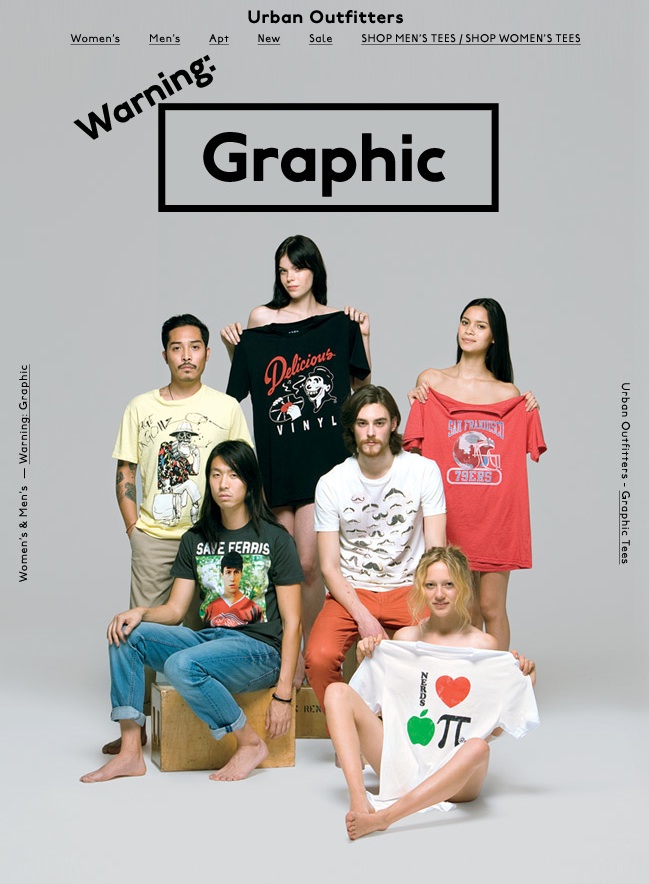
In a perfect example of the tendency to sexualize women but not men, MM sent in a screen capture of an image for the graphic t-shirts section of the Urban Outfitters website, in which the men are all fully clothed and the women…less so:


Students of mine who are unversed in race politics frequently use the phrase “colored people.” They hear me use the phrase “people of color” and assume that the phrases are equivalent. This is a truly reasonable assumption, even as people familiar with race-based struggle know for sure that “colored” is an offensive term and “people of color” is typically not considered so.

Occasionally a student asks me what the difference is and, to be frank, I’m not quite sure. I’ve simply absorbed the rules of talking-about-race and have a good idea of how to do so in ways that reflect grass roots language claims.

Accordingly, I was really excited to see a clip of famed activist Loretta Ross at Racialicious explaining the history of the phrase “women of color,” and later “people of color.” She explains that, while “colored people” was a phrase used to delegitimate black- and brown-skinned people, “people of color” was coined by activists hoping to bring all non-white people together into a coalition against racism.

(Thanks to decius for placing a transcript in the comments. I’ve pasted it in after the jump.)

more...

Yesterday I posted about media coverage, and possible exaggeration of, the problems at the Fukushima nuclear reactors in Japan. As a follow-up, over at Japan Probe I found a clip of Charlie Brooker discussing sensationalist of the earthquake, tsunami, and nuclear reactor. His takeaway message: If you can’t distinguish your news teasers from a video game ad, you may have a problem:

Also, Fox News seems to have somehow mistaken a club in Tokyo for a nuclear reactor:

Mindy Jovanovic sent in a vintage advertisement for “Stuffed Girl’s Heads”: fake heads meant to mimic the taxidermied trophies of hunted game oh-so-popular among some types.  Mindy said, “Now I think I’ve seen it all.”

Well Mindy, I hate to disappoint you, but I think I have something even more offensive to show you: Jingle Jugs.  At least the girls have heads in this “conquest,” Jingle Jugs are just fake dancing boobs mounted on a board (hard nipples included).  And they’re not vintage.  Oh no, they’re for breast cancer awareness.

Image borrowed from Dangerous Minds.

Lisa Wade, PhD is an Associate Professor at Tulane University. She is the author of American Hookup, a book about college sexual culture; a textbook about gender; and a forthcoming introductory text: Terrible Magnificent Sociology. You can follow her on Twitter and Instagram.