Last Friday at the University of California-Davis, a group of student Occupy Wall Street protesters were pepper sprayed by university police for refusing to vacate the campus quad. As Lisa pointed out, thanks to the widespread availability of phones with cameras, the incident was photographed and recorded by dozens of onlookers. As a result, images and videos of the pepper spraying incident have flooded the internet. One video has received over 1.7 million views on Youtube; another shorter clip has almost 1 million.

One image, taken by Louise Macabitas, has become iconic (via San Francisco Citizen):
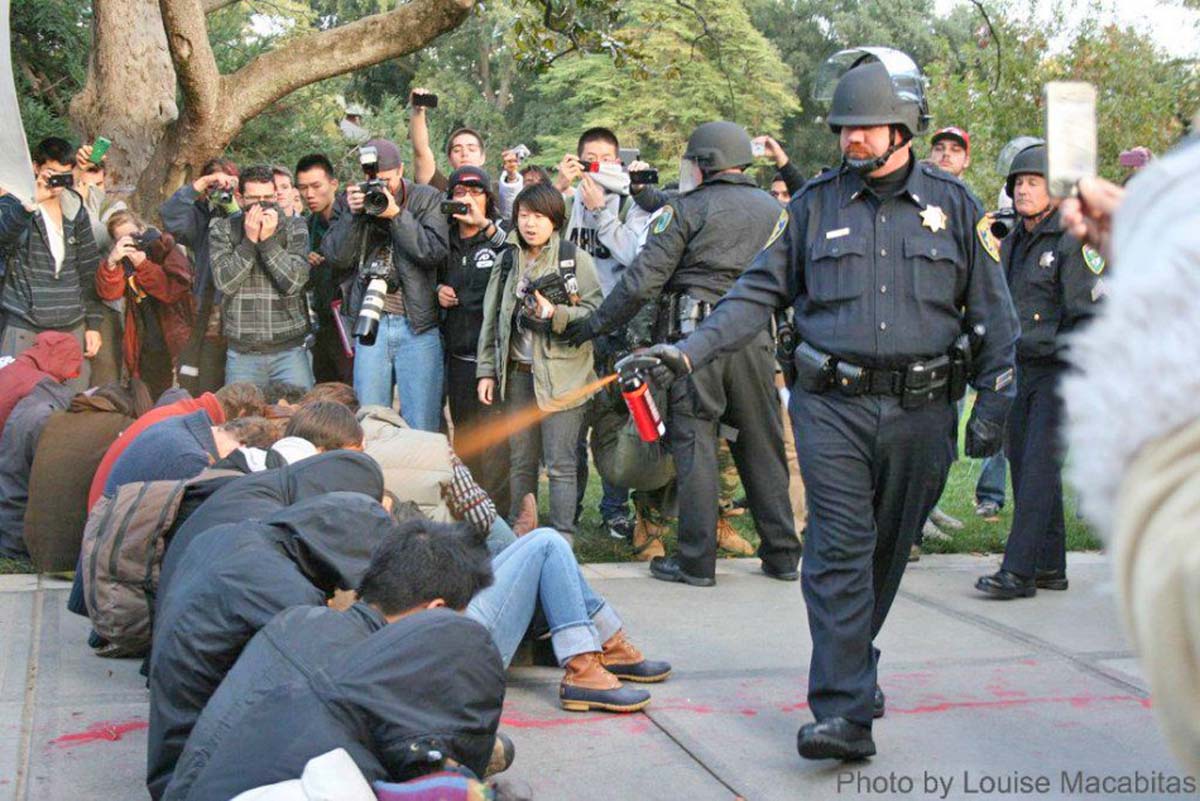
The image is striking in several ways. First, nearly everyone watching has a camera or cell phone and is documenting the event. Second, there is a strong visual separation of the police and protesters — the police are standing, while the protesters are seated. Third, the police officer who is spraying protesters has a very casual, removed demeanor and stance. There is no direct confrontation occurring to seemingly warrant such an action. The image depicts an imbalance of power, as students crouch and hide their faces from the pepper spray wielded by campus police.

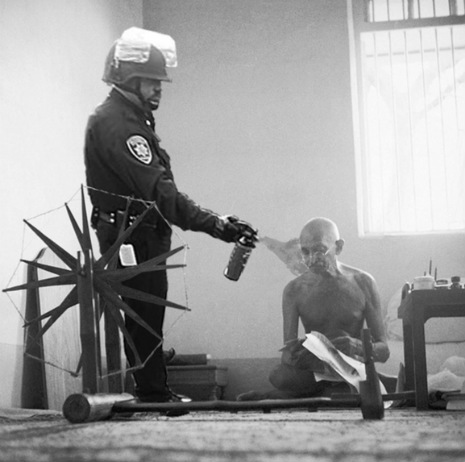
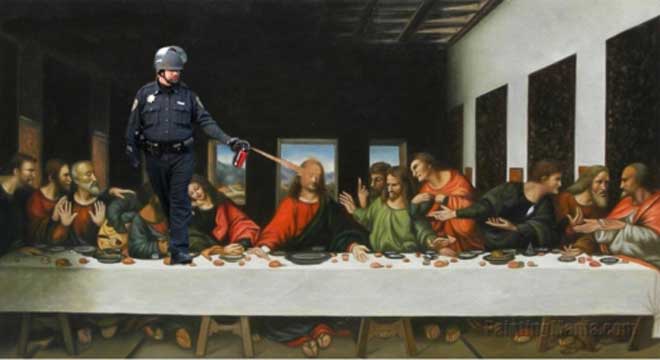
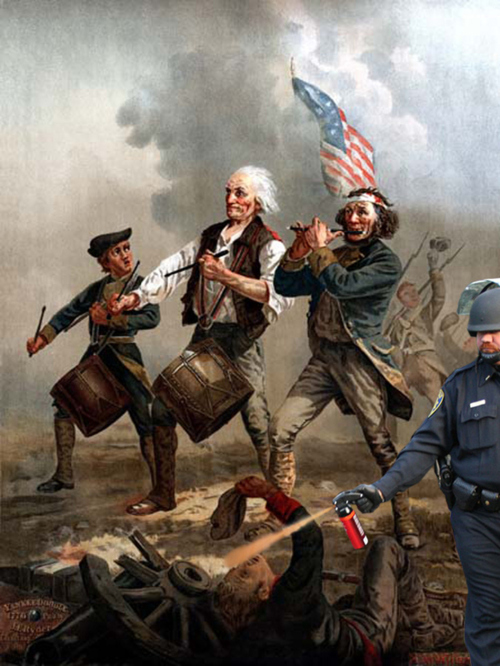
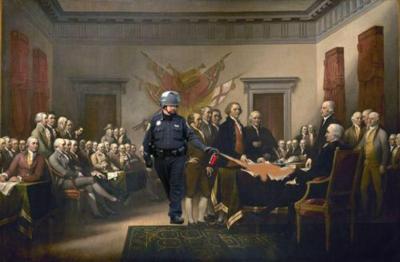
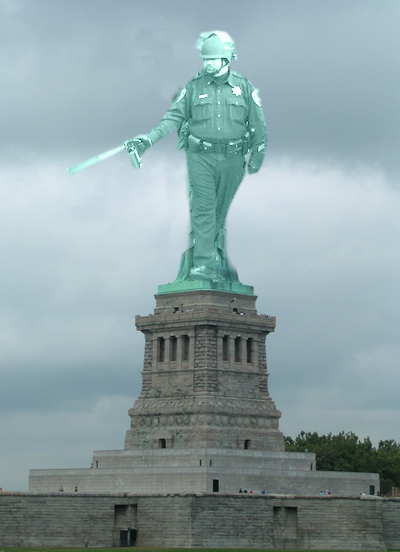
The image has so much visual power that it has taken off as an online meme. Consider these variations, all posted at Wired.

I think this meme is itself a form of visual protest. The variations on the original image reinforce the perception that the police officer’s actions were inappropriate and an abuse of power. The use of famous scenes and works of art creates a cartoonish depiction of inequality and injustice, of someone using their power unjustly against those who obviously have less power — children, kittens, the unemployed, etc. (via the Pepper Spraying Cop tumblr):


Other images present the officer’s actions are an affront to justice, by using images associated with freedom, democracy, or peaceful resistance (found at the Pepper Spraying Cop tumblr and CyBeRGaTa:
This one merges the image with another iconic photo of an abuse of police power on campus, the shooting at Kent State University in 1970 (via CyBeRGaTa):
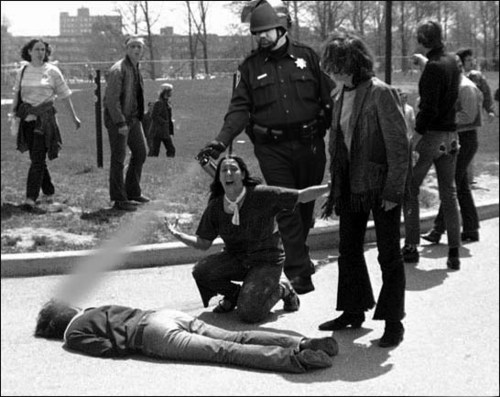
Reproducing this image of injustice online is a form of visual protest, spreading images of perceived injustice in different visual contexts across the internet. The meme is a commentary on how we culturally and historically understand power inequalities and the limits of appropriate uses of power.

Yet, while this is a powerful form of protest that draws important connections, the meme also removes the officer, Lt. John Pike, from the original context of his actions. This runs the danger of focusing on Pike as a lone actor, and not an individual whose actions are shaped within the larger institutional system of justice. As Alexis Madrigal warns us in “Why I Feel Bad for the Pepper-Spraying Policeman, Lt. John Pike“:

Structures, in the sociological sense, constrain human agency. And for that reason, I see John Pike as a casualty of the system, too. Our police forces have enshrined a paradigm of protest policing that turns local cops into paramilitary forces. Let’s not pretend that Pike is an independent bad actor. Too many incidents around the country attest to the widespread deployment of these tactics. If we vilify Pike, we let the institutions off way too easy.
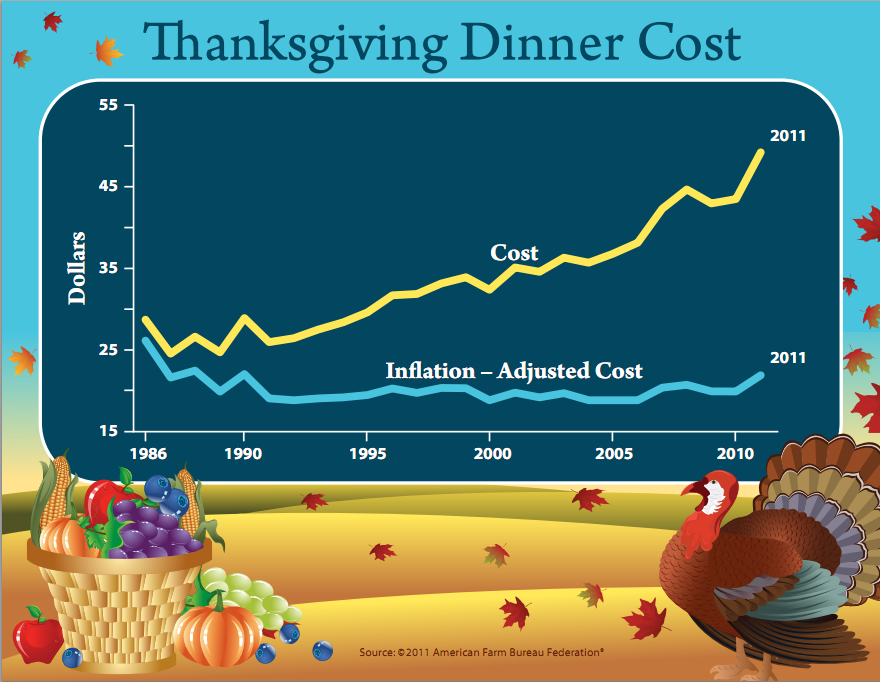
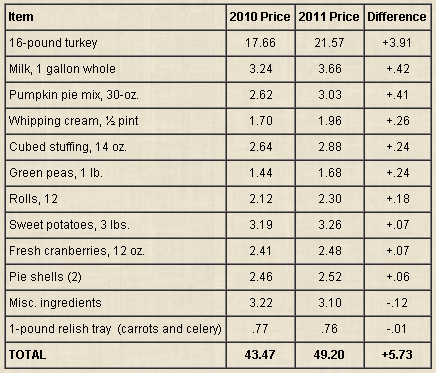
According to the Farm Bureau, Thanksgiving dinner will cost American families 13% more than it did last year.  They estimate an average of $49.20 for a family of 10.

Here are the details:

Farm Bureau economist John Anderson says the rise in prices is due, in part, to retailers “…being more aggressive about passing on higher costs for shipping, processing and storing food to consumers…”

Via Gawker.

Lisa Wade, PhD is an Associate Professor at Tulane University. She is the author of American Hookup, a book about college sexual culture; a textbook about gender; and a forthcoming introductory text: Terrible Magnificent Sociology. You can follow her on Twitter and Instagram.

In her August 13 column in the Washington Times Communities section, Rebekah Kuschmider declares proudly, “So here’s the thing: I am not embarrassed about my stretch marks.” It’s a great message. Women should love their aging skin and reject the impossible Photoshop beauty standards that make us hate ourselves. Kuschmider describers herself as, not a Barbie Doll, but a “Velveteen Rabbit, so worn and loved that I’ve become real.”

Two curious images, however, accompany this story about a (presumably) wealthy white woman’s stretch marks. The two women pictured with Kuschmider’s column are actually a Thai woman from a village near Burma and an Indian laborer from the city of Diu (according to the Flickr pages from which the photos were captured). The old Thai woman’s face is a shrunken apple;  tattoos cover the younger Indian woman’s neck, and the whites of her eyes are yellowed from exposure to the sun. Both women are beautiful.

But why don’t we see, not to get too invasive here, the stretch marks of which Ms. Kuschmider is justifiably proud? Why do we instead see haunting portraits that seem to come straight off the pages of National Geographic? The underlying message from whoever chose these photos (the author? an online editor?) is that wrinkles look exotic on poor women whom privileged Americans love to gawk at. We don’t expect them to be attractive by our standards – they’re so lovely in their way, so tragic. But wealthier white women?

Maybe the conservative readership of the Washington Times doesn’t want to see white women looking old or wrinkled, no matter what Rebekah Kuschmider claims about aging.  Is that kind of woman is too dignified to be seen looking so “unattractive”? Is aging easier to accept when it’s exotified and Othered — as if it can’t (and shouldn’t) happen to those of us who are more privileged?
Kushlani de Soyza is a reporter and producer for APA Compass, an Asian-Pacific-American public affairs radio program on Portland’s KBOO-FM. She teaches Women’s Studies at Clark College in Vancouver, WA, and English/Journalism at Oregon State University.

Nickey R. sent in a commercial by Blue Cross and Blue Shield of Minnesota that aims to encouraging people to stop putting off exercising, eating healthy, and quitting smoking. The problem with these ads is a simple one. It represents all unhealthy people as overweight… or smokers. It ends by flashing the phrase “for the health of all.”

But while exercise and eating healthy may correlate with being thin (and to what degree this is true is still very much up for debate), there are, in fact, lots of non-thin people who do exercise and eat right and lots of thin people who do not. Being thin is not the same thing as being healthy (as research and real people demonstrate), but these ads say that it is, justifying anti-fat prejudice and miseducating the public.

Lisa Wade, PhD is an Associate Professor at Tulane University. She is the author of American Hookup, a book about college sexual culture; a textbook about gender; and a forthcoming introductory text: Terrible Magnificent Sociology. You can follow her on Twitter and Instagram.

Cross-posted at Love Isn’t Enough.

Jay Smooth, of Ill Doctrine, recent gave an excellent Tedx talk at Hampshire College about the difficulties of talking constructively about race and racism in the U.S. These conversations are tricky to navigate because they often devolve from discussions about structural inequalities and the consequences of certain positions or policies to individualistic arguments about whether a specific person is racist. As he points out, this backs people into corners. Because people are extremely defensive at anything they see as an accusation they are racist, there is little room to listen to someone who challenges a comment, and perhaps then acknowledge that a statement was hurtful, or based on incorrect information, or connects to larger cultural discourses and structural inequalities that we might want to examine critically.

It’s a great 11-minute video on how we might try to discuss race, and racism, constructively:

Also see Jay’s video on boundaries in mixed-race communities and Brother Ali talking about White rappers and the “n word.”

We now have evidence that media coverage of the Occupy Movement has increased after each clash with police.  Many of these clashes have resulted in photographs and videos that appear to show police acting violently against peaceful protesters.  To many this is an unjustified use of force by the government, one that makes the state look like the bad guy and the movement look like the good guy.

This very process — media coverage of peaceful activism and violent backlash by the state — contributed to the success of the Civil Rights Movement.  And it couldn’t have happened before TV.

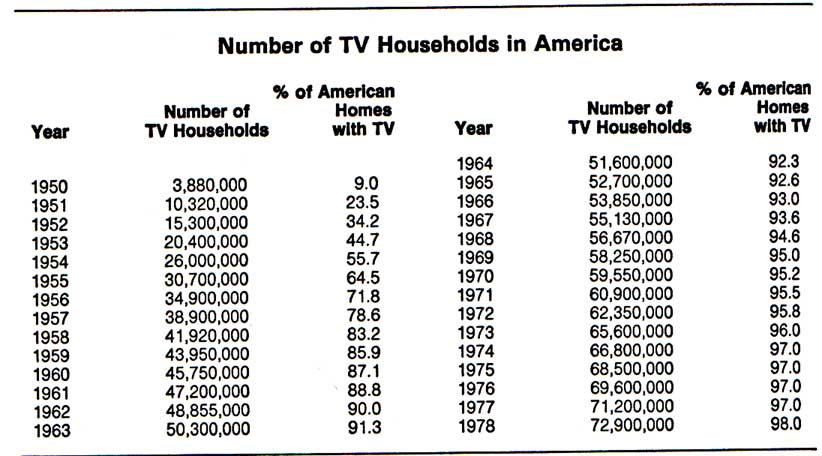
In 1950, only 9% of homes had a TV.  One year later, 24% of homes did.  And by 1963, when Martin Luther King told the world his dream, 91% of America could have tuned in.

(source)

The media frequently covered the protests positively, while the backlash was undeniably horrific.  So Americans sitting at home watching the TV could be simultaneously inspired by the activists and horrified by the establishment.  In the two videos below we see both sides of this coin.  In the first, a newscaster introduces and contextualizes the March on Washington before King begins his famous speech; in the second, we see news footage of a violent police attack on peaceful protesters in Selma, Alabama (trigger warning, also known as “Bloody Sunday”).

Television coverage of King’s speech:

Television coverage of the attack in Selma (trigger warning):

Ultimately, the success of the Civil Rights Movement must be credited to the people who gave their energy, heart, time, and lives to it. The invention of the television, though, and its introduction to so many homes at just the right moment in history, had an interesting role to play as well.

With this history in mind, it seems likely that aggressive responses to peaceful protests will likely raise support for Occupy.  And, with digital cameras, smart phones, youtube, facebook, twitter, and the like… the role of the media may be more important than ever.

Lisa Wade, PhD is an Associate Professor at Tulane University. She is the author of American Hookup, a book about college sexual culture; a textbook about gender; and a forthcoming introductory text: Terrible Magnificent Sociology. You can follow her on Twitter and Instagram.

The image below is an advertisement for Essure, a sterilization procedure for women. It vividly illustrates the heterosexual male gaze in the marketing of birth control: the female observes his leisure experience, while their children play in the background. She sits upright, supporting his head as he lays with his eyes closed. The male’s need to avoid “worrying about unplanned pregnancy”, so he can relax and enjoy a day in the park, takes priority, despite the fact that this procedure permanently modifies the female’s body.


The following video uploaded by Essure offers a more blatant effort to use male perspectives in their marketing:

Using male fears about having their scrotums operated on, the appeal of female sterilization over vasectomies is made clear. “Let’s face it: when it comes to their balls, guys just don’t have any… Essure: because you can only wait so long for him to man up.” While the narrator is addressing potential female consumers, the gaze is again fixed on the (unwanted) male experience of sterilization.  Her experience of the surgical and emotional process of sterilization is erased, meanwhile indulging men’s fears is used as justification for forcing women to take responsibility for birth control.

——————————
Dan Rose is an assistant professor of sociology at Chattanooga State Community College in Tennessee.  His research focuses on medical sociology and health inequalities in minority neighborhoods.
If you would like to write a post for Sociological Images, please see our Guidelines for Guest Bloggers.


TLC’s new reality program, Big Sexy, features five self-identified plus-size women who work in the fashion industry as models, stylists, and makeup artists. Their mission is to challenge contemporary bodily aesthetics that privilege the thin body and demonstrate that fat can be sexy.

In an interview for the Huffington Post, one of the featured women, Heather, explains, “You can be whatever size you want to be and work in the fashion industry.” However, as we see in this clip of Tiffany’s meeting with her modeling agent, that is not entirely the case. In the exchange, the agent informs Tiffany that a client wants her to lose weight and that “it’s a waste of time and money if the numbers are not right.” At her present size, Tiffany was dangerously close to exceeding the boundaries of plus-size required of models.

In modeling, an inch here or there does matter. In my research of plus-size modeling, I have witnessed other plus-size models, like Tiffany, face pressures from their agents to alter their bodies. These women, in order to work in fashion, must utilize their bodies as capital and embark on a variety of body projects. If their measurements are not in perfect proportion, some stick padding onto their hips, “chicken cutlets” onto their breasts, and squeeze themselves into a pair of Spanx. If a model loses weight, clients tell her to do whatever it takes to gain the weight back, even if that means binging on fat-laden foods that can wreak havoc on any individual’s body. Failure to do so would mean the end of her career.

Beauty is a social construction, but these women are not the ones in charge of its construction. Plus-size models must conform to an image created by fashion’s tastemakers, i.e., agents and designers. Ultimately, they must mold their bodies to fit an image, instead of being empowered in a way that allows them mold the image to fit their bodies. In this sense, they face the same pressures as thin models to be within a fraction of an inch of a shape predetermined by others to be acceptable.

——————————

Amanda M. Czerniawski is an Assistant Professor of Sociology at Temple University. She specializes in bodies and culture, gender and sexuality, and medical sociology.  Her past research projects involved the development of height and weight tables and the role of plus-size models in constructions of beauty.  Her current research focuses on the contested role of the body in contemporary feminist discourse.

If you would like to write a post for Sociological Images, please see our Guidelines for Guest Bloggers.