Cross-posted at Jezebel.

Yesterday I posted about U.S. immigration trends, updated through 2010. Following up on that, Dolores R. found another immigration-related post by KPCC…this time, a look at the wait time to get a family-sponsored immigration visa. With the removal of strict, racialized quotas in 1965, the U.S. turned to a policy based on a set of priorities for deciding who would be granted a visa; among the various categories was a preference for those who had sponsoring relatives already living in the U.S., with different visas and priorities based on family relationship:

  • F1 = unmarried adult children of U.S. citizens
  • F2A = spouses and children (under age 21) of permanent residents
  • F2B = unmarried adult children of permanent residents
  • F3 = married adult children of U.S. citizens
  • F4 = siblings of adult U.S. citizens

According to the U.S. State Department, the annual minimum family-reunification visa target is 226,000 (note that this excludes spouses, parents, and minor children of U.S. citizens, who are highest priority for immigration and are exempt from immigration caps). The Immigration and Naturalization Act requires that family-sponsorsed (as well as employer-sponsored) visas be granted in the order that eligible potential immigrants applied. Unsurprisingly, many years there are more eligible applicants than there are available visas, leading to a backlog of individuals who qualify to immigrate but are waiting for a visa to become available. In particular, China, Mexico, India, and the Philippines are “oversubscribed,” meaning there is a significant backlog.

How long? The table below shows the cut-0ff date for visa applicants in each category as of January 2012. That is, the dates given here are the date by which a person had to apply to finally have a visa available this month; the 2nd column shows for all areas excluding the four countries singled out because of their particularly long wait times:

The least oversubscribed visa category is the F2A, where those now receiving visas will have waited a bit under 3 years. But look at some of the other dates listed. For F1, F2B, and F3 visas from Mexico, the people now at the head of the line have been waiting nearly two decades, having applied in 1992 or early 1993. F4 applicants from the Philippines have been waiting almost a quarter century, since 1988.

This is part of the reason why undocumented immigration continues, and arguments about fairness and waiting their turn in line may not be particularly compelling to individuals who want to reunite with family members in the U.S. Waiting a year, or two, or five, may seem reasonable. If you learn there’s a 20-year wait, the cost/benefit analysis of whether to wait for the visa to come through or to find other means may shift significantly, regardless of how otherwise law-abiding a person might be.
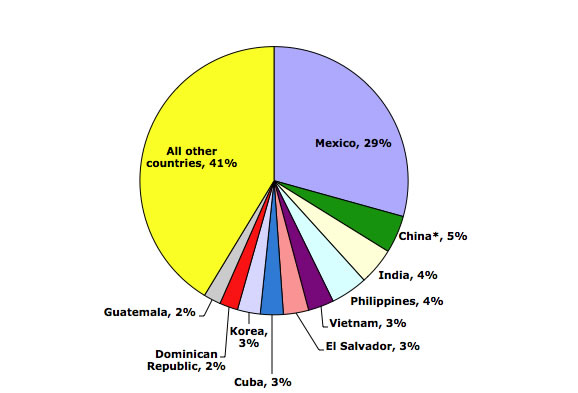
Dolores R. let us know that the Migration Policy Institute has a bunch of updated data and charts/graphs illustrating immigration trends in the U.S. through 2010 (via the KPCC website). So, in 2010, where did immigrants to the U.S. come from? As you may expect, the single largest source of immigrants was Mexico:

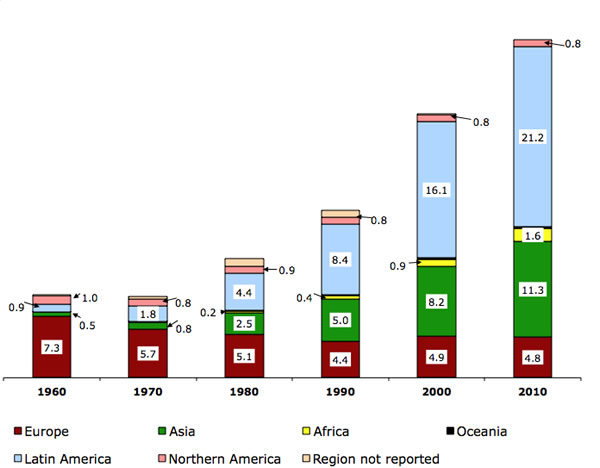
Looking at the region of birth of immigrants in the U.S. (in millions) over time reveals clear patterns:

Notice the shift over time, with fewer immigrants coming from Europe (red) but a major increase in the number of immigrants from Asian and Latin America (green and light blue), noticeable already by 1980. This reflects changes to U.S. immigration policy in 1965 that got rid of the old quota system that openly favored northern and western Europeans. The result was a major change in the demographics of U.S. immigrants.

As of 2010, immigrants made up about 13% of the total U.S. population — the highest level in decades, but still not at the all-time high levels seen at several points in the late 1800s/early 1900s:

Lots more data at the MPI website, including a map where you can get very detailed information about the foreign-born population for each state. You might also want to check out our posts on U.S. immigration and geographic names, an interactive map of immigrant settlement patterns, English acquisition among U.S. immigrants, and a map of concentrations of speakers of various languages in the U.S.

Cross-posted at Citings and Sightings.

In an interview discussing whether teen sleepovers can actually prevent teen pregnancy, CNN’s Ali Velshi says flatly, “This is a little bit counter-intuitive.” But as his interviewee, UMass sociologist Amy Schalet (who wrote on this subject in Contexts in “Sex, Love, and Autonomy in the Teenage Sleepover” in the Summer of 2010), explains:

Let me clarify: it’s not a situation where everything goes… It’s definitely older teenage couples who have established relationships and whose parents have talked about contraception.

Which is to say, as Velshi puts it, sex and sex education in countries like the Netherlands, in which parents are more permissive—or as Schalet says, “parents are more connected with their kids”—about allowing boyfriends and girlfriends to sleep over, take “a holistic approach.”

Schalet’s research, explored more deeply in her new University of Chicago book Not Under My Roof, takes a look at American parenting practices surrounding teen sex and the practices of parents in other countries. Using in-depth interviews with parents and teens and a host of other data, she finds:

The takeaway for American parents… isn’t necessarily “You must permit sleepovers.” Many parents are going to say, “Not under my roof!” That’s why it’s the title of my book. The takeaway is that you can have more open conversations—you should probably have more open conversations—about what’s a good relationship, sex and contraception should go together, what does it mean to be “ready,” how to get rid of some of these damaging stereotypes (gender stereotypes). Those are all things that are going to help promote teenage health and better relationships between parents and kids.

Schalet is clear that parental approaches are nowhere near the only factor in the stark differences in teen pregnancy rates between the U.S. and the Netherlands, but says they are, in fact, particularly important. “Kids are having sex, clearly,” Velshi says. And that’s precisely the point, no matter whether parents believe their kids should be able to have sex in their own homes, Schalet believes: “I think what you emphasize is that, above all, the conversation is important, and the conversation itself does not make kids have sex.” Ideally, she points out, that conversation will take place at home with parents, but a holistic talk about sexuality, relationships, and health can also take place in schools, with clergy, and in many other locations.

Dr. Schalet on CNN (we apologize for the commercial):

Amy Schalet’s new book is Not Under My Roof: Parents, Teens, and the Culture of Sex.

—————————

Letta Page is the Associate Editor and Producer of The Society Pages. She has a decade of experience in academic editing across a range of disciplines, including two years as the managing editor of Contexts. Page holds degrees in history and classical studies from Boston University and an art degree from the University of Minnesota.

If you would like to write a post for Sociological Images, please see our Guidelines for Guest Bloggers.

Since its release in November, Get Up!’s commercial supporting gay marriage in Australia has garnered substantial social media interest (over four million views on Youtube). The U.S. LGBT news magazine The Advocate called it “possibly the most beautiful ad for marriage equality we’ve seen” (source). Take a look:

From a sociological point of view, what is interesting about this ad is how it avoids the powerful, but charged language of equality and rights. Supporters of same-sex marriage typically frame their cause in terms of non-discrimination (“all people are equal”), non-interference or privacy (“how is my gay marriage affecting yours?”) or in terms of freedom of speech (“I should marry who I want”). See images of posters using this frame here and here.

Rights language such as this, however, comes with the potential of conflicts and trade-offs. Accordingly, opponents of same-sex marriage have often capitalized on this in their responses. This poster, for instance, expresses a fear or mockery of assertive, unbridled individualism. Posters with this frame here.

 This “Yes to Proposition 8” video is another good example. In it one woman claims that, if gay marriage is legal, her religious identity will be subject to discrimination and her freedom to speech will be contested.

The language used by the marriage equality movement, then, enables its opponents to re-frame their responses in the same type of language.

This is why the Get Up! commercial is a game changer. Instead of using “rights talk,” it keeps both words and slogans to a minimum. It uses visuals to embed the couple in a network of family and friends.  At the end, for example, the camera steps back to show not just the couple but a wider network of people who happily witness a marriage proposal. This approach implicates the happiness of not just two individuals, but a community.  The message is that gay marriage is not just about individual rights, but about collective celebration and social recognition.

—————————

Ridhi Kashyap is a researcher in the Migration Group at the Institute for Empirical and Applied Sociology in Bremen, Germany. She studied interdisciplinary social sciences at Harvard University, and was a human rights fellow there after graduating in 2010. She is actively interested in human rights, particularly as they implicate issues of gender, migration, and development.

If you would like to write a post for Sociological Images, please see our Guidelines for Guest Bloggers.


Lisa Wade, PhD is an Associate Professor at Tulane University. She is the author of American Hookup, a book about college sexual culture; a textbook about gender; and a forthcoming introductory text: Terrible Magnificent Sociology. You can follow her on Twitter and Instagram.

Cross-posted at Reports from the Economic Front.

Here is a short (less than 4 minute) video that illustrates the fact that 53% of our tax dollars, conservatively estimated, go to finance our military.

And here is a link to a recent study by Robert Pollin and Heidi Garrett-Peltier on the employment effects of military spending versus alternative domestic spending priorities, in particular investments in clean energy, health care, and education.

The authors first examine the employment effects of spending $1 billion on the military versus spending the same amount on clean energy, health care, education or tax cuts.  The chart below shows their results.

defense.jpg

Moreover, even though jobs in the military provide the highest levels of compensation, the authors still find that “investments in clean energy, health care and education create a much larger number of jobs across all pay ranges, including mid-range jobs (paying between $32,000 and $64,000) and high paying jobs (paying over $64,000).”

Let’s see if these facts come up in the next Congressional budget debate.

Shamus Khan brought my attention to an interesting image posted at La Course vers la Maison-Blanche, a French-language blog about U.S. politics. The image (in English) shows where U.S. troops are stationed around the world, at bases that vary widely in size and permanence.

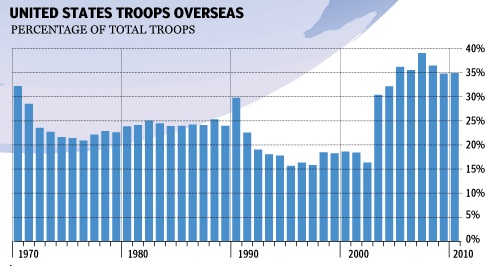
Not surprisingly, with the U.S. engaged in two wars (until the official announced end of U.S. involvement in Iraq at the end of 2011), during the 2000s the percent of all U.S. troops stationed in other countries has been at its highest levels since the end of the Vietnam War (though we also see an uptick in 1990, corresponding with the Gulf War against Iraq, and then a significant reduction during the ’90s):

Total number of troops stationed in other countries:

So where are these troops? Scattered on every continent except Antarctica, with concentrations in Europe, South Korea and Japan, and the Middle East,though the map in Iraq would presumably look different now):

Enlargeable image available here, with detailed descriptions of the U.S. military presence in various countries.

Twenty-three of you (a record I think) have sent in this clip of a little girl in a toy store critiquing the way the store is divided into pink princesses for girls and superheros for boys.  It’s heartwarming and inspiring to see a child offer a critical analysis of the world she lives in, something that most commentators have observed.

What I, and some of you, noticed was that her own analysis and that of the adult taking the video (presumably her Dad) differ.  And, believe it or not, her analysis is more correct than his.

Rightfully identifying what sociologists call “androcentrism,” she notes that girls like both girl and boy toys, but boys only like boy toys.  She says:

…because girls want superheros and the boys want superheros and the girls want pink stuff and the girls… and the boys want… and the boys don’t want pink stuff… (gently shaking her head back and forth)

Her Dad corrects her, saying “Boys, well, boys want both…”

But her Dad is wrong.  Boys in the U.S. are taught from a very early age to avoid everything associated with girls.  Being called a “girl” is, in itself, an insult to boys.  And the slurs “sissy” and “fag” are reserved for men who act feminine.  So, no, boys (who have learned the rules of how to be a boy) generally reject anything girly.  (Indeed, this was one of the themes of Jimmy Kimmel “bad present” prank played by parents on their kids.)

The girl’s Dad, however, articulates a symmetrical analysis. The idea is that there are gender stereotypes — ones that apply to boys and ones that apply to girls — and that both are inaccurate, unfair, and constraining.  His mistake is in missing the asymmetrical value placed on masculinity and femininity.  Boys and girls are simply not positioned equally in relationship to stereotypes of femininity and masculinity.

I have to admit, it’s pretty neat that she has picked up on this nuance so early. I wish most adults had her insight… and her passion:

Thanks to James, Julie G., Carly M., Brooklin N., BogganStoryTeller, Denise, Allie H., Yvonne R., Mark L., Karim S., Ann K., Lenny M., Isabeau P.-S., Daniel K., Marsha, Jay L., Shayna A.-S., Josh W., Kimberly L., Melissa, Colleen W., Simon G., and Brad for sending in the link!

Lisa Wade, PhD is an Associate Professor at Tulane University. She is the author of American Hookup, a book about college sexual culture; a textbook about gender; and a forthcoming introductory text: Terrible Magnificent Sociology. You can follow her on Twitter and Instagram.

Cross-posted at Ms.

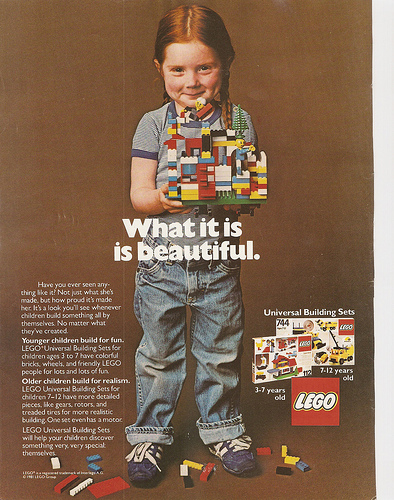
A few years back we published this fantastic ad for Legos as an example of gender-neutral advertising. It appeared in 1981; during my childhood, I’m happy to say.

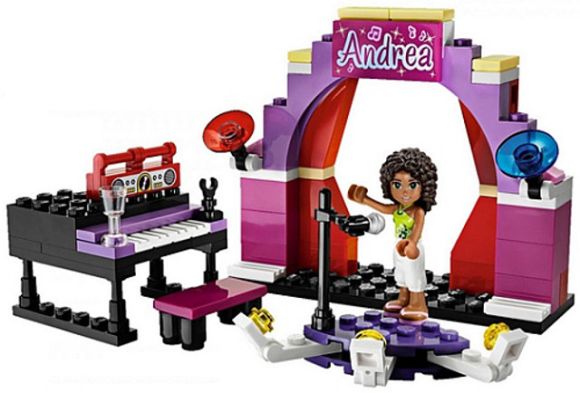
The ad offers nice context for the new effort by Lego to capture The Girl Market.  Their new line of Legos, Lego Friends, has gotten a lot of attention already. In the circles I run in, it’s being roundly criticized for reproducing stereotypes of girls and women: domesticity, vanity, materialism, and an obsession with everything being pastel.  Kits include a house, cafe, animal hospital, tree house, beauty salon, and an inventor’s lab.  Choice examples:


The new line also includes a new Lego figurine that is taller, thinner, and more feminine, with boobs.  There is no innovation here; it is the exact same makeover that we’ve seen in recent years with Dora the Explorer, Strawberry Shortcake, Holly Hobbie, Lisa Frank, Trolls, Cabbage Patch Kids, My Little Pony, Rainbow Brite, and Candy Land (or visit our Pinterest collection of Sexy Toy Make-Overs).

Examples of the old “mini-fig” and the new “mini-doll” available at The Mary Sue.

The company is framing their new line for girls with “science.” Executives are going to great lengths to explain that the line is based on research, using anthropologists who spent time with girls in their homes. The frame gives the company an excuse for reproducing the same old gender stereotypes that we see throughout our culture.  They can shrug their shoulders and say, “Well, what are we to do? This is what girls want.”  In this way they are trying to make it clear that they shouldn’t be held accountable for the messages their products send.

But it’s no accident that girls feel alienated from Lego.

According to Business Week, Lego has spent most of the last decade focusing their products on boys.  They have deliberately designed products that they expect will appeal to boys and included boys almost exclusively in their marketing material. Today Legos are shelved in the boy aisle is most toy stores.

So, basically, what Lego has done over the last few decades is take a truly wonderful gender-neutral toy, infuse it with boyness, and tell every kid who’ll listen that the toy is not-for-girls.  Now, stuck with only 50% of the kid market, they’re going after girls by overcompensating.  And, to top it all off, they’re shaking their heads and doing “science” to try to figure out girls, as if they’re some strange variant of human that regular humans just can’t get their head around.

In fact, girls don’t feel like the toy is for them because Lego has done everything in its power to ensure that they will not.

The market research manager sums up Legos’ impression of what girls want this way: “The greatest concern for girls really was beauty.”  How ironic, because the true beauty of Lego is its ability to inspire creativity, not enable conformity.  They somehow knew that back in 1981.

(An ad that deserves being looked at over and over.)

Thanks to Anjan G., Sangyoub P., Rachel W., Dolores R., Erin B., Christie W., and Paul K. for suggesting that we write about this!

Lisa Wade, PhD is an Associate Professor at Tulane University. She is the author of American Hookup, a book about college sexual culture; a textbook about gender; and a forthcoming introductory text: Terrible Magnificent Sociology. You can follow her on Twitter and Instagram.