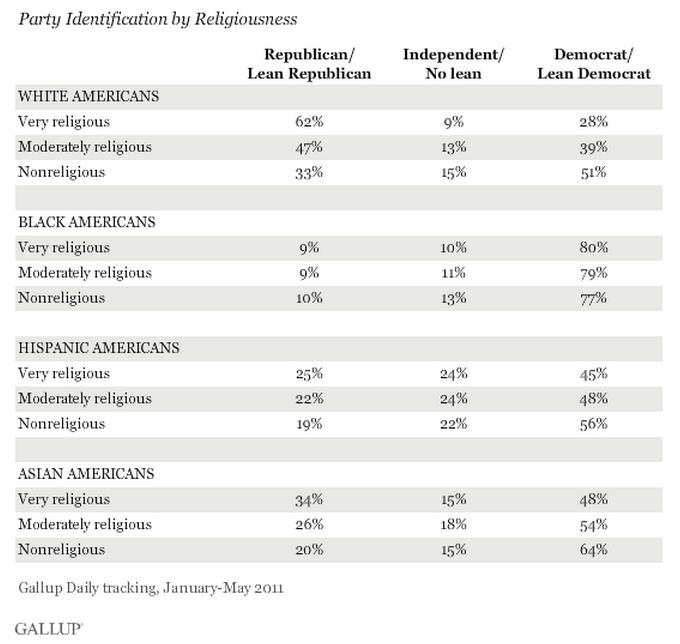
Identifying as Republican is strongly associated with religiosity in the U.S., so much so that people often use the term “Republican” and “Religious Right” interchangeably. Indeed, religious people are more likely to be politically conservative overall, but a Gallup poll shows that this relationship is moderated by race.  The figure below cross-tabulates religiosity for four racial/ethnic groups with the likelihood of affiliating with the Democratic or Republican party or neither.  You can see that the typical relationship — religion/Republican and no religion/Democrat — holds for all groups, except for African Americans.

At Gallup, Frank Newport writes:

Asian and Hispanic Americans, regardless of religiousness, are more likely to identify as Democrats than Republicans. But the Democratic advantage goes from 14 points among very religious Asians to 44 points among nonreligious Asians. The differences are less substantial among Hispanics; very religious Hispanics are more likely to identify themselves as a Democrats than Republicans by 20 points, while nonreligious Hispanics are more likely to identify themselves as Democrats by a larger 36-point margin.

Personal religiousness makes little difference among blacks, however, as the powerful partisan pull of Democratic identification among black Americans trumps any influence of religion.

The report is a great example of the importance of doing intersectional analyses.  When you pull groups apart (by, say, adding race when looking at the relationship between religion and politics), you often find that a more generalized examination is hiding interesting details.

Lisa Wade, PhD is an Associate Professor at Tulane University. She is the author of American Hookup, a book about college sexual culture; a textbook about gender; and a forthcoming introductory text: Terrible Magnificent Sociology. You can follow her on Twitter and Instagram.

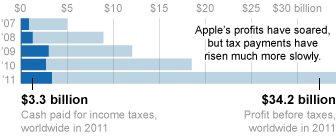
Apple’s profits more than quintupled in the last five years, but their tax burden has risen much more slowly.  Last year, just 9.8% of their profits went to taxes.   “By comparison,” writes economist Marty Hart-Landsberg, “Wal-Mart was downright patriotic — paying a tax rate of 24 percent.”

How does the company do it?  Hart-Landsberg summarizes the New York Times: “The answer is tax loopholes and a number of subsidiaries in low tax places like Ireland, the Netherlands, Luxembourg and the British Virgin Islands. ”  More details at Reports from the Economic Front.

Lisa Wade, PhD is an Associate Professor at Tulane University. She is the author of American Hookup, a book about college sexual culture; a textbook about gender; and a forthcoming introductory text: Terrible Magnificent Sociology. You can follow her on Twitter and Instagram.

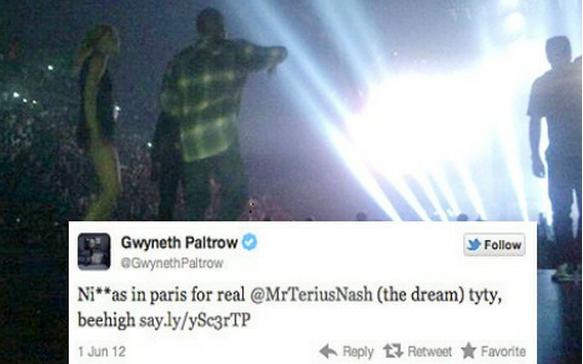
Last week Gwenyth Paltrow tweeteda photograph of Kanye West and Jay-Z performing in France along with the text: “Ni**as in paris for real.”  The tweet started a conversation about her right to use the n-word, even with asterisks. Paltrow defended herself, claiming that it is the name of the song they were performing (which it is).

At Colorlines, Jay Smooth offers a characteristically entertaining and insightful analysis of the incident.  What’s interesting, he observes, isn’t so much her use of the word, but her defensiveness about it.  Here’s how he puts it:

No matter how justified you feel, as soon as you start arguing about your right to use the n–, that is a sign that you have become too attached to the n–.

He calls on her to apologize and move on with her life because…

The right to use that word is not a right worth fighting for.

A great watch:

Lisa Wade, PhD is an Associate Professor at Tulane University. She is the author of American Hookup, a book about college sexual culture; a textbook about gender; and a forthcoming introductory text: Terrible Magnificent Sociology. You can follow her on Twitter and Instagram.

Cross-posted at Montclair SocioBlog.

If a person thinks that the media are infiltrating his mind and controlling his thoughts and behavior, we consider him a nutjob, and we recommend professional help and serious meds.  But if a person thinks that the media are infiltrating other people’s minds and affecting their behavior, we call him or her an astute social observer, one eminently qualified to give speeches or write op-eds.

The previous post dwelt on economist Isabel Sawhill’s Washington Post op-ed channeling Dan Quayle, particularly Quayle’s speech asserting that a TV sitcom was wielding a strong effect on people’s decisions — not just decisions like Pepsi vs. Coke, but decisions like whether to have a baby.

That was Quayle, this is now.  Still, our current vice-president can sometimes resemble his counterpart of two decades ago.  Just a last month, Joe Biden echoed the Quayle idea on the power of sitcoms.  On “Meet the Press,” in response to David Gregory’s question about gay marriage, Biden said that “this is evolving” and added:

And by the way, my measure, David, and I take a look at when things really begin to change, is when the social culture changes.  I think “Will and Grace” probably did more to educate the American public than almost anything anybody’s ever done so far.

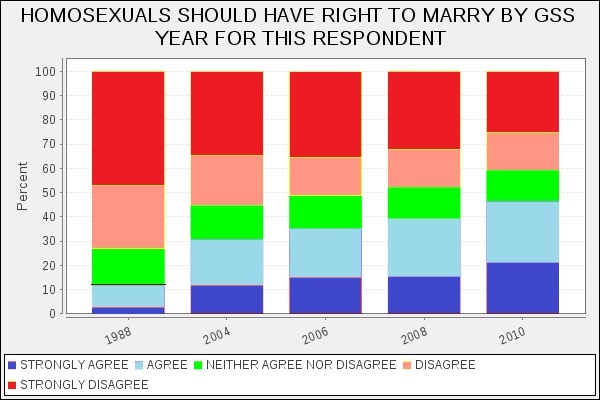
“Will and Grace” ran for eight seasons, 1998-2006.  Its strongest years were 2001-2005, when it was the top rated show among the 18-49 crowd. Biden could point to General Social Survey (GSS) data on the gay marriage question.  In 1988, ten years before “Will and Grace,” the GSS asked about gay marriage.  Only 12% supported it, 73% opposed it.  The question was asked again in 2004, six years into the W+G era.  Support had more than doubled, and it continued to rise in subsequent years.
We don’t know just when in that 18-year period, 1988-2004, things “really began to change.”  Fortunately, the GSS more regularly asked the respondent’s view on sexual relations between same-sex partners.  Here too, tolerance grows in the “Will and Grace” period (gray on the graph):
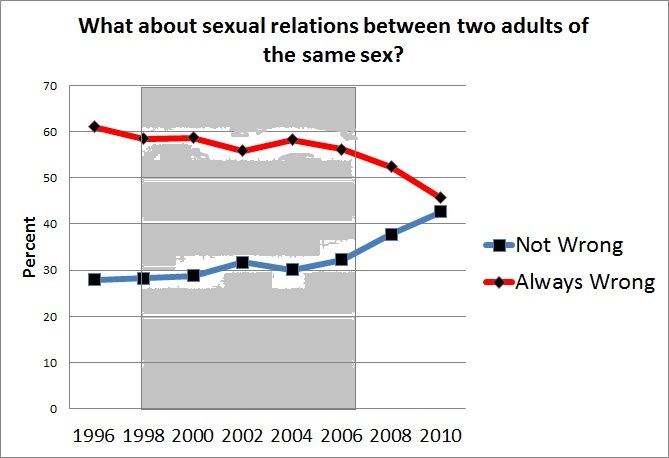
The graph is misleading, though. To see the error, all we need do is extend our sampling back a few years  Here is the same graph starting in 1973:
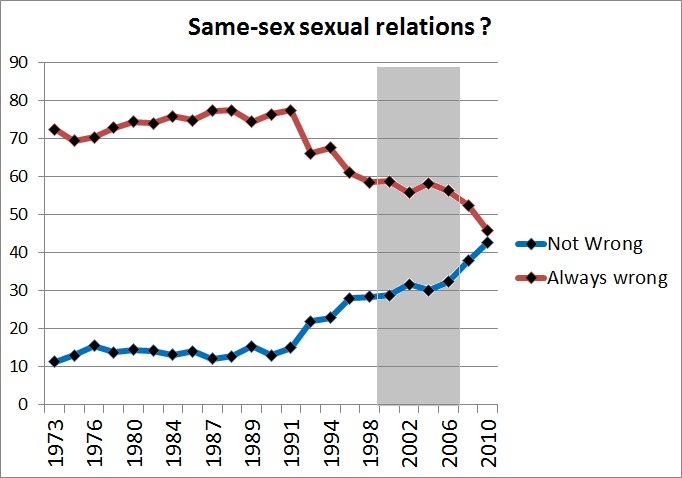
The GSS shows attitudes about homosexuality starting to change in 1990.  By the time of the first episode of “Will and Grace,” the proportion seeing nothing wrong with homosexuality had already doubled.  Like Quayle’s “Murphy Brown” effect, the “Will and Grace” effect is hard to see.

The flaw in the Quayle-Biden method is not in mistaking TV for reality.  It’s in assuming that the public’s awareness is simultaneous with their own.

Why do our vice-presidents (and many other people) give so much credit (or blame) to a popular TV show for a change in public opinion?  The error is partly a simplistic post hoc logic.   “Will and Grace” gave us TV’s first gay principle character; homosexuality became more acceptable.  Murphy Brown was TV’s first happily unwed mother, and in the following years, single motherhood increased.   Besides, we know that these shows are watched by millions of people each week.  So it must be the show that is causing the change.

It’s also possible that our vice-presidents (and many other people) may also have been projecting their own experiences onto the general public.  Maybe Murphy Brown was the first or only unwed mother that Dan Quayle really knew – or at least she was the one he knew best.  It’s possible that Joe Biden wasn’t familiar with any gay men, not in the way we feel we know TV characters.  A straight guy might have some gay acquaintances or co-workers, but it’s the fictional Will Truman whose private life he could see, if only for a half hour every week.

Does TV matter?  When we think about our own decisions, we are much more likely to focus on our experiences and on the pulls and pushes of family, work, and friends.  We generally don’t attribute much causal weight to the sitcoms we watch.  Why then are we so quick to see these shows as having a profound influence on other people’s behavior, especially behavior we don’t like?   Maybe because it’s such an easy game to play.  Is there more unwed motherhood?  Must be “Murphy Brown.”  Did obesity increase in the 1990s?  “Roseanne.”  Are twentysomethings and older delaying marriage?  “Seinfeld” and “Friends.” And of course “The Simpsons,” or at least Bart and Homer, who can be held responsible for a variety of social ills.

Yesterday I posted about the extraordinary number of people in Louisiana prisons.  The rise in imprisonment mirrors the U.S. growth that began with the so-called war on drugs, but was also triggered by a crisis in the early 1990s, after two decades of growth.  A federal court ordered Louisiana to reduce overcrowding in prisons, which had risen to an inhumane level.  They  had to either let criminals out or build more prisons.  They did the latter.

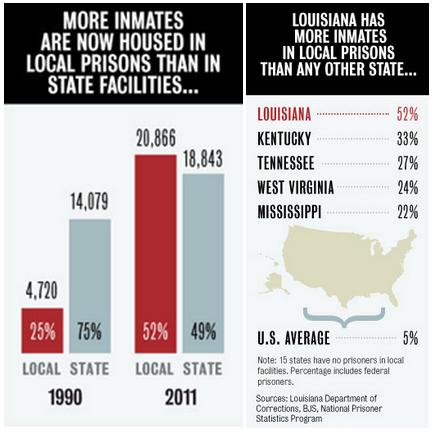
Instead of building more state-funded prisons, though, for-profit prisons were built by sheriffs and residents of local parishes.  Today there are more inmates housed in local, for-profit prisons than in state prisons (left) and Louisiana has more inmates in private prisons than any other state in the U.S. (right):

Why should we care if so many prisoners are housed in private, for-profit institutions?

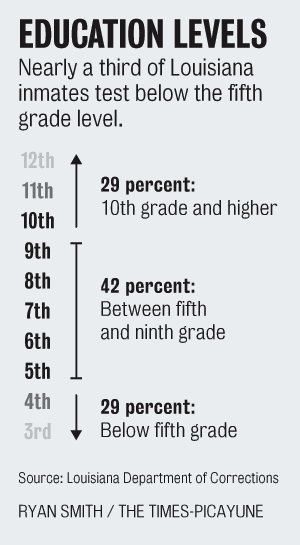
The conditions in these prisons are worse than those in state prisons, especially when it comes to quality of life (like the opportunity to develop hobbies or practice their religion) and rehabilitative services (like high school equivalency classes and job training). These are desperately needed services; the average Louisiana prisoner has a 7th grade education and nearly a 3rd read below a 5th grade level:

State facilities simply spend more money, while for-profit prisons skim as much off the top as possible.  Writes reporter Cindy Chang:

An inmate at the Angola state penitentiary costs $63.15 a day, compared with the $24.39 sheriff’s per diem. State facilities house the sickest and oldest, but [Department of Corrections] Secretary Jimmy LeBlanc admits part of the differential is the lack of educational offerings.

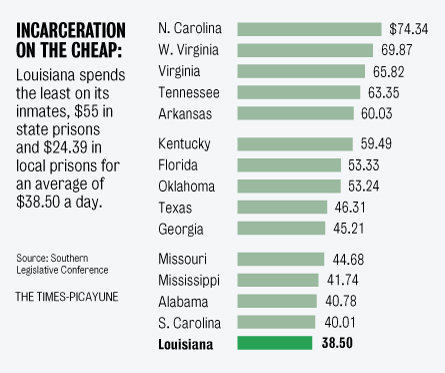
In fact, Louisiana spends less on its prisoners (in state and private facilities combined) than any other state in the U.S.:

Law enforcement officials and parish residents may not like what’s happened in Louisiana, but many feel trapped.  For-profit prisons are sustaining local communities: they fund police departments and employ residents. Often they are the only local jobs with decent wages and benefits. Those residents support the local economies and keep small towns alive.

In this short video, an employee talks about the occupational opportunity the prison provides:

Many Louisianans, then, see the harsh sentences and high imprisonment as a price worth paying.  Says Sheriff Charles McDonald: “I know it sounds crazy and impersonal… but we’re stuck with this jail. We can’t walk away. We’ve got investors, employees.”

Lisa Wade, PhD is an Associate Professor at Tulane University. She is the author of American Hookup, a book about college sexual culture; a textbook about gender; and a forthcoming introductory text: Terrible Magnificent Sociology. You can follow her on Twitter and Instagram.

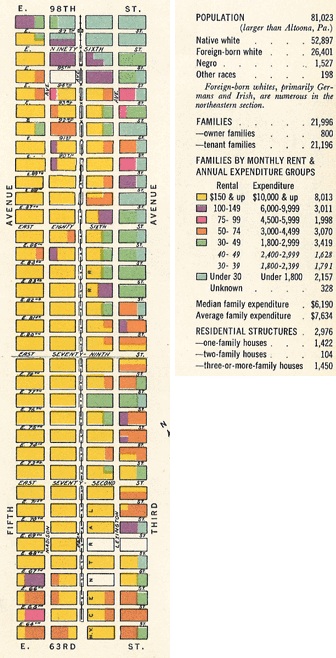
In the early 1940s, four news organizations — the New York Times, the Daily Mirror, News Syndicate Co. (now the Tribune Company), and Hearst Consolidated Publications — collaborated on a detailed market analysis of New York City, complete with statistics about racial/ethnic makeup, color-coded maps of rents, and photos and short narratives of each neighborhood. The Center for Urban Research, at the City University of New York (CUNY) Graduate Center, recently posted the resulting 1943 document, Market Analysis. The interactive archive is a treasure trove of information about New York in the 1940s.

Described as the “district of the silver spoon,” the Upper East Side, then as now, was among the most affluent neighborhoods, with many rents above the then-exorbitant $150 mark (now about $2,500):

The description points out that even in this affluent area, the rich and poor lived in close proximity, with $30/month apartments within a block of some of the most expensive real estate in the city.

The Lower East Side, on the other hand, is described as “the most populous, most crowded, most old-world district in New York City,” with so many immigrants that its atmosphere is “essentially alien”:

The narrative provides some information about urban planning policies of the time, as well. It notes that the Lower East Side had dropped by over 200,000 in 20 years, noting that “slum clearance” had led to more open public space; it also mentions the emergence of large housing developments, such as Knickerbocker Village — the type of large housing projects, often financed with government funding, that became the preferred solution to providing low-income housing, often leading to the displacement of many low-income residents when their residences were torn down to make room for the developments.

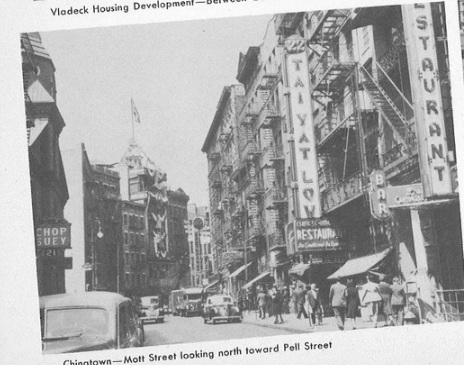
The “tiny Chinatown” that then existed on the Lower East Side at Pell and Mott Streets:

You get the idea. Clicking around for a while provides lots of interesting tidbits to illustrate major demographic, economic, and public-policy changes and how they have impacted life in the city. The Center for Urban Research has also provided a comparison of a number of characteristics between 1940 and today.

Several times we have posted images that reflect the realities of life within the U.S. prison system — for instance, photos of the impacts of overcrowding, life in juvenile detention centers, prison cemeteries, and the fate of prisoners during Hurricane Katrina. Alexander A. sent in a link to another striking collection of images of the corrections system. Josh Begley, a master’s student at NYU, collected aerial views of correctional facilities available from Google. His resulting project, Prison Map, makes visible an element of our society that most people rarely think about as actual, physical locations existing on the landscape. I’ve picked a few examples here, but I highly recommend going to the Prison Map website and looking at it in its entirely, which allows you to pick up on common patterns in the design of prisons.

Also check out the article about the Prison Map project at The Atlantic.

A new 8-part Times Picayune series on the prison industry in Louisiana starts off with these foreboding sentences:

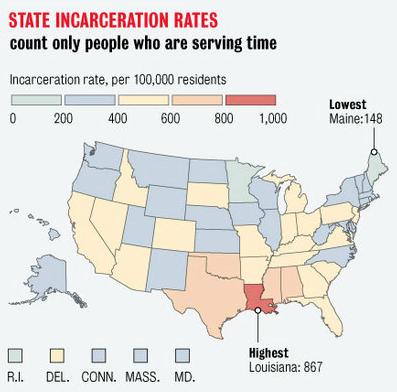
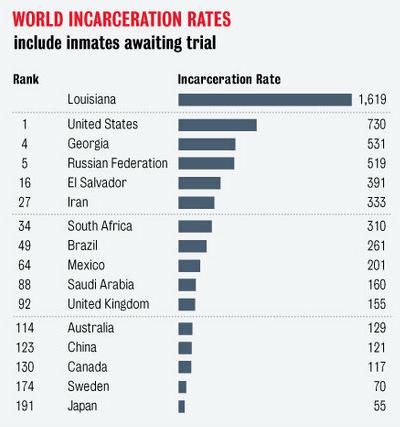
Louisiana is the world’s prison capital. The state imprisons more of its people, per head, than any of its U.S. counterparts. First among Americans means first in the world. Louisiana’s incarceration rate is nearly five times Iran’s, 13 times China’s and 20 times Germany’s.

One out of every 86 Louisianans is in prison.

The motivation is money.   Most prisoners in Louisiana are in for-profit prisons.  The state spends $663 million a year on imprisonment; $182 million of that goes to for-profit correctional companies or contracted local sheriffs.  Many small towns depend on the prisons to fund their law enforcement.

Burk Foster, a criminologist who’s been studying Louisiana prisons, explains:

They don’t want to see the prison system get smaller or the number of people in custody reduced, even though the crime rate is down, because the good old boys are all linked together in the punishment network, which is good for them financially and politically.

State Rep. Joseph Lopinto (R-Metairie) agrees:

The bottom line is, if locking everybody up and throwing away the key works, then we should have the lowest crime rate in the United States. We don’t. So then you have to really look at your policies. In my opinion, it’s strictly a fiscal issue.

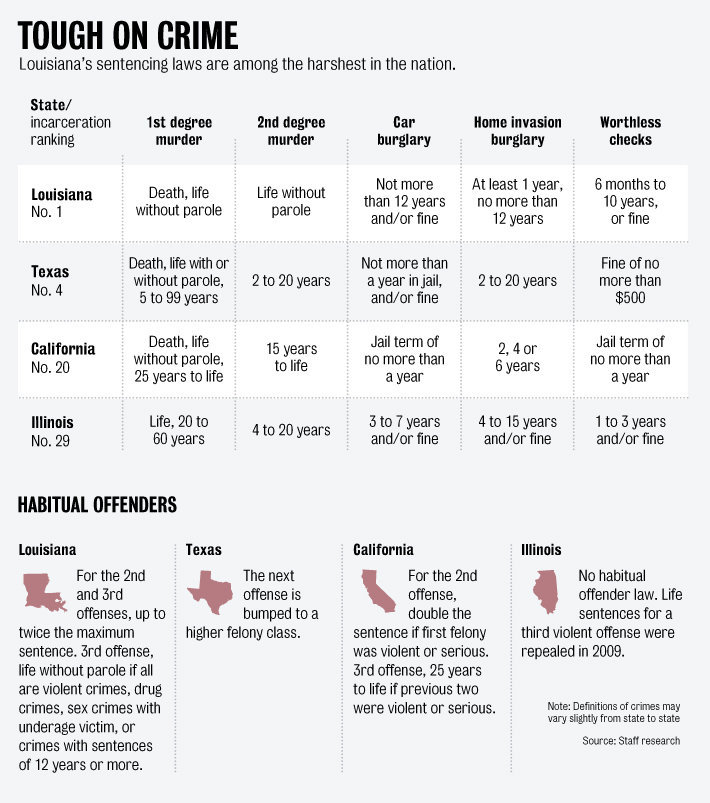
Those who benefit from the prison industry have pushed through some of the severest sentencing laws in the country and aggressively resist reform.  “Few lobbies in Louisiana,” writes reporter Cindy Chang, “are as powerful as the sheriffs association.”  As a result, Louisiana’s sentencing laws are out-of-step with the rest of the country:

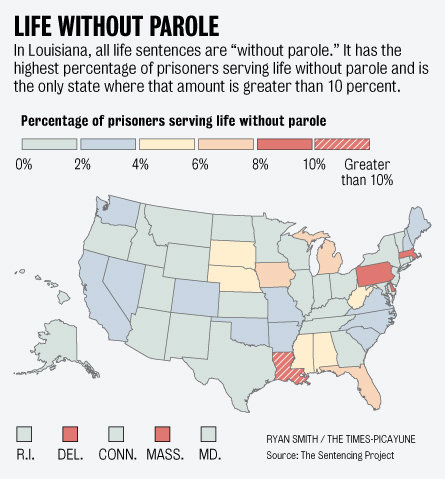
All life sentences are, automatically, without any chance of parole and more than one in ten Louisiana prisoners are serving life sentences (the majority of lifers were convicted before age 30):

Harsh where other states are lenient, and harsh where other states are harsh, Louisiana has “a much higher percentage behind bars for [non-violent] drug offenses.”  In 2009, 82% of the 17,223 new admissions to Louisiana prisons were convicted of non-violent felonies.

Tomorrow I’ll follow up with a post on why there are so many for-profit prisons in Louisiana and how it’s affected the lives of prisoners both during and after incarceration.

Lisa Wade, PhD is an Associate Professor at Tulane University. She is the author of American Hookup, a book about college sexual culture; a textbook about gender; and a forthcoming introductory text: Terrible Magnificent Sociology. You can follow her on Twitter and Instagram.