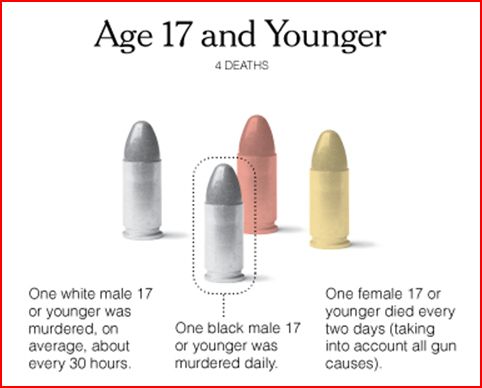
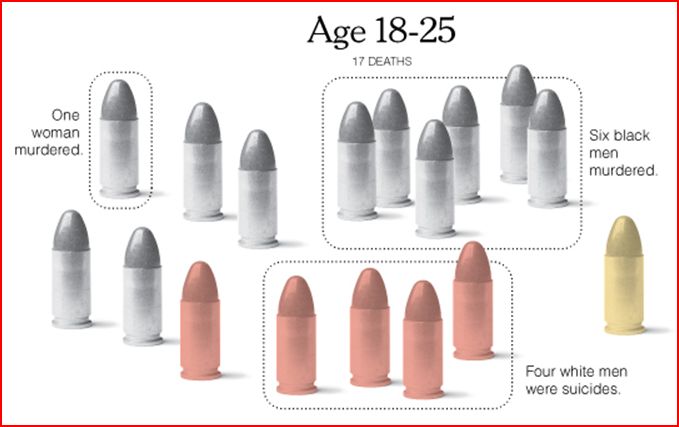
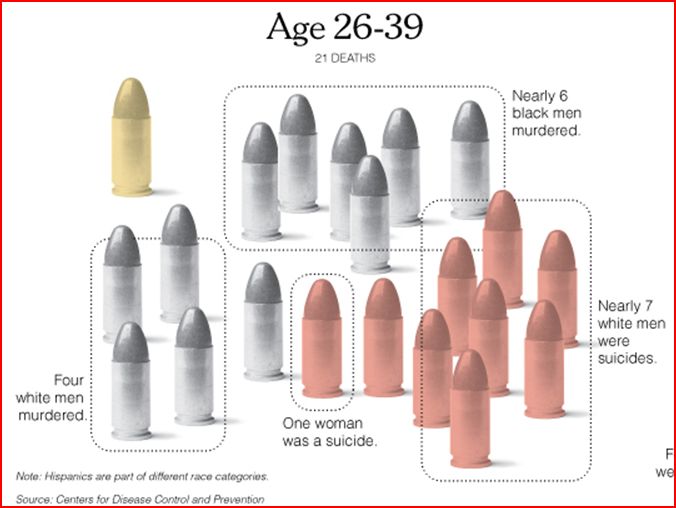
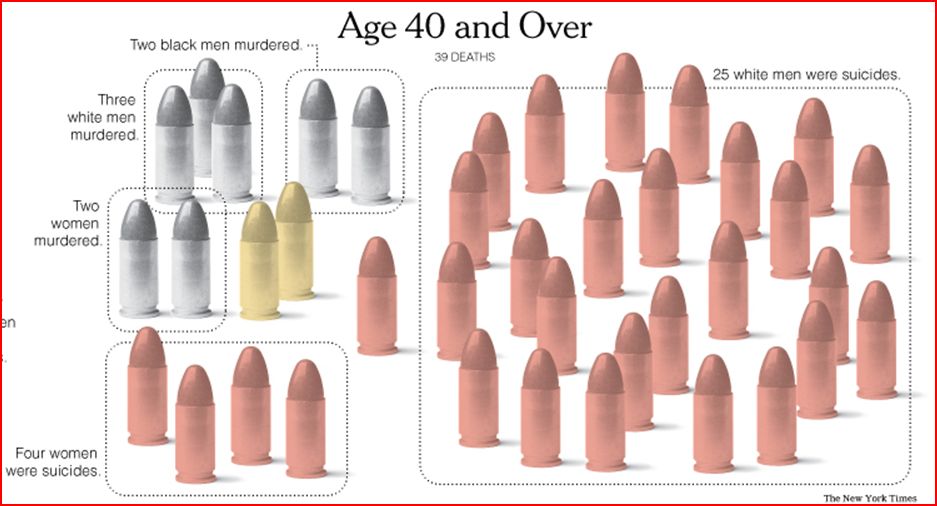
Ezra Klein at Wonkblog has put together an impressive collection of statistics on guns and mass shootings, including this data on public opinion on gun control.

To begin, people seem generally less interested in owning guns.  The percent of households with guns has been steadily decreasing for decades:

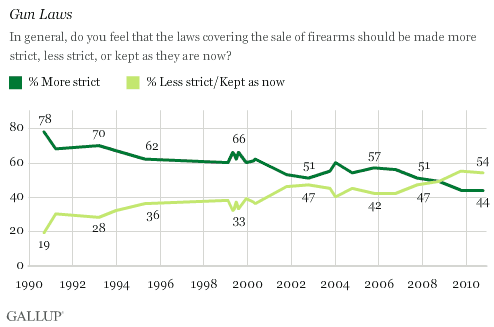
But, perhaps counter-intuitively, support for gun control has waned:

We might expect a tragedy like this week’s shooting to raise the overall level of support for gun control, but it probably won’t.  Previous shootings have not had much of an impact on opinion:

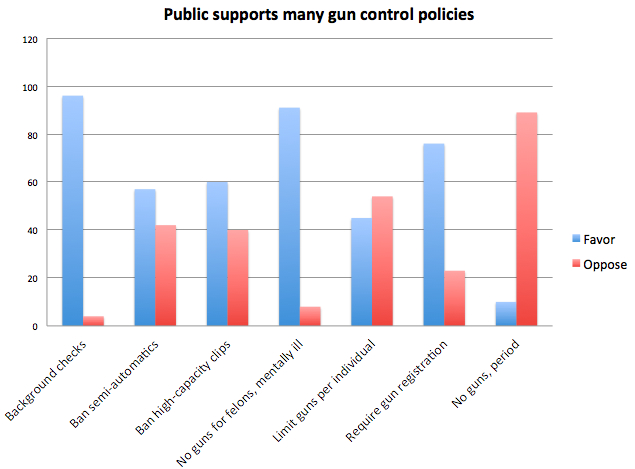
Still, there is more support for some forms of gun control than others:

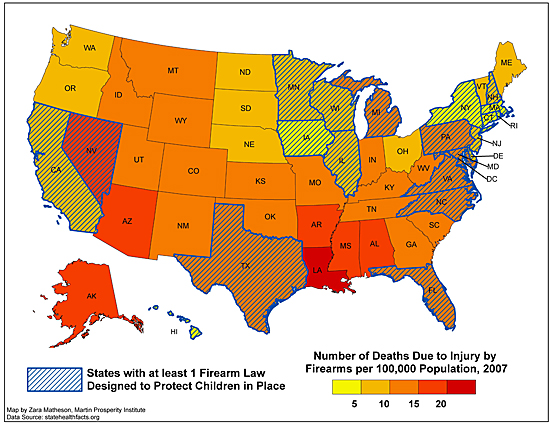
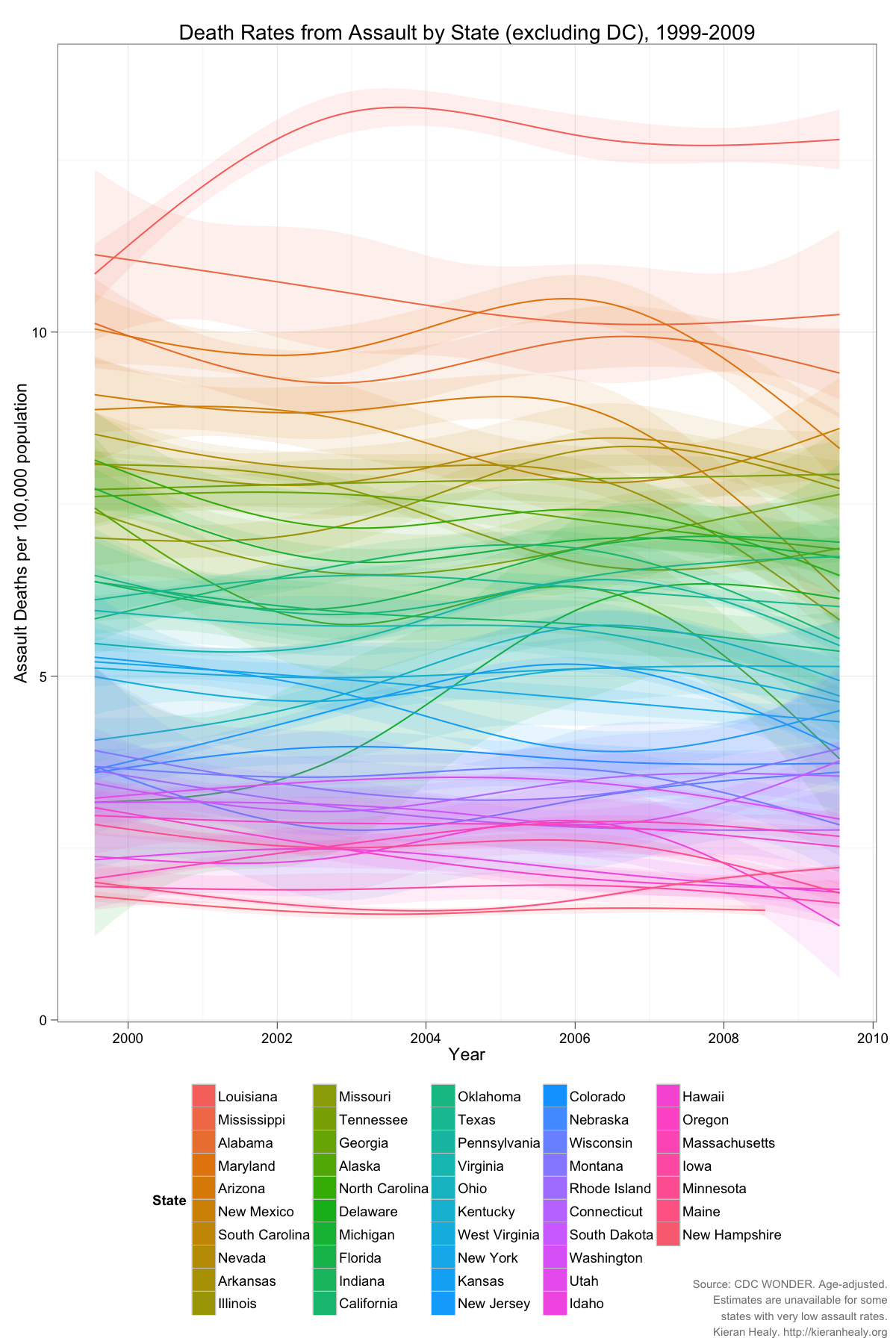
For what it’s worth, gun-related deaths are lower in states with stronger gun control.  Economist Richard Florida found “substantial negative correlations between firearm deaths and states that ban assault weapons (-.45), require trigger locks (-.42), and mandate safe storage requirements for guns (-.48)”:

It’s hard to know, however, whether this is correlation or causation.  Florida did not find correlations between gun deaths and other factors that we might expect to be correlated, including dense populations, high rates of stress, high numbers of immigrants, and mental illness.

Klein thinks that now is the time to talk about the role of gun control in preventing tragedies like the one in Newtown.  He suggests we go ahead and politicize the shooting, since silencing a discussion is just another form of politicization. He writes:

If roads were collapsing all across the United States, killing dozens of drivers, we would surely see that as a moment to talk about what we could do to keep roads from collapsing. If terrorists were detonating bombs in port after port, you can be sure Congress would be working to upgrade the nation’s security measures. If a plague was ripping through communities, public-health officials would be working feverishly to contain it.

Only with gun violence do we respond to repeated tragedies by saying that mourning is acceptable but discussing how to prevent more tragedies is not. “Too soon,” howl supporters of loose gun laws. But as others have observed, talking about how to stop mass shootings in the aftermath of a string of mass shootings isn’t “too soon.” It’s much too late.

I agree that now is a good time to talk about gun control. And, we should do it with as many facts as possible, no matter where they lead us.

Lisa Wade, PhD is an Associate Professor at Tulane University. She is the author of American Hookup, a book about college sexual culture; a textbook about gender; and a forthcoming introductory text: Terrible Magnificent Sociology. You can follow her on Twitter and Instagram.

Cross-posted at Guns, Rap, and Crime.

I have a heavy heart tonight.  My thoughts and prayers are with the families of Newtown.  The Newtown shooting is a terrible tragedy. It has reminded me of lessons learned while studying the families of murder victims.

For the past 2 years, I have been researching the everyday lives of families who lose someone in a murder.  This has been difficult — and often heartbreaking — research.  I have spent many nights thinking about how much I take my family, friends, and other people in my life for granted.   I think about the mothers, fathers, grandparents, aunts, uncles, and siblings whose first and last thoughts of each day are of the person they loved and lost. The things that I have seen and the stories that I have collected have left a deep and permanent mark on my soul.

Amongst the many thoughts swirling around in my head, I keep returning to a troubling “double standard” that we often taken for granted when shootings happen.

On one hand, the Newtown shooting reminds us that fatal violence can happen at anytime to anyone.  It is a painful reminder that life is precious and that it can be snapped away from us at any moment.  The Newtown shooting makes many of us feel an existential fall out. How could this happen?  Why did this have to happen?  And what does this mean for me?

For many of us, these shootings cut a little too close to home.  They happen in places to people who remind us of ourselves.  We begin to wonder: “Are we ever really safe?” “Will our children come home from school today?” “Will this happen at my favorite movie theater?”

In turn, these ideas shape how we feel about families who mourn in the wake of such tragedies.  We feel deep empathy, compassion, and sadness for families and victims in Newtown.  We talk about the victims here as innocent children who met a horrible death completely out of their hands.  We wonder how the families and friends of victims will cope with such a loss.

But, the same kinds of sympathy and compassion are often not extended to families who lose their children in street shootings every day.  These situations are treated very differently by the media, by our leaders, and by many of us.  We see these shootings as events that only happen to people who are caught up in the wrong crowd.  We assume that these victims — who are often children — must have been dealing drugs, in a gang, or doing something to meet such a horrible end.  Everyday violence in our inner-cities helps us hold onto a precious myth: Fatal violence only happens to people who bring it on themselves.  If we can believe this, or at least think it might be true, we can feel safe again.

How do we reconcile these conflicting responses to tragedy?

I’m here to tell you that many of our popular assumptions about the second group of victims are deeply problematic and misinformed.  Many of the people that I have followed over the years have been young men who were in the wrong place at the wrong time.  This is a powerful message that John Rich — a physician, scholar, and interventionist — teaches us in his powerful work on young black men’s experiences with trauma.

This is a theme that also resonates with my work:  One family I followed lost their youngest son in a street-style execution shooting.  The mother and two older brothers of the victim faced an unsympathetic and sometimes cruel world.  Newspaper articles talked about this case as an example of how families need to keep closer tabs on their children.  Local community leaders and church pastors used this event to denounce drugs in the community.  And, most hurtful of all, supervisors at the mother’s work filed complaints about her work productivity slipping after her son’s death.  When she told them that she was in the bathroom wailing over the loss of her youngest child — she was fired and released with severance.

This is only a small sample of the many tragedies that I followed in Philadelphia.  I hope that this underscores the need to rethink how we process and make sense of gun violence across the board.  The deep sympathy and pain that we all feel tonight for the victims of Newtown should be extended to families who lose sons, daughters, husbands, wives, grandparents, aunts, uncles, best friends, and siblings in our backyards everyday.

—————————

Jooyoung Lee is a professor of sociology at the University of Toronto. His research involves crime, gun violence, health, interaction, and culture.  You can follow him at his blog, Guns, Rap, Crime, and on twitter.

Cross-posted at Kieran Healy’s blog.

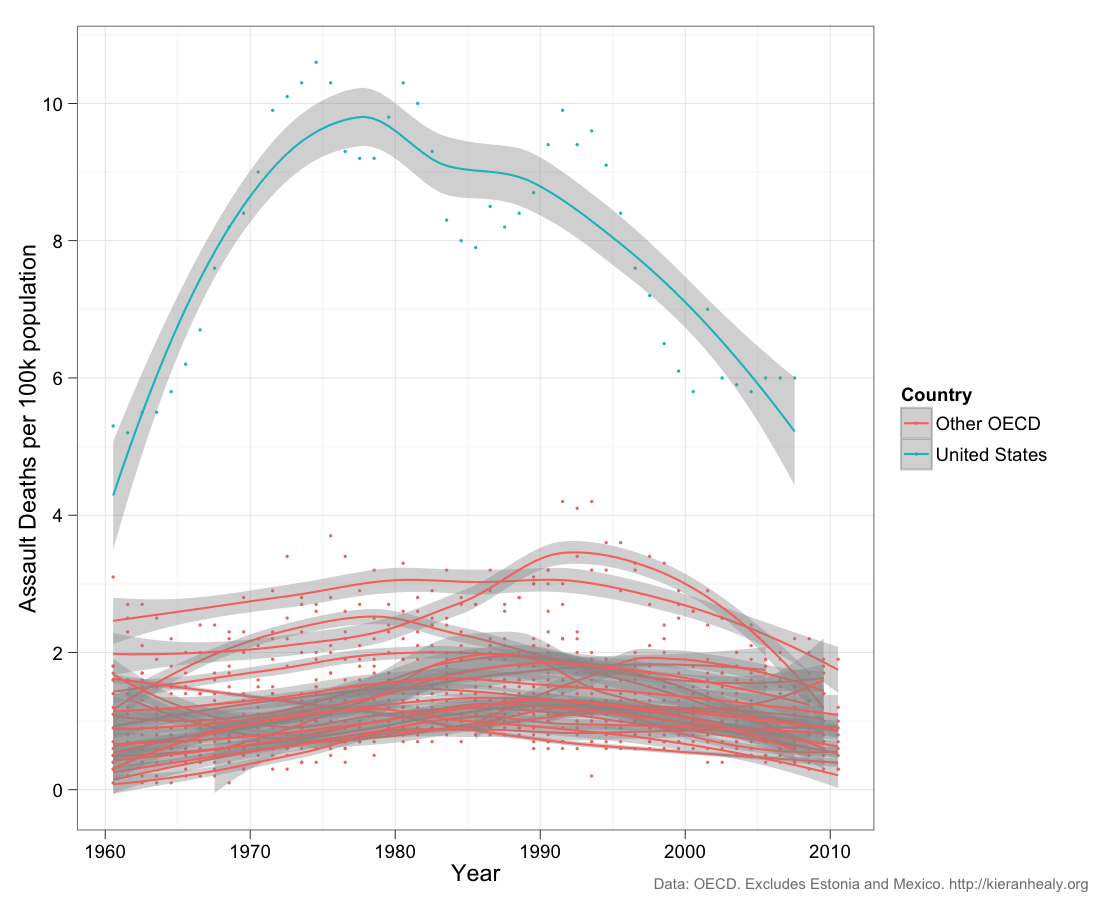
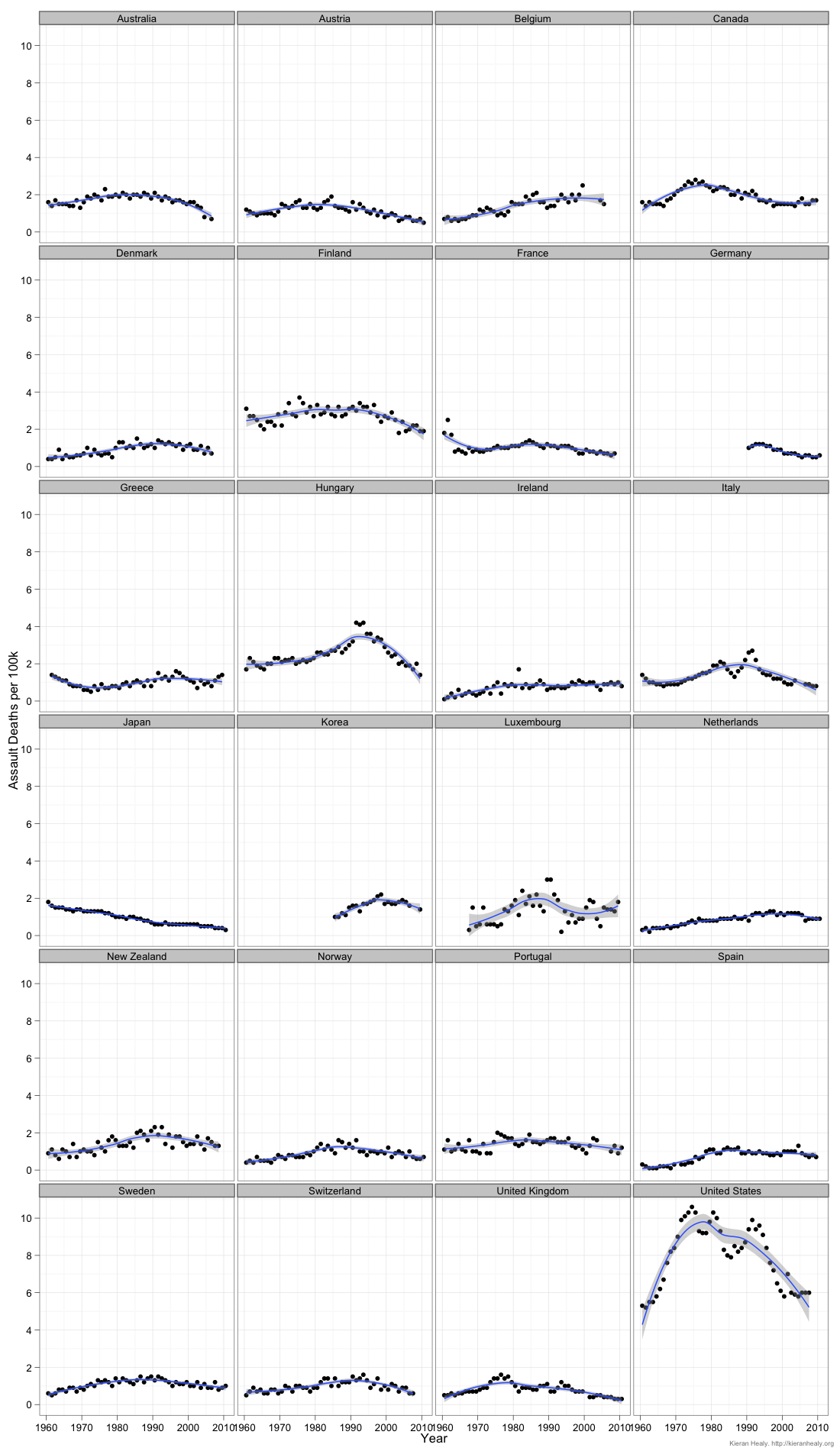
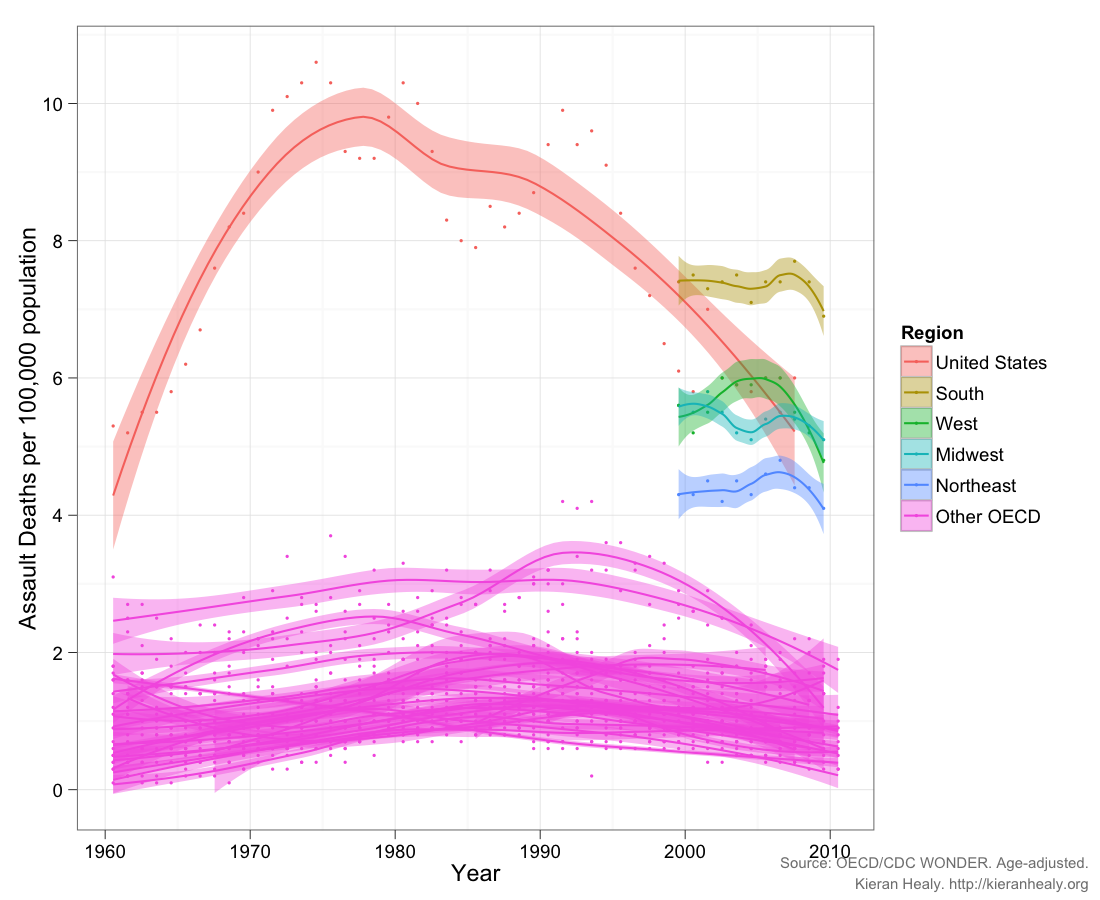
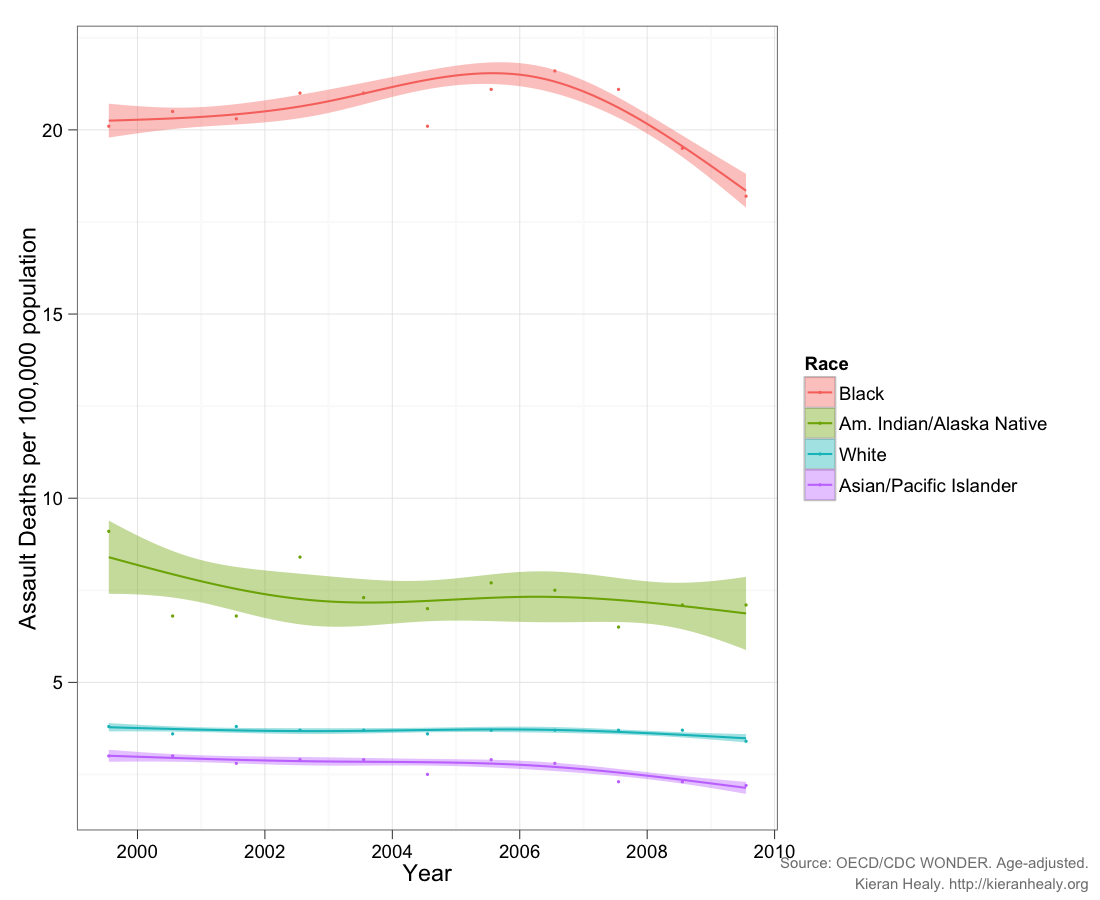
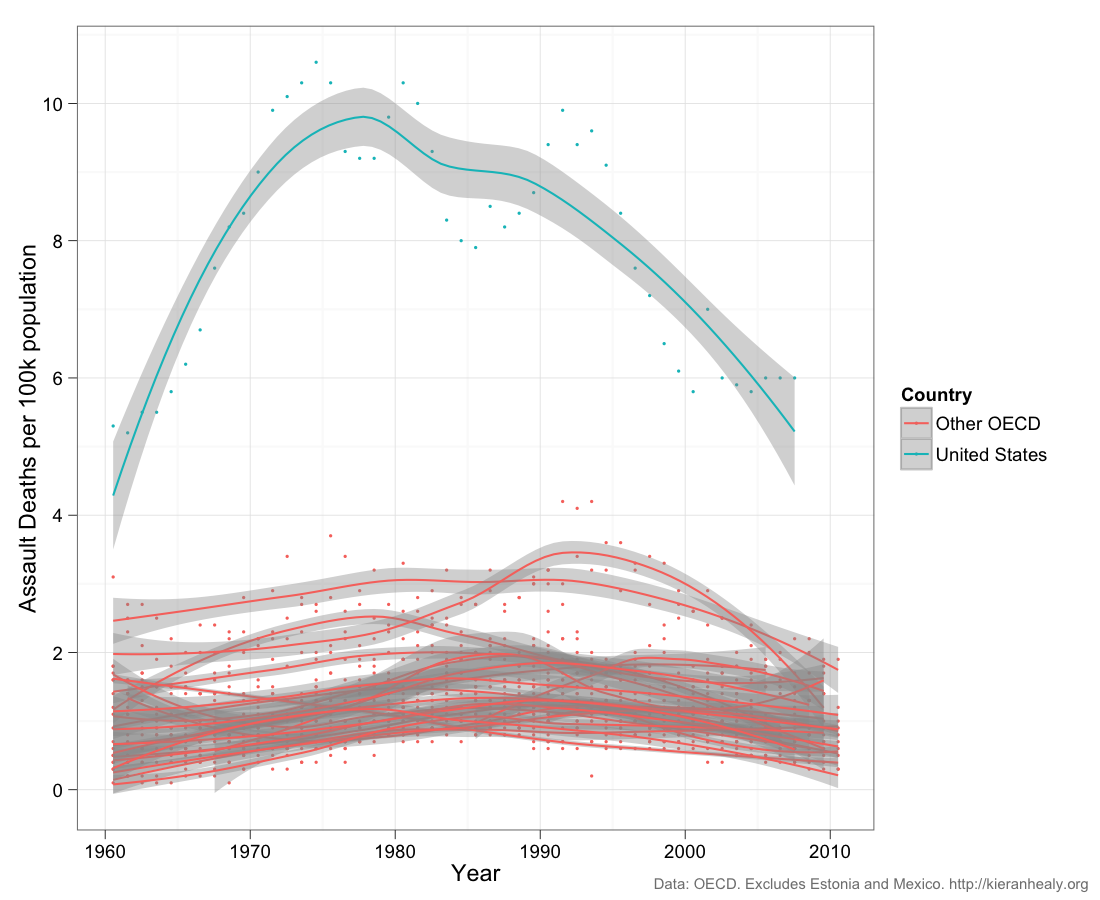
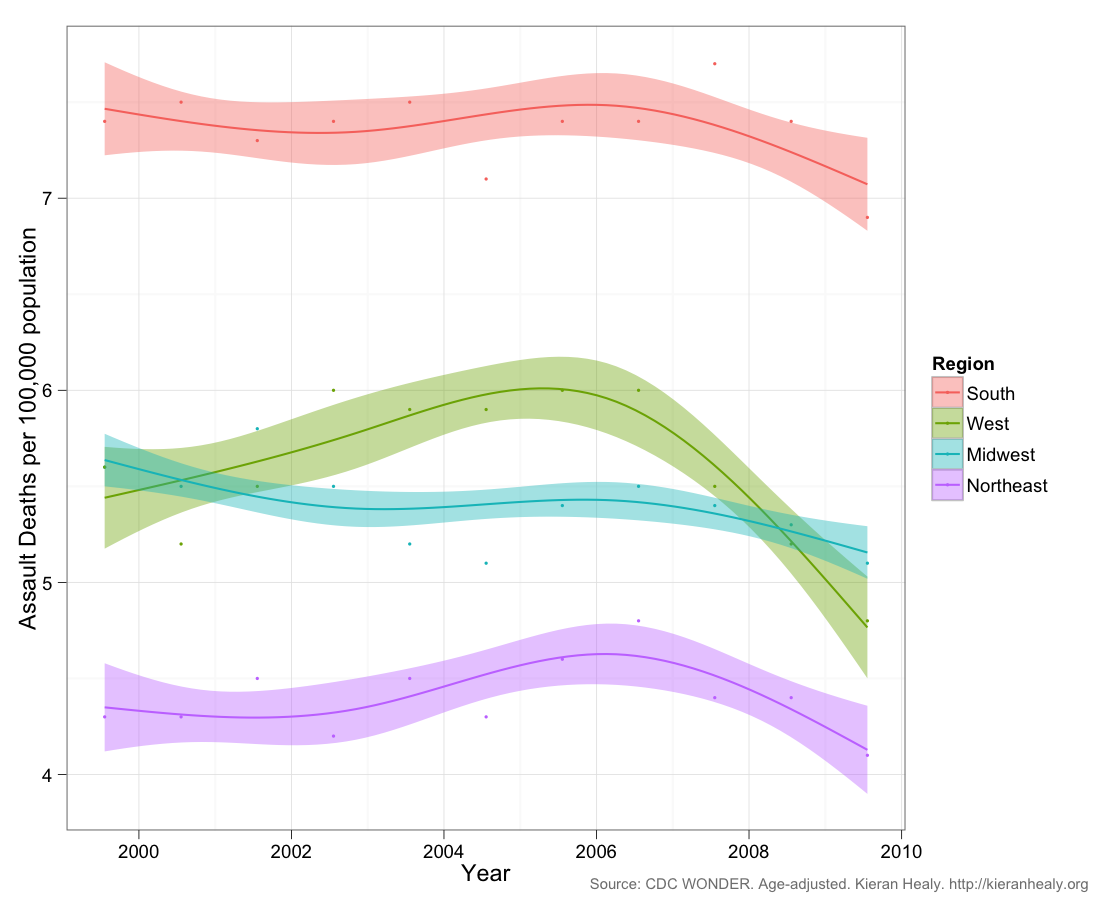
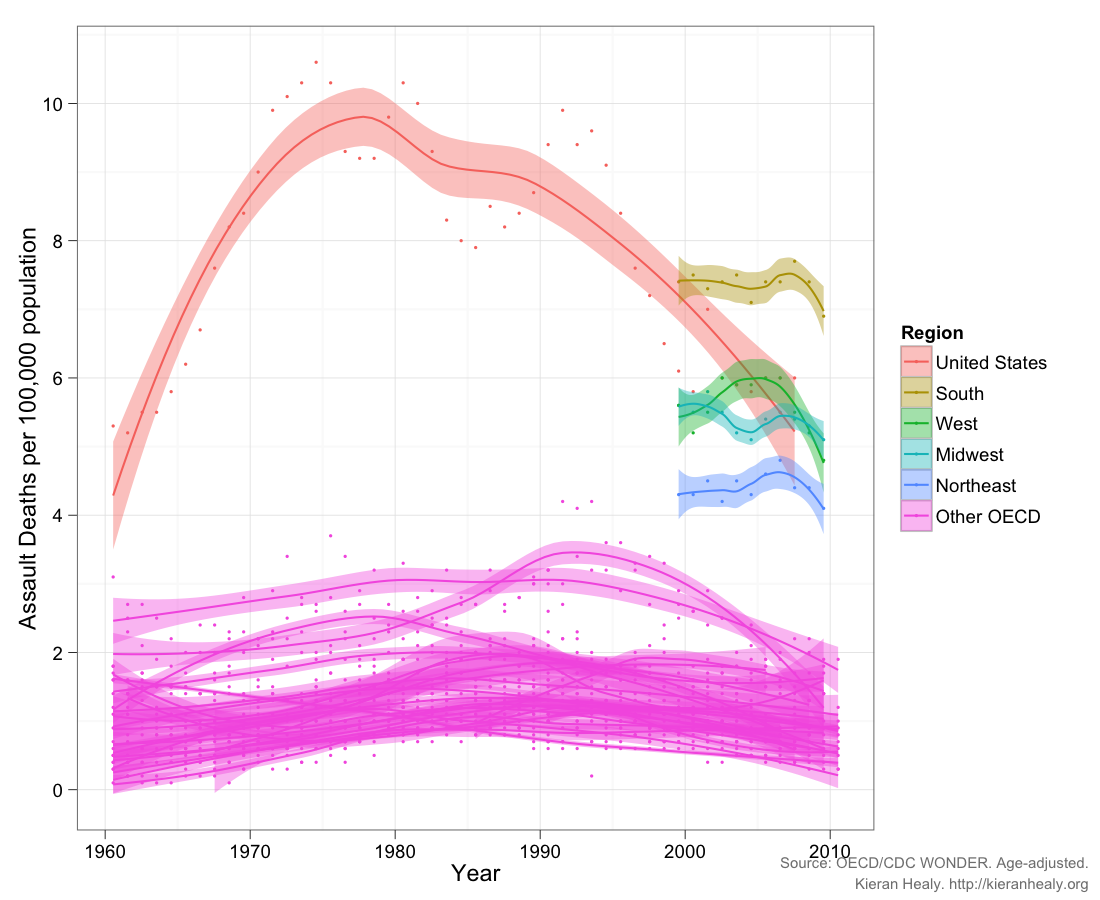
The terrible events in Connecticut prompted me to update an old post about comparative death rates from assault across different societies. The following figures are from the OECD for deaths due to assault per 100,000 population from 1960 to the present.

As before, the most striking features of the data are (1) how much more violent the U.S. is than other OECD countries (except possibly Estonia and Mexico, not shown here), and (2) the degree of change — and recently, decline — there has been in the U.S. time series considered by itself. Note that “assault” as a cause of death does not distinguish the mechanism of death (gunshot, stabbing, etc). If anyone knows of a similar time series for gun-related deaths only, let me know.

(Click for a larger PNG or PDF.)

Here are the individual time series:

(Click for a larger PNG or PDF.)

—————————

Kieran Healy is a professor of sociology in the Kenan Institute for Ethics at Duke University.  His research is primary concerned with the moral order of a market society. You can follow him on twitter and at his blog.

A moment of silence for the victims of the shooting at Sandy Hook Elementary School.

Lisa Wade, PhD is an Associate Professor at Tulane University. She is the author of American Hookup, a book about college sexual culture; a textbook about gender; and a forthcoming introductory text: Terrible Magnificent Sociology. You can follow her on Twitter and Instagram.
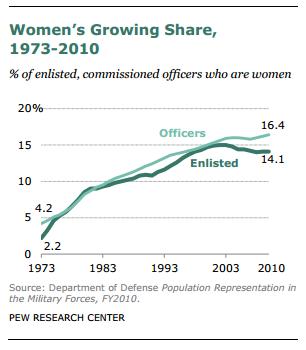
Pew Research Center reports that, as of 2010, women make up about 15% of enlisted soldiers and commissioned officers:

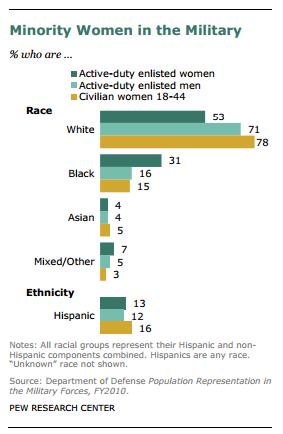
Not all types of women are entering the military at the same rate.  Nearly a third of women in the military are Black, about twice their proportion in the general population.  In contrast, about half are white, about 2/3rds their proportion among civilian women.

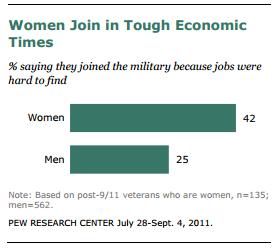
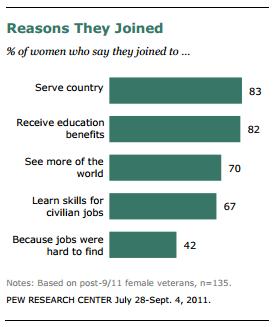
A larger proportion of women, compared to men, said that they joined the military because it was difficult to find a good civilian job:

They were just as likely as men, however, to report other more common reasons for joining:

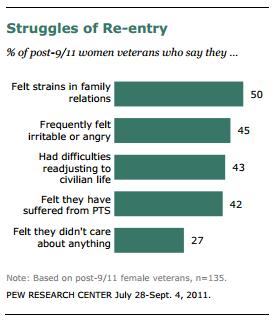
Interestingly, women reported high levels of strain re-entering the civilian population and the majority believe that the wars in Afghanistan and Iraq are not worth fighting:

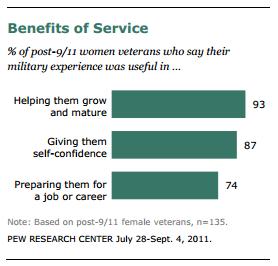
Nevertheless, a large majority felt that entering the military was good for their personal growth and career opportunities:

Lisa Wade, PhD is an Associate Professor at Tulane University. She is the author of American Hookup, a book about college sexual culture; a textbook about gender; and a forthcoming introductory text: Terrible Magnificent Sociology. You can follow her on Twitter and Instagram.
Cross-posted at The Huffington Post.In most densely-packed urban cities, one will be able to observe a disturbing phenomenon: wealthy people marching past the homeless, day in and day out.  Often, the residents of the street and the residents of the apartments recognize each other and even know each other’s routines.  And, yet, familiarity doesn’t breed concern.

Psychologists Lasana Harris and Susan Fiske were able to detect a neurological process behind the ability to get used to seeing others suffer. Using functional MRIs, they exposed individuals to images of the homeless.  These images tended to activate parts of the brain associated with disgust.  This, they argue, supports the idea that “extreme out-groups may be perceived as less than human…”  It is easy to overlook the suffering of the homeless, then, because we dehumanize them.

In an effort to disrupt this cognitive process, documentary film maker Goro Toshima has released a new film, Broken Doors.  The 36-minute documentary follows a young homeless couple in Los Angeles, Starr and Rico.  Not only does it put faces and names to an otherwise reviled and ignored population, the documentary shows viewers just how difficult it can be to survive on the streets and to get off.

Lisa Wade, PhD is an Associate Professor at Tulane University. She is the author of American Hookup, a book about college sexual culture; a textbook about gender; and a forthcoming introductory text: Terrible Magnificent Sociology. You can follow her on Twitter and Instagram.

Over the past couple of years, the U.S. appears to have finally reached a tipping point regarding attitudes toward same-sex marriage. In polls from a variety of organizations over the last two years, more people supported same-sex marriage than opposed it, and in some polls an outright majority expressed support for marriage equality.

Data from the Pew Research Center poll provide more evidence for this fairly rapid shift in public attitudes:

However, those attitudes vary widely by region. Looking more closely at the Pew data, we see that support is highest in New England, where over 60% of those surveyed in 2012 favored making same-sex marriages legal, but most regions of the U.S. now show more support than opposition. In fact, only in the South Atlantic and South Central states did more respondents oppose marriage equality than support it. The South Central region was least supportive, with 56% of respondents opposing same-sex marriage:

Support for same-sex marriage has grown in ever region over the past 10 years. A decade ago, supporting same-sex marriage was clearly a minority opinion across the U.S.:


As the Pew Center post points out, it’s not that attitudes in the South aren’t changing, but they’re only now approaching where the rest of the country was on the issue a decade ago.

Gwen Sharp is an associate professor of sociology at Nevada State College. You can follow her on Twitter at @gwensharpnv.

Over at The Global Sociology Blog, SocProf put up some interesting visuals about social mobility, the likelihood that you have a significantly different economic status than your father.  Social mobility is important because it measures the degree to which a society has a caste system (in which you are restricted to the class you are born into, by whatever means) or one that gives people equal opportunities to ascend or descend the class hierarchy according to their hard work and talent.

Compared to similar countries, the U.S. has low social mobility (though most Americans think the opposite), along with Italy, the U.K., Chile, and Slovenia .  Scandinavian countries, Canada, and Australia have the most (see SocProf’s data here).

SocProf, however, asked a question I’ve never seen asked before: does this mobility differ by gender?  It does.  She found that daughters are more upwardly mobile than sons.

This first graph shows the percent of sons, born to a low-earning father, who will end up the top 40% of earners (orange) or the bottom 40% (blue).  Social mobility in the U.S. is lowest among the countries featured; almost 70% of American sons of low-earners stay in the bottom 40%.

The second graph is the same data for daughters.  Mobility for daughters is higher in all countries, but it is especially so in the U.S.  While 70% of sons stay in the bottom 40%, we can say the same for less than half of daughters.

Reflecting on the fact that the difference between daughters and sons was higher in the U.S. than in the comparison countries, SocProf suggests that “[g]reater mobility seems to go together with greater gender equality” in mobility.

See also this interactive graph mapping social mobility where you can see how you compare to the rest of the U.S.

Lisa Wade, PhD is an Associate Professor at Tulane University. She is the author of American Hookup, a book about college sexual culture; a textbook about gender; and a forthcoming introductory text: Terrible Magnificent Sociology. You can follow her on Twitter and Instagram.