Cross-posted at Reports from the Economic Front.

The media continues to direct our attention to deficits and debt as our main problems.  Yet, it does little to really highlight the causes of these deficits and debts.

The following two figures from the Center on Budget and Policy Priorities help to clarify the causes.  It is important to note that the projections underlying both figures were made before the recent vote making permanent most of the Bush-era tax cuts.

Figure 1 shows the main drivers of our large national deficits: the Bush-era tax cuts, the wars in Iraq and Afghanistan, and our economic crisis and responses to it.  Without those drivers our national deficits would have remained quite small.

10-10-12bud-f1

Figure 2 shows the main drivers of our national debt. Not surprisingly they are the same as the drivers of our deficits.

10-10-12bud-f2

Significantly, the same political leaders that scream the loudest about our deficits and debt have little to say about stopping the wars or reducing military spending and are the most adamant about maintaining the Bush-era tax cuts.  That is because, at root, their interest is in reducing spending on non-security programs rather than reducing the deficit or debt.

Some of these leaders argue that the tax cuts will help correct our economic problems and thereby help reduce the deficit and debt.  However, multiple studies have shown that tax cuts are among the least effective ways to stimulate employment and growth.  In contrast, the most effective are sustained and targeted government efforts to refashion economic activity by spending on green conversion, infrastructure, health care, education and the like.

While Republicans and Democrats debate the extent to which taxes should be raised, both sides appear to agree on the need to rein in federal government spending in order to achieve deficit reduction.  In fact, federal government spending has been declining both absolutely and, as the following figure from the St. Louis Federal Reserve shows, as a share of GDP.

government-spending-as-a-percent-of-gdp

In reality, our main challenge is not reducing our deficit or debt but rather strengthening our economy, and cutting government spending is not going to help us overcome that challenge.  As Peter Coy, writing in BusinessWeek explains:

It pains deficit hawks to hear this, but ever since the 2008 financial crisis, government red ink has been an elixir for the U.S. economy. After the crisis, households strove to pay down debt and businesses hoarded profits while skimping on investment. If the federal government had tried to run balanced budgets, there would have been an enormous economy wide deficit of demand and the economic slump would have been far worse. In 2009 fiscal policy added about 2.7 percentage points to what the economy’s growth rate would have been, according to calculations by Mark Zandi of Moody’s Analytics. But since then the U.S. has underutilized fiscal policy as a recession-fighting tool. The economic boost dropped to just half a percentage point in 2010. Fiscal policy subtracted from growth in 2011 and 2012 and will do so again in 2013, to the tune of about 1 percentage point, Zandi estimates.

or02_GDPChart_405

If we were serious about tackling our economic problems we would raise tax rates and close tax loopholes on the wealthy and corporations and reduce military spending, and then use a significant portion of the revenue generated to fund a meaningful government stimulus program.  That would be a win-win proposition as far as the economy and budget is concerned.

—————————

Martin Hart-Landsberg is a professor of Economics and Director of the Political Economy Program at Lewis and Clark College.  You can follow him at Reports from the Economic Front.

My brilliant colleague, Adrianne Wadewitz, was featured on Wikipedia last month. In this two-minute video, she talks about how she’s incorporated writing for Wikipedia into her classes and why it’s such a powerful teaching tool.

Lisa Wade, PhD is an Associate Professor at Tulane University. She is the author of American Hookup, a book about college sexual culture; a textbook about gender; and a forthcoming introductory text: Terrible Magnificent Sociology. You can follow her on Twitter and Instagram.

I know, I know. We can expect nothing more from the Daily Mail.  And yet I can’t help but point out this scintillating article on what tennis player Roger Federer wore at the Australian Open.  An article on what a man was wearing, you might ask?  Indeed.  What might prompt such an abnormality?  Well, you see, Federer was wearing just the slightest bit of pink.

This daring choice earned Federer 374 words in the Mail Online and six photographs highlighting his apparently newsworthy fashion choice.

Now this isn’t a big deal, but it is a particularly striking example of the little ways in which rules around gender are enforced.  Federer took a risk by wearing even a little bit of pink; the Daily Mail goes to great lengths to point this out.  He also gets away with it, in the sense that the article doesn’t castigate or attempt to humiliate him for doing so.

Federer, however, is near the top of a hierarchy of men. Research shows that men who otherwise embody high-status characteristics — which includes being light-skinned, ostensibly straight, attractive, athletic, and wealthy — can break gender rules with fewer consequences (see also, the fashion choices of Andre 3000 and Kanye).  A less high-status man might read this article and take note: Federer can get away with this, kinda, but I should steer clear…. and they’re probably right.

Thanks to Todd Schoepflin @CreateSociology for the tip!

Lisa Wade, PhD is an Associate Professor at Tulane University. She is the author of American Hookup, a book about college sexual culture; a textbook about gender; and a forthcoming introductory text: Terrible Magnificent Sociology. You can follow her on Twitter and Instagram.

Cross-posted at Reports from the Economic Front.

Considering the enormous time spent debating tax policy, it is easy to imagine that the U.S. must have one of the high tax rates in the world.  Well, that is not the case.

The Atlantic has a great post which includes Business Insider graphs drawn from a KPMG report on global tax rates.

Here is one of them.  It shows the personal tax rate paid by people making the equivalent of $100,000 a year in 2012.  The U.S. is the 55th ranked country out of 114 in terms of tax rates.

tax rates ranking 100k (1)

The next graph shows the same thing but for those earning the equivalent of $300,000 a year.  The U.S. ranking is similar for this upper income group, 53rd highest out of 114.

tax rates world ranking 300k

 Moreover, as Derek Thompson, the author of the Atlantic post, notes:

But these numbers might understate how low taxes have been in the U.S. Unlike most advanced economies, the U.S. don’t supplement personal income taxes with a national sales tax, or value-added tax (VAT). Consumption taxes accounted for about a fifth of total U.S. revenue in 2008 (mostly at the state and local level) compared to an OECD average of 32 percent. In other words, the U.S. relies uniquely on personal tax rates to raise revenue — and we have relatively low personal tax rates.

Finally, here is a look at the U.S. ranking among OECD countries for taxes as a share of GDP in 2008.

The-Numbers-Jan-2012-International_1

So, given that the U.S. doesn’t seem to be a high-tax rate country, why is tax policy so contentious?  No doubt the answer has a lot to do with who actually pays the taxes and, perhaps even more importantly, what the revenue is used for.

—————————

Martin Hart-Landsberg is a professor of Economics and Director of the Political Economy Program at Lewis and Clark College.  You can follow him at Reports from the Economic Front.

On this day in 1916 the U.S. government passed the 18th amendment prohibiting the “…manufacture, sale, or transportation of intoxicating liquors.”  The rest is history.  But where did all the existing booze go and how did the feds dispose of alcohol confiscated in the years it was illegal?  Retronaut has a series of photos with the answer to this question.  It looks as if liquor fed the fishes and the daisies, marking an unintentionally intoxicating period of American history.

More at Retronaut.

Lisa Wade, PhD is an Associate Professor at Tulane University. She is the author of American Hookup, a book about college sexual culture; a textbook about gender; and a forthcoming introductory text: Terrible Magnificent Sociology. You can follow her on Twitter and Instagram.

Cross-posted at The Huffington Post.

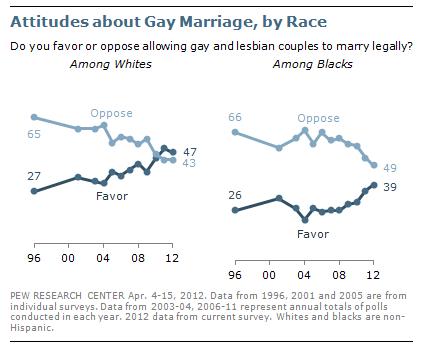
Last month Jet — a magazine marketed to African-American population — featured their first gay male couple in their wedding announcements.  The announcement may be a sign that African-American attitudes towards gay marriage may be turning around.  While the group has typically endorsed gay marriage at lower rates than White Americans, the gap between Blacks and Whites has been narrowing.

The Pew Research Center reports that the percent of Whites opposed to gay marriage dropped from 51% in 2008 to 41% in 2012.  Among Blacks, the percent in opposition dropped from 63% to 49%.  African-Americans and Whites are now separated by eight percentage points instead of twelve.

The data above was collected in April of 2012.  In May, Obama announced that he supported gay marriage.  It remains to be seen whether Obama’s modeling of a pro-gay stance will influence the opinions of the African-American community further.

Lisa Wade, PhD is an Associate Professor at Tulane University. She is the author of American Hookup, a book about college sexual culture; a textbook about gender; and a forthcoming introductory text: Terrible Magnificent Sociology. You can follow her on Twitter and Instagram.

Advanced quantitative analysis often controls for variables that aren’t of central interest. But what does it mean to “control for” a variable?  XKCD offers a fun example.

So, do subscribers to Martha Stewart Living live alongside furries?  Probably not. In any case, these maps don’t offer any evidence in favor of this conclusion.  This is because of a variable that hasn’t been controlled for: population density.

To control for population, one would have to divide the number of subscribers/furries by the total population.  This would give us the percentage of the population that is described by both proclivities, instead of the sheer number of devotees.  Then the maps would actually show variance in the proportion of the population instead of variance in the population itself.

In other words, we would have controlled for population in order to get a closer look at what we’re really interested in: furries, of course.

Lisa Wade, PhD is an Associate Professor at Tulane University. She is the author of American Hookup, a book about college sexual culture; a textbook about gender; and a forthcoming introductory text: Terrible Magnificent Sociology. You can follow her on Twitter and Instagram.

The year during which the U.S. will become a “majority minority” is well discussed.  It looks like it’s going to happen sometime around 2050 or earlier. This statistic, however, elides an interesting subplot: the year various age groups will be majority minority.

Over at The Society Pages Editors’ Desk, sociologist Doug Hartmann offered the following table. It shows that children under the age of 18 will be majority minority 32 years earlier, by 2018.  Young people ages 18-29 will join them by 2027.  By 2035, people aged 35-64 will be majority minority.  People 65 and older are quick to follow.

This data reminds us that demographic change is gradual.  The year 2018 is just five years away.  If young people continue to vote in numbers similar to those in the last two elections, their changing demographics could push forward a change that looks all but inevitable in the long run.

In the meantime, we need to be vigilant about how younger people are portrayed.  Today poverty is racialized so as to demonize social programs designed to help the less fortunate.  Can we imagine a future in which public education and other youth-oriented programming is similarly framed: as white people helping supposedly undeserving people of color?  This is likely something that we should be vigilant against in the coming years.

Lisa Wade, PhD is an Associate Professor at Tulane University. She is the author of American Hookup, a book about college sexual culture; a textbook about gender; and a forthcoming introductory text: Terrible Magnificent Sociology. You can follow her on Twitter and Instagram.