Cross-posted at PolicyMic and Racialicious.

In 1984 the U.S. began its ongoing experiment with private prisons. Between 1990 and 2009, the inmate population of private prisons grew by 1,664%  (source). Today approximately 130,000 people are incarcerated by for-profit companies.  In 2010, annual revenues for two largest companies — Corrections Corporation of America and the GEO Group — were nearly $3 billion.

Companies that house prisoners for profit have a perverse incentive to increase the prison population by passing more laws, policing more heavily, sentencing more harshly, and denying parole.  Likewise, there’s no motivation to rehabilitate prisoners; doing so is expensive, cuts into their profits, and decreases the likelihood that any individual will be back in the prison system.  Accordingly, state prisons are much more likely than private prisons to offer programs that help prisoners: psychological interventions, drug and alcohol counseling, coursework towards high school or college diplomas, job training, etc.

What is good for private prisons, in other words, is what is bad for individuals, their families, their communities, and our country.

This is a deeply unethical system and new research shows that, in addition to being disproportionately incarcerated, racial minorities and immigrants are disproportionately housed in private prisons.  Looking at three states with some of the largest prison populations — California, Texas, and Arizona — graduate student Christopher Petrella reports that racial minorities are over-represented in private prisons by an additional 12%; his colleague, Josh Begley, put together this infographic:

This means that, insofar as U.S. state governments are making an effort to rehabilitate the prison population, those efforts are disproportionately aimed at white inmates.  Petrella argues that this translates into a public disinvestment in the lives of minorities and their communities.

Lisa Wade, PhD is an Associate Professor at Tulane University. She is the author of American Hookup, a book about college sexual culture; a textbook about gender; and a forthcoming introductory text: Terrible Magnificent Sociology. You can follow her on Twitter and Instagram.

Cross-posted at Cyborgology.

Humans produce waste. A lot of waste—much of which comes from our very bodies. Indeed, the average American produces 7 pounds of organic waste per day, largely made up of feces and urine. Cities have to somehow manage this waste, manage these now expelled parts of human bodies, manage that which we produce, drop, leave, and conscientiously ignore. Such management is typically engaged by an underclass of workers, the sanitation department, waste management employees, septic cleaners. When all goes well, waste remains invisible. Unsmelled. Unseen. Silently moved through underground systems and channeled out in ambiguous ways. This is a process to which most producers of bodily waste remain blissfully ignorant.

Sometimes, however, this waste management becomes a problem, and when it does, our expelled and forgotten matter spills back up into human view, reconnecting humans with the ways in which their own bodies must be managed through external structures; reminding humans of the dirty reality of organic embodiment. Such is the case in the New York City sewer system. High water levels, coupled with high waste levels, can lead to sewer overflows, flushing raw human waste into the city’s waterways — including the East River and the Hudson. Nothing reminds humans of their own embodiment like literal consumption of expelled matter. Nothing reconnects humans to an otherwise hidden process than their own shit floating down the river.

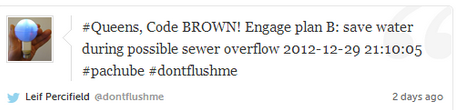
A recent solution to this problem of waste re-emergence comes from an unlikely place: social media. Leif Percifield recently introduced a social media tool called DontFlushMe, which allows New Yorkers to keep track of water levels and make waste management decisions accordingly — that is, decisions about whether or not to flush. The system works through sensors within the sewers, which notify users of high water levels via text message, Twitter, a call-in number, or by a website. When water levels get too high, users will ostensibly “let it mellow,” reducing the influx of waste into the sewer systems, and preserving the waterways.

The role of social media here is particularly interesting. Here we have a social tool, a communication medium necessarily removed from the body and physicality, working to reconnect the user to hir body, and reconnect the body to the architectures and structures in which it dwells. This form of mediated communication thins the mediating line between personal actions and public good, between expelling and consuming, between individuals and infrastructures. This tool makes invisible processes visible, and turns everyone into stewards of the shared land.

Such reconnection — between humans and their bodies; between individuals and infrastructures — is facilitated by a tool so often accused of causing disembodiment and disconnection. Social media republicizes and disseminates responsibility for that which was previously relegated out of sight, smell, and mind. This “new” technology, ironically, brings us back to an earlier time of chamber pots and smelly streets, in which bodily awareness was a communal necessity.

*Special thanks to James Chouinard for bringing this social media tool to my attention, and for sharing his vast knowledge on the Sociology of Dirt.

 ————————-

Jenny Davis is a postdoctoral researcher in the social psychology lab at Texas A&M University. Follow Jenny on twitter @Jup83.

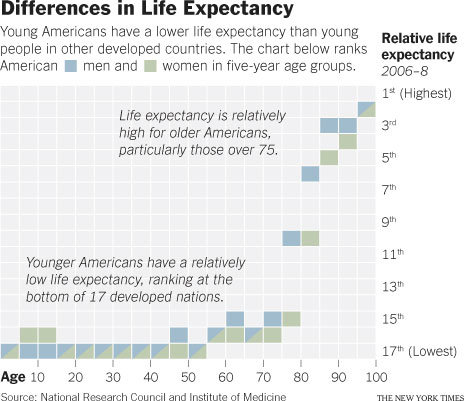
The Institute of Medicine and the National Research Council released some damaging numbers this month: Americans ranks startlingly low in life expectancy, compared to 16 other similarly developed countries.  This is especially true for younger Americans. Indeed, among people 55 and under, we rank dead last.  Among those 50-80 years old, our life expectancy is 3rd or 2nd to last.

Sabrina Tavernise at the New York Times reports that the “major contributors” to low life expectancy among younger Americans are high rates of death from guns, car accidents, and drug overdoses.  We also have the highest rate of diabetes and the second-highest death rate from lung and heart disease.

Americans had “the lowest probability over all of surviving to the age of 50.”  The numbers for American men were slightly worse than those for women. Overall, life expectancy for men was 17 out of 17; women came in 16th.  Education and poverty made a difference too, as did the more generous social services provided by the other countries in the study.

What isn’t making a difference?  Apparently our incredible rate of health care spending.

Via Citings and Sightings.

Lisa Wade, PhD is an Associate Professor at Tulane University. She is the author of American Hookup, a book about college sexual culture; a textbook about gender; and a forthcoming introductory text: Terrible Magnificent Sociology. You can follow her on Twitter and Instagram.

Cross-posted at Family Inequality.

It’s not that “working families” don’t exist, it’s just the way most people use this term it doesn’t mean anything.  Search Google images for “working families,” and you’ll find images like this:

And that’s pretty much the way the term is used: every family is a working family.

To hear the White House talk, you have to wonder whether there are people who aren’t in families. I’ve complained about this before, Obama’s tendency to say things like, “This reform is good for families; it’s good for businesses; it’s good for the entire economy.” As if “families” covers all people.

Specifically, if you Google search the White House website’s press office directory, which is where the speeches live, like this, you get 457 results, such as this transcript of remarks by Michelle Obama at a “Corporate Voices for Working Families” event. The equivalent search for “working people” yields a paltry 108 hits (many of them Obama speeches at campaign events, which include false-positives, like him making the ridiculous claim that Americans are the “hardest working people on Earth.”) If you search the entire Googleverse for “working families” you get about 318 million hits, versus just just 7 million for “working people” (less than the 10 million that turns up for “Kardashians,” whatever that means.)

You would never know that 33 million Americans live alone — comprising 27% of all households. And 50 million people, or one out of every 6 people, lives in what the Census Bureau defines as a “non-family household,” or a household in which the householder has no relatives (some of those people may be cohabitors, however). The rise of this phenomenon was ably described by Eric Klinenberg in Going Solo: The Extraordinary Rise and Surprising Appeal of Living Alone.

This is partly a complaint about cheap rhetoric, but it’s also about the assumption that families are primary social units when it comes to things like policy and economics, and about the false universality of “middle class” (which is made up of “working families”) in reference to anyone (in a family with anyone) with a job.

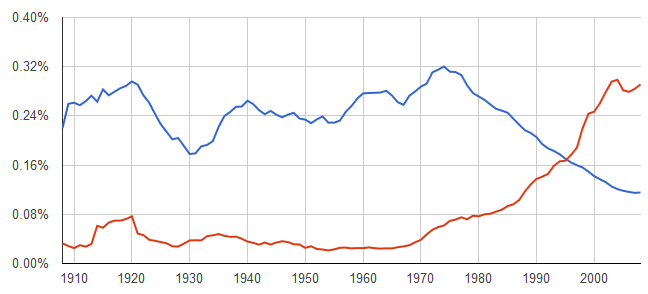
Here’s one visualization, from a Google ngrams search of millions of books. The blue line is use of the phrase “working people” as a fraction of references to “people,” while the red line is use of the phrase “working families” as a fraction of references to “families.” It shows, I think, that “working” is coming to define families, not people.

This isn’t all bad. Families matter, and part of the attention to “working families” (or Families That Work) is driven by important problems of work-family conflict, unequal care work burdens, and so on. But ultimately these are problems because they affect people (some of whom are in families). When we treat families as the primary unit of analysis, we mask the divisions within families — the conflicts of interest and exploitation, the violence and abuse, and the ephemeral nature of many family relationships and commitments — and we contribute to the marginalization of people who aren’t in, or don’t have, families.  And those members of the No Family community need our attention, too.

Philip N. Cohen is a professor of sociology at the University of Maryland, College Park, and writes the blog Family Inequality. You can follow him on Twitter or Facebook.

Yesterday was the anniversary of the landmark Roe v. Wade decision. On January 22, 1973, the U.S. Supreme Court handed down the landmark case establishing women’s right to an abortion (though not an unrestricted right).

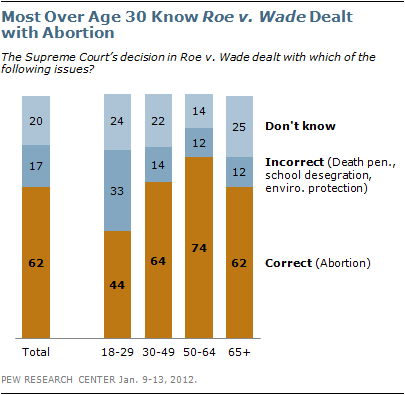
The Pew Research Center released some data on current public knowledge and opinion about abortion in the U.S. They found that well under half (44%) of younger people — those under 30 — knew what Roe v. Wade was about. A quarter said they didn’t know, and a third thought it was about another issue. This was a much lower level of familiarity than older age groups:

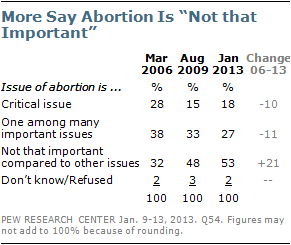
Abortion is still certainly a contentious issue, but it may not be quite the galvanizing cultural flashpoint it once was. Indeed, fewer people seem to see it as a critical issue. A growing percent of respondents say that abortion isn’t all that important — now over half say so:

That seems to indicate a lessening of the intensity of the culture war surrounding abortion. That could mean less intensity in opposition to abortion (most respondents thought it should be legal, though many personally thought it was morally wrong), but it may also lead to less resistance to the types of restrictions on clinics that leave abortion technically legal, but so difficult to access that it’s a hollow legality.

Gwen Sharp is an associate professor of sociology at Nevada State College. You can follow her on Twitter at @gwensharpnv.

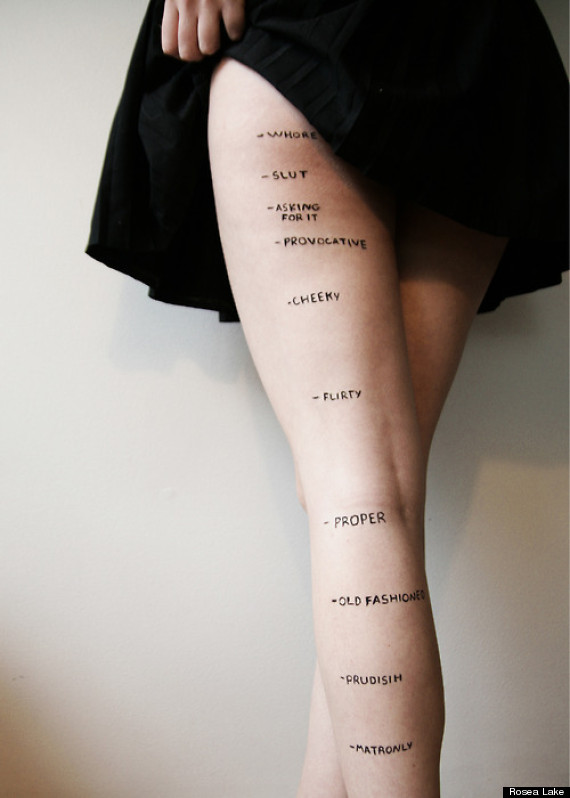
@bfwriter tweeted us a link to a college design student’s photograph that has gone viral.  Rosea Lake posted the image to her tumblr and it struck a chord.

What I like about the image is the way it very clearly illustrates two things.  First, it reveals that doing femininity doesn’t mean obeying a single, simple rule. Instead, it’s about occupying and traveling within a certain space.  In this case, usually between “proper” and “flirty.”  Women have to constantly figure out where in that space they’re supposed to be.  Too flirty at work mean’s you won’t be taken seriously; too proper at the bar and you’re invisible.  Under the right circumstances (e.g., Halloween, a funeral), you can do “cheeky” or “old fashioned.”

The second thing I like about this image is the way it shows that there is a significant price to pay for getting it wrong.  It’s not just a faux pas.  Once you’re “‘asking for it,” you could be a target. And, once you’re reached “prudish,” you’ve become socially irrelevant.  Both violence and social marginalization are serious consequences.

And, of course, all women are going to get it wrong sometimes because the boundaries are moving targets and in the eye of the beholder. What’s cheeky in one setting or to one person is flirty in or to another.  So women constantly risk getting it wrong, or getting it wrong to someone.  So the consequences are always floating out there, worrying us, and sending us to the mall.

Indeed, this is why women have so many clothes!  We need an all-purpose black skirt that does old fashioned, another one to do proper, and a third to do flirty… at the very least… and all in casual, business, and formal.   And we need heels to go with each (stilettos = provocative, high heels = flirty, low heels  = proper, etc, plus we need flats for the picnics and beach weddings etc).  And we need pants that are hemmed to the right length for each of these pairs of shoes.  You can’t wear black shoes with navy pants, so you’ll need to double up on all these things if you want any variety in your wardrobe. I could go on, but you get the picture.

Women’s closets are often mocked as a form of self-indulgence, shop-a-holicism, or narcissism.  But this isn’t fair.  Instead, if a woman is class-privileged enough, they reflect an (often unarticulated) understanding of just how complicated the rules are.  If they’re not class-privileged enough, they can’t follow the rules and are punished for being, for example, “trashy” or “unprofessional.”  It’s a difficult job that we impose on women and we’re all too often damned-if-we-do and damned-if-we-don’t.

Cross-posted at Business Insider and The Huffington Post.

Lisa Wade, PhD is an Associate Professor at Tulane University. She is the author of American Hookup, a book about college sexual culture; a textbook about gender; and a forthcoming introductory text: Terrible Magnificent Sociology. You can follow her on Twitter and Instagram.

As a sociologist who happens to DJ — or is that the other way around? — I’m always curious to see how DJing is depicted in popular culture and advertising. Ever since the 1970s, when the disco craze helped push the prominence of DJs into the public realm, disc jockeys have become iconic symbols of nightlife culture. Within the milieu of the dance floor, DJs serve as what Sarah Thornton once described as “orchestrators of a ‘living’ communal experience.”

As such, the image of the DJ standing behind a pair of turntables has become ripe for appropriation by liquor and cigarette companies in particular. For them, especially in print ads, the DJ serves as a visual shorthand for any number of values they want their product associated with: culturally hip/cool, entertainment/musical mavens, the source of good times, etc. However, when it comes to that shorthand, this Smirnoff ad from last summer may have come up just a little too short.

At first glance, this image of a DJ working the turntables, with a cleavage-baring admirer looking on, seems uncomplicated: Smirnoff promises a fun, sexy time. However, a closer examination of the mise en scéne yields some instant problems.

  • There are no records on the turntables.
  • There’s not a mat on the turntables. Especially in a nightclub setting, DJs always use felt mats that sit between the platter and record. This not only protects the vinyl surface from the platter but by reducing friction between the record and platter, the DJ can “slip” a record into play at just the right moment. Hence, felt mats are called “slip mats.” In short, it’s very strange to see a turntable without a slip mat.
  • There’s no needle on the turntable arm. Therefore, even if they had bothered to put records on the turntables, Mr. Hip DJ wouldn’t have been able to actually play them.
  • There’s no visible DJ mixer. The mixer is absolutely crucial, allowing the DJ to switch between two audio sources, i.e. what makes “disc jockeying” possible to begin with. Normally, the mixer would sit between the two turntables so its absence in the image is conspicuous.
  • The gesture — hands posed over both turntables — doesn’t make sense; it’s not a pose that any DJ would ever employ. Normally, you would have one hand on a turntable, the other hand working the mixer but no nightclub DJ would  be manipulating both turntables, simultaneously. He looks like he’s trying to play bongos. (A scratch DJ, aka turntablist, may work both turntables for certain techniques but scratch DJs aren’t typically nightclub DJs – hard to dance to someone scratching).

When this ad made its rounds on social media, theories were bandied about to explain just what went wrong in this ad. The most plausible explanation is that the Smirnoff campaign selected a stock image hastily but that still opens up the question of how no one, from the original photographer, to the people in the image, to the people working on the Smirnoff ad itself, seemed to realize just how ridiculous this image was. It’d be akin to a car ad where someone is pretending to drive a car… from the backseat. With the wheels missing. And facing the wrong direction.

Of course, the vast majority of people know what driving a car is supposed to look like. One conclusion one might draw from the Smirnoff ad is that while the basic image of a DJ has some resonance in the public imagination, as a practice/craft, DJing isn’t actually well-understood at all.

————————

Dr. Oliver Wang is an associate professor of sociology at Cal State Long Beach. He contributes regularly on music and culture for NPR’s All Things Considered, KPCC’s Take Two, the LA Times, and KCET’s ArtBound. He also writes the audioblog Soul-Sides.com.

Emily B. sent along this notice for a UC Davis cafeteria Martin Luther King day menu:

On the one hand, the cafeteria is making an effort to mark MLK day and, to be fair, the food choices are traditional “soul food” familiar to (especially Southern) Black populations and the South more generally.  On the other hand, preparing foods associated with Black people is about the shallowest possible way to celebrate such an important man.

The conundrum — do we or don’t we, as a cafeteria, acknowledge Martin Luther King day and, if so how? — is a familiar one.  Can one do so without reproducing stereotypes and appearing on blogs like these?  Or should we just pretend the day doesn’t exist?

The truth is, in a context of ongoing racial inequality in which stereotypes continue to harm, organizations such as these are stuck between a rock and a hard place.  That’s how racism has such staying power: it makes it such that all choices resonate with its ugliness.

See also: wrong ways to celebrate Black History Month and how not to include racial  history in school curricula.

Lisa Wade, PhD is an Associate Professor at Tulane University. She is the author of American Hookup, a book about college sexual culture; a textbook about gender; and a forthcoming introductory text: Terrible Magnificent Sociology. You can follow her on Twitter and Instagram.