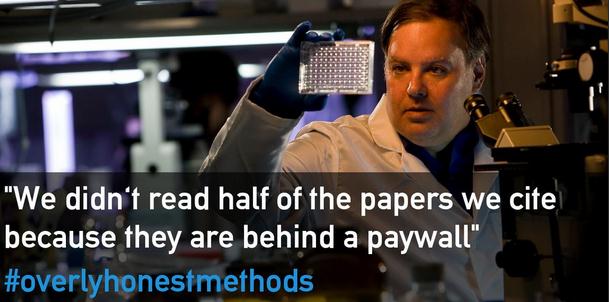
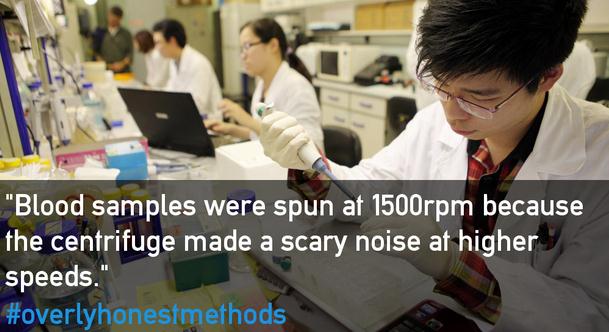
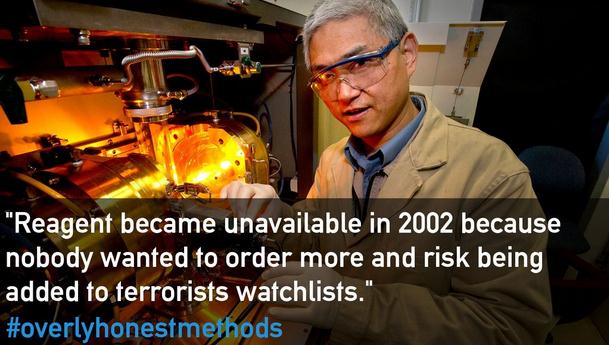
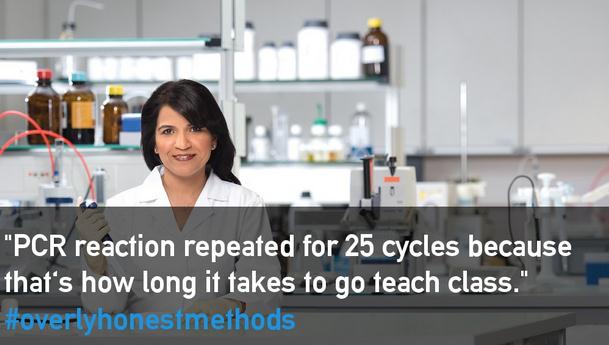
“We don’t know how the results were obtained. The post-doc who did all the work has since left to start a bakery” reads a tweet with the #overlyhonestmethods hashtag. The hashtag is being used for scientists to discuss the elements of their methodology that do not get discussed in “proper” scientific papers.
5

In response to this series of tweets, others have been reassuring readers that #overlyhonestmethods is a “‘joke” hashtag, and should not be construed to reflect the actual state of scientific work. Why? What’s the big deal?

Part of it is about the ways in which we like to consider science. The societal discourse is that science (particularly lab science) represents a “pure” form of knowledge, unbiased by human perceptions, relationships, and pragmatism.

In some ways, that may be true (if I mix Flourine and Francium, for example, the result is likely to be explosive whether I believe it to be or not), but that does not mean science isn’t shaped by social, cultural, and institutional forces.
2 31

For example, the choice of what to research is highly political. During wartime, scientific research is devoted to things that may aid the war effort, from weaponry, to vehicles, to food preservation. Political priorities in certain regions, likewise, direct research dollars into forestry management instead of ecological preservation. The scientists who do this research direct their efforts in this way because that is the research they can get funded.

#Overlyhonestmethods is, among other things, exposing the very real social nature of scientific research, pointing out that scientists may time their experiments so as to avoid being the lab on evenings and weekends. Or that it is sometimes difficult to know how certain results were obtained because people leave the profession and can’t tell you.

These concerns — about recording knowledge, and people’s quality of life at work — exist in every other profession, but in most cases we don’t need to discuss those statements as a “joke.” This is because most other professions do not make the claim of presenting absolute truth. In telling the “unpublished” stories of scientific research, #overlyhonestmethods makes it obvious that scientists are people who face constraints — personal, relational, practical, and institutional — potentially shaking the trust people put in science to offer “the” Truth.

Anastasia Kulpa teaches Sociology at Grant MacEwan University in Edmonton, Alberta, Canada. Her research interests include the sociology of post-secondary classrooms and cultural vehicles for transmitting ideology (class, music, television, etc).


Inequality by (Interior) Design, a blog by sociologist Tristan Bridges, turned one-year-old last month and it is quickly becoming one of my favorites.  In a recent post, Bridges featured a product that reminds us all why history is awesome: the “portable baby cage”:

1 2

As I discussed in a previous post, with industrialization came cities and with cities came crowded, cramped living quarters.  The baby cage kept infants out of harm’s way and gave the family a bit more space.  As Bridges discusses, it also coincided with the idea that babies needed a lot of fresh air to be healthy.  The baby cage seemed like the perfect solution.

Lisa Wade, PhD is an Associate Professor at Tulane University. She is the author of American Hookup, a book about college sexual culture; a textbook about gender; and a forthcoming introductory text: Terrible Magnificent Sociology. You can follow her on Twitter and Instagram.

1In the two-minute animation below, sociologist Dalton Conley describes how inequality between families can create inequality within families. My favorite of his examples: if a family doesn’t have a lot of resources, it will often pour more of them into the most promising child instead of spreading the goods around equally to everyone.

For more, watch:

More at Norton Sociology’s YouTube page.

Lisa Wade, PhD is an Associate Professor at Tulane University. She is the author of American Hookup, a book about college sexual culture; a textbook about gender; and a forthcoming introductory text: Terrible Magnificent Sociology. You can follow her on Twitter and Instagram.

Following up on our recent posts on representations of “person”, I discovered a set of stick figures from around the world, collected by Steve Portigal.  He has some observations on variations.  From a gender perspective, however, they all look more or less like this one from Bali, Indonesia:

bali

What is interesting for our purposes, though, is this Chinese language example from Bangkok, Thailand:

bangkok

Do you see it?  In case you doubted it, the fact that the fourth panel includes a stick figure in a skirt (1) proves that the non-skirted stick figures are implicitly men and, on an entirely different note, (2) reminds us that men do not take care of children.

Similarly, these two pictures of warning signs for moving sidewalks (snapped in the Dublin airport) feature “neutral” stick figures, unless a child is involved:

Picture2

Picture1

We see the same phenomenon in commercial airplanes, where “flight attendants” still tend to be pictured in skirts.

Prof. Shaun Huston sent in these photos from United Airlines. Everyone’s in pants… except the person changing a diaper:

IMG_1671 IMG_1672IMG_1673

Amanda C. sent in another example from a hotel in Sydney. When the stick figures are housekeepers, suddenly they sprout skirts!

Screenshot_16

Sophie pointed out that in Holland, bike traffic lights only include images of what most people would recognize as a “men’s” bike, with the bar across the top, thereby managing to gender the traffic signals without including any figures of people at all (images found here and here):

For what it’s worth, here’s a counter-example from Malmö, Sweden:

-1

Emanuelle, who took the photo and submitted it, says it’s the only time she can remember that she’s seen a silhouette figure like this with a kid where the figure isn’t clearly marked as female.  We’ve a fun collection of traffic lights featuring female stick figures.

We’d love to collect more examples!

Lisa Wade, PhD is an Associate Professor at Tulane University. She is the author of American Hookup, a book about college sexual culture; a textbook about gender; and a forthcoming introductory text: Terrible Magnificent Sociology. You can follow her on Twitter and Instagram.

2I absolutely love this six-minute video by Karen B.K. Chan, tweeted to us by Alex Darasang.  A professional sex educator, she tries to re-frame how we think about sex, and sexual consent, by offering a different metaphor.  While we use metaphors to talk about sex all the time — weirdly, often related to carpentry: bang, nail, screw, etc. — she wants us to introduce an alternative metaphor: jam.

Jamming — shared musical improv — asks us to work together with others to spontaneously create a piece of art that has never quite existed before.  It’s a lovely way to think about what sex should and could be.  And, importantly, it utterly changes what consent looks like and its role in sexual pleasure.

Lisa Wade, PhD is an Associate Professor at Tulane University. She is the author of American Hookup, a book about college sexual culture; a textbook about gender; and a forthcoming introductory text: Terrible Magnificent Sociology. You can follow her on Twitter and Instagram.

I just got home from a great visit to Ontario.  A huge “thank you” to the Health, Counseling, and Disability Services folks at Queen’s University. I had such fun sharing my research and learned a lot!

More Talks!

I’m looking forward to going back to Harvard in a couple weeks to give a lecture that’s close to my heart, “A Feminist Defense of Friendship.” It’s got a wonderful message and, equally importantly, it’s the cutest talk I have!  Really!

Then it’s Pomona College on March 27th, the Western Political Science Association the next two days, and the University of Akron for a special Sociology Department Keynote and Commencement Address.  What an honor!  I get to talk about my research on American discourses about “female genital mutilation” and what it can teach us about the future of progressive, multicultural democracies.

Next Year?

This month I got word that I will be on sabbatical next year and I would love to do lots of traveling, so please feel free to consider bringing me out for a visit!  Among the others, I have a new talk I’m dying to work up titled “Hook Up Culture: A History.”  It’s a wild ride through some crazy and surprising American history and explains everything.

New Pinterest Page:

I was inspired by the response to our post on the male neutral — i.e., men and people and women are women (2,000 likes!) — to make it a Pinterest page.  Check out the 48 pins at our Women vs. People board.

In the News:

Speaking of…

On the heels of publishing our post calling out the sexualized insult — e.g., “you suck” — Bess S. sent us the following screenshot.  “Note the headline up top,” she wrote.

Screen Shot 2013-02-09 at 11.44.26 AM

Social Media ‘n’ Stuff:

Finally, this is your monthly reminder that SocImages is on Twitter, Facebook, Google+, and Pinterest.  Lisa is on Facebook and most of the team is on Twitter: @lisawade, @gwensharpnv, @familyunequal, @carolineheldman, and @jaylivingston.

Tweet of the Month:

2

Lisa Wade, PhD is an Associate Professor at Tulane University. She is the author of American Hookup, a book about college sexual culture; a textbook about gender; and a forthcoming introductory text: Terrible Magnificent Sociology. You can follow her on Twitter and Instagram.

On this last day of Black History Month, let us return to posts past.

We have been urged to celebrate Black History Month…

<sarcasm> Good times. </sarcasm>

A reader named Caroline sent in a really nice email.  “I just wanted to tell you – again,” she wrote, “how much of an impression you’ve made on my 17yo daughter Eliza.”  She explains that they’d been reading SocImages together for “years (yes, years!).”  We can’t express how much that means to us!

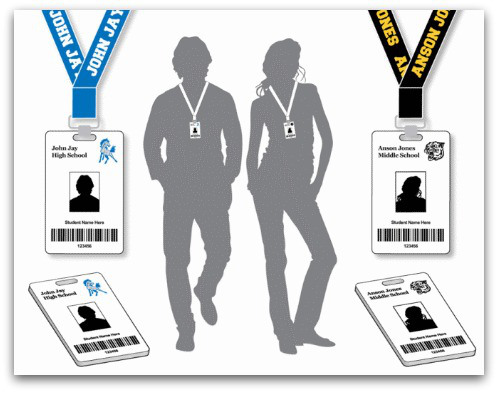
Caroline was inspired to write because Eliza had brought to her attention this image accompanying a story about a high school’s trackable ID badges:

1

Eliza had noted that, while the male figure was walking more-or-less directly towards the viewer, the female figure was standing with her torso contorted and her hip cocked.

Likewise, @low_hana sent us this screenshot of DC Comics Underoos available for sale. Men are posed like, well, superheroes, but the women twist, fiddle, and turn their backs:

1 (3)

Now, this might seem like a small thing, and unimpressive in the singular.  But, in fact, we see this kind of thing all the time, even in ostensibly objective medical textbooks and anatomy illustrations.  We even see it when only faces are involved, as in this series of movie posters featuring men looking straight at the camera and women looking askance.  Here’s one example:

2

As these types of images add up in our subconscious, they tell us a story about masculinity and femininity.  It’s a complicated one, but might include lessons like this: men face things head on, while women are uncertain; women pose and men take action;  men are straightforward, women sly.

Thanks Caroline, for sending in another example of such an insidious and largely invisible cultural pattern.  And great job, Eliza, for spotting it!

Lisa Wade, PhD is an Associate Professor at Tulane University. She is the author of American Hookup, a book about college sexual culture; a textbook about gender; and a forthcoming introductory text: Terrible Magnificent Sociology. You can follow her on Twitter and Instagram.