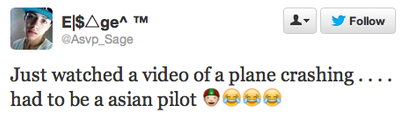
In case you were wondering if the racist “Asians can’t drive” stereotype was alive and well, here are some select tweets from the collection at Public Shaming (h/t to @Kevin_Stainback):

Screenshot_1 Screenshot_2 Screenshot_3Screenshot_5

And some couldn’t stop themselves from making fun of how some Asian people look:

Screenshot_1 Screenshot_2More, including accusations of North Korean terrorism, at Public Shaming, one of the most deeply disappointing sites on the web.

Lisa Wade, PhD is an Associate Professor at Tulane University. She is the author of American Hookup, a book about college sexual culture; a textbook about gender; and a forthcoming introductory text: Terrible Magnificent Sociology. You can follow her on Twitter and Instagram.

In academia, it’s fairly common to hear people bemoan students’ writing skills and the supposed effect that tweeting, texting, and other new communication technologies are having on our use of the written language. I’ve been known to do it myself after receiving an email in text-speak. Generally, humans have a tendency to think that the changes in their own time are unprecedented.

This xkcd comic presents quotes from various sources concerned about the impacts of technology, particularly the dying art of communication. It’s a nice reminder that bemoaning the effect of new technologies is nothing new, nor is the tendency to romanticize some period in the vague past as the “good old days” when things were better.

Gwen Sharp is an associate professor of sociology at Nevada State College. You can follow her on Twitter at @gwensharpnv.

1Excellent Occidental College student Ryan Metzler made a great 7 minute documentary about the decline of heteronormativity. Interviewing me and several other scholars and activists about the history of marriage and the changing definition of family, he offers a quick and optimistic analysis of what it means for this country to be changing.

Lisa Wade, PhD is an Associate Professor at Tulane University. She is the author of American Hookup, a book about college sexual culture; a textbook about gender; and a forthcoming introductory text: Terrible Magnificent Sociology. You can follow her on Twitter and Instagram.

Cross-posted at Reports from the Economic Front.

Media and policy-makers seem anxious to convince us that the economy is in strong recovery mode, therefore, no further significant policy interventions are needed.

Their optimism appears to rest heavily on the recent acceleration in consumer spending.  After all, there are strong reasons for concern with the other major sources of growth:  government spending on all levels is being cut, exports face a weakening world economy, and business investment remains largely stagnate.

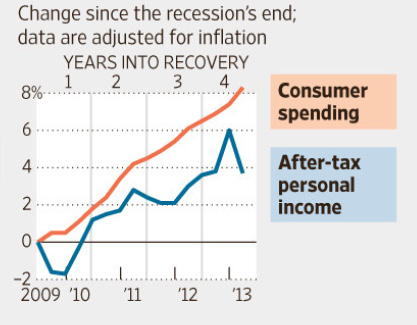
But there are also strong reasons to challenge this optimistic view of consumer spending as a growth engine.  The charts below, from a Wall Street Journal article, highlight some of the most important.

As we see below, while consumption spending is indeed accelerating, after tax personal income is falling.  In other words, there appears little reason to believe that there is a solid foundation for sustaining this trend.

1

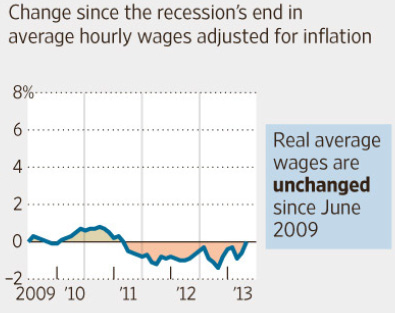
Additionally, after four years of recovery we still have 2.4 million fewer jobs than we had at the start of the recession.  Moreover, as we see below, there has been no real wage growth.  In fact, real average wages have fallen for most of the so-called expansionary period.

2

Yes, housing values are finally starting to rise and household debt payments as a share of after-tax income are declining.  But to a large extent the new burst in consumption spending has more to do with renewed borrowing than solid gains in job creation and income.

Unfortunately, there is little reason for us to have confidence that the economy is gathering strength in ways that will be sustainable or benefit the great majority of working people.

Martin Hart-Landsberg is a professor of economics at Lewis and Clark College. You can follow him at Reports from the Economic Front.

Cross-posted at Family Inequality.

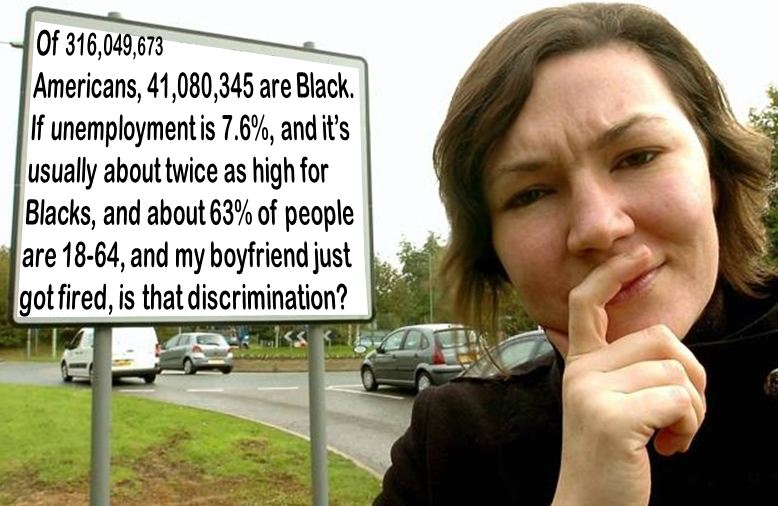
The other day I was surprised that a group of reporters failed to call out what seemed to be an obvious exaggeration by Republican Congresspeople in a press conference. Did the reporters not realize that a 25% unemployment rate among college graduates in 2013 is implausible, were they not paying attention, or do they just assume they’re being fed lies all the time so they don’t bother?

Last semester I launched an aggressive campaign to teach the undergraduate students in my class the size of the US population. If you don’t know that – and some large portion of them didn’t – how can you interpret statements such as, “On average, 24 people per minute are victims of rape, physical violence, or stalking by an intimate partner in the United States.” In this case the source followed up with, “Over the course of a year, that equals more than 12 million women and men.” But, is that a lot? It’s a lot more in the United States than it would be in China. (Unless you go with, “any rape is too many,” in which case why use a number at all?)

1

Anyway, just the US population isn’t enough. I decided to start a list of current demographic facts you need to know just to get through the day without being grossly misled or misinformed – or, in the case of journalists or teachers or social scientists, not to allow your audience to be grossly misled or misinformed. Not trivia that makes a point or statistics that are shocking, but the non-sensational information you need to know to make sense of those things when other people use them. And it’s really a ballpark requirement; when I tested the undergraduates, I gave them credit if they were within 20% of the US population – that’s anywhere between 250 million and 380 million!

I only got as far as 22 facts, but they should probably be somewhere in any top-100. And the silent reporters the other day made me realize I can’t let the perfect be the enemy of the good here. I’m open to suggestions for others (or other lists if they’re out there).

They refer to the US unless otherwise noted:

Description Number Source
World Population 7 billion 1
US Population 316 million 1
Children under 18 as share of pop. 24% 2
Adults 65+ as share of pop. 13% 2
Unemployment rate 7.6% 3
Unemployment rate range, 1970-2013 4% – 11% 4
Non-Hispanic Whites as share of pop. 63% 2
Blacks as share of pop. 13% 2
Hispanics as share of pop. 17% 2
Asians as share of pop. 5% 2
American Indians as share of pop. 1% 2
Immigrants as share of pop 13% 2
Adults with BA or higher 28% 2
Median household income $53,000 2
Most populous country, China 1.3 billion 5
2nd most populous country, India 1.2 billion 5
3rd most populous country, USA 315 million 5
4th most populous country, Indonesia 250 million 5
5th most populous country, Brazil 200 million 5
Male life expectancy at birth 76 6
Female life expectancy at birth 81 6
National life expectancy range 49 – 84 7

Sources:
1. http://www.census.gov/main/www/popclock.html
2. http://quickfacts.census.gov/qfd/states/00000.html
3. http://www.bls.gov/
4. Google public data: http://bit.ly/UVmeS3
5. https://www.cia.gov/library/publications/the-world-factbook/rankorder/2119rank.html
6. http://www.cdc.gov/nchs/hus/contents2011.htm#021
7. https://www.cia.gov/library/publications/the-world-factbook/rankorder/2102rank.html

Philip N. Cohen is a professor of sociology at the University of Maryland, College Park, and writes the blog Family Inequality. You can follow him on Twitter or Facebook.

In May we featured a block of cheese that inspired quite the response.  Riffing off the name “Monterey Jack,” a company was selling “Monterey Jill”: the same old cheese, but reduced fat.  It was an excellent example of the way dieting is feminized.

People — myself included — were pretty stunned to see gendered cheese; who knew this was going to be a thing.  In fact, Liam sent us an example of gendered string cheese with the exact same theme: there’s string cheese animated by a male character and reduced-fat string cheese animated by a female character.  Also, they’re surfing; aaaaaand I have no analysis of that.

Screenshot_1Thanks for reminding the ladies to be worried about their waistlines cheese people!  It’s not as if we don’t get that message absolutely every time we turn around!

Lisa Wade, PhD is an Associate Professor at Tulane University. She is the author of American Hookup, a book about college sexual culture; a textbook about gender; and a forthcoming introductory text: Terrible Magnificent Sociology. You can follow her on Twitter and Instagram.

We celebrate education as the answer to almost all our economic problems.  At the same time we largely ignore the enormous debt students are forced to acquire gaining a college degree and the great difficulties they face in landing a job that makes it possible for them to pay off that debt.

The Student Debt Problem

Student debt, as the Bloomberg Businessweek figure below highlights, is big and fast growing.

BW27_correlations_605a

As the figure shows, the share of Americans that have graduated college has steadily grown to a current high of 32%.  And, student debt has exploded.  It now stands at approximately $1 trillion, significantly higher than credit card debt and home equity loans (which are loans secured by a second mortgage).  Student debt is now second only to housing debt.

And, as Businessweek also points out, the share of young graduates suffering from debt is also on the rise.  In 2003, only 25% of 25 year old graduates had student loans.  In 2012, it was 43%.  Moreover, “Over half of all student debt is held by households whose net worth is under $8500.”

The Employment Problem

Of course, debt is only one side of the problem.  Lack of good employment is the other.  As an Economic Policy Institute (EPI) report explains:

The Great Recession that began in December 2007 was so long and severe, and the government response so inadequate, that the crater it left in the labor market continues to be devastating for workers of all ages. . . . The weak labor market has been, and continues to be, very tough on young workers: At 16.2%, the March 2013 unemployment rate of workers under age 25 was slightly over twice as high as the national average. Though the labor market is now headed in the right direction, it is improving very slowly, and the prospects for young high school and college graduates remain dim.

The figure below, taken from the EPI report, highlights just how bad the labor market is for recent college graduates.  It shows that the underemployment rate for college graduates that are 21-24 years old and not pursuing additional education is still over 18%.

employment

The underemployment measure used includes those officially listed as unemployed as well as those “that either have a job but cannot attain the hours they need, or want a job but have given up looking for work.” This measure does not “include ‘skills/education–based’ underemployment (e.g., the young college graduate working as a barista).”  The report cites one study that estimates that in 2000, 40% of employed college graduates under the age of 25 worked at jobs that did not require a college degree.  That rose to 47% in 2007 and 53% in 2012.

earnings

The table above, also from the EPI report, gives some sense of the wage pressure that young college graduates face.  It shows that their real hourly wages have significantly declined since 2000.

The Economic Consequences

If you think rising debt and poor employment opportunities cannot end well for graduates and the economy, you are right.  A post from the Naked Capitalism blog makes that clear:

Now that student loans are undeniably in bubble territory, the officialdom is starting to wake up and take notice. Evidence that students were taking on so much debt as a group that it was undermining their ability to be Good American Consumers wasn’t enough. . . .Student debt is senior to all other consumer debt; unlike, say, credit card balances, Social Security payments can be garnished to pay delinquencies. As a result, it has contributed to the fall in the home ownership rate, since many young people who want to buy a house can’t because their level of student debt prevents them from getting a mortgage.

Student loan delinquencies are getting into nosebleed territory. The Wall Street Journal, citing New York Fed data, tells us that student debt outstanding increased 4.6% in the last quarter [third quarter 2012]. Repeat: in the last quarter. Annualized, that’s a 19.7% rate of increase during a period when other consumer borrowings were on the decline. And this growth is taking place while borrower distress is becoming acute. 11% of the loans were 90+ days delinquent, up from 8.9% at the close of last quarter. The underlying credit picture is certain to be worse, since many borrowers aren’t even required to service loans (as in they are still in school or have gotten a postponement, which is available to the unemployed for a short period). And it was the only type of consumer debt to show rising delinquency rates.

This is the new subprime: escalating borrowing taking place as loan quality is lousy and getting worse.

The following chart, from the Wall Street Journal, illustrates the trends noted above.

Falling Behind

If the situation wasn’t serious enough, because of a lack of Congressional action, the interest rate on new, subsidized Stafford loans—the loans that the federal government gives to college and university students with financial need—doubled on July 1, from 3.4% to 6.8%.  These loans account for more than a quarter of all new federal student loans.

It sure seems like we need to stop stressing individualistic solutions to our economic problems and start talking about making broader structural changes to our economic system.


Martin Hart-Landsberg is a professor of economics at Lewis and Clark College. You can follow him at Reports from the Economic Front.

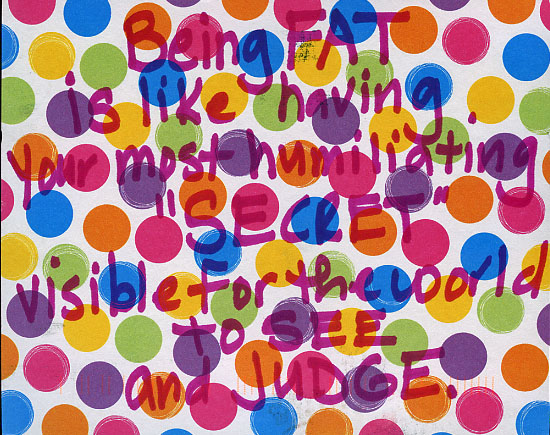
If this PostSecret confession doesn’t break your heart, you are a bad person.

fatjudge

Last week I chatted with the Canadian Broadcasting Company for a segment they’re doing on humor and power.  I used hateful jokes about fat people as an example of how patterns in comedy reveal our biases: who it is okay to revile, whose feelings we can dismiss, who we see as less-than-human.

I was surprised when the host said that some argue that pointing out people’s weight isn’t offensive because it’s “just a fact.”  I responded, “Sociologists don’t believe in that kind of fact.”  Two hundreds years ago being called fat would have been a compliment: it represented power, success, wealth, and (yes) health.  Today the meaning of fat has changed.  The word is now a weapon.  For the person who wrote this secret, fatness is not a fact; it’s a “humiliat[ion].”  This is what dehumanization feels like.

Whoever you are, I wish I could give your warm, comfy body a big giant hug.

Lisa Wade, PhD is an Associate Professor at Tulane University. She is the author of American Hookup, a book about college sexual culture; a textbook about gender; and a forthcoming introductory text: Terrible Magnificent Sociology. You can follow her on Twitter and Instagram.