“Next to being a Hollywood movie star, nothing was more glamorous.” This breathless statement, quoted in Femininity in Flight, was uttered by a flight attendant in 1945.  At the time being a stewardess was quite glamorous.  Like motion pictures do today, airlines trafficked in “the business of female spectacle.”  They hired only women who they believed to represent ideal femininity. Chosen for their beauty and poise, and only from among the educated, and slender, they were as much of an icon as Miss America.  And they were almost all White.

Victoria Vantoch tells the story of the first African American flight attendants in a chapter of her new book, The Jet Sex.  Patricia Banks was one of the first Black women to sue an airline for racial discrimination.  She graduated from flight attendant training school at the top of her class and applied to several airlines.  But it was 1956 and the U.S. airlines had never hired a Black woman.  After 10 months of trying, an airline recruiter pulled her aside and admitted that it was because of her race.  Which, of course, it was; airlines disqualified any applicants that had broad noses, full lips, coarse hair, or a “hook nose” (to weed out Jews).

Banks sued. After four years of litigation, Capital Airlines was forced to hire her.  She postponed her marriage and took the job (airlines only hired single women as flight attendants). When she put on her uniform for the first time, she said:

After all I had gone through, I couldn’t believe I was finally wearing the uniform. I had made it. I was going to fly. It was such an accomplishment.

patriciabanks

Individual women weren’t the only ones pushing to integrate the flight attendants corps.   International surveys showed that citizens of other countries knew that America had a “race problem” and this was a problem for then-President John F. Kennedy and Vice President Lyndon Johnson.  They needed to do something flashy and they turned to flight attendants to do it.  If they could make Black women the face of such an iconic and high-profile occupation, they thought, it would help restore America’s reputation.  According to Vantoch, Johnson “made stewardess integration his personal cause.”

That was 1961; in 1964 Johnson signed the Civil Rights Act mandating equal treatment in the workplace.  The following year, in response to even more lawsuits, approximately 50 Black women were hired by airlines.  This would make them 0.33% of the workforce.

Patricia  Banks and her fellow first African American flight attendants, including Mary Tiller and Marlene White, would continue to face racism, now from co-workers, passengers, and supervisors.  Banks would quit after one year, citing exhaustion in the face of emotionally draining feminine work and a constant onslaught of racism.  She was a great flight attendant, though, and proud to show the world that a Black woman could shine in the occupation.

Here’s Patricia Banks, telling the story in her own words at Black History in Aviation. It’s worth a watch; she’s amazing:

Cross-posted at VitaminW and Pacific Standard.

Lisa Wade, PhD is an Associate Professor at Tulane University. She is the author of American Hookup, a book about college sexual culture; a textbook about gender; and a forthcoming introductory text: Terrible Magnificent Sociology. You can follow her on Twitter and Instagram.

The great majority of Americans might find the post-recession expansion disappointing, but not the top earners.

The following table reveals that our economic system is operating much differently than in the recent past.  The rightmost column shows that the top 1% captured 68% of all the new income generated over the period 1993 to 2012, but a full 95% of all the real income growth during the 2009-2012 recovery from the Great Recession.  In contrast, the top 1% only captured 45% of the income growth during the Clinton expansion and 68% during the Bush expansion.

piketty_saez

Of that weren’t enough, the next chart offers another perspective on how well top income earners are doing. In the words of the New York Times article that included it:

…the top 10% of earners took more than half of the country’s total income in 2012, the highest level recorded since the government began collecting the relevant data a century ago… The top 1% took more than one-fifth of the income earned by Americans, one of the highest levels on record since 1913 when the government instituted an income tax.

We have a big economy.  Slow growth isn’t such a big deal if you are in the top 1% and 22.5% of the total national income is yours and you can capture 95% of any increase.  As for the rest of us…

One question rarely raised by those reporting on income trends: What policies are responsible for these trends?

Cross-posted at Reports from the Economic Front.

Martin Hart-Landsberg is a professor of economics at Lewis and Clark College. You can follow him at Reports from the Economic Front.

It always gives an old sociologist like me a big thrill when a classical concept that I love appears in a mainstream cultural product. I received such a buzz when I saw the movie Lee Daniels’ The Butler over the Labor Day weekend.

One of the movie’s African American characters, speaking in the 1940s, notes that a Black man must wear “two faces,” one for other Blacks and another for Whites. Perceptive critics have identified how this borrows from “double consciousness,” a concept that W.E.B. DuBois first wrote about in 1897. A.O. Scott cites Paul Laurence Dunbar’s line, “We wear the mask that grins and lies”; whilst Frank Roberts notes that the movie’s butler “wrestles with the realization that he is in The White House but certainly not of it,” which in turn illustrates the wider dilemma of being in America but not of America.

Screenshot_2
Still of Lee Daniels’ The Butler from imdb.com
Screenshot_1
Still of Lee Daniels’ The Butler from imdb.com

.

However, what really gives the movie its power is how it resonates with the continuing experiences of African Americans today. Black men who are still shell-shocked by the George Zimmerman verdict will know only too well how they often have to show “two faces” in order to avoid harassment. Barack Obama noted this fact when he observed, a week after the verdict, that there “are very few African American men who haven’t had the experience of walking across the street and hearing the locks click on the doors of cars” or of “getting on an elevator and a woman clutching her purse nervously and holding her breath until she had a chance to get off.”

Similarly, Father Bryan Massingale, who is a priest of the Archdiocese of Milwaukee and a professor of theology at Marquette University, records how he was once “abruptly stopped by the police, rudely questioned and roughly searched, under the suspicion that I was the perpetrator of a robbery” and how “Living with such terror and indignity is to be expected” even if you are ” a priest, a university professor, and a respected member of the community (or so I would have thought).” Such profiling strongly resembles DuBois’ emphasis upon:

…this sense of always looking at one’s self through the eyes of others, of measuring one’s soul by the tape of a world that looks on in amused contempt and pity.

The entire subtext of The Butler is the manner in which the movie’s different characters cope with the task of continually “measuring one’s soul” in this way: the continual feeling of being trapped in the gaze of the white employer’s “contempt and pity.” It is a tribute to the ability of popular culture to occasionally convey powerful truths that this movie does not pull its punches in staying true to that part of DuBois’ sociological vision.

Dr. Jonathan Harrison earned a PhD in Sociology from the University of Leicester, UK. His research interests include the Holocaust, comparative religion, racism, and the history of African Americans in Florida. He teaches at Florida Gulf Coast University and Hodges University. He’d like to thank Dr. Kris De Welde for her comments on earlier drafts of this piece.

Excess under age-60 female mortality in less developed countries is estimated to add up to 3.9 million missing women worldwide (World Bank, 2011).  A large proportion of this is due to sex-selective abortion practices.  The practice occurs most commonly among poorer families in societies where boy children are given greater economic and social status than girl children. In such a context, the transition to smaller families can lead parents to choose boys over girls. Notably, female fetuses are most likely to be aborted when the first child born is a girl.

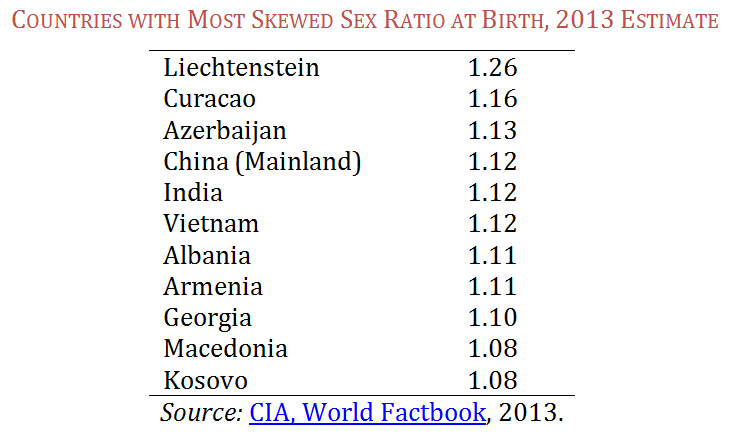
The table below shows the countries with the most skewed ratios at birth in the world. While there is naturally a slightly higher sex ratio of boys to girls — between 1.04-1.06 — ratios above that are considered to be altered by technology due to gender preferences for boy children.

Screenshot_1

The reason we find this newest 2013 data of particular interest is that, despite the popular Western focus on Asia, the practice occurs in more European countries. Perhaps most striking is the central European country that ranks at the top of the list—Liechtenstein. This strikes us as odd, given that Liechtenstein has never made this list in the past. Perhaps this is a data collection error (in very small populations, as also in Curacao, the results can be skewed). But we are surprised that no journalists have picked up on the fact that the worst offending son-preference country in the world is now, allegedly, a European country.  We contacted the CIA to ask them about this possible data anomaly but have not yet heard back.*

On the other hand, if the Liechtenstein data is accurate, this would be a very interesting story indeed, especially since Liechtenstein has the most restrictive laws against abortion in Europe.  A quick scan of gender equity policies in Liechtenstein shows that women there were not legalized to vote until 1984, indicating that it is not the most gender egalitarian of European countries.

In any case, whether Liechtenstein’s inclusion in this disreputable list is a data error or not, the other European countries on the list are legitimate.  They have been high for many years, and a recent report on Armenia, for example, documents longstanding norms in gender preference.  The disproportionate focus on birth sex ratios in China and India no doubt reflects their status as the #1 and #2 most populous countries, which means a much greater overall impact in sheer numbers.  Nevertheless, our point stands.  Why has the disproportionate inclusion of non-Asian countries on the above-list gone virtually unmentioned by journalists?

Do Developed Western Countries Prefer Boys?

Americans often think of parental sex preference as a thing of the past, or a problem in developing countries. After all, the U.S. sex ratio at birth falls in the normal range, at 1.05. This is in spite of the curious American cottage industry in sex-identification home use kits, such as the Intelligender, the GenderMaker and the Gender Mentor.

Screenshot_2

In surveys, American parents report an ideal of two children and equal preference for boys and girls. However, American gender preferences manifest themselves in more sneaky ways. A 2011 Gallup poll showed that, if they were only able to have one child, the highest preference was for a boy.  These results are little changed from the same Gallup question asked of Americans in 1941.

To return to a point made in an earlier post on skewed sex ratios, Americans may not be so different, after all, in their gender preferences from the countries in the above table.  The crucial difference, she noted, is that some Asian countries are more enabled to act on their boy preference than others. It appears we should now be including some European countries in that “enabled” group as well.

* Neither the United Nations, Population Reference Bureau, nor the World Bank have published 2013 statistics yet for comparison to the CIA data.

Jennifer Lundquist is an associate professor of sociology at the University of Massachusetts, Amherst who specializes in stratification and social demography.
Eiko Strader is a PhD student in sociology at the University of Massachusetts, Amherst who studies inequality in labor markets and the welfare state.

Some sociologists went to the US Open final and posted about it on Facebook.  Here’s what they saw. Notice the size of the court.

1
(Photo by Jenn Lena)

I saw the match too. When I got home from work, I turned on CBS.  Here’s what I saw.

2 3

On my 40″ flat-screen Samsung, I could see the match as though I were in the box seats, nothing between me and the court. I could see the grimace on a player’s face, the sweat stains on his shirt. I sat on an upholstered chair. And it cost me nothing.

How much was a plastic seat in the top rows of Arthur Ashe Stadium? I don’t know. My grounds pass on Day 3 was $66.  Seats for the finals were $95. I have sat up there near the top. The players are colorful miniatures moving around on the green rectangles. The distant perspective allows – forces – you to see the whole court, so you are aware of placement strategies and patterns of movement you might otherwise not have noticed. But tennis isn’t football; strategy, especially in singles, is fairly obvious and not complicated.

From way up there, the players are so far away.  It’s as though you were looking at your TV through the wrong end of a telescope. You see the game differently, and you hear it differently. A player hits a solid backcourt shot, and for a noticeable half-second or so, you hear silence. Only when the ball is clearing the net do you hear the impact of the stroke.

Why go out to Flushing Meadow? It’s ridiculous to think about this in the narrow economic framework of money and tennis narrowly defined.  My $0 view of the match was far better than that of my FB friends in their expensive seats high above the court.  Close that micro-economics book and open Durkheim.  Think about the match as ritual. It’s not just about Nadal and Djokovic whacking a fuzzy yellow ball back and forth for a couple of hours. A ritual includes everyone. If you’re there, you are part of that group. You are one with the with the people in the stadium and with the charismatic figures in center court

That’s why, if something is a ritual, being there is so important. Showing up is more than just 80%. It’s everything. If you’re there, you are part of our group. You go to Thanksgiving dinner at Aunt Diane’s house not because the food is good.  You might get better food and more enjoyment at home with take-out Chinese and a TV.  You go because your presence defines you as a member of the group. Not going is tantamount to saying that you are just not part of this family.

The Final is not just any match. It is the ritual that anoints our king, hence the trophies and pageantry and ritualistic incantations (speeches) after the match.  I would guess that most of the people there yesterday would choose even a so-so final over a close, well-played match on an outside court in Round 3.  Because this match is so important, it generates more mana. And that energy is created by the crowd.   Of course, the crowd’s perception is that it is the players who are creating that special feeling, and it helps if the match on the court is close and well-played. But the same match – every shot exactly the same – played in an early round in a nearly empty stadium would not create that same feeling for the handful of spectators who showed up.

What makes the ticket worth all the money then is not the quality of the play. It is the symbolic meaning of the ritual and the strong feeling you get from being part of that ritual. You were there, with Nadal and Djokovic.  That ritual exists in sacred time, linked to other great finals matches.  So maybe you save your ticket stub or your program as your link to that sacred past.

I saw the same match, and I had a better view. But I’m not going to save my cable TV bill.

Cross-posted at Montclair SocioBlog.

Jay Livingston is the chair of the Sociology Department at Montclair State University. You can follow him at Montclair SocioBlog or on Twitter.

Repeatedly at SocImages, we’ve offered data showing that the middle class is shrinking.  The rich are getting richer, while a rising percentage of Americans are having trouble making ends meet.  One measure of this is the number of households that include both adults and their adult children.  About 12% of 25 to 44-year-olds lived with their parents in 1960, that dropped to 9% by 1980 and, in 2010, topped out at 17%.  Almost one-in-five adults were living with their parents at the turn of this decade.

There are two scenarios, here, however.  One indicates the decreasing financial well-being of the elderly: parents move in with their children because they can’t afford to live alone, perhaps after retirement.  The other indicates the decreasing financial well-being of young and mid-life adults: children are moving in with their parents because they can’t get a good start to life.

It turns out that the first scenario is actually on the decrease, while the latter is on the increase.  The rise in co-residence is a consequence of the failure of our economy to integrate young people into jobs that pay a living wage.  Literally, a growing number of Americans — both young people and those in mid-life — can’t afford to leave the nest.  And, no, this didn’t start with the recession, it started in the ’80s.

1

We’ve done a decent job trying to ensure that the elderly don’t live in poverty, it’s time to start working on making sure the rest of America doesn’t either.

Thanks to @toddgorman for the link!  Cross-posted at Pacific Standard and The Huffington Post.

Lisa Wade, PhD is an Associate Professor at Tulane University. She is the author of American Hookup, a book about college sexual culture; a textbook about gender; and a forthcoming introductory text: Terrible Magnificent Sociology. You can follow her on Twitter and Instagram.

This seems like a good time to remind instructors that we have a series of image guides designed to make finding material for your classes as easy as possible.  These guides collect SocImages posts organized in a way that follows standard syllabi for frequently-taught sociology courses.

We’ve got the basics:

Major topics:

And sub-topics:

We hope they’re useful!

If you’d like to put an image guide together, we’re looking for sociology professors or graduate students to volunteer.  The task requires browsing our archives, pulling out the most compelling posts, and arranging them in ways other instructors would find familiar and convenient.  The Guides can cover entire courses, parts of courses, or be designed to help illustrate a well-known theory, article, or book.  We’re even happy to have duplicate Guides, since every instructor is different.

Happy teaching!

Lisa Wade, PhD is an Associate Professor at Tulane University. She is the author of American Hookup, a book about college sexual culture; a textbook about gender; and a forthcoming introductory text: Terrible Magnificent Sociology. You can follow her on Twitter and Instagram.

Screenshot_2If you haven’t watched Robin Thicke’s disaster of a music video for Blurred Lines, you absolutely must.  But first, feast your eyes on this quote by Virginia Woolf:

Women have served all these centuries as looking glasses… reflecting the figure of man at twice its natural size.

It’s women’s work to prop up male egos the idea of male superiority.  To me, that’s exactly what’s going on in this video.  It’s actually quite funny when you look at it that way; it makes the men look so desperate.

Anyhow, I’m glad smart, feminist, fearless women and men are fighting back:

An exercise in gender bending helps expose the ridiculousness as well. Why does it seem silly when men do it, but not when women do?  Because it’s women’s job to be fans of men.

Also, because I can’t help but add a little more snark, how does someone with ZERO charisma end up a pop star?  There’s got to be a story here about money and connections.

Thanks to Marie N., Bronwyn L., and Natalie S. for sending in the videos!

Lisa Wade, PhD is an Associate Professor at Tulane University. She is the author of American Hookup, a book about college sexual culture; a textbook about gender; and a forthcoming introductory text: Terrible Magnificent Sociology. You can follow her on Twitter and Instagram.