A few days ago, Juliano Pinto kicked off the World Cup with a first kick.  It was a media stunt designed to make us verklempt.  Pinto is a paraplegic who wore a mind-controlled robotic exoskeleton to make his move.

We were to be awed by the technology, too, of course, which is being developed by the Walk Again Project, a scientific consortium.  Says the leading scientist on the project, “With enough political will and investment, we could make wheelchairs obsolete.”

Red Nicholson isn’t having it.

Ask any wheelchair user, particularly one who’s been in the game a while, and they’ll tell you that they’re far too busy living their life to sit there worrying about whether or not they’ll ever walk. We just get on and do.

From his point of view, the exoskeleton is for people who aren’t in wheelchairs.  Getting “non-walkers to walk again,” he says, is about making everyone else happy.  As for him, he says, he’s fine:

My wheelchair is a very capable tool and to be honest, the last thing I want is to be strapped to a District 9-esque robot and become a puppet in some corporation’s half-baked execution of an obsession…

In the meantime, he says, everyone’s concern with getting him to walk again suggests that he, and everyone else who uses a wheelchair, is living a pitiable life.  “These stories,” he says, “are unwittingly invalidating a unique way of life for millions of people around the globe who are really happy with their wheelchairs.”   So, he goes on record: “This is not my dream.”

William Peace, an anthropologist who also uses a wheelchair, goes further, arguing that the exoskeleton is harmful to people who are newly paralyzed.  The scientists developing the exoskeleton are “sell[ing] the dream of walking to newly paralyzed people who cannot imagine life as a wheelchair user.”  This is bad, he says, because it encourages people to reject their new body instead of accept it.   He writes: “the exoskeleton is symbolically and practically destructive to a newly paralyzed person.”

Instead of focusing on the one thing people using wheelchairs can’t do, Peace argues, we should focus on all the things they do everyday:

Work, make a decent living, and be autonomous. Own a home even. Have a family. Get married. In short, be ordinary. Walking is simply not required for all this nor should it be glorified.

Nicholson concurs: “My life as a wheelchair-user is a very good one.”

So hey, able-bodied media: quit making me feel like wheelchairs are a shitty, sub-par option. Stop beating your exoskeleton drum. And most of all, let go of your obsession with walking, because it’s totally overrated.

Cross-posted at Pacific Standard.

Lisa Wade, PhD is an Associate Professor at Tulane University. She is the author of American Hookup, a book about college sexual culture; a textbook about gender; and a forthcoming introductory text: Terrible Magnificent Sociology. You can follow her on Twitter and Instagram.

Screenshot_1Please enjoy these posts from Father’s Days past:

Stereotyping Men on Dad’s Day

Also…

Lisa Wade, PhD is an Associate Professor at Tulane University. She is the author of American Hookup, a book about college sexual culture; a textbook about gender; and a forthcoming introductory text: Terrible Magnificent Sociology. You can follow her on Twitter and Instagram.

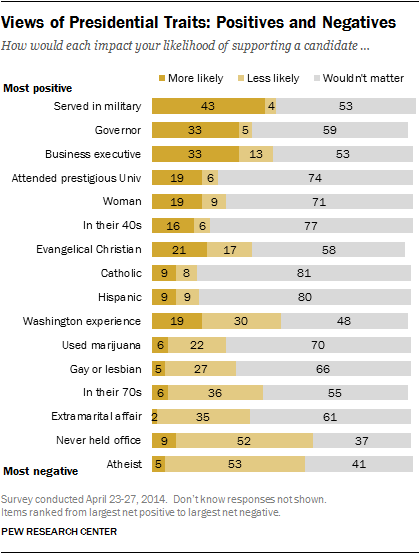
A new survey ranks the qualities that Americans dislike in a potential leader, discovering that they still give a strong side-eye to atheists.

1.jpg

Prejudice against those who say there’s no god is stronger than ageism, homophobia, and sexism.  People would also rather vote for people with admitted moral failings (in the eyes of some), such as those who’ve admitted to an extra-marital affair or the use of weed, than those who claim a perfect record guided by some other force than god.

On the plus side for atheists and their allies, the percent of people who say that they are disinclined to vote for an atheist for president has declined from 63% in 2007 to the 53% we see today.

Via Citings and Sightings.

Lisa Wade, PhD is an Associate Professor at Tulane University. She is the author of American Hookup, a book about college sexual culture; a textbook about gender; and a forthcoming introductory text: Terrible Magnificent Sociology. You can follow her on Twitter and Instagram.
Flashback Friday.

Below is a remarkable commercial in which a white woman is told that if she buys Pampers, the company will donate vaccines to children in other countries.   Thanks to Kenjus W. for the submission.

It is an example of “activism by purchase,” which we have discussed at length on this blog. Apparently Pampers will only help keep babies alive if you buy their product.  How nice of them.

It’s also a fascinating example of the way in which white Westerners are seen as rescuing the rest of the world. This white mother with her white baby represent the West (erasing the diversity of people who live there). And she and her baby are counterposed to all the other mothers and their babies representing different racial groups (which are assumed to be coherent categories, even continents).

In the narrative of this commercial, all women are bonded by virtue of being natural nurturers of babies (and I could take issue with that, too), but the white Western woman is the ultra-mother. They may be sisters, but there are big and little sisters in this narrative. The babies run to her as if drawn to her ultra-motherhood and she treats them all, just for a moment, as if they were her very own.

Pampers wants you to think, of course, that when you buy a pack of Pampers, you are “helping” Other mothers and can save those Other babies.

This is just another manfestation of an old colonial belief, the white man’s burden, or the belief that white men had to take care of the rest of the world’s people because they were incapable of taking care of themselves.

Great find, Kenjus!

This post originally appeared in 2008.

Lisa Wade, PhD is an Associate Professor at Tulane University. She is the author of American Hookup, a book about college sexual culture; a textbook about gender; and a forthcoming introductory text: Terrible Magnificent Sociology. You can follow her on Twitter and Instagram.

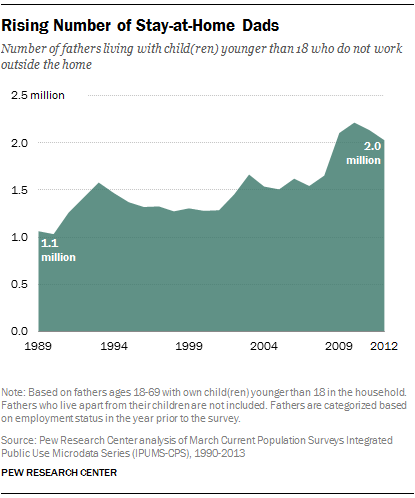
At Pew Social Trends, Gretchen Livingston has a new report on fathers staying at home with their kids. They define stay at home fathers as any father ages 18-69 living with his children who did not work for pay in the previous year (regardless of marital status or the employment status of others in the household). That produces this trend:

1 (2) - Copy

At least for the 1990s and early-2000s recessions, the figure very nicely shows spikes upward of stay-at-home dads during recessions, followed by declines that don’t wipe out the whole gain — we don’t know what will happen in the current decline as men’s employment rates rise.

In Pew’s numbers 21% of the stay at home fathers report their reason for being out of the labor force was caring for their home and family; 23% couldn’t find work, 35% couldn’t work because of health problems, and 22% were in school or retired.

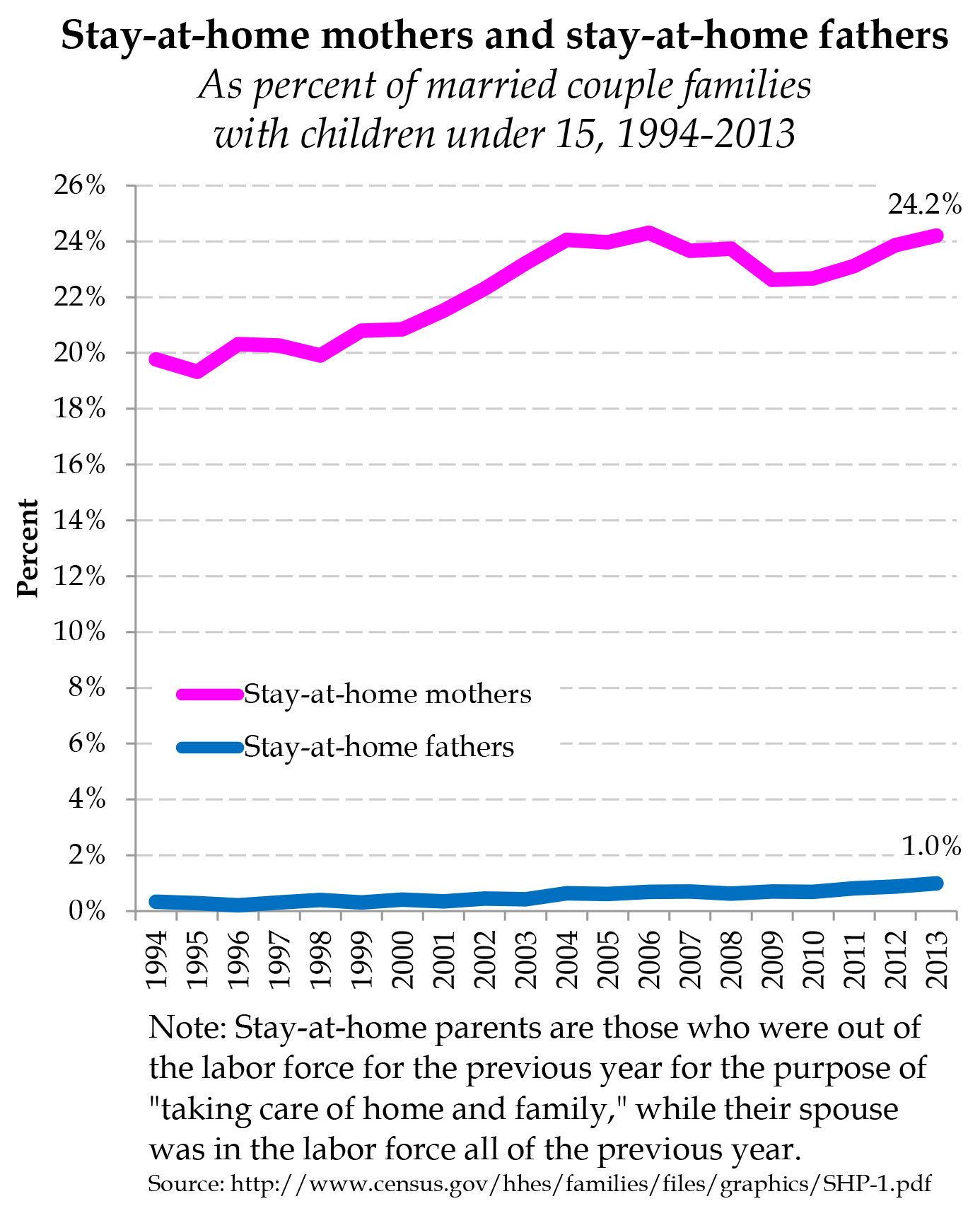
It is reasonable to call a father staying at home with his kids a stay at home father, regardless of his reason. We never needed stay at home mothers to pass some motive-based criteria before we defined them as staying at home. And yet there is a tendency (not evidenced in this report) to read into this a bigger change in gender dynamics than there is. The Census Bureau has for years calculated a much more rigid definition that only applied to married parents of kids under 15: those out of the labor force all year, whose spouse was in the labor force all year, and who specified their reason as taking care of home and family. You can think of this as the hardcore stay at home parents, the ones who do it long term, and have a carework motivation for doing it. When you do it that way, stay at home mothers outnumber stay at home fathers 100-to-1.

I updated a figure from an earlier post for Bryce Covert at Think Progress, who wrote a nice piece with a lot of links on the gender division of labor. This shows the percentage of all married-couple families with kids under 15 who have one of the hardcore stay at home parents:

SHP-1. PARENTS AND CHILDREN IN STAY-AT-HOME PARENT FAMILY GROUPS

That is a real upward trend for stay at home fathers, but that pattern remains very rare.

See the Census spreadsheet for yourself here.  Cross-posted at Pacific Standard.

Philip N. Cohen is a professor of sociology at the University of Maryland, College Park, and writes the blog Family Inequality. You can follow him on Twitter or Facebook.

We have the money and the know how to tackle most of our social problems.  Certainly unemployment, houselessness, and poverty.  So, why don’t we?

In large part it is because our socially created wealth remains outside social control.  Critical economic decisions are driven by private interests not the public good.  One result is hipster economics.

If you are not familiar with the concept, I recommend Sarah Kendzior’s The Perils of Hipster Economics. Here is the first part:

On May 16, an artist, a railway service and a government agency spent $291,978 to block poverty from the public eye.

Called psychylustro, German artist Katharina Grosse’s project is a large-scale work designed to distract Amtrak train riders from the dilapidated buildings and fallen factories of north Philadelphia. The city has a 28 percent poverty rate – the highest of any major U.S. city – with much of it concentrated in the north. In some north Philadelphia elementary schools, nearly every child is living below the poverty line.

Grosse partnered with the National Endowment of the Arts and Amtrak to mask North Philadelphia’s hardship with a delightful view. The Wall Street Journal calls this “Fighting Urban Blight With Art.” Liz Thomas, the curator of the project, calls it “an experience that asks people to think about this space that they hurtle through every day.”

The project is not actually fighting blight, of course – only the ability of Amtrak customers to see it.

1
Flickr creative commons, Knight Foundation.

“I need the brilliance of colour to get close to people, to stir up a sense of life experience and heighten their sense of presence,” Grosse proclaims.

“People,” in Grosse and Thomas’s formulation, are not those who actually live in north Philadelphia and bear the brunt of its burdens. “People” are those who can afford to view poverty through the lens of aesthetics as they pass it by.

Urban decay becomes a set piece to be remodeled or romanticised.

The rest of the article is here.

Martin Hart-Landsberg is a professor of economics at Lewis and Clark College. You can follow him at Reports from the Economic Front.

Usually, you want to match up with someone at about your level, or a little higher.  The trouble is that many people overestimate their own level.  Maybe that’s especially true of men.

One summer many years ago at the tennis courts, a guy I didn’t know  came over and asked me if I’d like to play. I hadn’t arranged a game with anyone, but I didn’t want to wind up playing some patzer.

“Are you any good?” I asked. He paused.

“Well, I’m not Jimmy Connors,” he said (I told this was many years ago), “but neither are you.”

In chess and other games, serious players have ratings. Give a roomful of possible partners, they can sort through the ratings and find a match with someone at roughly the same level.  It’s called assortative mating, though that term usually refers to the other kind of mating, not chess.  It’s the basis of the conflict in this poignant scene from “Louie.”

Vanessa is not a ten, neither is Louie.  According to principles of assortative mating, the tens will wind up with other tens, the nines with nines, and so on down the attractiveness scale. One problem in the “Louie” scene is that Louie seems to have an inflated view of his own attractiveness.  He’s aiming higher than Vanessa.  That’s typical.  So is the importance that Louie, the man, places on physical attractiveness. This excerpt begins with Louie telling Vanessa that she’s a really beautiful . . . . He can’t bring himself to say “girl”; he’s probably going to say “person.” But he’s obviously not saying what he thinks.

Or as Dan Ariely and colleagues concluded from their study of HotOrNot members:

[Men] were significantly more influenced by the consensus physical attractiveness of their potential dates than females were. [Men also] were less affected by how attractive they themselves were . . .  In making date choices, males are less influenced by their own rated attractiveness than females are.

Another dating site, OK Cupid, found a similar pattern when they looked at data about who gets messages.  They asked their customers to rate profile photos of the opposite sex on a scale of 0 to 5. They then tracked the number of messages for people at each level of attractiveness.  The graph below shows what women thought and what they did – that is, how attractive they found men, and who they sent messages to.

1 (2) - Copy

Men who were rated 0 or 1 got fewer messages than their proportion in the population.  That figures. But even men who were only moderately attractive got more than their share. Generally, the fewer men at a level of attractiveness, the fewer total messages women sent. The 4s, for example, constituted only 2% of the population, and they got only 4% of all the messages.  The Vanessas on OK Cupid are not sending a lot of inquiries to guys who look like George Clooney.

But look at the men.

1 (2)

Men are more generous in their estimates of beauty than are women. But they also ignore the Vanessas of the world (or at least the world of OK Cupid) and flock after the more attractive women.  Only 15% of the women were rated as a 4, but they received about 26% of the messages.  Women rated 5 received messages triple their proportion in the population.

What about those with so-so looks?  Women rated as 2s received only about 10% of the messages sent by men. But men at that same level received 25% of the messages women sent.  The women seem more realistic.

Vanessa too has no illusions about her own attractiveness. She refers to herself as “a fat girl,” and when Louie, trying to be kind, says, “You’re not fat,” she says: “You know what the meanest thing is you can say to a fat girl? [pause] ‘You’re not fat.’” But it’s only when she challenges Louie’s view of his own attractiveness that their relationship starts to change.

Y’know if you were standing over there looking at us, you know what you’d see?

What?

That we totally match. We’re actually a great couple together.

She doesn’t explain what she means by “totally match.” It could be their interests or ideas or personalities, but the imaginary stranger looking at them from over there couldn’t know about any of that. What that generalized other could see is that they are at roughly the same place on the assortative mating attractiveness scale.

Cross-posted at Pacific Standard.

Jay Livingston is the chair of the Sociology Department at Montclair State University. You can follow him at Montclair SocioBlog or on Twitter.

1a

PhD Comics.

Lisa Wade, PhD is an Associate Professor at Tulane University. She is the author of American Hookup, a book about college sexual culture; a textbook about gender; and a forthcoming introductory text: Terrible Magnificent Sociology. You can follow her on Twitter and Instagram.