
 In this five minutes, Jay Smooth attacks the “politics of respectability” and attacks it hard. What exactly will happen, he asks, if Black men pull their pants up? Affordable housing? Well-funded schools? Job opportunities? What is this politics really about? Our shame, internalized racism, and sense of helplessness, he says.
 This 4:15 minute video features women recounting instances of sexual harassment and battery by strangers. It’s a wake up call for the kinds of treatment that women routinely receive just by virtue of daring to be in public spaces.
Made by Laura Bates for the The Everyday Sexism Project. Thanks to Mytch for the tip.
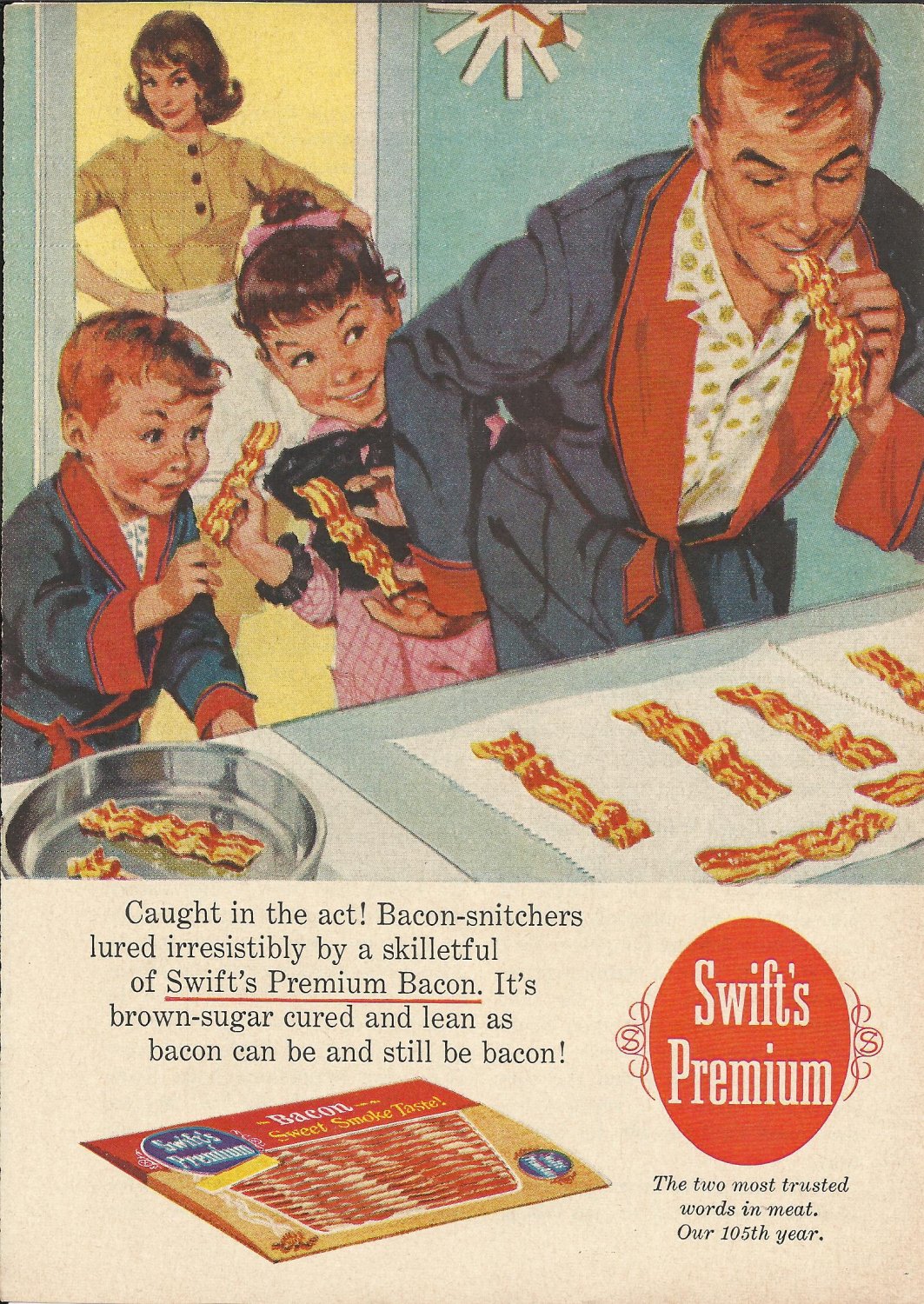
Lisa Wade, PhD is an Associate Professor at Tulane University. She is the author of American Hookup, a book about college sexual culture; a textbook about gender; and a forthcoming introductory text: Terrible Magnificent Sociology. You can follow her on Twitter and Instagram.Look at this cute ad from the 1950s. Mom is so satisfied as she watches her three children husband and two kids discover the Swift’s Premium bacon she just cooked up. We should wax nostalgic because that kind of feminine domesticity and helpless husbandry just isn’t expected in marriage any more. Right?
Wrong! Enjoy this dizzying ad from Maple Leaf in which a woman finally gets her three children husband and two kids to be decent human beings by feeding them, you guessed it, bacon:
Thanks to Tom Megginson, The Ethical Adman, for both of these examples and the title of this post.
Lisa Wade, PhD is an Associate Professor at Tulane University. She is the author of American Hookup, a book about college sexual culture; a textbook about gender; and a forthcoming introductory text: Terrible Magnificent Sociology. You can follow her on Twitter and Instagram.SocImages News:
We celebrated our 6th birthday this month. As a present, we were gifted a launch page!
We’re super grateful to Jon Smadja for building it and enabling us to highlight all of the cool things going on at SocImages: not just new posts every day, but an active Twitter feed, a far-reaching Facebook page, and an interesting, funny, and sometimes disturbing Pinterest presence (yes, we’ve been flagged for inappropriateness). Meanwhile, the slideshow helps us keep some of our favorite older posts at the forefront of the site. We love it!
For those of you who want to read the site the old way: just click on “blog” on the upper left under our logo.
Big Posts this Month:
We are eager to try and make public discourse more sociological, so we were really pleased when three of our posts this month made a significant impact:
- Our post in the aftermath of the Zimmerman verdict, showing that stand your ground laws exacerbate already racially biased court outcomes, received over 20,000 Facebook “likes” and was shared over 500 times.
- Our post about the divergent news coverage of two young boys who went for a joyride in their families’ cars, one white and one black, was re-posted at Huffington Post, where it received almost 30,000 “likes” and inspired almost 5,000 comments.
- And a SocImages Slate exclusive looking at hook up culture as a raced and classed phenomenon was picked up at TIME, Ebony, The Atlantic, and Jezebel.
Cross-post highlights…
- PolicyMic, Flight Attendants are Unsung Heroes in the San Francisco Crash
- Racialicious, What Current Demographic Facts Do You Need to Know?
- Huffington Post, How Do Physicians and Non-Physicians Want to Die?
- Pacific Standard, What “Literacy Tests” Looked Like in Louisiana Before the Voting Rights Act
- BlogHer, Why Do Firefighters Take Such Risky Jobs?
- Ms., Stand Your Ground Increases Racial Bias
Upcoming Visits:

I just booked a four month sublet just outside the French Quarter (February through May). So, all you New Orleanians out there, get ready to be my friend! (Meanwhile, if anyone wants to sublet a place in Los Angeles…). I’ll hopefully be travelling quite a lot this academic year for public speaking. I’ll be at Westminster College in Salt Lake City and Macalester College in the Twin Cities. I would love to come to your school too!
Social Media ‘n’ Stuff:
Finally, this is your monthly reminder that we’re on the social medias! I’m on Facebook and most of the team is on Twitter: @lisawade, @gwensharpnv, @familyunequal, @carolineheldman, and @jaylivingston.
Lisa Wade, PhD is an Associate Professor at Tulane University. She is the author of American Hookup, a book about college sexual culture; a textbook about gender; and a forthcoming introductory text: Terrible Magnificent Sociology. You can follow her on Twitter and Instagram.The reproductive health police are at it again, and this time they’ve got the gender and sexuality cops with them. Despite the CDC reporting a decline in teen pregnancy across ethnic groups, public health and privately funded campaigns are popping up across the U.S. aimed at chastising, shaming, and blaming teenage mothers.
And now, the city of Chicago has gotten in on the act. Not satisfied with the traditional images of cheerleading teenage mothers with babies strapped to their chests, or wailing toddlers scolding their mothers for being too poor or too single, or even pop music icons who assure young women that motherhood ‘sucks’ even more than high school, the city of Chicago has decided to get creative. The Chicago Department of Public Health has created a series of posters featuring shirtless young men with apparently pregnant bellies – below the caption “Unexpected?”

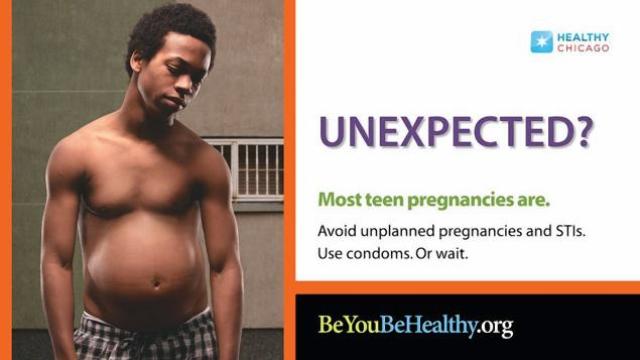
Ok, I get it. The campaign was designed to communicate the fact that most teen pregnancies are, yes, unexpected, and that teen fathers should bear an equal responsibility for said pregnancies. But as someone working at the interstices of narrative, health, and social justice, I am less concerned with wondering if teen pregnancy is ‘bad’, or even if shame and/or shock are effective motivators for behavior change (which I would argue they are not, check out Brené Brown’s eloquent argument). What concerns me is what other work such images are doing. In other words, what additional cultural stories is this campaign telling, and are those narratives socially just or unjust?
As this fantastic take-off from the Media Literacy Project shows, the primary problem with the Chicago campaign is its deeply trans-phobic narrative:
In the frame of the advertisers, the pregnant bellies in the ads are solely female while the rest of the body is solely male. The contrast is supposed to cause discord in the viewer, yielding feelings that the image is “disturbing” or “unexpected,” as the ads say. However, sex and gender are much more complicated than the advertisers understand. Transgender boys and men can become pregnant. Calling their bodies disturbing perpetuates a culture of ignorance, prejudice, and violence against transgender people.
The truth is, bodies which do not look traditionally ‘female gendered’ can and do become pregnant (consider the much publicized story of Thomas Beattie, for instance, a transgender man who bore three children) while bodies which do look traditionally ‘female gendered’ sometimes can or do not.
Philosopher Judith Butler asserted that gender is nothing more than a series of repetitive performances; behaviors which, in cis-gendered (not transgendered) people, are often so subconscious as to feel ‘natural.’ But simply consider that the gender-coding of many such behaviors have changed over time. Hairstyles, clothing, and work-home-balance are all easy examples. Requiring at the very least a working uterus, pregnancy is one type of public ‘performance’ that still appears ‘naturally female.’ Therefore, ‘male pregnancy’ can be a subversive act, as with the work of cyber-artists Virgil Wong and Lee Mingwei, where, as feminist science scholar Donna Haraway would say, one ‘queers what counts as nature.’
But that’s not what is going on here. As with the broadly comic absurdness of male pregnancy in films like Arnold Schwarzenegger’s Junior, this anachronistic Chicago campaign actually reinforces a traditional gender binary while essentializing pregnancy as a function of only cis-gendered female bodies. In doing so, the campaign defeats its own stated purpose. By looking at these posters, cis-gendered boys won’t feel like pregnancy can happen to them. Rather, they will scoff, or laugh at the ‘absurdness’ of male pregnancy, reassured that their (utterly and fixedly ‘masculine’) bodies are ‘safe’ from such conditions. More devastatingly, the cis-gendered general public looking at these images will have their own prejudices and expectations about male pregnancy reinforced: as something ‘unexpected,’ shocking, and ‘unnatural.’
Additionally, like other individual-level ‘shaming and blaming’/’shocking’ campaigns, this Chicago anti-teen pregnancy series deflects attention from more systemic understandings and structural changes: from finding funding for affordable and accessible reproductive health care, to anti-poverty work, to programs which support LGBTQ youth. While they may satisfy the need for a ‘moral panic’ among us middle-aged people as we ‘clutch the pearls and think of the children,’ what such anti-teenage pregnancy campaigns don’t do is actually increase the well being of our young people – be they male or female, cis- or trans-gendered.
Cross-posted at Adios Barbie.
Sayantani DasGupta is a faculty member in Narrative Medicine at Columbia University. She is the editor of Stories of Illness and Healing: Women Write their Bodies, co-authored The Demon Slayers and Other Stories: Bengali Folktales, and authored Her Own Medicine: A Woman’s Journey from Student to Doctor.
Earlier this year I wrote about how truly disturbing it is that so many of our insults have sexual connotations. “Fuck you,” is a choice example, but I give lots more in the original post (read at your own risk). I concluded:
…it’s interesting, right, to notice how often attempts to hurt other people come in the language of sexuality. This reveals why sex can be scary, especially for women who are so often positioned as the one who “gets fucked”… It’s also part of how we demean and marginalize gay and bisexual men.
This post came to mind when I saw this confession at PostSecret:

Let me put this in black and white: this person expressed “hate” by exposing another person to his penis. So he considers his penis a thing that can defile. This is the same penis that he puts (presumably) in his wife who he (presumably) doesn’t hate. If I were his wife, I would wonder how exactly he decides when putting his penis in things is a loving thing to do and when it’s a way to harm or humiliate someone.
I don’t mean to pick on this individual. The idea that it’s funny (“LOL”) to expose this woman to his genitalia without her consent is widespread. This confession is just a manifestation of our cultural belief that men can hurt people with their penises. And that it’s funny when they do.
Lisa Wade, PhD is an Associate Professor at Tulane University. She is the author of American Hookup, a book about college sexual culture; a textbook about gender; and a forthcoming introductory text: Terrible Magnificent Sociology. You can follow her on Twitter and Instagram.Sociology represent! Watch Kjerstin Gruys, UCLA sociology Ph.D. student, on The Colbert Report. Her new book is called Mirror, Mirror Off the Wall: How I Learned to Love My Body By Not Looking at It.
See also a previous guest post where she answered the question, Can a Feminist Diet?
Lisa Wade, PhD is an Associate Professor at Tulane University. She is the author of American Hookup, a book about college sexual culture; a textbook about gender; and a forthcoming introductory text: Terrible Magnificent Sociology. You can follow her on Twitter and Instagram.Trayvon Martin was a black teenage boy. He was walking home from the convenience store when he caught the attention and ire of George Zimmerman. Perceived as a “punk” and a threat, Martin was accosted by the older man, and a physical altercation ensued. Trayvon Martin died when he was shot through the heart at close range. Though Florida’s expansive “Stand Your Ground” laws were invoked in media conversations, that defense never even entered into the trial. Zimmerman was acquitted when a jury decided he’d killed Martin in self-defense. Zimmerman has since said Martin’s death was “God’s plan.”
Some Americans believe that race was not central to this killing or to the case that followed—they have believed it from February 2012 right up until today. But ask yourself: How many times you have been stopped and harassed because you looked threatening or suspicious wearing a hooded sweatshirt? For me, an Asian American female, that number is zero.
Yes, my gender alone distinguishes me from Trayvon Martin, but my partner Mike is a white male, and he, too, can only say “Zero.” We have never been stopped nor questioned, no matter how many times we’ve pulled on our hooded sweatshirts for warmth (and, in my case, to hide sea-tangled hair) after early morning surfing.
Stopping for breakfast or to run errands, Mike and I may not look polished in our hoodies, but we’ve also never had to worry that our appearance would cause suspicion. That’s privilege. It’s such a privilege, this presumed innocence of ours, that the morning after Zimmerman was acquitted, we went ignored even while acting suspiciously. Hoodies up, we casually stopped to look at a condo for rent in an affluent beach community in southern California. We knew from the online ad that the condo was vacant, so we parked outside, walked up the stairs to the unit, and peered into its windows. We sauntered around the grounds and walked into the unlocked community laundry room and garage. Several neighbors saw us, and they smiled.
I couldn’t help but think that the scenario would have been very different if Mike and I were black. Mike and I don’t have to wear our class in order to obviate being treated like threats or criminals; we can wear hoodies and board shorts without worrying that others will be suspicious, fearful, or make assumptions about our class status. Just being “not black” affords us this benefit of the doubt. It is a privilege because it is not something we have earned, but it is gifted to us every day regardless. I have always known about my privilege intellectually, but I felt it keenly last Saturday.
That some are afforded this privilege while others are systematically denied should make us all more empathetic. People perceive and experience the same event differently, depending on visible status markers such as race, gender, age, and class. Such status markers are more than just categories, they form a “system of social practices” that organize social relations. Status markers presume difference, and so people will react to and engage with Mike or with me differently than they would with someone like Trayvon Martin, even when we’re dressed the same.
We would like to believe that we don’t make assumptions based on race or gender, but evidence proves otherwise, as this social experiment of three individuals (a white male, a black male, and white female) trying to steal a bike clearly reveals:
As the sociologist Robert K. Merton insightfully observed nearly three-quarters of a century ago, “The very same behavior undergoes a complete change in evaluation in its transition from the in-group to the out-group.” As the video above indicates, the behavior of a black male (an out-group member) is regarded entirely differently than the same behavior of a white male and white female (in-group members).
The in-group/out-group divide goes further, with grave consequences in our criminal justice system. For example, Jennifer Eberhardt’s research has shown that race affects the severity of sentences that juvenile offenders receive, even for the same crime. Just the idea of a black juvenile offender leads people to imagine juveniles more like adults. Even liberal white Americans who claim low levels of prejudice project more blame onto black boys and sentence them more harshly. As Eberhardt has shown, “race has the power to dampen our desire to be merciful.”
I don’t have children, but if I did, I don’t know how I would explain Trayvon Martin’s death or the acquittal of his killer. But even just imagining being a parent to a black son makes me feel immense empathy for the parents of young black men. Can just that simple exercise make others more aware of race and class privilege, more aware of the power they have to recognize and even challenge that privilege and its consequences? As Henry David Thoreau asked, “Could a greater miracle take place than for us to look through each other’s eyes for an instant?”
References:
Jennifer Eberhardt and Aneeta Rattan, “The Race Factor,” New York Times, June 12, 2012.
Robert K. Merton. 1968 [1948]. “Self-fulfilling Prophecy,” in Robert K. Merton, Social Theory and Social Structure, 2nd edition. New York: Free Press.
Cecilia L. Ridgeway. 2011. Framed by Gender. New York: Oxford University Press.
Cross-posted at The Society Pages.
Jennifer Lee is a sociologist at the University of California, Irvine. Her book, The Diversity Paradox, examines patterns of intermarriage and multiracial identification among Asians, Latinos, and African Americans.