Archive: Feb 2015

SocImages News:

You like!  Here are our most appreciated posts this month:

We had one BIG winner this month! In “Where Do Negative Stereotypes about Feminists Come From,” I collected some pre-1920s anti-suffrage propaganda that revealed that stereotypes about feminists are 100 years old or more.  It got 5,200 likes here on SocImages and 16,250 notes on our Tumblr. Thanks everybody!

Editor’s pick:

My favorite was the one about tomatoes.

Upcoming Lectures and Appearances:

  • If anyone’s going to MSS this year, I’d love to say “hi”! I’ll be giving a plenary on March 27th titled “Doing Public Sociology: Notes from a Practitioner.”
  • Afterward I’ll be dropping by to the University of Missouri, Columbia to give a talk on hookup culture. Drop me a line if you’d like to meet up!

Follow us!

Finally…

I’ve started a little side project. Just a place to store and collect my thoughts about New Orleans. Most of what’s on there now has already been posted here, and I can’t promise that won’t be the case for what comes next. But if you’d like to follow along, please be my guest. It’s part of my long-term fantasy of writing a social science-inspired guidebook to the city. You know, for nerds.2 (1)

Lisa Wade, PhD is an Associate Professor at Tulane University. She is the author of American Hookup, a book about college sexual culture; a textbook about gender; and a forthcoming introductory text: Terrible Magnificent Sociology. You can follow her on Twitter and Instagram.
Flashback Friday.

Dating site OKCupid did an analysis of 500,000 inquiry messages to determine what keywords correlate most strongly with getting a reply.  It has some great lessons about dating and some counter-stereotypical news about what heterosexual women want from men.

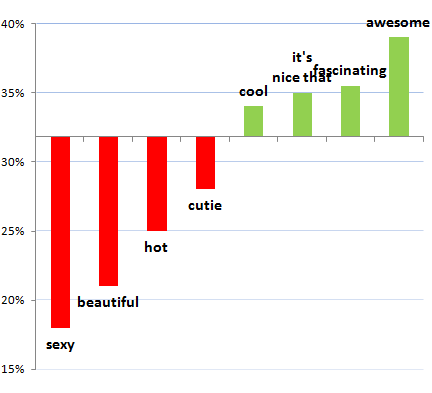
This first graph shows that mentioning someone’s level of attractiveness decreased the likelihood of getting a response (for both men and women), though men were more likely to mention looks.  But general compliments about one’s profile increased the likelihood of getting a response (the middle line is the average number of responses, the green bars signify an increase in the number of responses, and the red bars a decrease):

compliments-chart

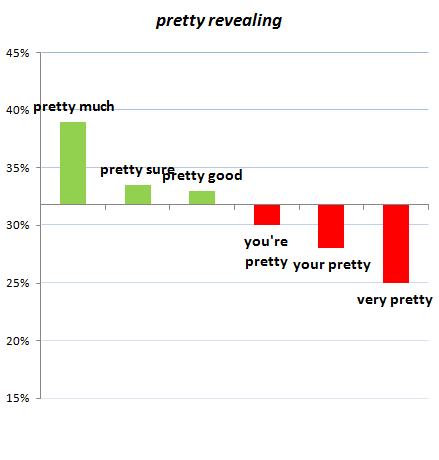
A good lesson in operationalization: “pretty” is used in two ways in our culture, so when they made sure to differentiate between pretty (meaning “sort of”) and pretty (meaning “attractive”), you can see clearly the way that commenting on looks decreases the recipients’ interest:
pretty-chart

So, in contrast to stereotypes, many women cannot be flattered into a date (though the figure above includes men and women, I’m assuming most people being called “pretty” are female).

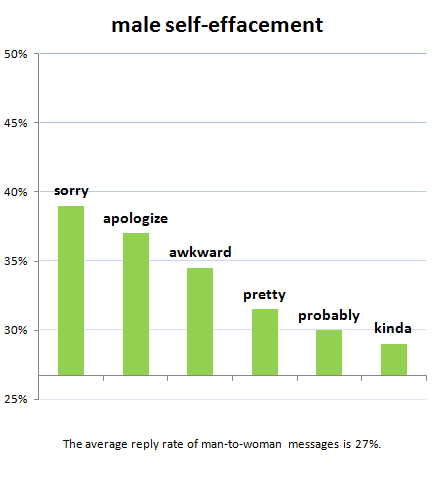
Further, the site found that when men sent messages, female recipients preferred humility to bold self-confidence.  The words below all increased the chances of a woman responding to a man’s inquiry:
efface-chart

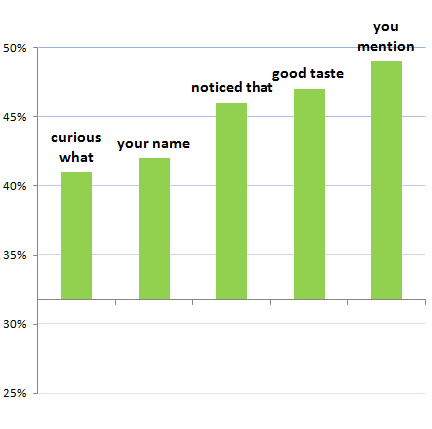
Instead of bravado and flattery, women appear to actually like men who take an interest in them.  They respond positively to phrases that indicate that a guy actually read their profile and is interested in the content of their person:
engage-chart

The lesson: Treat a woman (on the OK Cupid dating site) like a human being and she will respond positively.

And to answer the question, “What do women want?”  As my dear friend David Landsberg would say: “Everything!

This post originally appeared in 2009.

Lisa Wade, PhD is an Associate Professor at Tulane University. She is the author of American Hookup, a book about college sexual culture; a textbook about gender; and a forthcoming introductory text: Terrible Magnificent Sociology. You can follow her on Twitter and Instagram.
“First, let me say that I’m tired of all of this talk about ‘snubs,'” said an anonymous member of the Academy of Motion Picture Arts and Sciences. And continued:

And as far as the accusations about the Academy being racist? Yes, most members are white males, but they are not the cast of Deliverance — they had to get into the Academy to begin with, so they’re not cretinous, snaggletoothed hillbillies.

In the video below, Jay Smooth takes on the idea that only “hillbillies” are racist and asks about the idea of the “good person” and what it actually takes to be one.

Lisa Wade, PhD is an Associate Professor at Tulane University. She is the author of American Hookup, a book about college sexual culture; a textbook about gender; and a forthcoming introductory text: Terrible Magnificent Sociology. You can follow her on Twitter and Instagram.
The United States imprisons more people than any other country. This is true whether you measure by percentage of the population or by sheer, raw numbers. If the phrase mass incarceration applies anywhere, it applies in the good ol’ U. S. of A.

It wasn’t always this way. Rates of incarceration began rising as a result of President Reagan’s “war on drugs” in the ’80s (marijuana, for example), whereby the number of people imprisoned for non-violent crimes began climbing at an alarming rate. Today, about one-in-31 adults are in prison. his is a human rights crisis for the people that are incarcerated, but its impact also echoes through the job sector, communities, families, and the hearts of children. One-in-28 school-age children — 2.7 million — have a parent in prison.

2 (1)

In a new book, Children of the Prison Boom, sociologists Christopher Wildeman and Sara Wakefield describe the impact of parental imprisonment on children: an increase in poverty, homelessness, depression, anxiety, learning disorders, behavioral problems, and interpersonal aggression. Some argue that taking parents who have committed a crime out of the family might be good for children, but the data is in. It’s not.

Parental incarceration is now included in research on Adverse Childhood Experiences and it’s particular contours include shame and stigma alongside the trauma. It has become such a large problem that Sesame Street is incorporating in their Little Children, Big Challenges series and has a webpage devoted to the issue. Try not to cry as a cast member sings “you’re not alone” and children talk about what it feels like to have a parent in prison:

Wildeman and Wakefield, alongside another sociologist who researches the issue, Kristin Turney, are interviewed for a story about the problem at The Nation. They argue that even if we start to remedy mass incarceration — something we’re not doing — we will still have to deal with the consequences. They are, Wildeman and Wakefield say, “a lost generation now coming of age.”

The subtitle of their book, Mass Incarceration and the Future of Inequality, points to how that lost generation might exacerbate the already deep race and class differences in America. At The Nation, Katy Reckdahl writes:

One in four black children born in 1990 saw their father head off to prison before they turned 14… For white children of the same age, the risk is one in thirty. For black children whose fathers didn’t finish high school, the odds are even greater: more than 50 percent have dads who were locked up by the time they turned 14…

Even well-educated black families are disproportionately affected by the incarceration boom. Wakefield and Wildeman found that black children with college-educated fathers are twice as likely to see them incarcerated as the children of white high-school dropouts.

After the Emancipation Proclamation, Jim Crow hung like a weight around the shoulders of the parents of black and brown children. After Jim Crow, the GI Bill and residential redlining strangled their chances to build wealth that they could pass down. The mass incarceration boom is just another in a long history of state policies that target black and brown people — and their children — severely inhibiting their life chances.

Hat tip Citings and Sightings. Cross-posted at Pacific Standard.

Lisa Wade, PhD is an Associate Professor at Tulane University. She is the author of American Hookup, a book about college sexual culture; a textbook about gender; and a forthcoming introductory text: Terrible Magnificent Sociology. You can follow her on Twitter and Instagram.
California’s Central Valley is a bread basket of America. It is the source of much of the country’s grapes, tree fruit, nuts, and vegetables. Many of the farms are massive, requiring large amounts of capital, land, and labor.

In the nearby small towns are the homes of the state’s farm laborers. They are primarily Latino. About half are undocumented. Most are poor and few have health care. Politically and economically weak, they are the primary human victims of pesticide drift.

Pesticide drift occurs when chemicals leave the fields for which they’re intended and travel to where humans can be exposed. According to data summarized by geographer Jill Harrison for her article on the topic, California is a pesticide-intensive state. It accounts for 2-3% of all cropland in the U.S., but uses 25% of the pesticides. One in ten of registered pesticides are prone to drift and a third include chemicals that are “highly acutely toxic” or cause cancer, reproductive or developmental disorders, or brain damage. Officially, there are an average of 370 cases of pesticide poisoning due to drift every year, but farmworker advocates say that this captures 10% of the victims at best.

Teresa DeAnda, an environmental justice advocate, stands on the dirt road between an agricultural field and her neighborhood in an image posted at Voices from the Valley.

State officials and representatives of agriculture business minimize pesticide drift; Harrison calls this “down-scaling.” They claim it’s accidental, rare, and not an integral part of the system when it operates well. “Unfortunately from time to time we have tragic accidents,” says one Health Department official. “I think the number of incidents that have occurred given the, are really not that significant…” says another. “The system works,” says an Agricultural Commissioner, “Unfortunately, we have people who don’t follow the law.” All of these tactics serve to make the problem seem small and localized.

It’s not easy to get politicians to pay attention to some of the weakest of their constituents, but activists have made some headway by what Harrison calls “pushing it up the scale.” Contesting its framing it as small problem by virtue of its frequency or impact, they argue that pesticide drift is routine, regular, and systemic. “These things happen every day,” says one resident. “You can smell [the pesticide use],” says another. “You can see it. When you drive, it gets on your windshield.” An activist argues: “The art of pesticide application is not precision delivery. It’s sloppy, and it often spills.” They further contest the downscaling by arguing that pesticide drift is harming the overall air quality. By describing it as air pollution, they make it a state of California problem, one that affects everyone. This makes it more difficult for big agriculture to say it’s no big deal.

Upscaling and downscaling are both part of the politics of scale, a tactic that involves making a problem seem big or little. Harrison notes that many environmentalists advocate a local approach. “The local,’” she writes, “is commonly touted as the space in which people can most directly voice their concerns and effect political change, due to local officials’ proximity to constituents and familiarity with local issues.” This case, though, suggests that justice isn’t one size fits all.

If you’d like to know more the struggle for environmental justice in the San Joaquin Valley, sociologist Tracy Perkins has started a website, called Voices from the Valley. You can also check out Remembering Teresa for more on pesticide drift. Cross-posted at Pacific Standard.

Lisa Wade, PhD is an Associate Professor at Tulane University. She is the author of American Hookup, a book about college sexual culture; a textbook about gender; and a forthcoming introductory text: Terrible Magnificent Sociology. You can follow her on Twitter and Instagram.

Strawberry shortcake, chocolate covered strawberries, strawberry daiquiris, strawberry ice cream, and strawberries in your cereal. Just delicious combinations of strawberries and things? Of course not.

According to an investigative report at The Guardian, in the first half of the 1900s, Americans didn’t eat nearly as many strawberries as they do now. There weren’t actually as many strawberries to eat. They’re a fragile crop, more prone than others to insects and unpredictable weather.

In the mid-1950s, though, scientists at the University of California began experimenting with a poison called chloropicrin. Originally used as a toxic gas in World War I, scientists had learned that it was quite toxic to fungus, weeds, parasites, bacteria, and insects. By the 1960s, they were soaking the soil underneath strawberries with the stuff. Nearly every strawberry field in California — a state that produces 80% of our strawberries — was being treated with chloropicrin or a related chemical, methyl bromide.

In the meantime, a major grower had collaborated with the University, creating heartier varieties of strawberries and ones that could be grown throughout the year. These developments doubled the strawberry crop. This was more strawberries than California — and the country — had ever seen. The supply now outpaced the demand.

Enter: Strawberry Shortcake.

Photo by Ghislaine flickr creative commons.

Strawberry Shortcake was invented by American Greetings, the greeting card company. She was created in cahoots with the strawberry growers association. They made a deal, just one part of a massive marketing campaign to raise the profile of the strawberry.

The head of the association at the time, Dave Riggs, aggressively marketed tie-ins with other products, too: Bisquick, Jello, Corn Flakes, and Cheerios. Cool Whip still has a strawberry on its container and its website is absolutely dotted with the fruit.

Photo by Mike Mozart flickr creative commons.

Riggs went to the most popular women’s magazines, too — Ladies’ Home Journal, Redbook, and Good Housekeeping — and provided them with recipe ideas. It was an all out strawberry assault on America.

It worked. “Today,” according to The Guardian, “Americans eat four times as many fresh strawberries as they did in the 1970s.” We think it’s because we like them, but is it?

Lisa Wade, PhD is an Associate Professor at Tulane University. She is the author of American Hookup, a book about college sexual culture; a textbook about gender; and a forthcoming introductory text: Terrible Magnificent Sociology. You can follow her on Twitter and Instagram.

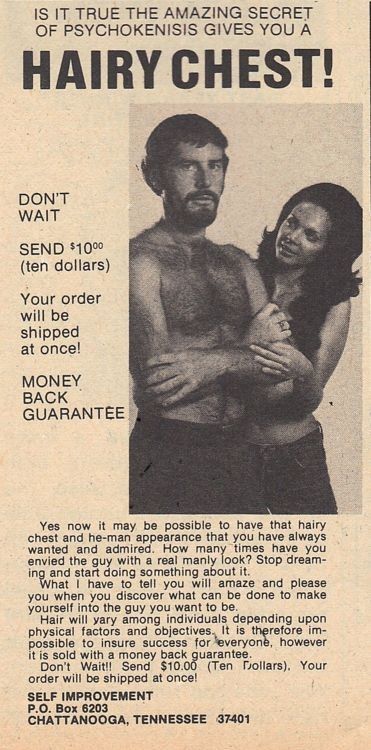
Back in the heyday of Burt Reynolds, having a hairy chest was oh-so-sexy. What a departure from the hairless chests of today’s masculine icons. At least it makes some sense to associate chest hair with masculinity, since men on average have more of it than women. It just goes to show that everything’s a social construction. But you knew that. ;)

2

Found at Cult of the Weird.

Lisa Wade, PhD is an Associate Professor at Tulane University. She is the author of American Hookup, a book about college sexual culture; a textbook about gender; and a forthcoming introductory text: Terrible Magnificent Sociology. You can follow her on Twitter and Instagram.

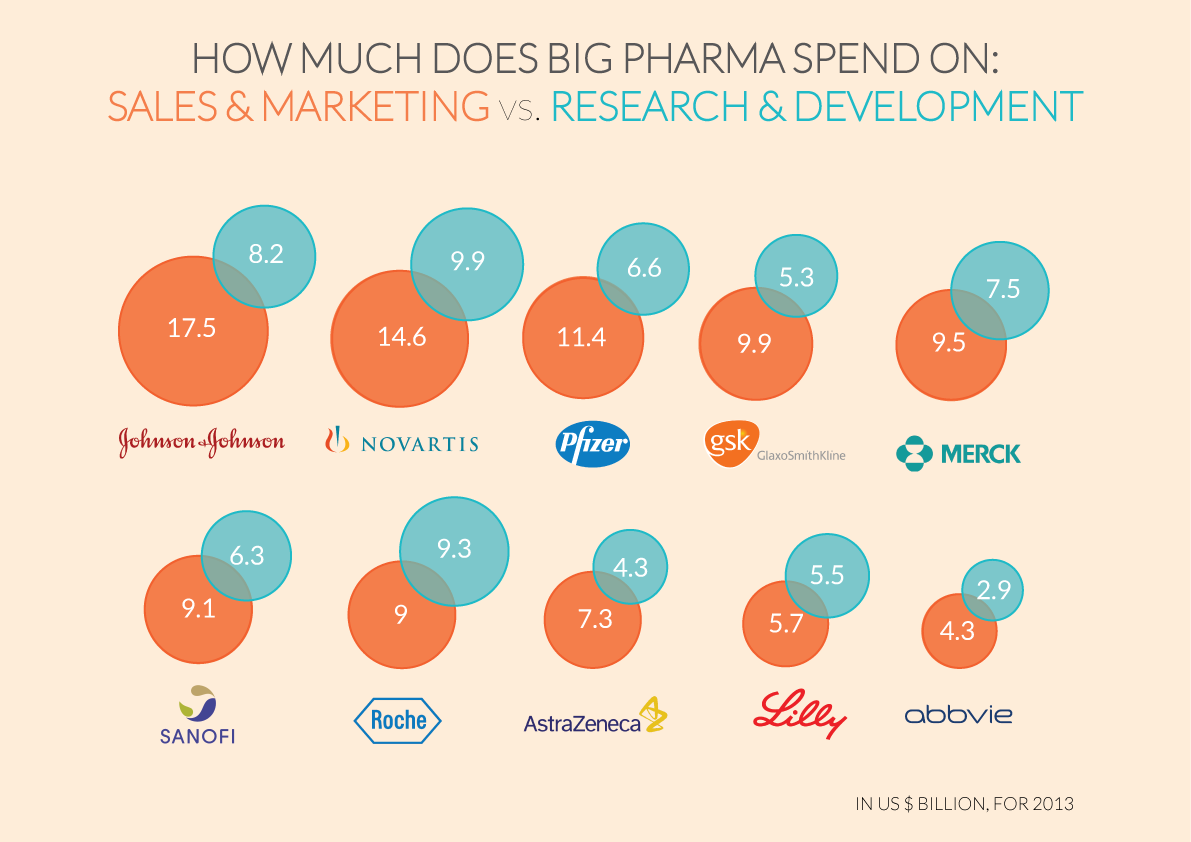
Pharmaceutical companies say that they need long patents that keep the price of their drugs high so that they can invest in research. But that’s not actually what they’re spending most of their money on. Instead, they’re spending more — sometimes twice as much — on advertising directly to doctors and consumers.

Data from the BBC, visualized by León Markovitz:

2“When do you cross the line from essential profits to profiteering?,” asked Dr Brian Druker, one of a group of physicians asking for price reductions.

Lisa Wade, PhD is an Associate Professor at Tulane University. She is the author of American Hookup, a book about college sexual culture; a textbook about gender; and a forthcoming introductory text: Terrible Magnificent Sociology. You can follow her on Twitter and Instagram.