Archive: Feb 2015

Flashback Friday.

An article at Scientific American draws attention to the environmental cost of the commodification of flowers as a symbol of love.  Carolyn Wheelan writes:

[Roses] are… fragile and almost always flown to the U.S. from warmer climes in South America, where roughly 80 percent of our roses take root; to warm the hearts of European sweethearts, they are most often imported from Africa. They are then hauled in temperature-controlled trucks across the U.S. or the Continent and locked up overnight in cold boxes before their onward journey to the florists of the world… sending the roughly 100 million roses of a typical Valentine’s Day produces some 9,000 metric tons of carbon dioxide (CO2) emissions from field to U.S. florist.

When flowers aren’t shipped in to cooler climates, they must be grown in greenhouses, like the Yuzhny Greenhouse Farm in Russia pictured above.  Some flower farms take the form of vast arrays of greenhouses that use energy to maintain a microclimate out of synch with the climate in which they are situated.

The SciAm article does a good job of pointing out that not all flower farms are equal and there are lots of more and less environmentally- and socially-conscious choices.Fair trade, worker-conscious, organic, and otherwise environmentally-friendly flower companies claim to offer an alternative.  Florverde, for example, advertises its flowers as “for the earth, for the workers, for you”:

Originally posted in 2009. h/t Jezebel.

Lisa Wade, PhD is an Associate Professor at Tulane University. She is the author of American Hookup, a book about college sexual culture; a textbook about gender; and a forthcoming introductory text: Terrible Magnificent Sociology. You can follow her on Twitter and Instagram.
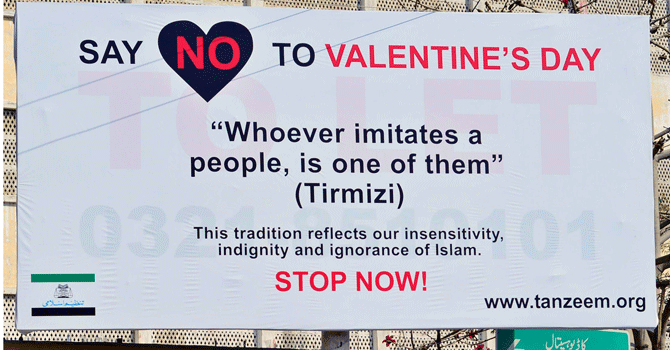
On Valentine’s day last year, my Facebook feed exploded with Pakistani memes that, on the one hand, used Islamic texts to criticize the day as unIslamic and, on the other, poked fun at the religious opposition to the holiday.
6a00d83451e32769e2017c37de69e8970b-800wi
When I conducted interviews with Pakistani women in Karachi over the summer, I expected Valentine’s day to be a salient event for my participants.  I did find religious resistance to Valentine’s Day.  The more religious-minded participants  were likely to say things like: “St. Valentine is remembered for fathering illegitimate children, so the day is sinful.”

Less religious women, however, seemed surprised that I even asked about it.  “I can’t remember what I did,” they would say, or they would criticize it as “cheesy” or  “too commercial.” A few respondents asked: “Why does there have to be one day for love? Every day should be a celebration of love.”

Based on the media, I was expecting a contest between people who embraced Valentine’s Day and people who rejected it, but I only found one side of the debate: the rejection.  There didn’t seem to be a large group of women who embraced it. Among those who didn’t outright reject it, I discovered only disinterest.

All this suggests that the push to make Valentine’s Day a thing in Pakistan is more about capitalism and the globalization of Western norms and practices, than it is about a grassroots desire for such a celebration.  It is the marketers, mall managers, and restaurant owners that seem most interested in Valentine’s Day.  I originally thought of this as a battle between the religious and secular members of the society, but it seems to be, instead, a resistance by some to efforts of companies to find one more way to make money.

Fauzia Husain is a PhD student in sociology at the University of Virginia.  She is currently studying globalization through an exploration of Pakistani women’s narratives about love.

The day I defended my dissertation I watched Chaotic, the Britney Spears/Kevin Federline reality show, from beginning to end. True story. The next day I pulled all of the paperback classic novels from my bookshelves and donated them to Goodwill. They were mostly tattered Penguin copies of things like The Sun Also Rises and The Stranger. I was done with them.

I was the first person in my family to get a traditional college degree and those books meant a lot to me for a long time. I was an insecure student; a sufferer of the famous imposter syndrome.  The books were a signal to myself — and perhaps others, too — that I was a Smart, Educated Person with Intelligent Tastes. They were what sociologist Pierre Bourdieu would call cultural capital, objects that indicate my membership in a particular class. Both Chaotic and the purging of the books were part of the same cathartic expression: relief, incredible relief, at having not-failed. I had a new form of cultural capital now, a more powerful version of that message. I had a PhD. I could afford to toss the paperbacks.

Today, as someone who has officially “made it” in academia, I need those books even less than I did on that transitional day. And, as I’ve made the journey from nervous graduate student to tenured professor, I’ve slowly come to understand what an incredible privilege it is to carry the institutional capital that I do.

Every time I have the opportunity to admit I was wrong or confess a lack of knowledge, for example, I can do so without fear that anyone will think that I’m generally stupid or ignorant. Others assume I’m smart and knowledgeable because of the pedigree, whether I am or not. People who aren’t as lucky as I — who have the wrong accent, the wrong teeth, or the wrong clothes, and who don’t have the right degrees, jobs, and colleagues — they are at risk of being labeled as generally stupid or ignorant whenever they make an intellectual misstep, whether they are or not.

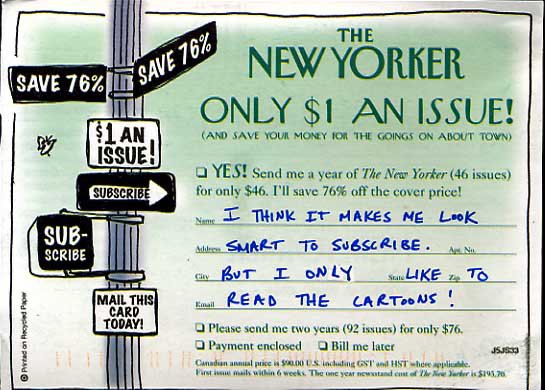
To them, that used Penguin copy of The Stranger may be more valuable than the $0.03 it costs on Amazon. In another part of the social strata, it might be worth it to pay $46 for that subscription to The New Yorker. The subscriber may only read the cartoons, but they don’t mind because, after all, that’s not really what they’re paying for.

1aImage via PostSecret. Cross-posted at Pacific Standard.

Lisa Wade, PhD is an Associate Professor at Tulane University. She is the author of American Hookup, a book about college sexual culture; a textbook about gender; and a forthcoming introductory text: Terrible Magnificent Sociology. You can follow her on Twitter and Instagram.
If it were to happen that the decision as to whether the tomato was a fruit or vegetable made it to the highest court of the land — if such a strange thing were to happen — certainly the botanist’s opinion would weigh heaviest. Right?

Nope.

In fact, this decision did make it all the way to the Supreme Court. It happened in 1893. The case was brought by a tomato importing family by the last name of Nix. At the time, the law required that taxes be collected on vegetables that were imported, but not fruit.

The lawyers for the Nix family argued that the tomato is a fruit and, therefore, exempt from taxation. They were, of course, correct. Botanists define fruit according to whether it plays a reproductive role. So, any plant product with one or more seeds is a fruit, whereas vegetables don’t have seeds. Fruits are ovaries, for lack of a better term. All other plant products — stems, roots, leaves, and some seeds — are vegetables.

But the Supreme Court said, essentially, “We don’t care” and gave their gavel a good pound. Here’s some of the text of their unanimous opinion:

Botanically speaking, tomatoes are the fruit of a vine… But in the common language of the people, whether sellers or consumers of provisions, all these are vegetables which are grown in kitchen gardens, and which, whether eaten cooked or raw, are… usually served at dinner in, with, or after the soup, fish, or meats which constitute the principal part of the repast, and not, like fruits generally, as dessert.

The judges were referring to the common understanding, which has more to do with how we use the plant products than how plants use them. Your typical chef roughly divides plant products according to whether they’re sweet or savory. Fruits are sweet. Vegetables are savory and used for main courses and sides. It’s all about whether you eat them for dinner or dessert. And that’s what the Supreme Court upheld.

Culinary vs. botanical categorization (source):

2

Since the culinary scheme dominates our colloquial understanding, we mis-classify lots of other things, too. Zucchini, bell peppers, eggplants, string beans, cucumbers, avocado, and okra — all fruit. Rhubarb is a vegetable. No seeds. Pineapples are fruits. “Ah ha!” you say, “I’ve never noticed a pineapple having seeds!” That’s because commercial growers sell us seedless pineapples. Who knew. Berries are fruit, but strawberries, blackberries, and raspberries are not actually berries. Isn’t this fun?

Bruno Latour and Steve Woolgar, in Laboratory Life: The Social Construction of Scientific Facts, wrote:

If reality means anything, it is that which “resists” the pressure of a force. … That which cannot be changed at will is what counts as real.

We often think of cultural facts as somehow less real than biological ones. For the Nix family, though, biology mattered naught. They still had to pay the damn tax on their tomatoes. Culture is real, folks. Social construction is not just something we do to reality; for all intents and purposes, it is reality.

Cross-posted at Pacific Standard.

Lisa Wade, PhD is an Associate Professor at Tulane University. She is the author of American Hookup, a book about college sexual culture; a textbook about gender; and a forthcoming introductory text: Terrible Magnificent Sociology. You can follow her on Twitter and Instagram.

Thanks for the comic about meta-analyses, xkcd.

Click to enlarge:2
From Business Insider; h/t Gin and Tacos.

Lisa Wade, PhD is an Associate Professor at Tulane University. She is the author of American Hookup, a book about college sexual culture; a textbook about gender; and a forthcoming introductory text: Terrible Magnificent Sociology. You can follow her on Twitter and Instagram.

Flashback Friday.

I have always found it bizarre that lipstick is supposed to make a woman’s lips more irresistible, yet kissing a woman with lipstick gets sticky red or pink smudge all over both faces. So women dress up and look all gorgeous and then their dates can’t kiss them. Or, it’s the end of the night and a woman wants her date to kiss her, does she put on lipstick or go for the chapstick?  Gah, being a woman is hard. And I supposed it can’t be that easy being the person who wants to kiss her in that situation either.

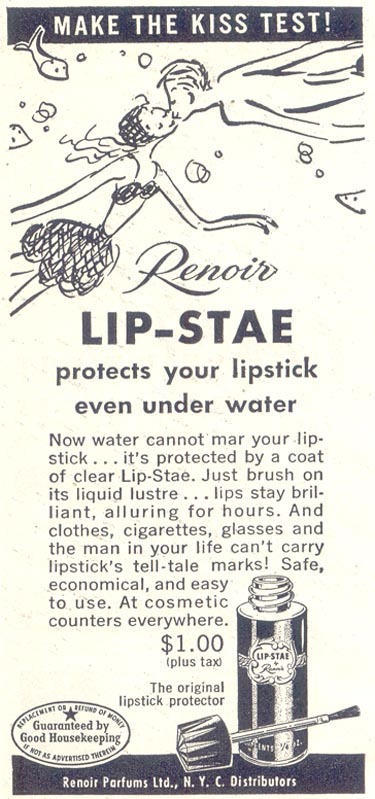
It’s odd to me that this kiss-ability paradox is never addressed in lipstick advertising.  So I was intrigued to see it in this vintage ad:

2b3b0750

Text:

Now water cannot mar your lipstick… it’s protected by a coat of clear Lip-Stae.  Just brush on its liquid lustre… lips stay brillint, alluring for hours.  And clothes, cigarettes, glasses and the man in your life can’t carry lipstick’s tell-tale marks!  Safe, economical, and easy to use. At cosmetic counters everywhere. (my emphasis)

There is so much to unpack here, but I think it all revolves around the fact that women are supposed to wear makeup, but pretend that the face that they put on is their real face.  As the copy reads, lipstick leaves “tell-tale marks.”  Those marks reveal a degree of deception regarding her true attractiveness and, in fact, this is exactly how makeup was characterized in the Victorian era.  This is why a woman’s lipstick must remain on her lips (and be left nowhere else) even when swimming or kissing.  Because, in principle, she’s not wearing lipstick at all.

This post originally appeared in 2009.

Lisa Wade, PhD is an Associate Professor at Tulane University. She is the author of American Hookup, a book about college sexual culture; a textbook about gender; and a forthcoming introductory text: Terrible Magnificent Sociology. You can follow her on Twitter and Instagram.
Americans have become increasingly critical of public policy as a means of addressing social problems.  Many believe that these policies don’t work; the reality is that public policies are often subverted in ways that make them ineffective or even counterproductive.

Take taxes and inequality.  As Danny Vinik, writing in the New Republic explains:

The vast majority of Americans—both liberals and conservatives—believe that state and local taxes should also be progressive. That’s the finding of a new report released by WalletHub Monday. The researchers surveyed 1,050 Americans on what they thought the combined rate of state and local taxes should be at various income levels. Not surprisingly, liberals want the rate structure to be a bit more progressive than conservatives do, but their responses [as the following chart shows] were relatively similar:

1 (3)

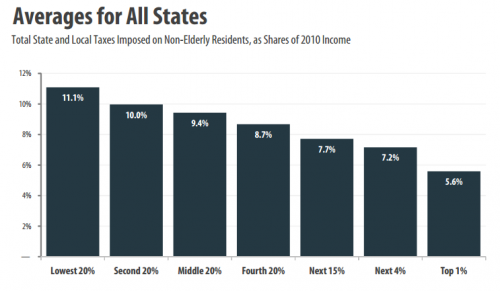
However the reality is quite different.  State and local taxes are actually quite regressive.  The Institute for Taxation and Economic Policy studied the “fairness of state and local tax systems by measuring the state and local taxes that will be paid in 2015 by different [non-elderly] income groups as a share of their incomes.”  They did this state by state and, as presented below, on an overall basis.  As we can see, the lower the income, the greater the state and local tax burden.

1 (4)

Here are some of the report’s key findings:

  • Virtually every state tax system is fundamentally unfair, taking a much greater share of income from low- and middle-income families than from wealthy families. The absence of a graduated personal income tax and overreliance on consumption taxes exacerbate this problem.
  • In the 10 states with the most regressive tax structures (the Terrible 10) the bottom 20 percent pay up to seven times as much of their income in taxes as their wealthy counterparts. Washington State is the most regressive, followed by Florida, Texas, South Dakota, Illinois, Pennsylvania, Tennessee, Arizona, Kansas, and Indiana.
  • Heavy reliance on sales and excise taxes are characteristics of the most regressive state tax systems. Six of the 10 most regressive states derive roughly half to two-thirds of their tax revenue from sales and excise taxes, compared to a national average of roughly one-third . Five of these states do not levy a broad-based personal income tax (four do not have any taxes on personal income and one state only applies its personal income tax to interest and dividends) while four have a personal income tax rate structure that is flat or virtually flat.
  • States commended as “low tax” are often high tax states for low-and middle-income families. The 10 states with the highest taxes on the poor are Arizona, Arkansas, Florida, Hawaii, Illinois, Indiana, Pennsylvania, Rhode Island, Texas, and Washington. Seven of these are also among the “terrible ten” because they are not only high tax for the poorest, but low tax for the wealthiest.

In short, we know how to construct tax policies that can lessen inequality, but we’re not using state and local taxes to do it.

Cross-posted at Reports from the Economic Front and Pacific Standard.

Martin Hart-Landsberg is a professor of economics at Lewis and Clark College. You can follow him at Reports from the Economic Front.