Archive: 2012

Cross-posted at Montclair SocioBlog.

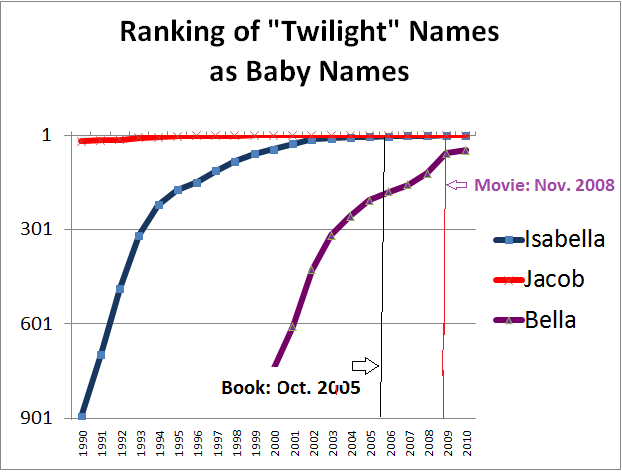
Jacob and Isabella were the most popular baby names last year.  Some observers, even some sociologists, see this as the influence of the Twilight series.  (See here for example.)

But Jacob, Isabella, and even Bella were on the rise well before Stephanie Meyer sent her similarly-named characters out to capture the hearts, minds, and naming preferences of romantic adolescents:
The forecasters predict a bumper crop soon in Rue, Cato, and perhaps other names that are from the Hunger series.  Still, since the YA (Young Adult) audience for these books and movies are more Y than A, I’m hoping for lag time of at least a few years before they start naming babies.  As I blogger earlierSplash, the film with Darryl Hannah as Madison the mermaid, came out in 1984, but it was not until nine years later that Madison surfaced in the top 100 names. And if there’s a Hogwarts effect, we’re still waiting to see it.  The trend in Harry and Harold is downward on both sides of the Atlantic, and Hermione has yet to break into the top 1000.

Don’t look for any Katnisses to be showing up in your classes for quite a while.

Alexandra O’Dell, a student at North Idaho College, does a great job of integrating data, interviews, and images in this 11-minute video about the sexualization of young girls in the media:

Lisa Wade, PhD is an Associate Professor at Tulane University. She is the author of American Hookup, a book about college sexual culture; a textbook about gender; and a forthcoming introductory text: Terrible Magnificent Sociology. You can follow her on Twitter and Instagram.

Dolores R. sent in a flubbed opportunity to represent Mexicans positively and reach out to the expanding Mexican market in the U.S.  In “honor” of Cinco de Mayo, Mike’s Hard Lemonade hired five men —  in fake mustaches and sombreros — to pretend to be a Mariachi band.  They then improvised songs in response to submissions from viewers.  The stunt is self-conscious, along the lines of the “ironic” “hipster racism” we now see so much of.

The fake band may have been making fun of themselves, but they did so by engaging in something that they had already decided was ridiculous, Mariachi music.  Happy Cinco de Mayo, everyone.

A better approach, Latino Rebels suggests, would have been to spotlight some of the actual awesome Mariachi music out there.  They wouldn’t have even had to be traditional.  They could have hired a real band to improvise, or they could have drawn on the existing Mariachi cover bands, bands that do really neat stuff!  Here’s, for example, is a band covering Hotel California:

Lisa Wade, PhD is an Associate Professor at Tulane University. She is the author of American Hookup, a book about college sexual culture; a textbook about gender; and a forthcoming introductory text: Terrible Magnificent Sociology. You can follow her on Twitter and Instagram.

CGP Gray is in rare form in this 4 1/2 minute argument in favor of phasing out the penny. He argues, entertainingly, that:

…they cost more to make than they’re worth, they waste peoples’ time, they don’t work as money, and because of inflation they’re less valuable every year making all the other problems worse.

See what you think:

Also from CGP Gray:

Lisa Wade, PhD is an Associate Professor at Tulane University. She is the author of American Hookup, a book about college sexual culture; a textbook about gender; and a forthcoming introductory text: Terrible Magnificent Sociology. You can follow her on Twitter and Instagram.

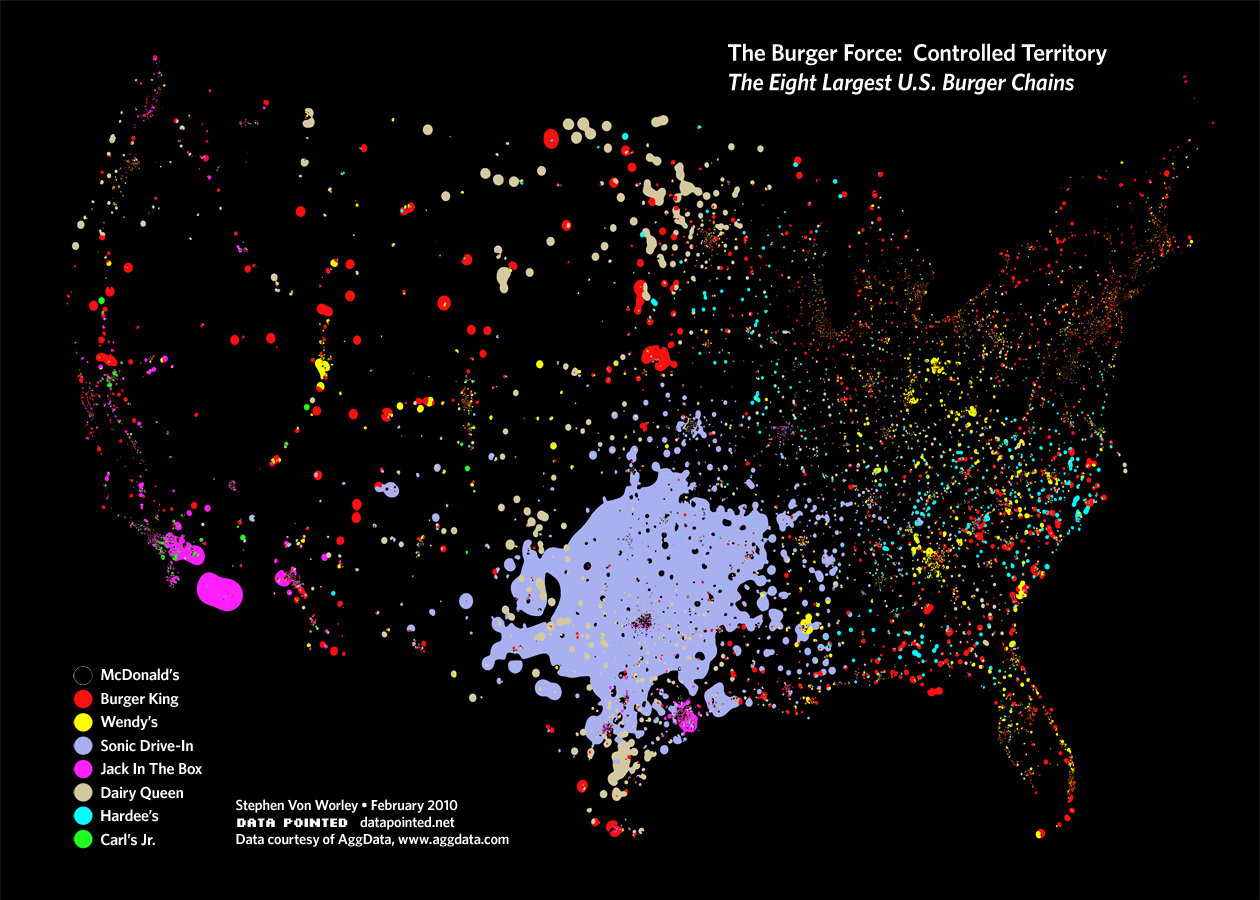
A couple of years ago, Lisa posted about the ubiquity of McDonald’s in the U.S., highlighting a map that showed the distance from the nearest McDonald’s. As a follow-up to that, Data Pointed posted a map that illustrates the unevenness of its market dominance across the country. If we plot the markets dominated by the top 8 hamburger-based chains (in terms of sales), we see that though McDonald’s is the single largest burger chain in most of the U.S. (all the black territory), other chains outsell McDonald’s in many markets, with the Sonic-dominated Southern Plains the most obvious:

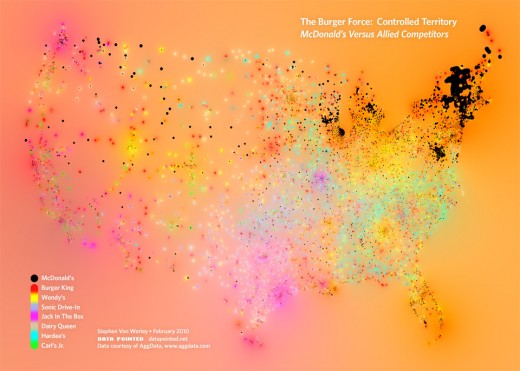
In fact, there are relatively few places where McDonald’s has an outright majority of the market share; in most areas, the combined sales of its 7 largest competitors are more than McDonald’s:

This illustrates the importance of the ubiquity shown in the map Lisa originally posted. McDonald’s might like to truly dominate every market; it ideally would probably like to have a monopoly on them. But it doesn’t have to in order to successful and to exert incredible market power. It doesn’t need to control every individual market in order to exert enormous influence on the fast food industry, from setting the standard for labor practices to influencing which varieties of potatoes farmers grow for the french fry market. The “be everywhere” model allows it to win the larger burger chain war, even if it loses some regional market battles.

Cross-posted at Montclair SocioBlog.

I don’t know much about game theory.  I’ve always found it hard to squeeze real-life situations into the shape of a prisoner’s-dilemma matrix and to think of life as a game.  A game show, on the other hand, is a game.  And the final round of the British show “Golden Balls” is totally Prisoner’s Dilemma.  (Shouldn’t that apostrophe be moved to make it be Prisoners’ Dilemma? After all, it’s not solitaire.)

You can get the idea of the set-up in the first two minutes of this clip.*  But don’t stop there.  Watch the full six minutes, and appreciate the ingenuity of the strategy played by Nick (he’s the guy in the brown shirt on the right of the screen).

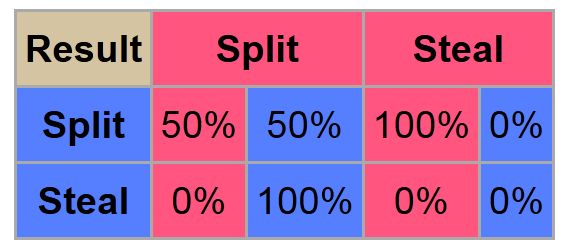
SPOILER SPACE, which I’ll fill with the “Golden Balls” matrix.

In many prisoner’s dilemma scenarios, the prisoners are separated and can’t discuss their options.  In “Golden Balls,” they can talk things over, the only catch being that each player is well aware that the other might be lying.  Earlier rounds of the game are designed to encourage lying.

Nick is ingenious in two ways.  First, he brings in an option that “Golden Balls” does not include but cannot exclude: the offer to split the loot 50-50 after the show even if the show gives the entire amount to him.

Second (and here is where my lame game-theory knowledge is showing), by convincingly maintaining that he is going to Steal, he destroys the Nash equilibrium that “Golden Balls” tries to create.  He forces Ibraham to choose Split, for Ibraham’s position now becomes this:

  • If Nick is fully telling the truth about sharing: Split, I get £6500. Steal, I  get 0.
  • If Nick is lying about sharing: Split, I get 0.  Steal, I get 0.
  • So my only hope of getting anything is Split.

Which is what he does.

Nick’s ploy also creates an interesting dramatic switcheroo for the viewers as well.  As we watch the clip, it looks as though all the pressure is on Ibraham.  We can see him debating with himself and with Nick.  But after the two men show their balls, we realize that in reality, it’s Nick who had to be sweating, not about which choice he will make – he has already decided that – but about whether he is actually fooling  Ibraham.  He was betting £13,000 on his own acting ability.  That takes balls.

One other observation: I used to watch “Survivor,” and when players would lie and succeed, I might have admired them for being the clever strategist, but I didn’t like them.  In fact, I often actively disliked them.  But here, when I found that Nick had lied successfully, I was hoping that Ibraham or “Golden Balls” would give him a few extra pounds as a bonus.

* The clip is from February.  I found it thanks to  Planet Money, which posted it last week without comment.

I recently put together a Pinterest board featuring our examples of light-tan clothes and products described as “nude,” “skin-colored,” or “flesh-colored.”  The practice erases or marginalizes people with medium or dark-colored skin by presuming that everyone’s flesh is light tan… even Michelle Obama can be a victim of this kind of insensitivity.  Lil’ Kim, too!

Inspired by our older posts, I decided to check up on the Internets and see if the trend was still alive.  Indeed, and alas.  The first example I stumbled upon was Vera Wang’s 2012 wedding dress collection.  The collection isn’t up on Wang’s website at the time I’m writing, but media outlets are consistently describing the collection as featuring “nude” and “black” dresses.  The Huffington Post is one example.

I decided to go with the wedding theme. At Martha Stewart, she suggests a “powder blue and nude palette” for the ceremony and reception. Project Wedding had many examples of nude clothing and other items. Finally, Belle had a collection of “nude” wedding shoes.

To reiterate, calling this color “nude” reminds us all that light-skinned people are regular people and everyone else needs a modifying adjective.  In addition to the many other examples of this that we encounter everyday — like lotion for “normal to darker skin,” ornaments in “bride and groom” and “African-American bride and groom,” and dolls in “dolls” and “ethnic dolls” — these instances can be constant and exhausting examples of one’s marginality.

Lisa Wade, PhD is an Associate Professor at Tulane University. She is the author of American Hookup, a book about college sexual culture; a textbook about gender; and a forthcoming introductory text: Terrible Magnificent Sociology. You can follow her on Twitter and Instagram.

The foreclosure crisis that emerged in 2006 continues to displace families and change neighborhoods, creating holes in the social fabric of communities. Kathryn Clark, artist and former urban planner, has created a series of “foreclosure quilts” based on maps of urban areas, with holes representing foreclosed houses.  These unique visual representations call our attention to the holes that remain after foreclosure.

Clark writes on her blog:

The quilt is pieced together using patterns of neighborhood blocks taken from RealtyTrac maps.  Within these, foreclosed lots are shown as holes in the quilts.  The lot locations are completely random and they yield an unexpected beauty when laid out on fabric. These torn holes question the protective nature of a quilt. The situation is so dire that even a quilt can’t provide the security one needs.

Clark’s artistic rendering of these maps points to the size and spread of the foreclosure problem, but also evokes the conflicting experience of home and the reality of the housing market.  Homes, like quilts, promise warmth, comfort and continuity, a connection to family and a sense of protection.  The holes in the quilts powerfully evoke the false promise of security offered by home ownership in the contemporary U.S.

Public policy and real estate market professionals have actively worked to construct home as an owner-occupied, single family house (as opposed to rental, communal space, or other residential option).  The preference for ownership has become so strong that many forgo other forms of investment for a mortgage on a house, and those who rent are told that they are “throwing their money away.”  This normative belief that home ownership is the most desirable option for adults provided justification for consumers to risk their savings, even when offered poor subprime loans, because ownership is symbolically important.

The foreclosure quilts call our attention to the holes that have been produced by the collapse of the housing market.  The focus on neighborhoods and blocks rather than individual houses and families encourages us to think about the impact on communities as well as individuals.  These quilts offer little comfort, and hopefully provoke questions about the sustainability of our singular focus on home ownership.

For images of Clark’s quilts, check out her blog and website or an article on her work at The Atlantic Cities page.

Karen McCormack is an assistant professor of sociology at Wheaton College in Norton, Massachusetts.  She is currently studying the strategies that people employ to manage the risk of losing their homes to foreclosure.