Archive: Aug 2012

Tip: This may look like a boring update post, but you really, really, really want to scroll down to the bottom.

SocImages News

Resources for Instructors (and Other Curious Types)

If you haven’t yet, please visit our For Instructors page.  Here are some highlights:

Course Guides

As you begin the Fall semester, don’t forget about our amazing Course Guides!  These organize SocImages posts in a way that follows standard syllabi for frequently-taught sociology courses.  We currently feature the following:

For those of you that already use them.  Thank you so much!  Our guides have been visited, collectively, 43,000 times.  We’re thrilled.

Have a Guide you might like to put together?  We’re looking for volunteers — sociology professors or graduate students — who are willing to browse our archives, pull out the most compelling posts, and arrange them in ways other instructors would find familiar and convenient.  The Guides can cover entire courses or be designed to help illustrate a theory, article, or book.  (We’re even happy to have duplicate Guides, since every instructor is different.)  Send us an email at socimages@thesocietypages.org.

Pinterest Pages

Our Pinterest pages are fun for everyone, but they’re useful for professors looking for just the right image to illustrate an idea.  We currently have one page with all SocImages material (over 9,000 pins!) and 17 pages on specific topics.  Please feel free to browse!

Upcoming Lectures and Appearances:

Lisa has started booking talks and lectures for the fall.  Her first talk will be at Indiana State University (Sept. 17th-19th) where she’ll be giving a featured lecture at the International Crime, Media & Popular Culture Studies Conference.

Social Media ‘n’ Stuff:

Finally, this is your monthly reminder that SocImages is on TwitterFacebookGoogle+, and Pinterest.  Lisa is on Facebook and most of the team is on Twitter: @lisadwade@gwensharpnv@familyunequal@carolineheldman@jaylivingston, and @wendyphd.

In Other News…

We totally went to an aerobics class taught by Richard Simmons! It was every bit as wacky and amazing as you would think it would be. He even took a  photo with us. If you’re in L.A., you can take a class with him for only $12, and we highly recommend it. Here we are with Richard in all our post-workout glory:

The recession is over in the U.S.. We’re now in the recovery period.

This would be more comforting if the pace of the recovery weren’t glacial. If you pay attention to weekly unemployment numbers or monthly economic reports, you’ve gotten used to the word “disappointing.” Yes, the economy is gaining jobs, but slowly. At this rate, it would take years to climb out of the hole the recession left us in.

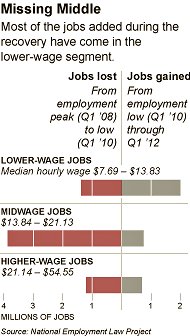
But the slow pace of growth isn’t the only concern. The New York Times discusses the types of new jobs being created. While the majority of the jobs lost were midwage jobs, so far most of the new jobs are low-wage:

We’re not gaining new jobs very quickly. And when we do, it’s hard to find a job that provides a solidly middle-class income among those that are being added, continuing the trend of job polarization that economists have shown is reinforced during economic downturns.

Sociological Images owes a great debt to Jean Kilbourne, a pioneer in the feminist critique of advertising.  She’s most famous, probably, for her video series, Killing Us Softly.

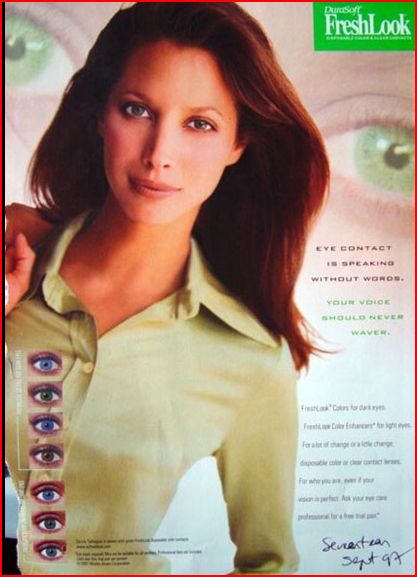
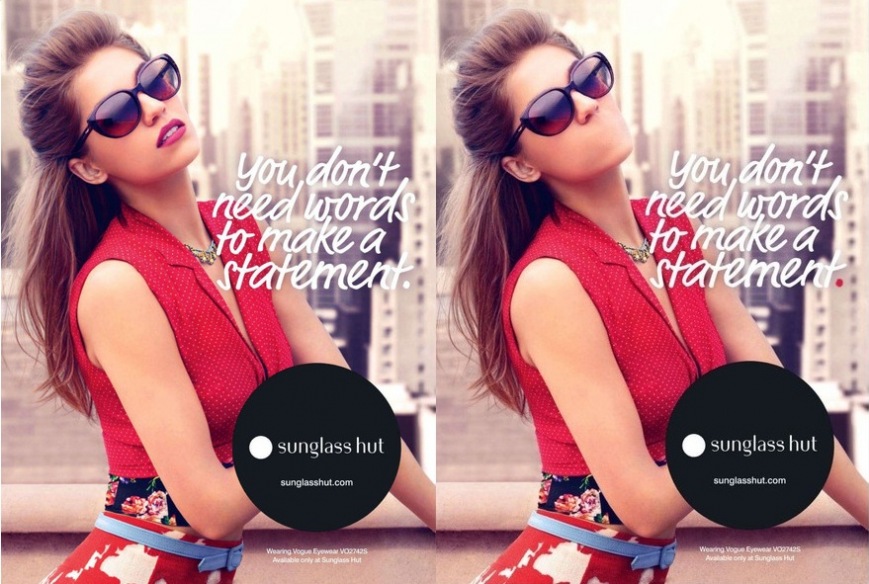
In those videos, she offers a typology of ways that women are subordinated in media content.  One of those is silencing.  Sometimes this means actually covering a woman’s mouth (forcibly, but also playfully), other times copy simply says that she need not (or shouldn’t) speak.  Below are a series of images we’ve collected that illustrate this.  Some of them are dated, but they give you an idea of what the mechanism of silencing looks like.

Canada’s Next Top Model (Cycle 3), sent along by Julie C., included a photoshoot in which the models’ mouths were covered with duct tape.

Erin S. sent in a link to a set of fashion photos in New York Magazine that show faceless women.

Reanimated Horse sent us an American Apparel ad in which the woman’s body is highlighted but her face is obscured:

-1

The next two ads are examples of one’s that suggest that women need not speak, that products can speak for them.

“Eye contact is speaking without words”:
capture111

“Make a statement without saying a word”:
capture221

Finally, Sarah B. sent along a form of resistance to these kinds of images.  Colin von Heuring, who just started a brand new blog on media subversion, saw an ad with the copy  “You don’t need words to make a statement.”  He decided to “ma[k]e it explicit” (original on the left, modified on the right):

For more on Jean Kilbourne and the subordination of women in advertising, here’s the trailer to Killing Us Softly 4:

Lisa Wade, PhD is an Associate Professor at Tulane University. She is the author of American Hookup, a book about college sexual culture; a textbook about gender; and a forthcoming introductory text: Terrible Magnificent Sociology. You can follow her on Twitter and Instagram.

Today is the first day of school at the college where I teach, so I thought it would be a nice time to re-post this oldie-but-goodie on the relationship between income and SAT scores.  I’m sure all of our students are brilliant, of course, but whether the SAT measures intelligence fairly is up for debate.

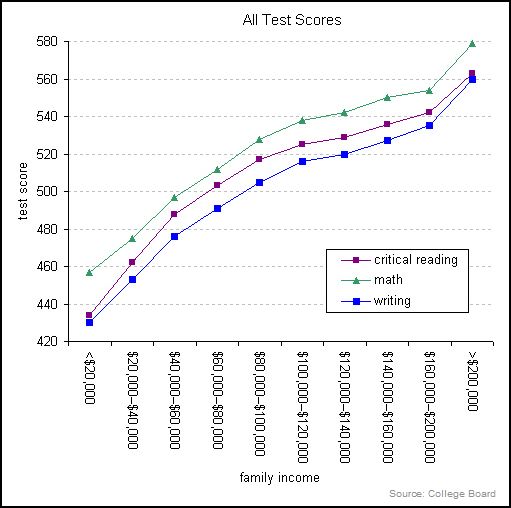
The College Board is an education association that, among other things, administers the SAT college entrance examination.  A report on the scores from 2009, reviewed by the New York Times, included a break down of scores by the household income of the student. Scores correlate strongly and positively with income:

I can think of two explanations for the correlation.

First, it is certainly true that children with more economic resources, on average, end up better prepared for standardized tests.  They tend to have better teachers, more resource-rich educational environments, more educated parents who can help them with school and, sometimes, expensive SAT tutoring.

Second, the test itself may be biased towards wealthier students.  These tests tend to be written and evaluated by privileged individuals who may inadvertently include class-based knowledge, not just knowledge, in the exam (asking questions, for example, that rely on background information about golf instead of basketball).

In any case, this correlation should give us pause; it calls into question, quite profoundly, the extent to which the SAT is functioning as a fair measure.  Perhaps it measures preparedness for college, but whether it measures potential is up for debate.

Lisa Wade, PhD is an Associate Professor at Tulane University. She is the author of American Hookup, a book about college sexual culture; a textbook about gender; and a forthcoming introductory text: Terrible Magnificent Sociology. You can follow her on Twitter and Instagram.

August 29th is the anniversary of the day that Hurricane Katrina devastated the Gulf Coast and side-swiped New Orleans, breaching the levees.  These posts are from our archives:

Was Hurricane Katrina a “Natural” Disaster?

Racism and Neglect

Disaster and Discourse

Devastation and Rebuilding

Lisa Wade, PhD is an Associate Professor at Tulane University. She is the author of American Hookup, a book about college sexual culture; a textbook about gender; and a forthcoming introductory text: Terrible Magnificent Sociology. You can follow her on Twitter and Instagram.

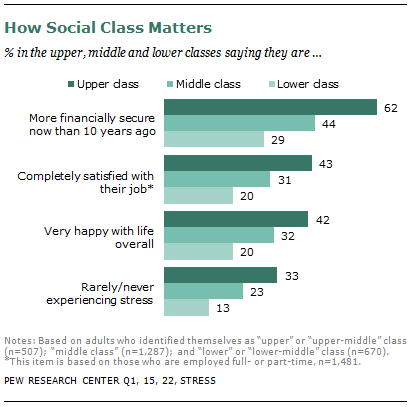
The Pew Research Center has released the results of a poll of 2,508 adults about social class and life experiences.

An important caveat to start with: the poll asked people to categorize themselves as upper (2% of respondents), upper-middle (15%), middle (49%), lower-middle (25%), or lower class (7%). We know that there’s a tendency among people in the U.S. to identify as middle class, even when their actual income falls far below or above what could reasonably be considered middle class, and the survey didn’t ask about incomes or assets to compare to individuals’ self-identification. There’s likely to be some overlap between the categories if we actually looked at the income/wealth of participants. The graphs below combine those who defined themselves as upper or upper-middle class together into the “upper class” category, while those who said lower-middle are assigned to the “lower class” group.

Not surprisingly, there were large differences by social class in a number of quality-of-life areas. The higher one’s class, the more likely they were to say they were better off than they were 10 years ago and were happy with life and rarely experience stress (though apparently we’re generally pretty stressed overall):

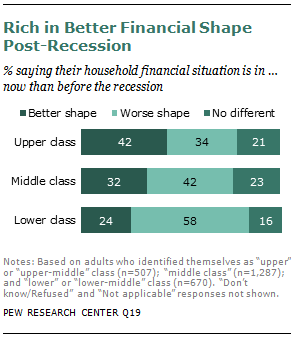
The lower class is much more likely than the other groups to say they are in worse shape than they were before the recession, indicating that they continue to suffer disproportionately from the effects of the economic meltdown and the slow recovery:

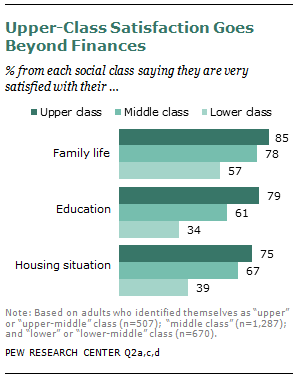
Those defined as lower class were much less satisfied with family life, their level of education, and their housing situation:

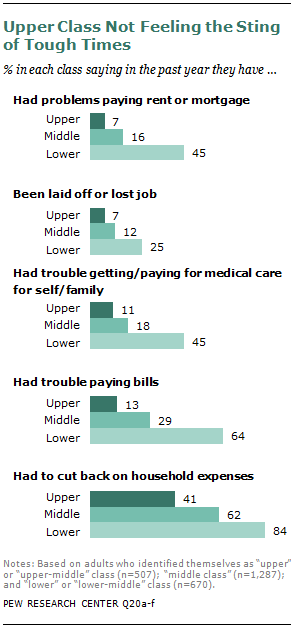
They were also much more likely to report specific difficulties in the past year, including trouble paying rent/mortgage and other bills, losing a job, and problems paying for medical care:

The results show a consistent, unsurprising pattern: the rich are weathering the slow recovery relatively well, while the poor suffer disproportionately. Check out the full report for information on participants’ perceptions of the wealthy, the fairness of the tax burden across classes, and which political party best represents each group.

[Note: The last item on this page might be NSFW in some workplaces; it’s behind a jump, but if you came to the post directly, be careful about scrolling down past the raincoats.]

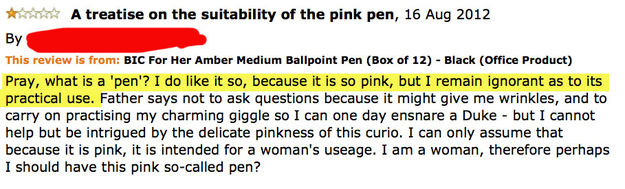
Seven readers — Aneesa D., mouskatel, Brandi B., Lisa B., Jared B., Tom Megginson (of Work that Matters), and sociologist Michael Kimmel — all let us know about the attention Bic’s “for Her” pens have been getting, so I thought it was a good day for another round-up of the many items we have decided must be differentiated into versions for men and women. We’ve featured pens like this before; Bic’s are designed just for us ladies and our special pen needs, which apparently include the colors pink and purple and “easy glide” and “smoothness”:

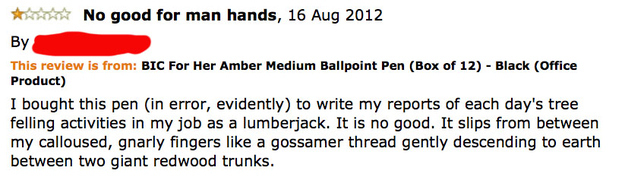
The pens are for sale on Amazon in the UK, and they’ve inspired a lot of push-back over the gendering, with people writing reviews mocking the product and its packaging. Buzzfeed featured a number of the reviews, which highlight the way that internet marketing certainly helps companies, but also opens up more avenues for the public to complain about or ridicule products in a very direct, immediate way that can quickly attract others to do the same — a much faster form of complaint than the days when you had to write a letter to a company’s headquarters:

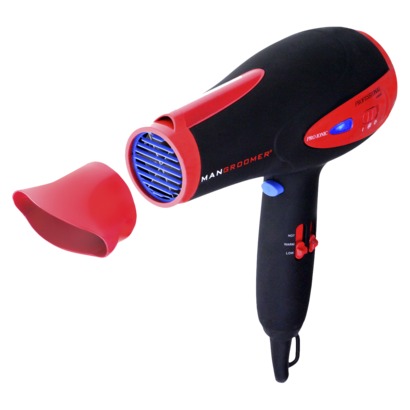
But don’t worry, guys! There are products just for you, too! J.V. is happy to report that there’s now a hair dryer for men, called the Man Groomer. After all these years of wishing you had some way to quickly dry your hair the way women can, a solution is at hand:

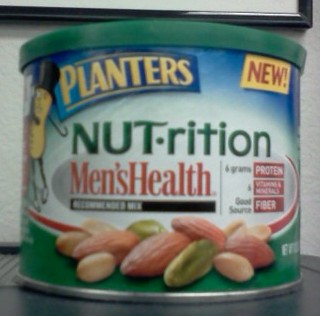
And Sean discovered that Planters is helpfully now selling cans of mixed nuts that are specifically chosen to support men’s health. Obviously women may eat almonds, peanuts, and pistachios separately, but when combined, these form a magical Man Food that addresses men’s unique needs for protein, vitamins, minerals, and fiber:

UPDATE: Reader Kat says,

The Men’s Health on the can of nuts is because they are a product the editors of the magazine Men’s Health felt were a healthy option…The can of nuts aren’t gender specific they are just boasting their “award” of being well liked by the editors of this particular magazine. No different than when any other product has the label “recognized by *fill in the blank* magazine.”

In other gendered products news, Jessie L. noticed these face masks for sale in Taiwan. They are different sizes, but instead of simply presenting them as Medium and Large, for whoever might need those sizes, those size differences are clearly connected to expectations about gender. They’re differentiated by color, by the person shown wearing each one, and the pink package even has a heart-shaped hole that lets you feel the mask.

Similarly, Joonas L. saw his-and-hers versions of disposable raincoats for sale in Helsinki, Finland, and couldn’t see anything different about them except the color and the use of language (miesten = men’s, naisten=women’s) to explicitly gender them:

Finally, Megan C. pointed out an example of gendered personal lubricant. The exact same product it “Tush Eze” when it’s pink and features a woman, but “Anal Eze” in the blue bottle featuring a man. I’m putting it after the jump, just in case it’s not safe for some workplaces:

more...

Last year I posted about a map several geographers put together showing the distribution of last names across the U.S. Historical immigration and internal settlement patterns are reflected in the concentrations of names across the country.

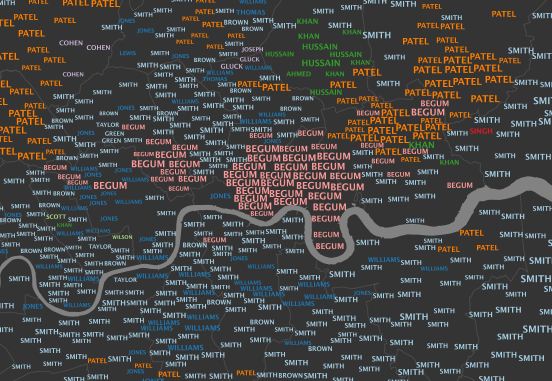
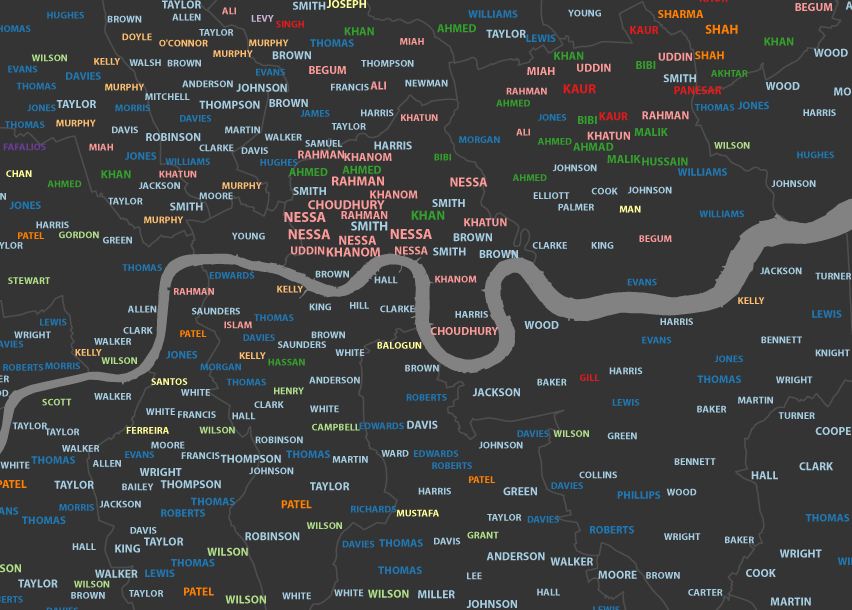
Now one of the geographers involved in that project, James Cheshire, has done the same for London. Using 2001 electoral rolls, Cheshire plotted the 15 most common surnames in 983 separate London districts. Here’s a section of the map of the most common name:

The size of the font is scaled to represent the number of people with each name. They’re color-coded by place or origin (though since many immigrants have Anglicized names, origin of a name may not reflect a person’s ancestry).

As Cheshire points out, a few names fill the top slot throughout most of London. As you go a bit further down the list, London’s diversity becomes more apparent. Here’s a small slice of the map of the 10th most common surnames:

Those of you with more knowledge of London, what noteworthy patterns do you see?