Archive: Dec 2008

Emily K. sent me a link to this story about a soccer team in Amsterdam, Ajax, known as the Jews. According to this New York Times article, the team got the nickname from opposing teams, who began calling the club the Jews because of the supposed history of Jews on the team. There isn’t any particular connection between the Jewish community and the team today–the team doesn’t have a large number of Jewish players, nor is the fan club made up of a higher number of Jews than other soccer teams.

This leads to some interesting situations. Most notably, fans (the vast majority of whom are non-Jewish) have adopted symbols of Judaism and Israel to show team spirit. Here’s a fan wrapped up in an Israeli flag:

And this fan has tattooed the Ajax logo along with a Star of David on his arm:

(Both images from the NYT article.)

Fans sometimes display gigantic Israeli flags in the stands during games (image found here):

This brings up some interesting issues about the appropriation of cultural symbols. When I first saw the pictures, I thought it was a bit disturbing that people use the Israeli flag as a prop to express support for an athletic team. But then I remembered that people do this all the time–I’ve seen pictures of soccer fans wrapped up in, for example, the Spanish flag, or wearing shirts with pictures of flags on them (not to mention people wearing clothing with American flags). Of course, that is often by people who are citizens of those countries. So is it weird to have non-Israelis using the Israeli flag in this way? I’ve thought about it, and I think maybe the strong association between Israel and Judaism makes this seem a little different than those other examples, since it then appears to be the appropriation of a religious symbol, even though the Israeli flag is not, technically speaking, itself a religious item (as opposed to, say, if fans were wearing yarmulkes or something). And clearly the people using the flag in this way are doing so because of its association with Jewishness, not because they have any particular interest in Israel or like an Israeli team.

The other problem that arises is opposing fans’ heckling. Because Ajax is nicknamed the Jews, fans of other teams often use anti-Semitic chants during games. Some examples (found at the Ajax USA site):

Ssssssssssssssssssssssssss… (the hissing sound of gas)

We’re hunting the Jews!

There is the Ajax train to Auschwitz!

Sieg! Sieg! Sieg! (German for ‘victory’, yelled while performing the Hitler’s Salute)

According to the NYT article, they have also yelled “Hamas! Hamas!”, a reference to the Palestinian political party. And there’s this, from Ajax fans themselves:

…during a game against a German team late last year, a group of Ajax supporters displayed a banner that read “Jews take revenge for ’40-’45,” a reference to the Holocaust.

Some Jewish fans now report that they have stopped attending games because they find the behavior offensive.

This would be a great example to use in a discussion of sports mascots, particularly how it compares to American Indian mascots (for examples, see this post) and Notre Dame’s Fighting Irish mascot (see post here). Critics of American Indian mascots often ask questions along the lines of “What would happen if a team called itself the Fighting Jews?” (see here and here for examples of this rhetorical strategy), but it’s always presented as an unimaginable, completely hypothetical situation. And yet it turns out not to be so hypothetical after all. My guess is students would generally have a much more negative reaction to the Ajax Jews than to teams like the Washington Redskins, and it would be useful to discuss why that might be (keeping in mind that fans of teams playing against teams with Indian mascots sometimes use images that depict violence against Indians).

And of course there’s also the whole issue of the appropriation of Jewish culture and the trivialization of the Holocaust and Nazism by both Ajax and opposing fans. The whole thing is creepy.

Thanks, Emily!

The United States is highy individualistic.  Most advertisers appeal to our indivdual self-interest, as do politicians when trying to “sell” public policy.  The idea that we should do something for the greater good is not, somehow, as appealing an appeal.

In light of this, it is interesting to see a counter-example.  Chris Uggen posted this image of a sticker he received after he got his flu shot from the University of Minnesota health clinic.


Most of the time we are encouraged to get a flu shot so that we, personally, do not get sick.  In this case, we are encouraged to get a flu shot for the good of the greater community.  This is a nice example of the way that a collectivist ideology can be used in place of an individualist ideology.

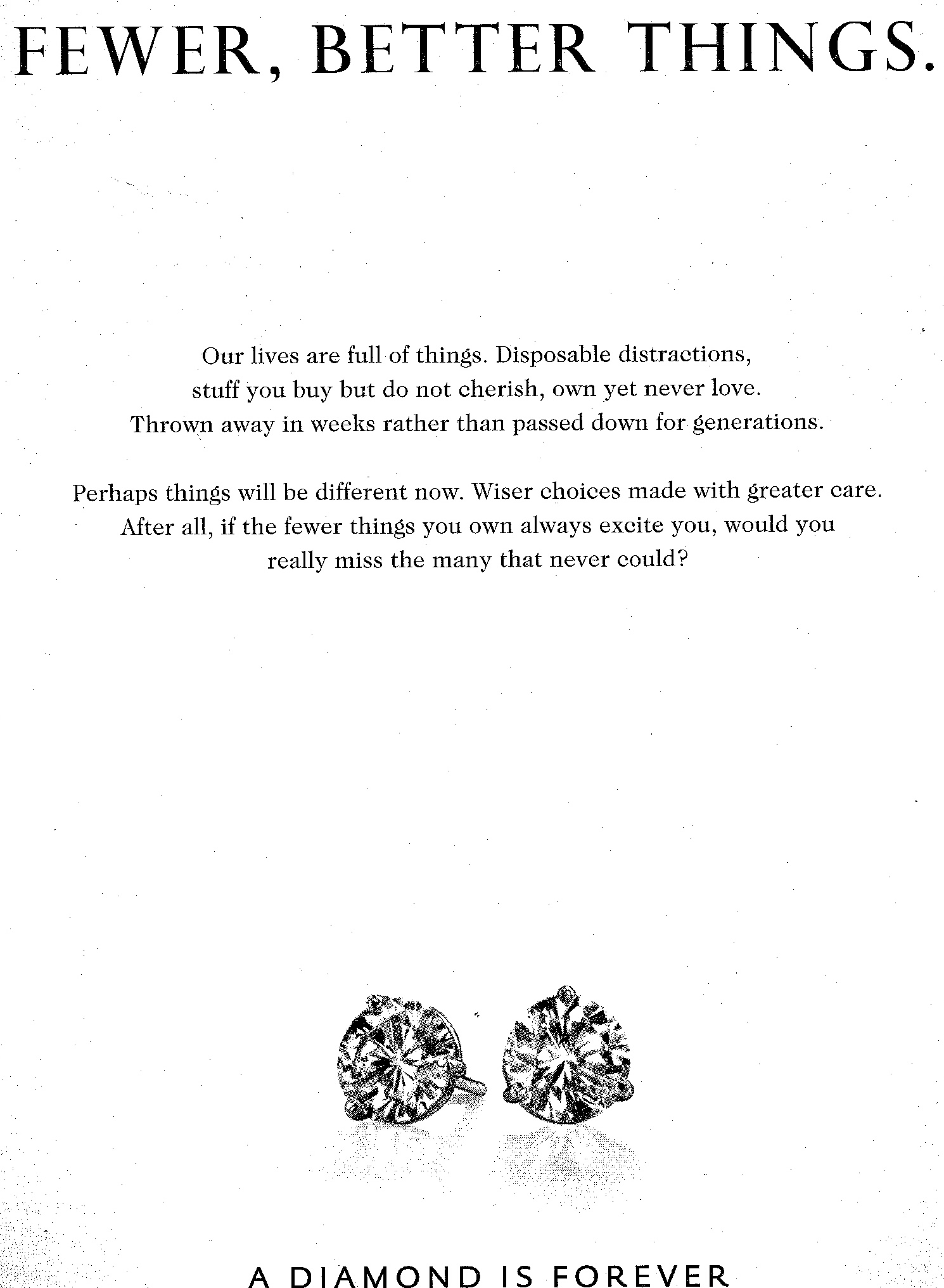
I found this ad for the De Beers diamond company in the New Yorker:

It uses the fascinating strategy of selling diamonds, an unnecessary luxury item made very expensive because the De Beers company has a monopoly on diamond mines and makes sure to keep supply artificially low, by criticizing consumerism based on buying unnecessary items. The message here is that we should stop buying so much unnecessary stuff…but that diamonds don’t fall into the category of unnecessary. Rather, diamonds are “better” things you should cherish “forever.” Of course, this anti-consumerist, buy-less-stuff message is also useful for De Beers because buying fewer things might be the only way, in a struggling economy, for people to save up to buy one or two more expensive items that can become family heirlooms to be “passed down for generations”…such as, say, diamonds.

Honestly, this is one of the most interesting ads I’ve seen in a while. I mean, it takes some nerve to sell luxury jewelry by telling people to stop wasting money on unimportant things.

UPDATE: Commenter Barbar pointed me to this interesting article in The Atlantic about the history of the diamond market.

Miguel E. sent us a link to a story about Natural High, a Japanese company that reportedly makes “extreme” pornography.   The producer, Sakkun, felt bad that many children in Africa live in poverty and so he sent a porn star to Kenya to have sex with African men (on film, of course).  The company gave a Kenyan aid organization one million yen (around $10, 800 U.S.) and 1,000 more (currently about $10.77 U.S.) is donated for every DVD sold (story here).  Images and discussion after the jump:

more...

Welcome to Christmas 2008!

Rose McM. sent us this great example of rigidly gender-coded toys from the Sears Wish Catalog (click to enlarge):

NEW! (Jan. ’10): Sarah O. snapped this photo of toys that teach girls they should cook and care for babies, while boys can build things and be doctors:

-2

See also these posts on the Rose Petal Cottage and Tonka Trucks (“built for boyhood!”).

Lisa Wade, PhD is an Associate Professor at Tulane University. She is the author of American Hookup, a book about college sexual culture; a textbook about gender; and a forthcoming introductory text: Terrible Magnificent Sociology. You can follow her on Twitter and Instagram.

I found this Absolut Vodka ad in Entertainment Weekly:

It draws on that whole Men Are from Mars, Women Are from Venus ideology in which men and women are so different we can barely understand each other without expert help.

UPDATE: Commenter ihdl pointed out this German dictionary, titled Woman-German, German-Woman: Quick Help for the Clueless Man:

And Emberiza noted that a Man-German, German-Man is available as well:

Thanks for pointing them out!

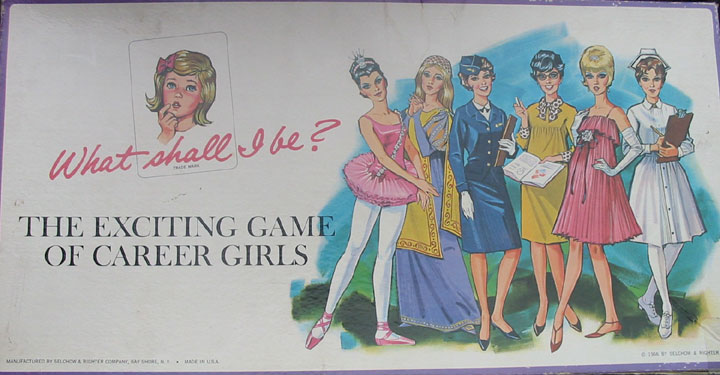
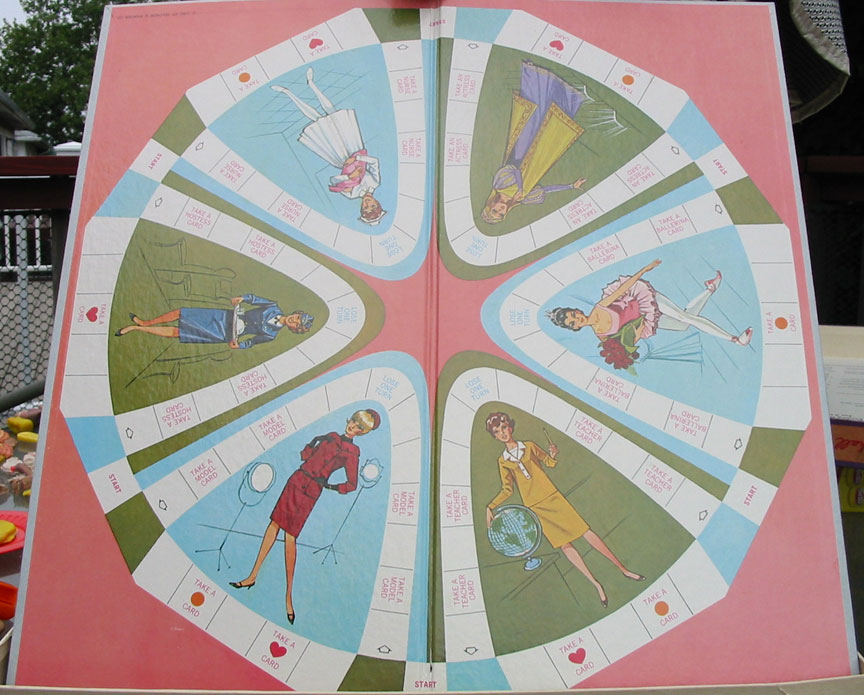
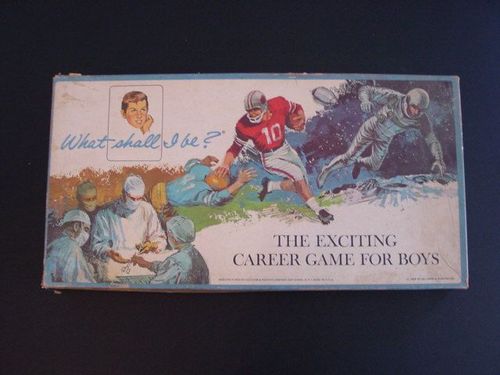
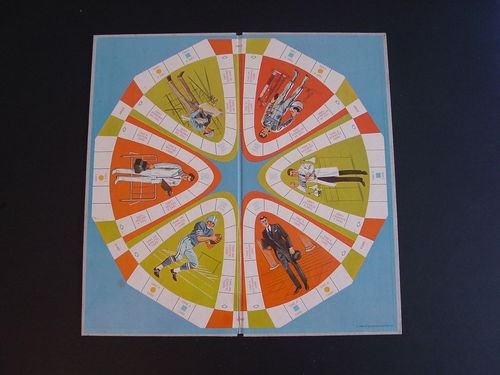
The 1966 and 1976 editions of this old board game illustrate both historical ideas about gender and the way they can change in just ten years.

The 1966 version for girls (found here):

Options for girls include going to charm school to become a model, nursing school to become a nurse, drama school to become an actress, college to become a teacher, ballet school to become a ballet dancer, or airline training school to become an airline hostess.

The 1966 version for boys (found here):

Options for boys include going to law school to become a statesman, graduate school to become a scientist, medical school to become a doctor, college to become an athlete (!?), technical school to become an engineer, or flight school to become an astronaut.

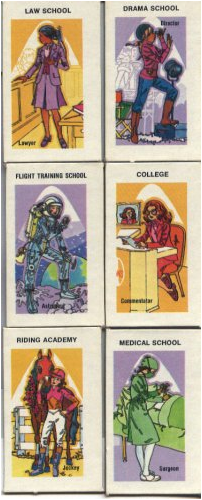
They revised the girl’s game (I’m not sure about the boy’s game) in 1976 (found here).  Girls could now choose between going to medical school to become a surgeon, the riding academy to be a jockey, flight training school to be an astronaut, college to be a commentator, drama school to be a director, and law school to be a lawyer.

I wonder if the revised boy’s version included going to college to become an elementary school teacher, to medical school to be a pediatrician, or to a dance academy to become a dancer.  I predict not.

From 1987 (found here):

No date (found here):

Also in “Oriental” stereotypes: a new restaurant in Rhode Island and Oriental Pearl Cream.