Archive: Nov 2013

My thanks to colleague Deborah Siegel for starting off what has now become an even more complicated debate over the toy company GoldieBlox.  I’ve been amazed — and disappointed — at the turning tide during the past few days.  While GoldieBlox’s Twitter feed implies the product is selling well, it’s also clear they’re now spinning into damage control.
beastie-post

Despite controversy over the product itself, everyone seems to agree that GoldieBlox took a clear misstep in their reappropriation of the Beastie Boys’ song “Girls.” For one, the late Beastie Boys member Adam Yauch left specific instructions in his will that he never wanted his work used for advertising purposes.  GoldieBlox claims that the song is parody, hence “fair use,” rather than copyright infringement.  But, just to make their point, they have initiated a lawsuit against the The Beastie Boys, puzzling some by this preemptive strike and causing yet more rumors to swirl that they are simply after more publicity, no matter how negative. The Beastie Boys issued an “open letter” to GoldieBlox in support of their product, but also clearly stating that the reappropriation wasn’t to their liking.  GoldieBlox, so far, appears to have refused comment.  Last year, Jessica Valenti wrote about the group’s “feminist turnaround,” and I’ve wondered if founder Debbie Sterling thought for this reason the Beastie Boys might be sympathetic.  Whether she received bad legal advice, engaged in naïve business practices, or this move was deeply calculated is hard to tell, but there’s no doubt this development is further tarnishing the good will her company initially generated.

Criticism has also been leveled at the company for its practices during the making of the commercial’s famous Rube Goldberg machine.  One point is simply that its construction was unrealistic for the ages of the girls represented.  There has also been speculation that no women engineers were actually involved in its making and the “behind the scenes” videos which they released online hardly showcases the girls featured having any agency in its construction, despite the fact that none are models and are all supposedly initial testers of the product.  GoldieBlox has disputed that the Rube Goldberg machine was made chiefly by male engineers, but in each of the “behind the scenes” clips released women are conspicuously absent.  Here in L.A. where “industry talk” is thick, more unscrupulous scuttlebutt has emerged about the sources of the commercial’s filming which has hardly helped the product’s reputation.  The tide has turned from those who zealously cheered the company on to a general sense of disappointment.

https://www.youtube.com/watch?v=sfxHhTHcoTg

Yet, what the whole product launch, from Kickstarter to present-day debacle has revealed is intriguing.  One point of interest to me is how GoldieBlox’s contention that they are taking originally misogynistic lyrics and ‘subverting’ them into a pro-girl message seems to parallel the larger critique of their toy, highlighting what some see as damaging short-sightedness purportedly used for greater gain.

As Deborah writes, and many of our Brave Girls Want colleagues have so articulately expressed is that GoldieBlox seems to have stepped backwards from what was first presented on their Kickstarter campaign, where a very sincere Sterling talked about giving girls options beyond “pinkifying” STEM-related toys for the girls’ aisle.  When I first saw the campaign, I was excited.  And I was hopeful, although there were things that concerned me.  For one, Sterling’s essentializing view that her strategy came down to “one simple thing: boys like building and girls like reading.”  Really?  This comment seemed like odd stereotyping from someone whose purpose is to break down a gendered divide.  In an article last year about the product, her remarks about how girls “care about nurturing” also seemed suspiciously stereotypical.

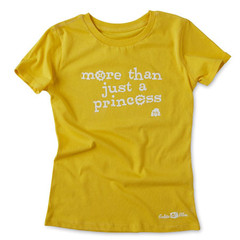
Sterling’s casual remark might be at the root of where many (but not all) think her product went astray.  She reiterates “every girl you know is so much more than a princess” and in the now famed YouTube commercial the three young girls look painfully bored while passively watching three tiara-wearing and scepter-waving pink doppelgangers.  This phrase “more than just a princess” also bedecks the T-shirts the girls wear when they storm Toys ‘R’ Us in this video.
Tshirt-1_medium

Pivoting on the idea that all girls are told they are princesses, sold a “princess bill of goods” (and, of course, actual goods), yet can be turned another direction seems to be where Sterling has staked her foundation.  Her inclusion of princess-themed material within the toy, as Deborah writes, and so many others have usefully analyzed, is what has caused critics to speak out and withdraw support.  And this seems to be where Sterling seems most baffled and defensive, with the complicating thought that rejecting princess culture altogether is a way of denigrating girls and withdrawing an option that they might sincerely want.

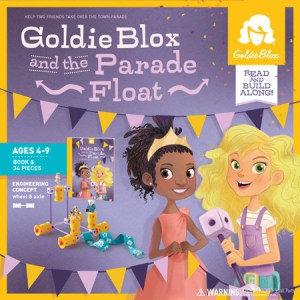
Watching this saga unfold, what I found most insightful has been keeping a close eye at the comments churning out under each story, or comment thread, notably on the GoldieBlox YouTube page (with over 8 million views, a week ago).  The point of view presented by Sterling, most often, is what has been largely supported, with detractors in the minority.  It’s cheering to know how many people desperately want this type of product for their daughters.  There is a palpable sense of relief many expressed which I take as a positive sign of general fatigue with the limiting products marketed to girls.  There seems to be real joy in finally being able to offer girls something — GoldieBlox — considered innovative and cutting edge with lots of support for Sterling’s “good intentions.”  It also seems clear that many think that giving girls some princess-themed “hook” is just fine since this reels them in.  You’ll lure more girls in by pinkifying the product is their thinking (and Sterling’s it seems) and then surprise-attack the girl playing with it that there’s a new activity literally at hand, perhaps even a new world opening up.
GB_Box_BT002_v1_r1

Fairly prominent was still the “so what?” response, maintaining that it’s “just a princess” or just a bit pink and girls aren’t defined just by this.  So what if this is included, as a “naturalized” view of princesses and pink culture is seen as part of any product for a girl, with the flip argument that girls will summarily reject products if that don’t subscribe to this.  More reactionary is the worrying expression that eliminating princesses from girls’ toys is an unfair and even anti-feminist move, that bleaching pink from the palette available to girls is an ever worse form of reverse stereotyping.  Common enough was reactionary pushback to being told girls shouldn’t have pink or this product isn’t “progressive” enough, when, as many parents wrote, their girls did naturally gravitate to the color.

“Natural,” of course, is deeply vexed issue for those of us who think hard about these topics.  For many parents who responded, the line between what girls are being offered and what girls are being denied seemed confusingly thin.   I completely understand the point of view of those who are turned off by the product’s princess-themed story and see hypocrisy in Sterling’s mixed message, which, worse yet, is undermining.  I think the bait and switch is what is most maddening to me, as I wrote about with the Monster High line in the past.

Within my academic work in the past few years in Girls’ Studies I’ve studied what I’ve come to call “fauxpowerment” — products or programs that purport to serve girls (often for economic gain or free publicity) while, in fact, deploying undermining and essentializing messages in the most disheartening ways.  I’m disappointed that GoldieBlox has taken the path it has, although this feedback seems useful as a gauge of the set beliefs that are largely shared about what girls want and, simultaneously, what they are denied.  It’s crucial to remember that while these toys will shape girls’ attitudes about gender, it’s the parents who purchase them, hence responding to their own limitations is critical.

Perhaps new to the world business, (and giving her the benefit of the doubt), Sterling’s work now seems to be causing more negative talk than good, although there’s no doubt it’s got people talking.  Despite a steep rise in clubs and advocacy groups to increase girls going into STEM fields there is a lot of work to doThis ridiculous and insulting video, produced under the guise of “speak their language to lure them in” received such negative feedback it was finally (thankfully) pulled.  I want to be hopeful that, in the hands of girls who might receive GoldieBlox over the holidays, there is some net gain in having them even begin to associate the words “girl” and “engineer.” Like last year’s intervention with Lego’s LadyFigs line, I want to believe Sterling will get this message as well.  

I’m glad to see the conversation this controversy has stirred, particularly from parents who are trying to parse princess world and what this means for their daughters.  Many seem bewildered by which choice to make and fear their daughters will reject or be ostracized if she chooses, or if they offer, outside of the “pink box.” The sense of longing in many women’s comments about how much they wish something like this been around in their girlhoods has also been striking.  
mercy-ads-4mercy-ad-hed-2013

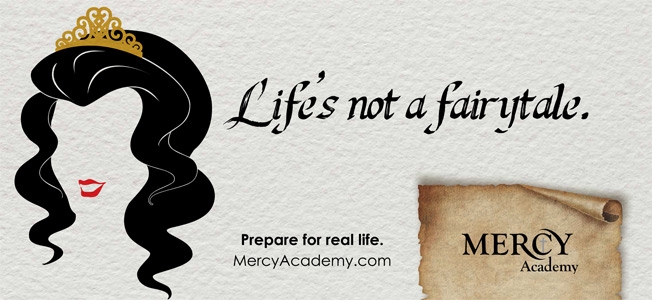
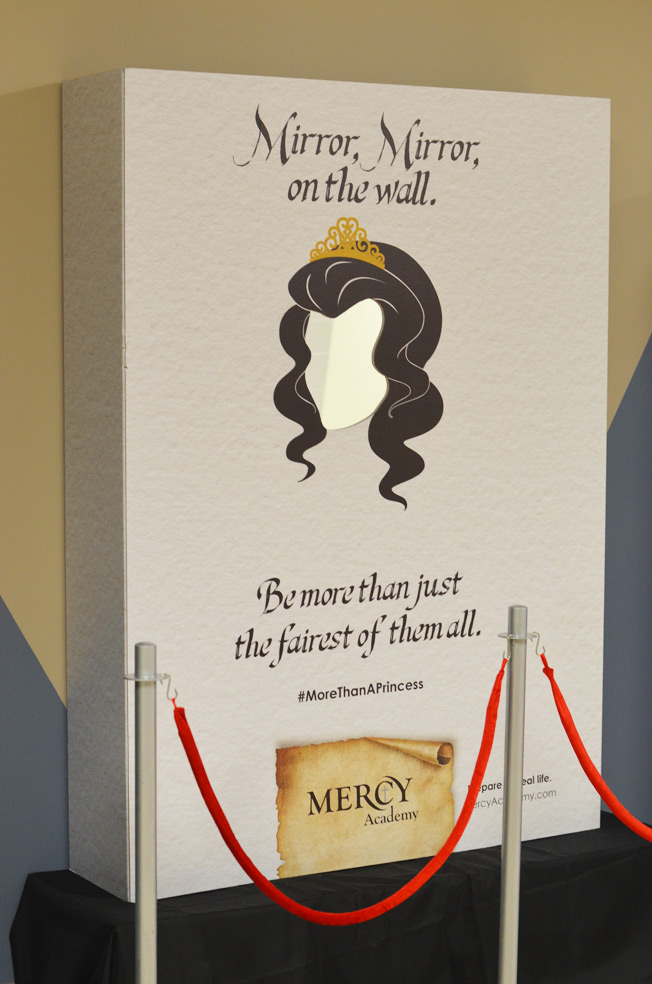
This past week an advertisement for Mercy Academy, a small Catholic private girls’ school in Kentucky also went viral with their slogan “You’re Not a Princess.”  Mercy also uses the trope of the princess in its campaign, but only to offer it as a traditional narrative that is better off rejected in favor of girls taking charge of their own stories.  Its reception was been roundly cheered.

I was struck by the boldness of this slogan which isn’t trying to spin or hedge or translate the cultural message that being a princess is okay for a girl, or even that she can be “more than a princess.”  “Prepare for Real Life” seems to be the school motto as their message flat out refuses the princess stereotype.  If only GoldieBlox could have been so bold.
There’s a controversy brewing online around girls and STEM, princesses, and, believe it or not, the Superbowl.

First, if you haven’t already, watch this:

Next, read this, this, and this.

I’m in partial agreement with my feminist colleagues who are in outrage over the fact that GoldieBlox is selling a princess-themed toy. Many had been rooting for the start-up toy company, which started on Kickstarter, with a full on mission to spark a love for STEM in girls. They feel rightly let down that the sequel to the original product (a building toy, with a narrative story) features a princess tale. They critique the manufacturer’s market-straddling approach. Writes media studies scholar Rebecca Hains, “GoldieBlox is having it both ways: appealing to parents with anti-princess rhetoric and then, in stores, selling girls on a princess-themed toy.”

Reelgirl’s Margot Magowan smartly notes, “This is how fucked up kidworld has become. Finally, parents are catching on that gender stereotyping children limits potential. So what do we get?  An anti-everything pink and princess themed ad, which is great, selling a princess themed toy. WTF?”

WTF indeed. Melissa Atkins Wardy (whose new book, Redefining Girly, will be published on January 1), perhaps says it best: “[W]hen we use princess culture, pinkification, and beauty norms to sell STEM toys to girls and fool ourselves that we are amazing and progressive and raising an incredible generation of female engineers we continue to sell our girls short. It is the equivalent of covering broccoli in melted processed cheese and thinking we’ve very served a healthy meal.”

Yes, yes, and yes. Blech.

But.

I’m not convinced the ad isn’t progress. I’ve watched every video GoldieBlox has produced and have gotten teary over every one. I’ve played with the original toy in the Marbles store with my 4-year-old daughter (no princesses in that one) and am still considering it as a Hannukah gift. I’m a sucker, perhaps, and an easy target. But let’s put personal reaction aside.

I believe in evolution, as well as revolution. I’m a writer who wrote a book on feminism and let her publisher slap on a hot pink cover. I wanted people–and young women in particular–who wouldn’t necessarily pick up a book on the women’s movement to read about it. And they did.

I certainly understand why my colleagues are upset. Indeed, as educational psychologist and blogger Lori Day noted on Twitter, sneaking a princess narrative into an otherwise girl-empowering toy is an act of Trojan Princess.

But couldn’t it be an act of Trojan Feminism, too?

This debate brings up all the issues feminist scholars love to debate: subversion, containment, appropriation, consumption, narrative revision, mediation, and the like. Heck, the ad will be a great addition to the curriculum of Women’s Studies classes to debate for years to come.

But here’s what’s going on here and now: The GoldieBlox ad is vying for a coveted spot during the Superbowl on Feburary 2, 2014. It’s one of four other small businesses in the running. Anyone can vote, and the business with the most votes wins the grand prize. GoldieBlox is up against Locally Laid (an egg company), Diary Poop (natural dairy compost), and an ad for dog treats.

I don’t know about you, but I’d sure like to see this ad featuring little girls kicking engineering ass to the tune of a highly appropriated Beastie Boys jingle hit prime-time. Some will say my colleagues’ vision of empowerment is too big. They say GoldieBlox founder Debbie Sterling’s vision is too small. But while we’re all working hard and searching for the one that’s just right, let’s get this ad—which many of us agree subverts traditional images of girlhood—into the living rooms of all those watching the Superbowl. No?

PS. Debbie Sterling, I hope you are listening. My feminist colleagues want to love you, but you’ve let them down. I get it. And I also get your impulse to change the status quo. May your kingdom, which I continue to root for, continue to evolve, and may you ultimately de-princessify.

I welcome your thoughts-any and all!

Thanksgiving is a week away.  The holiday is uniquely American, grounded in our history rather than our various religions, in a sense of family and community rather than military victories. Increasingly, commercial aspects have intruded on family priorities, but it remains a time when we gather to give thanks for what we have, and hopefully, to recognize and support those less fortunate. I wish it could also be a time for many of us to do more than feel good about spending a few hours serving turkey dinners at a shelter for battered women or homeless families. I wish it could be a time to consider the steps needed to eliminate the poverty, violence and hopelessness that create the need for such places.

But as the holiday approaches our nation confronts the largest levels of income inequality in close to a century. A college education remains a key to economic success but is less affordable every year. These realities are coupled with unrelenting, well-funded efforts that disproportionately effect the poorest among us: women and children; the elderly; those with disabilities.

Attacks against health care reform and the supplemental nutrition assistance program (SNAP), fierce opposition to an increase in the minimum wage, measures to cut off access to safe abortion, are all in the news and on the political playing field. And for some it appears that is exactly what these critical issues are—political play things. Play it right; insure your privileged position.  The idea that actual individuals—mothers, grandparents, children, war veterans, caregivers—will suffer and that those most affected are powerless to change the dynamics of the political game seem lost in allegiance to one’s group or one’s ambition, or both.

Political differences are important ingredients in any democracy, but robust measures of compassion and compromise are required as well.  Empathy for those living in less fortunate circumstances appears missing from the calculations of some of the most powerful players–those inside as well as outside political office.

How can this be?

Two recent studies offer clues. Research conducted at the University of California, Berkeley revealed that the economically advantaged are less likely to express compassion for others than are people with lower incomes. Jennifer Stellar, the lead author of the study said, “It’s not that the upper classes are cold hearted. They may just not be as adept at recognizing the cues and signals of the suffering because they haven’t had to deal with as many obstacles in their lives.”

A second study by Canadian researchers found that a sense of power can influence how people respond to others by changing the way the brain functions. Feeling powerful tends to diminish brain signals that foster empathy.

Yet obviously many powerful, affluent people are deeply compassionate and emphatic. These research studies are not about inevitable outcomes, they simply point to danger signals.

We live in a country where economic disparities foster experiences that enhance a sense of power among the affluent. These same economic divisions result in communities segregated by income, communities where few personal encounters of any depth take place across socio-economic lines. Understanding the circumstances of others becomes more difficult for everyone.

My wish this Thanksgiving is for time to consider the dangers extreme income inequality, an absence of empathy and failures of compassion pose for our country.  Feminists have long pointed out that there are no individual solutions to society-wide problems. Every one of us, politicians included, must find ways to work together if democracy is to flourish.


This month’s column features a guest-post by Adrienne Trier-Bieniek, Ph.D.: she critiques a recent pop culture debate and encourages us to question the impact of imagery and songs on healthy sexuality.  Trier-Bieniek is an assistant professor of sociology at Valencia College.  She studies pop culture, gender and healing after trauma; she also wrote the book Sing Us a Song, Piano Woman: Female Fans and the Music of Tori Amos (Scarecrow Press 2013).

_____________________

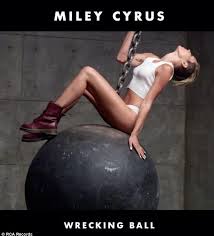
A few months ago I was sitting in the Philadelphia airport waiting to fly home to Orlando when I got a Facebook alert on my phone.  One of my college friends had tagged me in a post, a news story, with the headline “Michigan University Removes Pendulum Statue.” What followed was an E! News article featuring a large wrecking ball that hangs in the campus of my alma mater, Grand Valley State University.  The ball was being ridden by a naked person, seemingly an imitation of Miley Cyrus in her video for her song Wrecking Ball where she sings about heartbreak while naked and swinging on a wrecking ball.  As I read through the short blurb what struck me (beyond the naked student) was E!’s statement that “Miley Cyrus, the tongue flickering demon… Has set her sights on your college students!”  This was probably meant to be tongue in cheek (pun intended), but the message was clearly connected to the dangers of feminine sexuality.

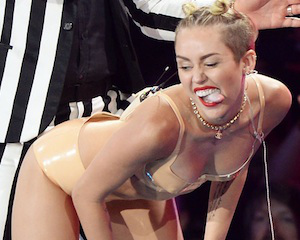
mileywreckingA few days later, Sinead O’Conner wrote an open letter to Miley about the music industry’s penchant for over-sexualizing female pop stars and kicking them to the curb once executives have made their money.  This lead to an exchange between Cyrus and O’Conner in which Miley Cyrus attacked Sinead O’Conner’s history of being treated for bipolar disorder and her attempts at suicide.  Then Robin Thicke appeared on Oprah’s Next Chapter to discuss his performance with Cyrus at the performance with Cyrus at the Video Music Awards (VMA’s). In case you are not familiar, the routine included Miley Cyrus wearing a gold two-piece outfit, seemingly to make her appear close to nude, while “twerking” in front of Thicke’s groin while also getting sexual with a foam finger.  Thicke said that, when he is performing, he doesn’t pay attention to who is touching his body because he is focused on his music and vocals.

I study gender and music and I have spent a lot of time thinking about this series of events and their connection to sexuality and body privilege.  No doubt the video for Wrecking Ball was created to get Cyrus some attention, it couldn’t be more obvious that she was literally shedding the image of Hanna Montana as she swung on the ball.  Yet there was a vulnerability to the performance that got lost in the reaction to her appearing naked.  Most people seemed to be so caught up in gazing at her body that the expression of loss and heart-break she sang about was missed.  Perhaps this is just the media doing what it does best, finding the most alluring part of a story and exposing it.  Or, maybe the reactions to the song are found in the age-old assumption that nudity, particularly nude women, are objectionable.  Except, in 2013 women’s nude bodies not only battle the puritan stance on nudity, they also are attacked with judgments on weight, symmetry, skin color and expectations of perfection.

Sinead O’Conner is right, the music industry sets up young and attractive people in order to cash out on their youth and beauty.  It creates a standard for what young women must do in order to get noticed and to keep the audience’s attention.  Thicke’s comments about not noticing how sexual Cyrus’s dancing was at the VMA’s demonstrates a privilege that is specific to masculinity and male bodies.  How can he not realize that there is a half-naked girl grinding on him?  I find this hard to believe. What Thicke did in this moment was affirm that Cyrus’s body was the object and the subject of the performance and that his body didn’t need to be a part of the discussion.  This is a privilege granted to the person in power, most women who are performing cannot escape the objectification of the male gaze.

While I am not sure if Cyrus should be flattered by people riding naked on a wrecking ball at my alma mater, I will give them the benefit of the doubt and assume that a handful of them were hoping to connect with the vulnerable side Cyrus showed in the video.  Later this month, when I return to campus to speak, I hope to find out if this is true. Much like the famous feminist mantra that floats around “If I had a hammer I would smash patriarchy”, in this case what we need, ironically, may be a wrecking ball.

Terms like “empowerment” have flooded popular culture for quite some time, often in relation to promoting consumerism as well as hypersexual self-presentation. Of late, though, a rather unlikely source employed the word “feminist” to describe herself. Last week, media sensation Miley Cyrus stated: “I’m one of the biggest feminists in the world because I tell women not to be scared of anything.”

Central to Miley’s values of “not being scared of anything” is her embrace of shock value, especially as related to seemingly self-assured hypersexual posturing. As consumers of popular culture are likely familiar, she exhibited her self-confidence at the August 2013 VMAS, in which she performed a raunchy rendition of “Blurred Lines” with Robin Thicke. She continued her domination of the headlines by appearing nude (save for some boots) in the music video for her song “Wrecking Ball.” This sort of “empowerment” has underscored Miley’s rebranding effort from Hannah Montana to…something else more…well, “adult.”

miley-cyrus-vma-performance

Given that Miley’s brand of feminism feels more like Girls Gone Wild than a feminist figurehead, it’s quite interesting that she uses “feminist” as a self-descriptor. It’s notable, too, since many female celebrities, especially her contemporaries, have distanced themselves from identifying as a feminist. For example:

Katy Perry: “I am not a feminist, but I do believe in the strength of women.”

Carrie Underwood: “I wouldn’t go so far as to say I am a feminist, that can come off as a negative connotation. But I am a strong female.”

Beyoncé: “That word [feminist] can be very extreme … I guess I am a modern-day feminist. I do believe in equality … Why do you have to choose what type of woman you are? Why do you have to label yourself anything? I’m just a woman, and I love being a woman.”

The qualifications in Katy, Carrie, and Beyoncé’s communication about employing the word “feminist” reflects a longstanding conversation in feminist scholarship about why feminist has become a label that is fraught with contention. Part of the reason seems to be the history of generational conflict associated with women’s efforts to fulfill feminist aims. Along these lines, women seem to want to assert that their view of feminism is not that of their mothers or grandmothers. They want to own their feminism.

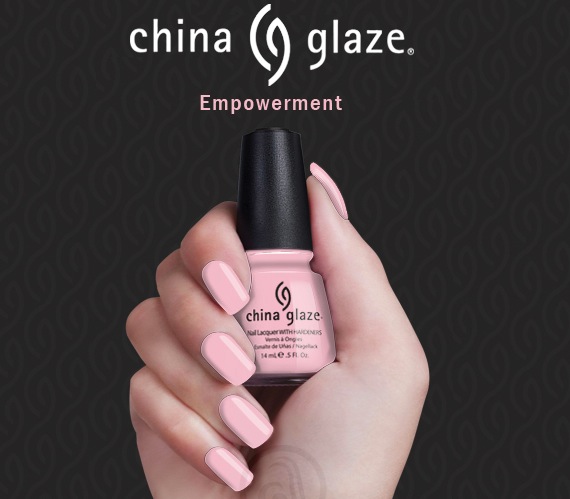
In addition, female celebrities’ ambivalence towards the term “feminist” is perhaps based on the ways in which notions of feminism have been communicated through mass media outlets over almost fifty years. As many scholars of consumer culture have identified, feminist discourse has been employed in advertisements and other media products to create a positive association between goods and the values we associate with them. This, in turn, has led to a devaluing of the language of feminism in popular culture, particularly in relation to feeling good through self-beautification. So, for instance, even though most people are aware that it’s simplistic to equate an experience of empowerment with nail polish, the constant presence of manufactured visual/verbal associations reinforces the desired meaning of the message, as in this advertisement:

9852420ce6b16a5eec1c05ca3cad9a53

While it is unlikely that wearing a nail polish called “Empowerment” will actually lead a woman to feel empowered when she wears it, it is possible that her act of carving out a space in her busy day to take care of herself and exercise an aesthetic pleasure will constitute a meaningful assertion of her power. The trouble here is that it’s not just one nail polish advertisement that links meanings of empowerment with a beauty product. The messages in this advert connect to those in other types of media texts (films, tv shows, ads/branding campaigns, celebrity images) as well as to cultural values that equate women’s work on their beauty/bodies with self-improvement. This sort of messaging about “empowerment” reinforces the idea that beauty routines are a necessity for presenting ourselves as socially acceptable and transform the pursuit of beauty into an oppressive journey of conformity.

Although feminism and feminist may currently be nebulous terms, there exists nonetheless an understanding among the public about what feminism, in essence, means. A poll conducted on People Magazine‘s website found that 92% of those who responded did not think that “Miley is, as she claims, one of the world’s biggest feminists.”

People poll

In early twenty-first century Western culture, it’s not a leap to argue that meanings and practices of feminism have become distorted and distant from their origins or that they have come to be associated with beauty-related goods and issues in consumer culture. Feminism is not a catch all for anything that involves a woman feeling good about herself, nor is it an excuse for a woman’s bad behavior. There is much feminist work to be done (see, for instance, recent studies on gender pay gaps here and here). As a culture and as individuals, we need to start thinking more about what we want feminism to be and do for women and society. Miley’s brand of feminism opened up a conversation. Let’s continue it.

I just returned from the National Women’s Studies Association Conference feeling inspired and energized. (There’s so much amazing work that I can barely stand it!) Two panels in particular spoke to an issue that I think about a great deal: how can we bridge the various kinds of feminist work going on in different places?
Ileana Jiménez spoke about how to bridge women’s and gender studies in high school and university classrooms at a visionary session moderated by Patti Provance and featuring an amazing lineup: Stephanie Troutman (Berea College), Rachel Seidman (whose Duke University undergraduate students in her Women in the Public Sphere class started the Who Needs Feminism? campaign), and Jiménez, who has been publicly sharing her work as a high school feminist teacher and advocating for social justice education for over fifteen years.

Jiménez talked about “breaking down the silos” of K-12 and university classrooms, which really resonated with me on multiple levels. As a women’s and gender studies professor and a former high school teacher, I’ve felt for a long time that we should collectively think about social justice education in middle and high school, a focus of the recent AAUW Gender Studies Symposium. I’ve been following Jiménez’s work for a while, and it was inspiring to hear her as well as Seidman and Troutman, all of whom are working in innovative ways to break down educational borders.

To move to the boundaries of geography: I had the honor of presenting on a panel with Alicia Catharine Decker (Purdue University), who talked about the development of women’s and gender studies in Morocco and Uganda. Decker’s close analysis of the histories of these two programs suggested some interesting differences in disciplinary focus, a theme that emerged in my own comparison of women’s and gender studies in Africa and North America. (A third panelist, Adrianna L. Ernstberger, was unfortunately unable to present her research on women’s and gender studies in Uganda.) Our panel suggested the possibility of mutually beneficial collaborations that might come out of future conversations between women’s and gender studies teacher-activists based in Africa and the U.S.

As Jiménez put it so eloquently: feminists must break out of our individual silos in order to create a larger movement for social change. I’d only add that we must understand the larger landscape—both our own location as well as others’—in order to cross borders and figure out how each of us can work best with one another.

by Tristan Bridges and C.J. Pascoe

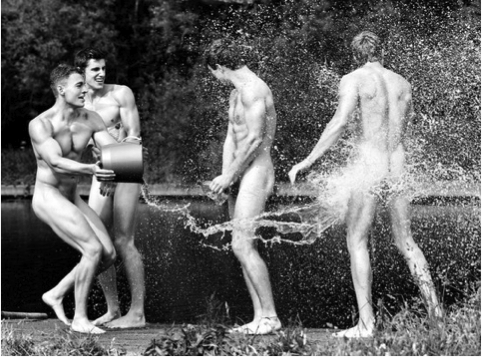
Warwick BoysEvery year, since 2009, the men of England’s Warwick University’s Rowing Team pose nude together in a series of photos that can be purchased individually or collectively as a calendar. The sales from this calendar go toward supporting their team and to raise awareness about bullying and homophobia among youth. This year, however, the team received international attention (prompting the development of a twitter account, a website, and a store to sell the photos and other team paraphernalia—like their 2013 film, “Brokeback Boathouse”). At first glance it may seem surprising that (presumably) straight men would pose naked with one another to raise money. But, when looking at other straight, young, white men’s stances on homophobia it becomes clear that, ironically, part of what is happening here is a shoring up of a particular form of heterosexual masculinity. Indeed the Warwick Women’s Rowing Team produced a similar calendar without the same amount of media attention (significantly, however, the attention they did receive was more often condemnatory).

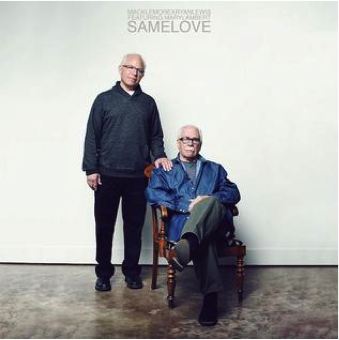
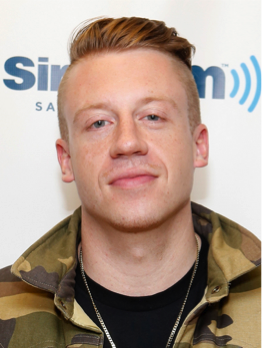
MacklemoreThe attention the Warwick boys received echoes that directed at Seattle-based hip-hop artist Ben Haggerty (Macklemore) upon the release of his hit song “Same Love” in 2012.  The song, a ballad of support for gay and lesbian rights, was recorded during the 2012 campaign in Washington state to legalize same-sex marriage. It reached 11 on Billboard’s “Hot 100” list in the U.S., and hit number 1 in both New Zealand and Australia.  The single cover art features an image of Ben’s uncle and his partner, Sean. Macklemore, who “outs” himself as straight in the song’s opening, same-loveclaims that the song grew out of his frustration with hip-hop’s endemic homophobia.*

What do the Warwick University men’s rowing team and Macklemore have in common?  They are all young, straight, attractive, white men taking a public stance against homophobia and receiving a lot of credit for it. This development seems to contradict a great deal of theory and research on masculinity (as well as conventional wisdom) which has consistently shown homophobia to be an important way in which young men prove to themselves and others that they are truly masculine (see here, here and here for instance). Upon first glance it seems that Macklemore and the Warwick University Rowers are harbingers of change – young, straight, white men for whom homophobia is unimportant and undesirable. That is, homophobia is no longer a building block of contemporary forms of masculinity.  Indeed, such a reading may be part of the story.

more...

Victoria BartizVictoria Baritz (pictured here), a non-profit professional and political activist in New York whose work has focused on educational access and women’s empowerment, emailed me recently with questions about my career path, and the feminist nonprofits I’ve worked with along the way. I thought I’d post my responses to her questions as this month’s column, in the hope that sharing my story might be helpful to others following “alt-ac” (as in alt academic) and or/feminist paths. And speaking of following, you can follow Victoria on Twitter @victoriabaritz. She’ll be one to watch.

VB: What skills have been most helpful in building your career?

DS: My journey has been a bit atypical. Unlike many writers I know, I’m extremely social. An extrovert. Networking is something I’ve always done, without necessarily calling it that. I find people and their stories fascinating. I think that curiosity has served me.DSC_0046+med_r

Also, I have a hunger to learn new tricks. Eight years in graduate school left me with the ability to get smart fast on topics that seem foreign or overwhelming. That quality deepened over time. When I left academe, I got excited about embracing new technologies. These days, I’m all about embracing new modes for disseminating ideas—TEDx, Pinterest, Cowbird, Tumblr, more.

VB: Could you tell me a little bit about how you developed your career?  

DS: Before getting into the nitty gritty, here’s what I’m up to these days. After 20 years translating specialized knowledge for popular consumption, I’m now working one-on-one as a thought leadership coach and consultant while working toward my next book. I recently lead a webinar hosted by She Writes, called Thought Leadership for Writers, which shows my approach to it all. (A sampler is below.)


I’m sharing what I know as an author and platform creator by teaming up with emerging and established thought leaders wishing to differentiate or amplify their written voice, migrate “think-filled” activities to the web, and connect passionately through words—on the page, on the TEDx stage, and online. (New logo, below!)DS logo_new

I’ve been a consultant for over 15 years, but my primary focus on coaching individuals is more recent. On other fronts, I’m currently a Visiting Scholar in Gender and Sexuality Studies at Northwestern University and Director of the OpEd Project’s Public Voices Fellowship Program for faculty at DePaul University, now in its second year. I’ve been an author and professional speaker from 2007 on, when my first two books appeared. I’m one of those people my friend Marci Alboher describes as having a “slash career,” meaning one that integrates multiple passions, like author/speaker/consultant. I’m a multi-tasker, for sure, but one of the most important lessons I’ve learned over time is that multi-purposing is far more effective (not to mention sanity-inducing) than multi-tasking.

My current vocation is all about multi-purposing, in other words, repurposing knowledge, content, and skills. I’m helping others forge the bridge to a public voice, even as I continue to learn new skills to further my own. I’m multi-purposing life’s content in that my next book is about my boy/girl twins, or rather, it’s a graphic memoir about the gendering of childhood in the earliest years. I sense multi-purposing might be a helpful quality to develop early on, if you plan on living with slashes. Make sure your various roles feed each other. Otherwise, you burn out. There are only so many hours in a day.

So that’s where I’ve ended up. How’d I get where I am now? It’s a longer story, and not a linear one, so I’ll share the bulleted version. It sounds something like this:

  • After college, still hungered for knowledge. Needed to immerse in world of professional work first. Interned and then worked at the Center for the Education of Women in Ann Arbor, where attended college. Was generously mentored (thank you, Carol Hollenshead), and landed a life-changing job at the National Council for Research on Women, an umbrella organization of women’s research and policy centers based in New York City.
  • Hired by Council short-term to draft a report on sexual harassment, on the eve of Anita Hill’s charges against then-Supreme Court nominee Clarence Thomas. Ended up staying two years.  Generously mentored once again (thank you, Mary Ellen Capek, Debra Schultz, and the late Mariam Chamberlain, otherwise known as fairy godmother to Women’s Studies). Side note: While interviewing at Council, was simultaneously looking for editorial job at women’s magazine. Ms. seemed like Mecca, but was also interviewing at glossies, where would have ended up penning sex tips instead of synthesizing research on sexual harassment. Life funny that way.
  • Inspired by Council colleagues, thought might like to be nonprofit leader one day. Higher ups at Council and member organizations had PhD’s. Decision to pursue doctorate confirmed.
  • In graduate school, remained passionate about writing for broader audience than academic. But struggled. A lot. Sought out opportunities to gain skills, in addition to teaching, that might transfer to realms outside academe. Apprenticed with and generously mentored by editor of American Literary History. Interned at university press. Gained professional editorial skills. Generously mentored by feminist academics (thank you Susan Stanford Friedman, Susan Bernstein, the late Nellie McKay), who ultimately supported me in pursuing an alt academic path.
  • New York City beckoned. Again. Took leave of absence, moved, worked as Content Strategist (dot com language circa late 1990s for someone with editorial skills) for various tech start-ups in Silicon Alley. Joined Webgrrls. Learned basic html (pre-Wordpress). Pseudonymously  launched “Dottie and Jane’s Adventures Beyond the Ivory Tower” with friend.
  • Finished dissertation. Became Visiting Fellow at Barnard Center for Research on Women, where helped launch webjournal, The Scholar & Feminist Online. Became Visiting Scholar at Center for Education of Women. Reinvented as feminist journalist. Rewrote dissertation into more commercial book, after apprenticing self to friend, Katie Orenstein, who helped whip prose into shape. Joined WAM! (Women, Action, Media), then just starting. Invited to be part of first class of Women’s Media Center Progressive Women’s Voices training program. Sharpened media skills.
  • Returned to Council, working closely with member centers (think tanks, policy centers, advocacy orgs) and on communications and reports that drew on network at large. Generously mentored by Linda Basch.
  • Left Council the year first book pubbed. Launched Girl w/Pen blog. Began career as author/speaker/consultant, working with thinkers in nonprofit and business sectors and helping think tanks, advocacy and policy organizations deepen public impact through written word. Developed first workshop, “Making It Pop: Translating Your Ideas for Trade.”
  • Tech and entrepreneurship beckoned. Again. Joined visionary Kamy Wicoff to create a social network for women writers, She Writes (now 23,000+ members strong).
  • Katie Orenstein beckoned. Joined The OpEd Project, helped bring programs to the Midwest.
  • Left New York City for Chicago in 2012, when toddler twins hit preschool.

Again, my journey hasn’t been linear. I’ve ricocheted between New York City and the Midwest, multiple times. I’ve reinvented, then reinvented again. I’ve tried to live by that Eleanor Roosevelt quote that’s on the back of my current business card: “You must do the thing you think you cannot do.”

The other quote I live by: E.B. White wrote in Here Is New York that a requirement for success in that city is the willingness to be lucky. I like this statement because it combines serendipity and will. You have to believe in yourself to the extent that you feel entitled to make your own luck. I credit my parents for that.

There’s a fair degree of luck, I think, in finding good mentors. But a willingness to be mentored is a quality I encourage for those just starting out. And mentoring works best when it’s a two-way street. Many of those I’ve mentored have since ended up mentoring me back. (Thank you, Courtney Martin.)

VB: What organizations that work with women’s causes in New York do you admire?  

DS: So many. I adore the Women’s Media Center. Their Progressive Women’s Voices training is top notch. The National Council for Research on Women will always be close to my heart, and I’ve long held an affinity for The Feminist Press. Catalyst is outstanding; their research grounds so much of contemporary debate about glass ceilings in business, and work/life. Girls, Inc and Girls Write Now are two of my favorite organizations servicing girls. And The OpEd Project, of course, is a social venture of which I’m honored to be a part.

Here in Chicago I’ve become an admirer of Women Employed, Chicago Foundation for Women, the Jewish Women’s Foundation of Metropolitan Chicago. And I’m still learning about new organizations out here all the time.

VB: What are some of the challenges involved in working at a feminist organization?

DS: So many feminist nonprofits are financially challenged; they’re doing the best they can with scarce resources. It constantly amazes me how much even the most challenged organizations can push out. But when an organization is fighting to stay alive, the atmosphere can be that of a pressure cooker. Also, there’s often the expectation, going in, of a nonhierarchical structure, which, for practical purposes, is frequently not the case. Generational tensions arise, as they do anywhere, but at feminist organizations these tensions can be intense, in part because of the outsized expectations we have going in.

I generally advise people interested in feminist organizational work to enter it with eyes open, just as they would any other line of work. I think it’s important to talk to people currently working at the places you’re interested in, to learn about the culture and the financial health of the organization overall, because these factors set the tone.

VB: Are there any professional or volunteer organizations that you would recommend joining?

DS: I’ve benefited hugely from networking organizations where a main focus is women helping women. Some of those I belonged to in the past no longer exist, but newer ones on my radar right now include Step Up Women’s Network (with branches in New York, Chicago, and LA). Also, it’s important to join professional organizations in your field – WAM! and Journalism and Women Symposium (JAWS), if you’re a woman journo; Women in Communications, if that’s your deal; Webgrrls if you’re a woman interested in learning more tech; and so forth. Personally, I’m finding the Women’s Business Development Center to be an enormous help, at this stage in my path.

VB: What publications do you read to stay informed?

DS: It changes. These days, aspirationally at least, the list includes The New York Times, Talking Points Memo, Bitch, feministing, Racialicious, RH Reality Check, The Hairpin, Jezebel, The Juggle (WSJ blog), ForbesWoman, Women’s eNews, Women and Hollywood, Truthout, DoubleX, Salon, Buzzfeed, Upworthy, Brain Child.

And the Council on Contemporary Families briefing that goes out to members is something I can’t live without. (To those interested, you can join CCF, here.)

VB: What are some of the developments that you see in women’s activism? 

DS: There’s way too much going on to do justice to here, so I’m going to answer this one in list form, a-z, with links. The organizations and initiatives below represent some of the developments I’m most excited about, with the caveat that this list is partial, and that I’m, of course, partial to causes in which I’m currently engaged.

Adios, Barbie

Brave Girls Alliance

Change the Ratio

Day of the Girl

Endangered Bodies

Founding Moms

Goldie Blocks

Hardy Girls, Healthy Women

Ladies Who Launch

Ladydrawers

Makers

Moms Rising

She Writes Press

SPARK

Take the Lead Women

TEDWomen

The OpEd Project

Women Moving Millions


Follow Deborah on Twitter @deborahgirlwpen