feminism

Beth Schneider was the chair of my department the year I was hired and retired last winter. During the time I have come to know Beth, she quickly became one the models of the kind of feminist mentor and scholar I endeavor to be. But, before I knew her, I was pretty nervous to meet Dr. Schneider when I arrived on campus for my interview. What I later learned was that my initial interactions were sort of classic Beth. While hiring me, Beth also mentored me through the hiring process—with more than a bit of feminist panache. If you don’t know of her or her work, Dr. Beth Schneider is a sociologist of sexualities and gender (in that order, thank you very much). Here, I want to share a bit about her role in helping to produce an identifiable sociology of sexualities and to tell you about the “Beth Schneider Effect.”

Beth has had an unusually influential role in the production of a sociology of sexualities. Her impact affected scholarship in the areas she studied (workplace relationships, harassment, sexual violence, work on HIV/AIDS and AIDS activism, and more). But it also stretched far beyond. Beth is a field builder and has been making space for feminist scholars of and feminist scholarship on sexualities for decades. This is a quality that I’ve started referring to as the “Beth Schneider Effect.”

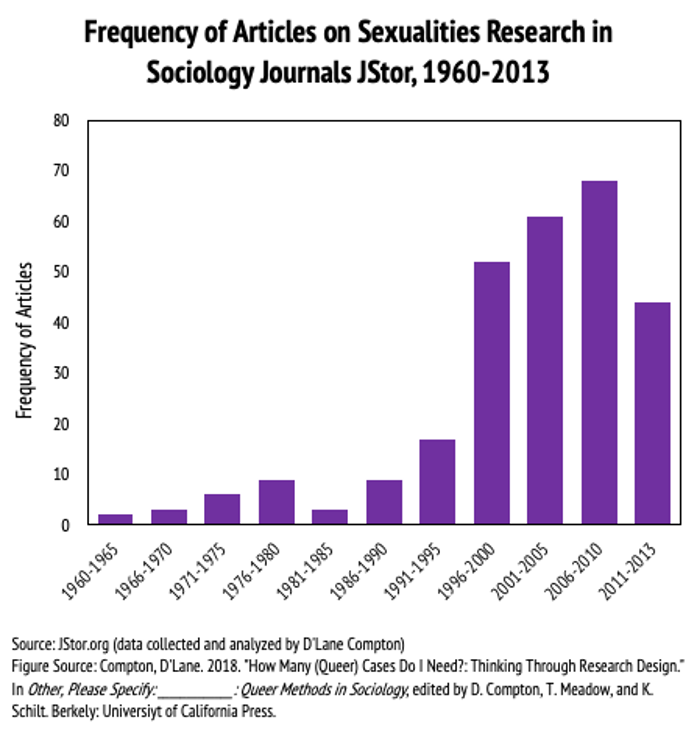
Sociological scholarship addressing sexualities has long existed. But we didn’t always have a section, with members, subspecialties, awards, and more. The figure below is drawn from D’Lane Compton’s archival research in JStor, looking back through published work in sociology journals. Beth received her PhD from the University of Massachusetts in 1981. While she was in graduate school, the numbers of published articles in sociology journals on issues to do with sexualities were small. They were so small that two grad students huddled in a university library could enumerate all of them with their fingers and toes with digits to spare. You can see that the period of growth in the field came after Beth received her PhD. Beth’s early work was ahead of the curve in this respect. And for anyone who knows Beth, this won’t be much of a surprise.Beth’s dissertation research analyzed the sexualization of the workplace, comparing the experiences of heterosexual and lesbian women, focusing on everything from workplace affairs to sexual harassment and assault. It is as timely and important a topic today as when she first completed it. In the project, she found that many women in her study found sexual partners at work. The heterosexual women in her sample were more likely to partner with men who were their superiors while the lesbian women were more likely to end up with women who were their equals. She explained this as a logical outcome in gender stratified workplaces. Among the many aspects of this study that are noteworthy is that the dataset Beth produced included information from almost 300 lesbian women—an impressive sample today, but extraordinary at that time. And studies on lesbians were very rare, particularly in sociology.
In one of her first articles published from this study, Beth reports on her impressive sample of lesbian and heterosexual identifying women with a survey she sent out by mail. In that article, decades before #MeToo, she wasn’t surprised to find that women experienced numerous unwanted physical and sexual experiences at work. But Beth Schneider helped to identify the “recognition problem” wherein fewer women were willing to label the unwanted behavior “sexual harassment.” It’s a problem that continues to be examined today. A key finding in that portion of her research was that lesbian women were more willing than straight women to recognize and label sexual harassment as such.

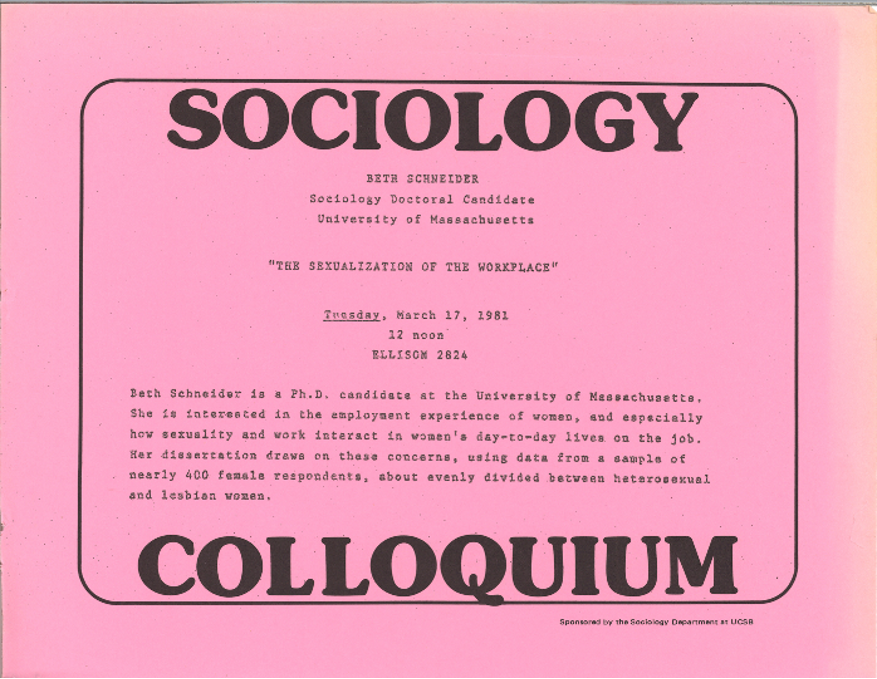
I know this because I re-read Beth’s scholarship when I nominated her for the Simon and Gagnon Lifetime Achievement Award. But I decided to dive in the deep end after I found a copy of the job talk poster from when she came to our campus as a PhD candidate.Beth gave her job talk at UCSB 16 days before I was born, on March 17, 1981. I mention this specifically because anyone reading this essay who is a scholar among my generation or younger entered this field on very different footing. Or perhaps it would be more accurate to say that we entered this field with an identifiable subfield to stand on in the first place. And a great deal of this is due to feminist scholars of sexualities like Beth. Beth was not alone. Indeed, there is a small group of scholars of her generation who had a Beth Schneider Effect of their own – on slightly different areas and among slightly different communities (with a heavy amount of overlap I’d guess). But here, I want to consider the Beth Schneider Effect Beth has had on the sociology of sexualities.
To date, there is little agreement on precisely how to measure a Beth Schneider Effect. We might consider citation records, reprints, article downloads, or presence on course syllabi. And while all of these measure influence, and Beth has notable achievements on each, none of these measures get at what I mean. None of those measures illustrate an individual scholar’s ability to create more seats at the table, or assemble the table in the first place. And it’s precisely that quality of Beth’s work in this field on which I reflect here.

I’m a sociologist, so it’s easiest for me to think through a puzzle like this with a bit of data. And it’s certainly not a random sample of data I’ll present here, but in an attempt to settle scholarly disputes over measuring Beth Schneider Effects that is perhaps in vain, I want to present some data that shapes one of the first ways I came to know Beth Schneider’s name and work. She served as the third Editor of Gender & Society. When I came out to give a job talk at UCSB, I looked back through the issues that came out under her tenure and noted the incredibly influential work published during her tenure. [A note: I realize Gender & Society is not a sexualities journal, but a silly thing like that would never have stopped Beth.]This paragraph above is the conclusion to Beth’s first Editor’s Note. These notes range from 2-3 pages and they offer some insight into some of Beth’s vision for the journal and field. While Beth edited Gender & Society, she published 16 Editor’s Notes. Collectively, they are approximately two Gender & Society article’s worth of text – 15,912 words. I read all of them preparing for a presentation I gave on her work and influence. They’re beautifully written, and if you don’t know Beth, they’re a lovely introduction. Listen to the beginning of her first Editor’s Note:
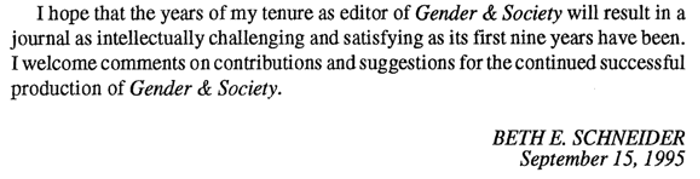
“It is mid-September in Santa Barbara, California. A hummingbird is feasting at the Mexican sage, and the watermelon, cantaloupe, and peppers still grow in our garden... This year I am teaching two new courses (“Lesbian, Gay, and Bisexual People of Color” and “Feminist Politics and Policy”) and transforming two others (“Les­bian and Gay Communities” and “Contemporary Women’s Movements”). Prepar­ing the materials for these courses has made me hunger for more systematic data collection on the undocumented activities of grassroots and community organiza­tions and more sustained theorizing about the interconnections of the relations of sexuality, gender, race, and class… These courses reflect the complicated intellectual ground on which I currently stand, a conflicted place torn between the problematics and debates in feminist scholarship and those of queer theorizing and lesbian and gay politics. No doubt, some of these concerns will be addressed over the next several years in Gender & Society.” (HERE: 6)

Whether or not that last bit was meant as invitation or mandate, Beth was right. Many of these concerns were addressed over the next several years and continue to provoke scholarship today. And Beth played a crucial role in helping create a home for that scholarship. Indeed, Beth served as Chair of the Sexualities section of the American Sociological Association twice (2001-2002 and again in 2009-2012), was a member of the Editorial Board of Sexualities for a decade of her career, and mentored an impressive collection of feminist scholars who study sexualities and have gone on to have Beth Schneider Effects of their own as well. Her work as Editor of Gender & Society is only one piece of her impressive career. I focus on it here because it helps me to neatly illustrate the point I want to make about how much gratitude we all owe Beth Schneider.

When Beth edited Gender & Society, she encouraged people to call the editorial office at UCSB with questions and concerns in her Editor’s Notes. Can you imagine? Manuscript submissions came in by snail mail to the journal, where they were filed, mailed out to reviewers, mailed back to the editor’s office, reviewed, and sent back by snail mail back to authors. People read the hard copy of the journal, or thumbed through the volumes bound together in university library stacks. Today, Gender & Society dedicates fewer pages to Editor’s Notes. But when Beth was editing and scholars were more apt to read the journal cover to cover, Editor’s Notes helped provide some of the connective tissue out of which “the field” took shape. This provided editors a chance to tell readers about the types of work being submitted, to push scholars to engage with new work and ideas, to reflect on feminist issues of the day, and more. Beth did all of this and more. For instance, Beth encouraged more work on sexualities as well as work pursuing an intersectional perspective. And she deliberated publicly on how to encourage scholars to engage with these ideas. In one Note, she wrote,

“I [am] still… pondering how to encourage authors to take seriously what I believe to be a central feature of feminist sociology: the recognition of the complex relations of race, class, gender, and sexuality and how they shape every study undertaken, no matter what the research subject, methodological approach, or theoretical perspective…. I want to move toward a deliberate consciousness of these relations and processes on the part of our contributors, such that the analyses of their own findings explicitly explore and discuss these potentially challenging implications. As a reminder, no lesbian need be present to consider structure and relations of heterosexuality, and race is present in any study of white women.” (HERE: 365)

Beth consistently pushed scholars to consider sexuality as an integral part of the initial holy trinity of intersectionality: race, class, and gender. And whilst celebrating scholarship coming out in these issues, she also challenged some and pushed scholars to strive for more and called for a feminism that was explicitly and unabashedly anti-racist. In another Note, she wrote:

“Some [authors] are more attentive to the question of how to make sense of the question of these [intersecting] inequalities even in work not intended to tackle this question directly. The embeddedness of class and class relations seems easier to grapple with than race and race relations in most of these contributions, and this pattern generalized over time raises questions for me about how race continues to be taken for granted in research on, and/or by, white women.” (HERE: 679)

Many of these issues and others raised consistently and boldly by Beth are issues that remain in feminist scholarship today. This work helps to provide a sense of some of what I have come to understand as Beth’s mission as Editor, a mission that has guided her work and influence in the field more broadly as well.

All of this helps me to demonstrate that Beth consistently asked for more sexualities scholarship and wanted that work to be explicitly intersectional. But, to really document a Beth Schneider Effect, we ought to properly document it. To continue using Gender & Society as just one metric, I wanted to see if I could demonstrate some of what I thought might be true. So, I counted and coded all of the articles and research reports published in Gender & Society between the first issue in 1987 and 2020. And I also counted the number of those articles and reports that might legitimately be called “sexualities scholarship” really broadly defined (below). The gray columns illustrate numbers of articles and reports published, and the black columns visualize the number of those articles and reports that are centrally about sexuality/ies. This period shaded in purple illustrates Beth Schneider’s term as Editor.A year prior to Beth taking over, Sage asked Gender & Society to move from 4 issues a year to 6. So, the work of editing the journal increased a bit as the journal provided more space for more work because of the journal’s fast success. Right in the middle of Beth’s editorship, Sage also started publishing Sexualities, an international interdisciplinary journal dedicated to publishing sexualities scholarship.  
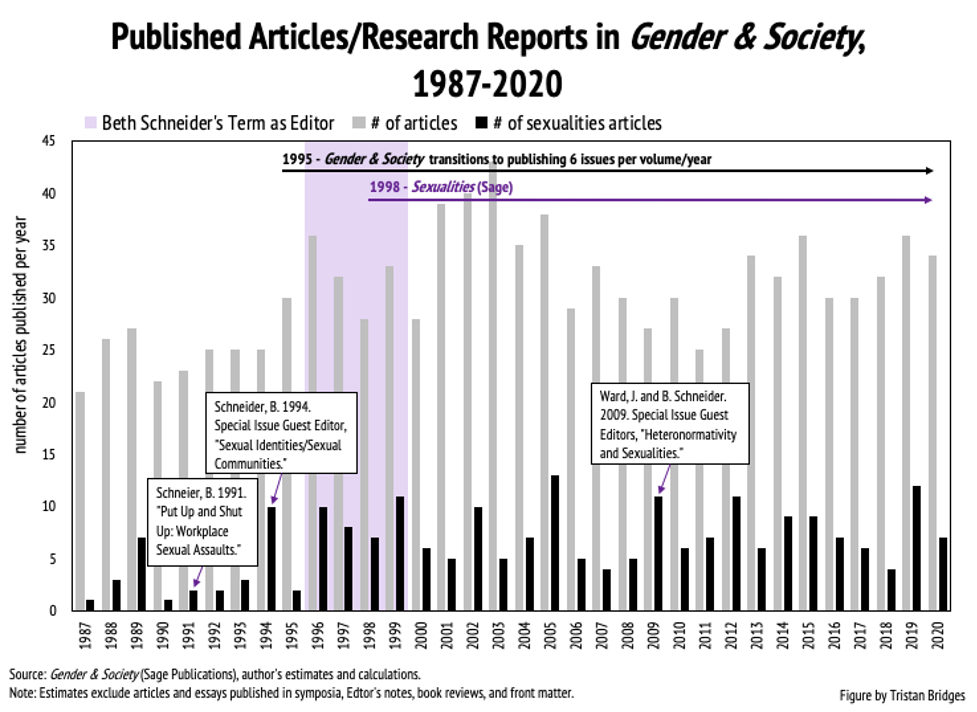
In fact, one of the early articles in Gender & Society on sexuality was Beth’s. In 1991, she published her important article in the journal on workplace sexual assault. Prior to her term as Editor, Beth got some early practice guest editing a special issue in 1994 on “Sexual Identities and Communities.” More articles were published in G&S on sexuality that year than any prior because of that special issue. Additionally, about a decade after her term as Editor, having clearly not had enough, Beth and Jane Ward (one of her graduate students who also served as a Managing Editor at Gender & Society while in graduate school) came back to guest edit a second special issue on “heteronormativity and sexualities.” And all of this work created a home for scholarship that has gone on to be incredibly influential.

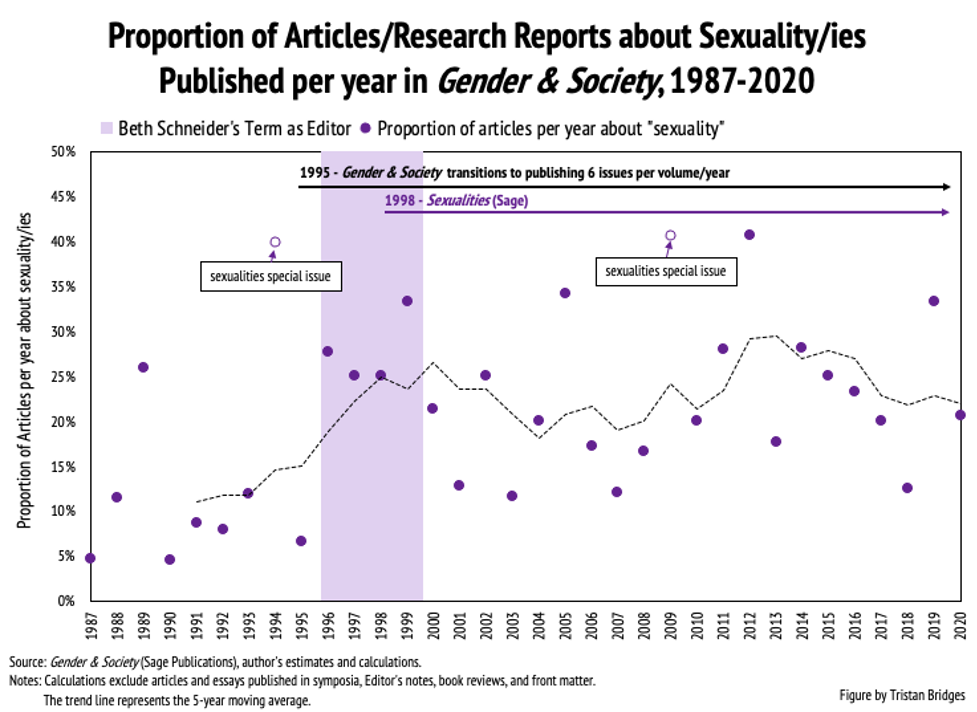
Those data also give us the information to consider the proportion of work published on sexualities in one journal over time (see below). There is a bit of noise in these data. You can vaguely decipher an upward trend, but year-to-year, the data fluctuate; they’re not perfectly linear. And among the reasons they’re not linear, I’m arguing, is Beth Schneider. And herein lies one small piece of evidence for the Beth Schneider Effect she has had on our field.The trend line on the figure above helps to visualize the bi-modal shape of the trend I’m documenting here. There are two peaks. The first begins when Beth published her first article in Gender & Society, continues to rise with her first guest edited issue, and is sustained during her tenure as Editor. The second appears to have been precipitated directly by Jane Ward and Beth’s subsequent guest editorship and special issue. The work in these articles does not necessarily cite Beth Schneider. It wouldn’t show up on many traditional metrics of scholarly influence. But this is a kind of feminist scholarly influence to which I think more scholars ought to aspire.
In addition to her many accolades as a scholar, teacher, and mentor, this is what I mean when I say Beth has had a “Beth Schneider Effect” on our field. No matter who you are or what you study, teach, or learn in sociology, if it has to do with sexualities, this woman helped to build an academic subfield big enough for you to find a seat at the table, and scholarly homes in which that work might be better appreciated. Sociology is a better place for having Beth among us.

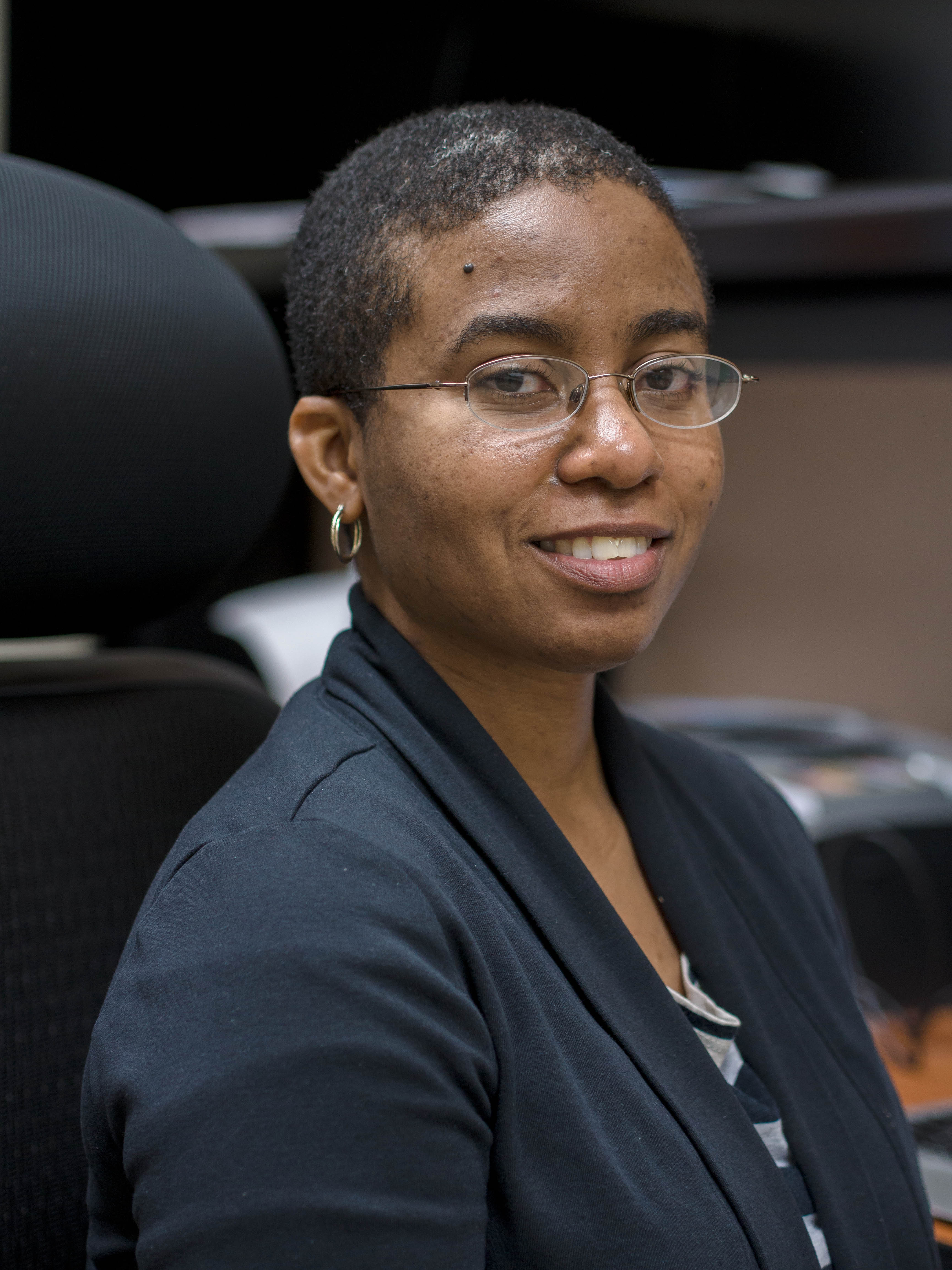
Dr. Beth Schneider as an Assistant Professor at UCSB, circa 1986.

______________________

NOTE: This essay began as a talk I gave at Beth’s invitation at the American Sociological Association conference in August of 2019 on a panel celebrating Beth Schneider’s work in honor of her receiving the Simon and Gagnon Lifetime Achievement Award from the Sexualities Section of ASA. Since that presentation, I’ve wanted to do something more with this and decided to edit it to share as a public essay celebrating Beth’s work and legacy.

Tristan Bridges is Associate Professor of Sociology at the University of California Santa Barbara.

What do Louis Farrakhan, George H. W. Bush, Barack Obama, and Mark Zuckerberg have in common? They are examples of the strange political bedfellows who support separate, publicly funded schools for black boys.

As a public school graduate and one of the few black women faculty at the University of Wisconsin-Madison, I know what discrimination in the classroom looks like. So, when I first heard about the effort to establish all-black male schools (ABMSs), I was relieved that school districts were finally listening to anti-racist activists’ assertion that structural racism in schools is unacceptable. In other words, I situated the push to open ABMSs within black people’s well-established understanding of the classroom as a place for resisting racism. To this end, proponents of the forty-plus ABMSs established since 1991 rightly argue that: black urban schools are under-resourced relative to white suburban ones; traditional public schools utilize racist curricula; black students are disciplined more harshly than white students, and black teachers are under-represented in the nation’s schools.

At the same time, the anti-feminist ethos sometimes present in #Black Lives Matter and other expressions of black politics is also evident in conversations about ABMSs. It is unsurprising then that my initial optimism about ABMSs soon turned to concern. I recognized that despite their best intentions, some advocates of ABMSs minimize the degree of black girls’ own oppression in school. Equally disturbing is many ABMS supporters’ assumption that black schoolboys underperform because they are distracted by black girls. This claim reproduces harmful images of black women as “jezebels” who sexually corrupt the men in their midst.

There is much to learn from the movement to open ABMSs. One lesson is that intersectionality – the analytical framework pioneered by black feminists to illuminate how racial, gendered, and other systems of power are mutually reinforcing – can be used to advance multiple political agendas, including anti-feminist ones.  On the one hand, advocates of AMBSs embrace intersectionality when they assume that black boys underachieve not only because they are black in racist schools but also because they are black boys in white, female-dominated classrooms. This intersectional logic highlights black boys’ experience of gender-specific racism or the fact that the nation’s teachers, most of whom are white women, suspend black boys at higher rates than other students, including black girls. On the other hand, numerous advocates of ABMSs assume that black boys underachieve because white women teachers create racist, “feminized” classrooms at odds with these boys’ “naturally” aggressive learning style. This latter intersectional approach obscures research which indicates that biology does not automatically make boys tactile learners and girls oral learners. Most significantly, ignoring these data leads far too many supporters of ABMSs to overlook the needs and aptitudes of black children, like highly verbal black boys, who defy stereotypical gender roles.

So where does the reality that the push for ABMSs resists racial inequality but sometimes relies on gender inequality leave those of us committed to challenging intersecting inequalities in our personal, activist, and/or professional lives? I believe that supporters and critics of AMBSs can form politically progressive coalitions. This might seem like an unrealistic goal given that advocates of ABMSs sometimes reject black feminist criticism of their efforts. Indeed, black feminists who express concerns about these schools have heard that we are “colluding with the enemy” or giving racist whites the opportunity to condemn ABMSs and, in turn, stifle black boys’ academic prospects. It is also true, however, that while many proponents of ABMSs conceptualize black children’s oppression in ways that threaten bridge-building, other advocates recognize that the sometimes sexist and heterosexist rhetoric in favor of these schools harms both black boys and black girls.

Building on this finding requires all participants in the debate about ABMSs to embrace a particular type of educational advocacy – one which recognizes that public schools are key to addressing oppression and that black children are forced to learn in some of the worst public schools. Putting this kind of nuanced advocacy into practice means using accessible, community-based spaces to challenge our assumptions about how and why black children are oppressed in school. It also means defining “good” public schools as those which foster all black children’s capacity for self-determination and self-actualization in the classroom, and beyond.

_________________________

Keisha Lindsay, PhD is an associate professor of gender and women’s studies and political science at the University of Wisconsin-Madison. Her research and teaching interests include black feminist theories, black masculinities, and gender-based politics in the African diaspora. She is the author of In a Classroom of Their Own: The Intersection of Race and Feminist Politics in All-Black Male Schools (University of Illinois Press 2018).

Originally posted at Democratic Socialists of America

In the 1950s, a collection of sociologists and psychologists (which included, among others, Theodor Adorno) wrote The Authoritarian Personality. They were attempting to theorize the type of personality — a particular psychology — that gave rise to fascism in the 1930s. Among other things, they suggested that the “authoritarian personality” was characterized by a normative belief in absolute obedience to their authority in addition to the practical enactment of that belief through direct and indirect marginalization and suppression of “subordinates.” While Adorno and his colleagues did not consider the gender of this personality, today gender scholars recognize authoritarianism as a particular form of masculinity, and current U.S. president Donald Trump might appear to be a prime illustration of a rigid and inflexible “authoritarian personality.”

Yet Trump’s masculinity avoids a direct comparison to this label precisely because of the fluidity he projects. Indeed, the “authoritarian personality” is overly fixed, immutable, and one dimensional as a psychoanalytical personality type. Sociologists understand identities as more flexible than this. Certain practices of Trump exemplify the fluctuations of masculinity that illustrate this distinction, and the transformations in his masculinity are highly contingent upon context. While this is a common political strategy, Trump’s shifts are important as they enable him to construct a “dominating masculinity” that perpetuates diverse forms of social inequality. Dominating masculinities are those that involve commanding and controlling interactions to exercise power and control over people and events.  These masculinities are most problematic when they also are hegemonic and work to legitimize unequal relations between women and men. Here are a few examples:

First, in his speeches and public statements prior to being elected, Trump bullied and subordinated “other” men by referring to them as “weak,” “low energy,” or as “losers,” or implying they are “inept” or a “wimp.” (“Othering” is a social process whereby certain people are viewed and/or treated as somehow fundamentally different and unequal.) For example, during several Republican presidential debates, Trump consistently labeled Marco Rubio as “little Marco,” described Jeb Bush as “low energy Jeb,” implied that John McCain was a “wimp” because he was captured and tortured during the Vietnam War, and suggested that contemporary military veterans battling PTSD are “inept” because they “can’t handle” the “horror” they observed in combat. In contrast, Trump consistently referred to himself as, for example, strong, a fighter, and as the embodiment of success. In each case, Trump ascribes culturally-defined “inferior” subordinate gender qualities to his opponents while imbuing himself with culturally defined “superior” masculine qualities. This pairing signifies an unequal relationship between masculinities—one both dominating and hegemonic (Trump) and one subordinate (the “other” men).

A second example of Trump’s fluid masculinity applies to the way he has depicted himself as the heroic masculine protector of all Americans. This compassion may appear, at first blush, at odds with the hegemonic masculinity just discussed. For example, in his Republican Convention speech Trump argued that he alone can lead the country back to safety by protecting the American people through the deportation of “dangerous” and “illegal” Mexican and Muslim immigrants and by “sealing the border.” In so doing, Trump implied that Americans are unable to defend themselves — a fact he used to justify his need to “join the political arena.” Trump stated: “I will liberate our citizens from crime and terrorism and lawlessness” by “restoring law and order” throughout the country — “I will fight for you, I will win for you.” Here Trump adopts a position as white masculine protector of Americans against men of color, instructing all US citizens to entrust their lives to him; in return, he offers safety. Trump depicts himself as aggressive, invulnerable, and able to protect while all remaining US citizens are depicted as dependent and uniquely vulnerable. Trump situates himself as analogous to the patriarchal masculine protector toward his wife and other members of the patriarchal household. But simultaneously, Trump presents himself as a compassionate, caring, and kind-hearted benevolent protector, and thereby constructs a hybrid hegemonic masculinity consisting of both masculine and feminine qualities.

Third, in the 2005 interaction between Trump and Billy Bush on the now infamous Access Hollywood tour bus, Trump presumes he is entitled to the bodies of women and (not surprisingly) admits committing sexual assault against women because, according to him, he has the right. He depicts women as collections of body parts and disregards their desires, needs, expressed preferences, and their consent. After the video was aired more women have come forward and accused Trump of sexual harassment and assault. Missed in discussions of this interaction is how that dialogue actually contradicts, and thus reveals, the myth of Trump’s protector hegemonic masculinity. The interaction on the bus demonstrates that Trump is not a “protector” at all; he is a “predator.”

Trump’s many masculinities represent a collection of contradictions. Trump’s heroic protector hegemonic masculinity should have been effectively unmasked, revealing a toxic predatory heteromasculinity. Discussions of this controversy, however, failed to articulate any sign of injury to his campaign because Trump was able to connect with a dominant discourse of masculinity often relied upon to explain all manner of men’s (mis)behavior — it was “locker room talk,” we were told. And the sad fact is, the news cycle moved on.

We argue that Trump has managed such contradictions by mobilizing, in certain contexts, what has elsewhere (and above) been identified as a “dominating masculinity(see here, here and here) — involving commanding and controlling specific interactions and exercising power and control over people and events. This dominating masculinity has thus far centered on six critical features:

  1. Trump operates in ways that cultivate domination over others he works with, in particular rewarding people based on their loyalty to him.
  2. Trump’s dominating masculinity serves the interests of corporations by cutting regulations, lowering corporate taxes, increasing military spending, and engaging in other neoliberal practices, such as attempting to strip away healthcare from 24 million people, defunding public schools, and making massive cuts to social programs that serve poor and working-class people, people of color, and the elderly.
  3. Trump has relied on his dominating masculinity to serve his particular needs as president, such as refusing to release his tax returns and ruling through a functioning kleptocracy (using the office to serve his family’s economic interests).
  4. This masculinity is exemplified through the formulation of a dominating militaristic foreign policy (for example, U.S. airstrikes of civilians in Yemen, Iraq and Syria have increased dramatically under Trump; the MOAB bombing of Afghanistan; threats to North Korea) rather than engaging in serious forms of diplomacy. Trump has formed a global ultraconservative “axis of evil”— whose defining characteristics are kleptocracy and dominating masculinity — with the likes of Putin (Russia), el-Sisi (Egypt), Erdogan (Turkey), Salman (Saudi Arabia), Duterte (Philippines) among others.
  5. So too has this dominating masculinity had additional effects “at home” as Trump prioritizes domestically the repressive arm of the state through white supremacist policies such as rounding-up and deporting immigrants and refugees as well as his anti-Muslim rhetoric and attempted Muslim ban.
  6. Trump’s dominating masculinity attempts to control public discourse through his constant tweets that are aimed at discrediting and subordinating those who disagree with his policies.

Trump’s masculinity is fluid, contradictory, situational, and it demonstrates the diverse and crisscrossing pillars of support that uphold inequalities worldwide. From different types of hegemonic masculinities, to a toxic predatory heteromasculinity, to his dominating masculinity, Trump’s chameleonic display is part of the contemporary landscape of gender, class, race, age and sexuality relations and inequalities. Trump does not construct a consistent form of masculinity. Rather, he oscillates — at least from the evidence we have available to us. And in each case, his oscillations attempt to overcome the specter of femininity — the fear of being the unmasculine man — through the construction of particularized masculinities.

It is through these varying practices that Trump’s masculinity is effective in bolstering specific forms and systems of inequality that have been targeted and publicly challenged in recent history. Durable forms of social inequality achieve resilience by becoming flexible. By virtue of their fluidity of expression and structure, they work to establish new pillars of ideological support, upholding social inequalities as “others” are challenged. As C. J. Pascoe has argued, a dominating masculinity is not unique to Trump or only his supporters; Trump’s opponents rely on it as well (see also sociologist Kristen Barber’s analysis of anti-Trump masculinity tactics).  And it is for these reasons that recognizing Trump’s fluidity of masculinity is more than mere academic observation; it is among the chief mechanisms through which contemporary forms of inequality — from the local to the global — are justified and persist today.

I remember, about a decade ago, meeting U.S. scholars at an international conference. In the period of an otherwise nice lunch, one particular colleague – a second wave (cisgender, straight) feminist of color – initiated a conversation on what turned out to be her nephew going through gender reassignment (although she voiced this as her “niece” going through “bodily mutilation”). I remember the challenge of having to articulate a harsh and yet loving criticism of this colleague who I otherwise respected, and still respect today, and my need to understand how, and why, these readings of the flesh took center stage in this colleague’s fears. Having experienced racialized sexualities and racialized gendered readings throughout our lives, she came to the table with preconceived notions about the sanctity of one’s body, and trans* identities and experiences challenged that idea.

About 10 days ago, I recalled that moment when I started reading criticisms of Chimamanda Ngozi Adichie’s recent comments, and various responses from transwomen, among them Laverne Cox. Adichie has clarified her points most recently, where she reiterated the main premise of the separation between trans* and cisgender women – that transwomen have had “male privilege,” inserting, pretty much god-like, that posture on transwomen’s histories (please read this inspiring story on the challenges this poses to cisgender women agreeing with Adichie). This has been the point of contention of much of the public debate. The character of her accusations as transphobic are two-fold. On the one hand, they are politically efficacious for trans communities – a group that should be directly speaking on trans* issues (and not Adichie). Yet, on the other hand, they are a shallow move that avoids addressing the historically charged relationship between feminist thought, sociology, and trans* rights, a move that cannot be brushed away with a mere accusation of transphobia.

My goal is to converse with (cisgender and trans*/transsexual) feminist scholars and activists, and although I center my remarks on the sociological discipline, I want to reach social scientists and non-academics alike. I wish to engage whatever politics we activate when we deploy a monolithic view of feminism, but also, the subsequent attacks and remarks of Adichie as transphobic. To be sure, cisgender (straight and lesbian identified) feminist wars have taken shape for decades: as a case in point, Cherríe Moraga’s work has been critiqued for its posture against transmen (in ways that have been labeled transphobic). True, there is a lot of tension in the sex-gender wars between cisgender feminist activists/scholars, and those of latter waves of feminist thought. But what seems problematic in this case is the focus on Adichie as a target.

It seems so easy, so self-celebratory, to challenge a woman whose engagement with “third-world” postcolonial writing has been exponentially far more advanced than White cisgender feminists in the US, a scholar whose premise has been one of liberation. This, especially when there are feminists with a stronger platform – and many more untapped issues on intersectionality to address – than Adichie. Thus, I remain suspect of the inherent colonial underpinnings of those (White, well intended, trans* and cisgender activists) accusing a Nigerian woman of transphobia, in light of how Nigeria, and other countries in the African continent, are portrayed in terms of their perceived more homophobic/transphobic stands. (How much does that stance caters to USAmericans’ elevated sense of righteousness?) That, too, has to be a point of contention, and one to focus on, and work through, in these discussions.

The context of the interview is often missing from the criticisms. Ironically, and literally a minute before the oft-quoted excerpt, Chimamanda was critiquing the cliquish way (think social movements) in which left-ist groups (say: feminist groups, but let’s extend it to queer groups, anti-racist groups, “radical” groups, etc.) organize, develop a common language, solidify boundaries, and consequently police each other in terms of the maintenance of the most progressive language. She acknowledged it as a genuine attempt to create social justice and change, yes, but with the (often) unintended effect of sustaining their status.

Certainly, sociologists such as Viviane Namaste (in her book, Oversight) have critiqued these in-group linguistic privileged cues/behavior. In the context of gender-neutral language, Namaste problematizes the use of requesting self-pronouns in group setting introductions, when attempting to provide voice to a diverse set of experiences. Namaste critiques these moves for what they do – further alienating trans* and transsexual people by magnifying the White savior (cisgender and straight) complex in the utterance of the “preferred” pronouns. (Really, some do not have preferred, but their own, pronouns, defined by them and articulated in everyday interactions, and not in mere utterances.) To expect many trans (especially non-gender queer transgender and transsexual) people to unequivocally utter their identity – which has been for many a source of stress and an identity in process – and turn it around to make it seem liberating, only benefits the ones evoking its use. Ultimately, is the language we use a tool for freedom, or is language a set of exclusionary layered accounts that, by virtue of its precision, erase and dismiss those who are not “engaged” enough?

Beyond Adichie’s interview, but including it, we also fail to account for the imagery, and imaginaries, we (in US society) hold of trans people (this includes the reaction cisgender feminist women – including Adichie – often have of transwomen). In the US, most USAmericans are still more exposed to Caitlyn Jenner as a trans figure, and not so much to people like actress Laverne Cox, writer Janet Mock, or Jennicet Gutiérrez, the trans Latina activist who challenged Obama to free those undocumented immigrants in detention centers at the cusp of same sex marriage becoming legal nation-wide. (The fact that I find myself in need to add qualifiers for each of them may signal that they are not yet recognized in many places outside of these cliquish groups.) Transgender imaginaries dominate certain narratives, and Jenner’s centrality in the “reality” TV shows signals a protagonism in the US’ mainstream imagery of transwomen.

This take on transwomen’s histories, however, may also speak to the US’ obsession with power through masculinity. That tired old narrative – that Jenner renounced masculinity (after being recognized as an incredibly talented male athlete) – is still, for most USAmericans, a “shocking” narrative. Overall, such readings reveal how we conceive of power, how much we cling to it, and how little do we think of the non-masculine (or give it space, for that matter) in the world.

As another case in point, Joanne Meyerowitz documented the “former GI turned beauty queen” 1950s “bombshell transformation” – about Christine Jorgensen – in her incredibly resourceful book How Sex Changed. (Cox references Jorgensen in her tweets by mentioning the lack of recognition of transwomen, except in the “macho guy becomes a woman” pre-fixed recipe framework.) There, the focus on masculinity – a conflation of maleness and masculinity, really – is an example of the type of obsession with maleness, masculinity, and other axes of power that are often not interrogated when studied from some humanities and fields in the social sciences, and automatically plopped as a convenient narrative to explain away the “outliers.” We should know better. But masculinity serves as a way to continue to leave un-interrogated some of our assumptions.

In Adichie’s brief exchange, the interviewer set her question up in ways that seemed leading. In that context – when receiving a question that suggests transwomen always already enter feminist spaces through a history of male privilege – there is already little to salvage. I do think that language betrays us, and sometimes we fail to see something, or act right then and there. Adichie could have restated the question, rethought her assumptions, critiqued the premise of the query. That she did not is precisely what we should be considering an opportunity rather than a chastising imperative to discipline her – or those who do not see things the way “we” do. As it turns out, she continues to defend this narrative over and again. A cisgender-driven feminist thought that is perhaps engrained in Adichie should not result in judgment, but the starting point of action and conversation, en route to coalitional work. We must challenge these tired old arguments with counter arguments. Some of us do it from an academic platform, though that is not the only (or even main or “best”) way to do so. In my own research on masculinity and transmen, it was clear how, as one interviewee noted, “I had no past as a man, but I had no future (as a woman).” Others noted how, even as they faced life as men in the world, and seemed to benefit from male privilege, a sudden bodily exposure—be it a car accident, a medical test at an OBGYN office, or in potential erotic/sexual encounters—immediately removed this so-called privilege. Yes – Adichie, and others, should not fall on the “male privilege” trap. But we can explain, and elaborate on, why these are fallacies that need rethinking.

Sociologists too have lived with a fascination with gender deviance, understanding social norms through categorical gender lenses, and using excess to illustrate the rules of its ordering. (Perhaps as sociologists we need to challenge our simplest use of socialization altogether.) Privilege and power do not operate in simple binaries and opposites—we do know this from feminist thought—but to name biological circumstances (XY or XX chromosomes, external genitalia) as social is to reinstate sex circumstances as gender fixed criteria in our histories (with no room for variation or degrees). The humanities and social sciences of our times should move beyond the notion that transwomen are biologically male, and trans* activists are pushing us to see how damaging this is (and doing so through coalitional efforts). Thankfully, yet painfully, through her comments on being policed because of her femininity, Laverne Cox is really moving forward the discussion Adichie began. Cox did so by invoking a simple element: that her perceived deficit in the accomplishment of masculinity was indeed the fact of her femaleness (not just her femininity) and an “unknown” (if not unspoken) gender identity. That uncovers a previous social scientific approach to difference that challenged, and simultaneously reified, sex/gender.

We must challenge feminism in transformative ways, so that transwomen’s womanhood is no longer addressed through discourses of male privilege. However, that does not require forcing cisgender feminists to equate transwomen’s experiences with cisgender women’s experiences. What is damaging is not just the erasure of trans experience and identities as women, if they so wish to see themselves as (some trans* people do not abide nor work within that binary), but the homogeneous articulation of a single womanhood, which feminist thought has constantly refuted. To say ‘trans women are trans women’ is noting women with a particular life experience, and that can be, without the automatic mainstream-feminist compulsory answer that falls back on the tired “male privilege” narrative. In thinking intersectionally, one should be disturbed not so much because of the separate articulation of transwomen from (but also as) women; but the overgeneralization of that statement and what it erases – Jenner, Cox, Mock, Gutiérrez, and others have infinitely distinct experiences based on class and immigration and race and ethnicity and education and age and body type/size and ability, to name but a few markers.

Because of Adichie’s intent to see transwomen as non-universally women, I still believe Adichie’s feminism is intersectional. It may not be my cup of tea, and yes, I will continue to resist that narrative. But that should not reduce her history of intersectional work to ashes because of a single criticism. We must also be critical of the uses and abuses of the terms and their reach—here, I am reminded of the impossibility of intersectionality in Jane Ward’s Respectably Queer (in this case, in three sites that used sexuality as the basic premise to show the ways in which race/class/gender could not be addressed in tandem). And I see a chance, an opportunity, to build, not to shut down. What remains for us is the harder work of communicating across differences, which is not so shallow. It requires commitment, but also, an understanding of these feminist postures. Yet, I agree, it certainly does not require their endorsement.

I am not suggesting that we should not hold our activists, scholars, heroines or public intellectuals to task – not at all.  What I am suggesting is that we do not disavow them because they’ve taken a historically narrow position, given their own social location and experience. What I am suggesting is that we take a stand (especially those of us, non-trans scholars) to challenge, as in my opening vignette, both the assumptions about second wave feminism as the uncritical read of trans* lived experience. Laverne Cox’s tweets (which can be read in their totality here) were filled with an intent to engage, to communicate and challenge, and to not alienate Adichie as a feminist cisgender woman – and by extent, feminist cisgender women. I sure hope those of us, trans* and not trans-identified alike, can at least follow in Cox’s footsteps.

_____________________
Salvador Vidal-Ortiz (Ph.D.) is associate professor in the sociology department at American University (AU), in Washington, DC. He coedited The Sexuality of Migration: Border Crossings and Mexican Immigrant Men (NYU Press, 2009) and Queer Brown Voices: Personal Narratives of Latina/o LGBT Activism (University of Texas Press, 2015). Aside from his Fulbright-based research on forced migration/internal displacement and LGBT Colombians, he is now engaged in a new project, with Juliana Martínez, also from AU, on “Transgendering Human Rights: Lessons from Latin America.” He was an inaugural editorial board member of Duke’s newest journal TSQ: Transgender Studies Quarterly.

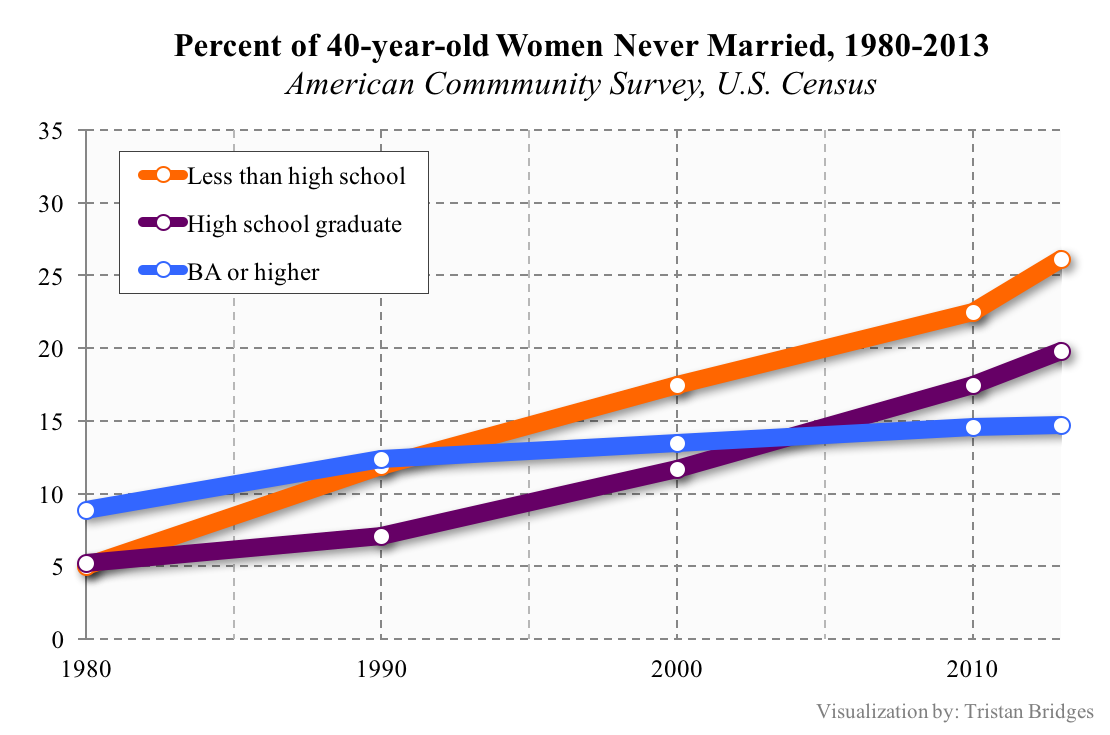
The situation. Americans are delaying and foregoing marriage in larger numbers than they used to.  In 1980, about 5% of 40-year-old women with only a high school education or less had never been married.  Almost 9% of 40-year-old women with at least a BA had never married.  And these numbers have been rising for all of these groups, some more than others.  It’s all the more interesting because, in this same time period, marriage has become legally accessible to more individuals.  But, by 2013, the proportions of 40-year-old women who had never married exploded (see graph below*).  There are a variety of reasons that account for this shift.  At a basic level, women are getting more education and have more life options than they did 30+ years ago.  But are heterosexual women foregoing marriage altogether, or are they still waiting for “Mr. Right”?  And if they’re waiting, are there enough Mr. Rights to go around?

never-married-women-by-education-1980-2013

The man question. With the rise of women’s options not to marry, no wonder questioning men’s status as “marriage material” is pervasive in popular culture.  This “man question” is so accepted that further elaboration is not typically required when suggesting an individual man fails to pass muster.  But, sociologists take the idea seriously. We have examined three decades of research to demonstrate the rise of the man question—and the ways it relates both to rising gender equality and economic inequality.

Marriageability = jobs? In the late 1980s, sociologist William Julius Wilson sought to give the phenomenon a social scientific name and a more precise and measurable quality. Wilson studied poor and working-class communities and discovered that inner-city joblessness among lower-income black men was resulting in a dilemma for inner-city lower-income black women: a growing shortage of men who might qualify as marriageable. Since the majority of marriages and relationships in the U.S. (both then and now) are between people with similar class and racial backgrounds, this extended the gap even further.

Wilson defined men’s “marriageability” in terms of economic stability. Employment was key, in his view, to men’s suitability as marital partners. Changes in the economy in the prior several decades had produced ripple effects that left fewer men in this group able to find gainful employment. And these problems still exist.  Using education as a proxy for class status, lower-income heterosexual women still face a pool of marriageable men that is too small for them to all find husbands.  In fact, the data above suggest that it may very well be a problem that has gotten worse, particularly for Black Americans.  In recent times, we have seen returns to higher education for Black women increase at a modest rate, while Black college educated men’s returns have actually declined.  And the lack of employment for those without a college degree—which is hard to obtain for both Black men and women—has become more difficult for Black men.  This means fewer and fewer men match women in terms of education, jobs, and other social class characteristics.

But who is thinking about men as more than a pay check? Wilson’s suggestion that too many lower-class men are not really marriage material because of the job market produced a stream of research on how lower-income women are navigating this challenging terrain. In the 1990s, the use of economic stability as the primary measure of “marriageability” received little push-back from other scholars.  Few scholars, for instance, have sought to examine men’s marriageability outside of lower-income groups. And from the graph above, you can see that less educated women’s rates of never marrying have increased much more than more educated women’s.  But, are middle- and upper-class women measuring men by the same yardstick?  And if so, how do they measure up?

We examined over thirty years of research from 1984 – 2015.  Our overview confirmed that “marriageability” research that emphasizes men’s value as a paycheck focuses exclusively on lower income groups of women and neglects the ways that women across the class divide may struggle finding “marriageable” men, but perhaps for different reasons.  Our overview confirmed that “marriageability” research neglects a consideration of more complex measures than economic stability and is limited to research examining the lower-class. We suggest that scholars begin to ask about men’s “marriageability” across the class divide.

If it is about jobs, why are middle class men subject to the marriageable man question? Existing research suggests that the yardsticks for working class and middle class men are distinct—but maybe not in the way you’d expect.  Our review of the research shows that while lower-income men often fail to measure up as a result of joblessness, substance abuse, and incarceration (all issues which negatively impact their employment), middle- and upper-class men able to find employment are not always understood as marriageable.  Data from online dating sites like OkCupid.com illustrate this issue, too. In online dating profiles, straight men are much more likely than straight women to list words associated with jobs and professions (assuming these are the qualities women are looking for).  But, as studies of middle- and upper-class women show, that just isn’t enough. These women’s understandings of what qualifies as a “marriageable” man goes beyond a paycheck—it has to do with relationship quality and equality as well.

Meanwhile, women’s expectations for their relationships have transformed across the class divide.  Women want more out of marriage.  Many still want the economic security associated with marital households, though women today may not need to lean on this security as much as they did thirty years ago.  But, they also want a set of intangibles that is much more related to the quality of the relationship than the individual qualities any given man might possess.  High quality relationships provide economic support, but they also come with emotional support, shared commitments to household labor, childcare, and more.  They want a partner in every sense of the word. And within this transformation, men of different class backgrounds are failing to prove themselves “marriageable”—but not necessarily for the same reasons.

For instance, research shows that in the face of economic constraints that make the breadwinner model unattainable to many working-class and poor fathers, they are redefining this role to prioritize what they can and do bring to the table—a more involved form of parenthood. Ironically, this kind of relational fathering sounds like what many middle- and upper-class women with children or desiring children say they want more of from their partners. Middle- and upper-class fathers, however, end up prioritizing the paycheck and minimizing parenting involvement due primarily to workplace policies and constraints. Many lower-income men fail by the old metric—income.  But research suggests that in some ways, they fulfill many women’s desires for egalitarian relationships.  Conversely, middle- and upper-income men are more likely to qualify as “marriageable” by the old metric (income), but fail by new egalitarian standards for relationships—relationships both women and men claim to desire.

Men’s “marriageability” is best understood, we find, in the context of two trends: increasing expectations of gender equality among both women and men and growing economic inequality and insecurity.  Research shows that these twin trends make egalitarian relationships and marriages available to relatively few.  Wilson used income as synonymous with marriageability; a steady and reliable paycheck was all men needed.  But, marriageability is more complex than that.  Today, income is more of a baseline expectation for consideration.  And research suggests that some men may be prizing these qualities in themselves to the detriment of things that women might actually want from them.

____________________________

Thanks to Virginia Rutter for advanced comments on this draft (a while ago).

*Thanks to Philip Cohen for the data.

sex rolesThe journal, Sex Roles, is among the most highly ranked and influential journals publishing research on gender in the world.  I recently joined the editorial board and am really honored to evaluate research considered for publication there.  This isn’t a  post about the content of the journal, though; it’s a post about the title.  I want to suggest that we change it.  I recognize what a logistical nightmare this would be for the publisher, Springer, and how much work would need to be done to re-brand the journal.  But, I also think that some of the most cutting edge scholarship going on in gender might never see the journal as an appropriate venue with a dated title that relies on a concept and pays homage to a theory gender sociologists moved away from over three decades ago.

Sex role theory was the first systematic attempt to theorize gender when sociology was dominated by the paradigm of structural functionalism.  But, when we teach undergraduate and graduate students about sex role theory today, we often address the various failings of the theory (and to be clear, there are many).  Sex role theory was really the first systematic attempt to tie the structure of gender identities and what others called personality or “sex temperament” to the structure of society.  This might sound like a small feat today, because it is so taken for granted as a basic assumption behind so much scholarship motivated by this simple premise.  Put another way, sex role theory helped to label something “social” that lacked status as something to be studied by sociologists, at least in the ways sex role theory invited.

Like structural functionalist theory more generally, however, sex role theory was subject to a variety of critiques.  In C.J. Pascoe and my introduction in Exploring Masculinities, we summarize four prevalent critiques of sex role theory.  The theory is tautological, teleological, ahistorical, and fails to account for gender diversity or inequality–damning critiques, to be sure.  I won’t belabor the point.  Rather, I’ll put it this way.  The first time I submitted something to Gender & Society there was a brief caveat in the manuscript submission guidelines that explicitly stated that work relying on sex role theory was not appropriate for publication in the journal.  It’s since been removed–and I’d imagine this was probably done because people no longer submit articles that attempt to use the theory to explain their findings.  But it speaks to the level of agreement about the demise of the framework.

The current editor of Sex Roles, Janice Yoder, is fantastic.  She wrote a really insightful and inspiring essay in her new role as editor in December of 2015–“Sex Roles: An Up-To-Date Gender Journal With An Outdated Name.”  I won’t reiterate all of the great points Yoder addresses there (but you should read them).  What I will say is that she addresses the origins of the journal in the 1970s, as an publication desiring to publish scholarship focusing on “sex roles” as opposed to “biological, dimorphic sex”–an important project.  At the time, sex role theory was in vogue, and it was a concept and theory that had purchase in a variety of disciplines, likely helping initial editors justify the need for a journal in a still-emerging field of study.  The first issue was published in 1975.  Other journals emerged around this time as well, like Feminist Studies (1972) and Signs (1975) for instance.

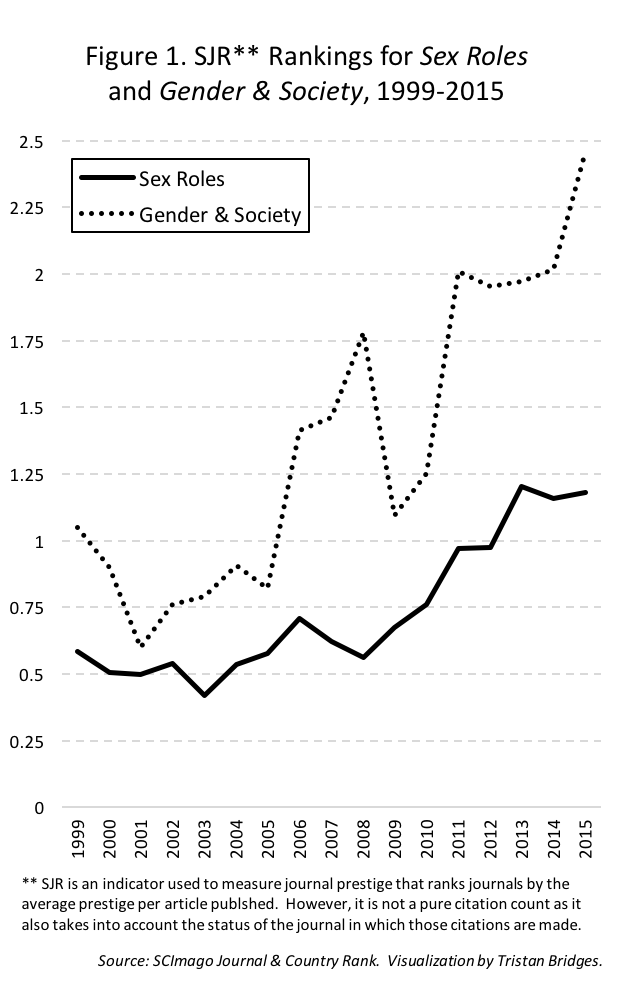
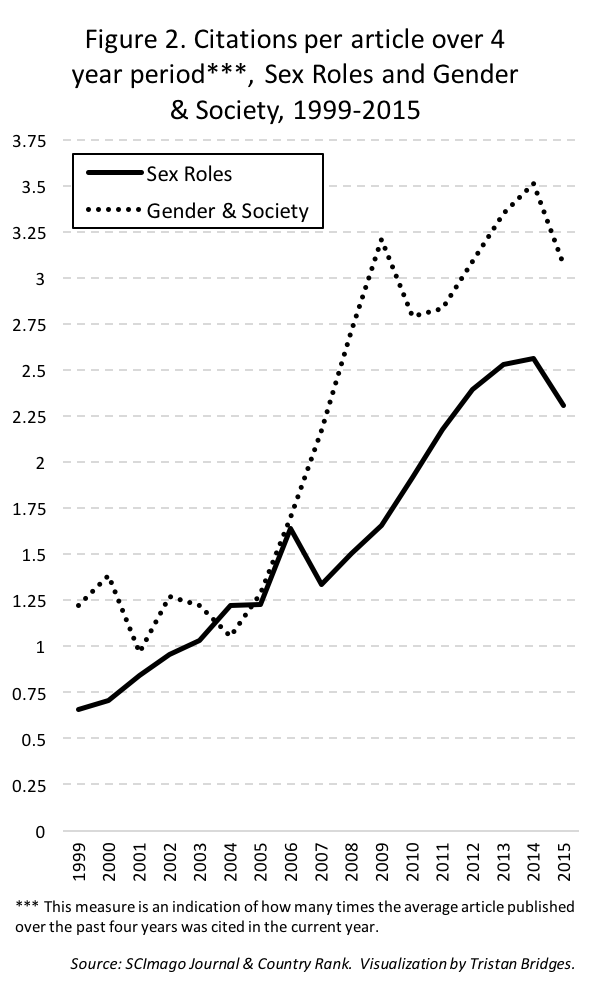
But a separate collections of journals arrived a bit later like Gender & Society (1987), the Journal of Gender Studies (1991), and a whole collection of journals around the world and in different fields of study.  Sex Roles has consistently been ranked a top 10 journal publishing gender studies research.  Below, I want to compare the journal to the top ranked journal publishing research on gender–currently Gender & Society–to illustrate the impact of Sex Roles.  This is helpful to sociologists, I think, because Gender & Society is the gender journal many use to evaluate other gender journals in this field.  Gender & Society and Sex Roles are both hugely influential in the field (Figure 1).  Both journals have climbed in the rankings recently and have seen their impact grow.  Gender & Society is also a journal with a high citation per article count, and articles published in Sex Roles are not far behind (Figure 2).

Figure 1

Figure 2

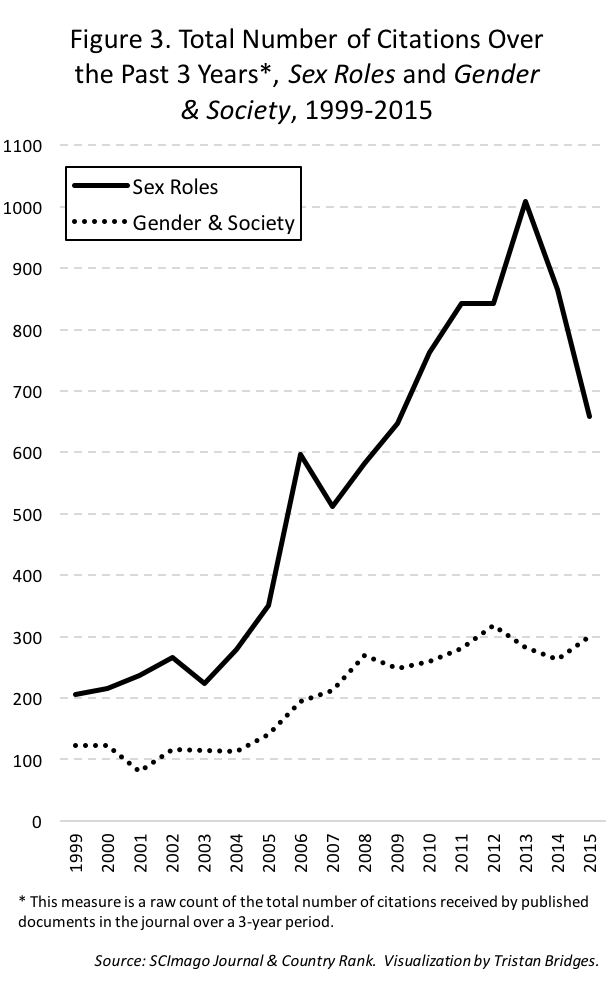
Sex Roles, however, has also been published over a longer period of time and publishes more articles over the course of a year.  So, while the average article published in Gender & Society receives more citations than the average article published in Sex Roles, the total number of citations that articles published in Sex Roles receive is roughly 2-3 times the number received by Gender & Society (Figure 3).

Figure 3

All this is to say that there are certainly lots of ways to measure influence.  And by all measures, Sex Roles has a lot.  It matters–and the research published in Sex Roles ends up in a whole lot more reference sections of books and articles than does the work published in Gender & Society.

I think the journal should change the title.  And I realize that I’m not centrally involved in the work that would be required to undertake this task.  But, I’d wager that most of the scholars publishing research in that journal would support the critiques leveled against sex role theory in the 1980s by scholars like Barrie Thorne, Judith Stacey, and Raewyn Connell.  And I think a larger group of scholars would consider Sex Roles as an outlet for their research with a different title.  I realize that the logistics of this are much more complex than simply changing the cover and masthead.  It would involve a campaign on the part of Springer, current and former editors, as well as interdisciplinary collaboration among gender researchers.

After considering the change possible, the very first step would likely be to figure out what the new title of the journal might be.  My vote would be for “Gender Relations,” a concept that comes out of Raewyn Connell’s theory of gender.  Embedded in this concept was a critique of sex role theory and the biological reductionism that Yoder discusses in the essay I mentioned earlier.  On top of this, when we look at the mentions of the concept of “sex roles” in Google ngrams, you can see the decline of use over the years from a high point right around 1980.  Since then, the concept has fallen out of favor–a shift that coincides neatly with the increasing prevalence of “gender relations” (see below).
As I’ve become more familiar with the journal over the past couple years and enjoy the research published there.  I realize that I have little influence and that this blog post is unlikely to initiate this change.  But when I’ve discussed this with other sociologists who study gender, I have yet to get into a conversation with someone who doesn’t have a problem with the title.  Maybe we can do something about it.

I am an abortion provider. I provide abortions because I understand that a woman’s ability to control her life trajectory is intimately tied to her ability to control her fertility. Having worked in rural Africa, I have witnessed firsthand the medical and social consequences of limited access to safe and legal abortion. It is my mission to maintain access to safe and legal abortion in the United States. In the U.S. almost half of all pregnancies are unplanned and about half of unplanned pregnancies will end in abortion. This makes surgical abortion one of the most common procedures performed in the U.S. Do I wish there were fewer unplanned pregnancies and abortions? Of course. But there will always be a need for abortion because contraception fails, pregnancy complications arise, and rape doesn’t just “shut that whole thing down.”

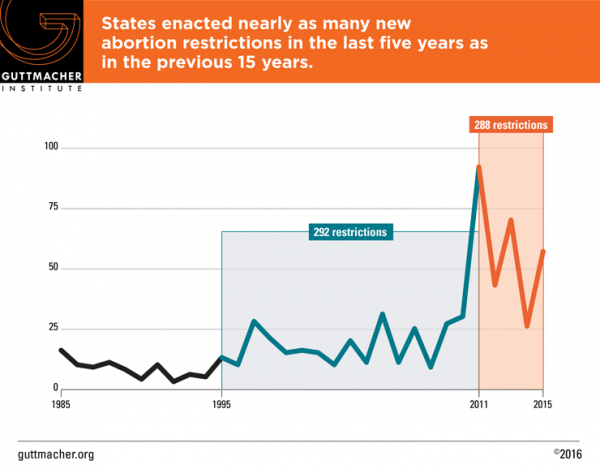
While Roe v. Wade guarantees women’s legal right to abortion, states have the legal authority to restrict and regulate abortion. “TRAP” (Target Regulation of Abortion Providers) laws are state laws that single-out abortion providers and apply burdensome regulations that make it difficult or impossible to provide abortions. TRAP laws have addressed building regulations, staffing requirements, the informed consent process, mandatory waiting periods, whether public funds (such as Medicare or Medicaid) can be used to pay for abortions, and even the surgical technique physicians are allowed to use to perform abortions (see here for a summary of state-by-state laws). Immediately following Roe v. Wade in 1973, states began to regulate abortion provision. But in the last five years the number of restrictions has skyrocketed. From 2011 to 2015, 288 new TRAP laws were enacted.

On the surface, these laws sound great. Who doesn’t want abortion to be safe? However, abortion is already extremely safe and these laws do nothing to protect women. There is no evidence to support the claim that TRAP laws improve the safety of abortion. Multiple legislators have been pleased to admit that passage of TRAP laws would be a means to the end of abortion in their states; revealing their true motives. What proponents of TRAP laws don’t understand (or maybe they do?) is that TRAP laws actually hurt women and their families.

Clinics close because they can’t afford to adapt to ever-changing facility regulations. Physicians are afraid to provide abortion care because of the stigma and violence associated with doing so. Many states require multiple clinic visits to obtain an abortion. Women have to travel increasing distances to find an abortion provider. All of this burdens women and their families in the form of increased procedure cost, transportation, lost wages, and childcare expenses, to name a few. It also leads to increased gestational age at the time of abortion. First trimester abortion is incredibly safe—much safer than pregnancy and childbirth. The risks associated with abortion, though, increase with increasing gestational age.

Recent data from Texas provides evidence of the harmful effects of TRAP laws. Texas House Bill 2 (H.B.2), required hospital admitting privileges for physicians performing abortions, set strict facility guidelines, required specific surgical practices for medical abortions, and banned most abortions after 20-weeks of gestation. When abortion clinics closed as a result of H.B.2, the number of self-induced and late abortions increased (see here and here). Other women were unable to obtain abortions, forcing them to carry unwanted pregnancies to term. Late abortion, illegal abortion, self-induced abortion, and unwanted childbearing are associated with women’s increased morbidity and mortality when compared to early, accessible, and legal abortion. TRAP laws are a form of state-imposed gender-based structural violence.

rate of abortion laws

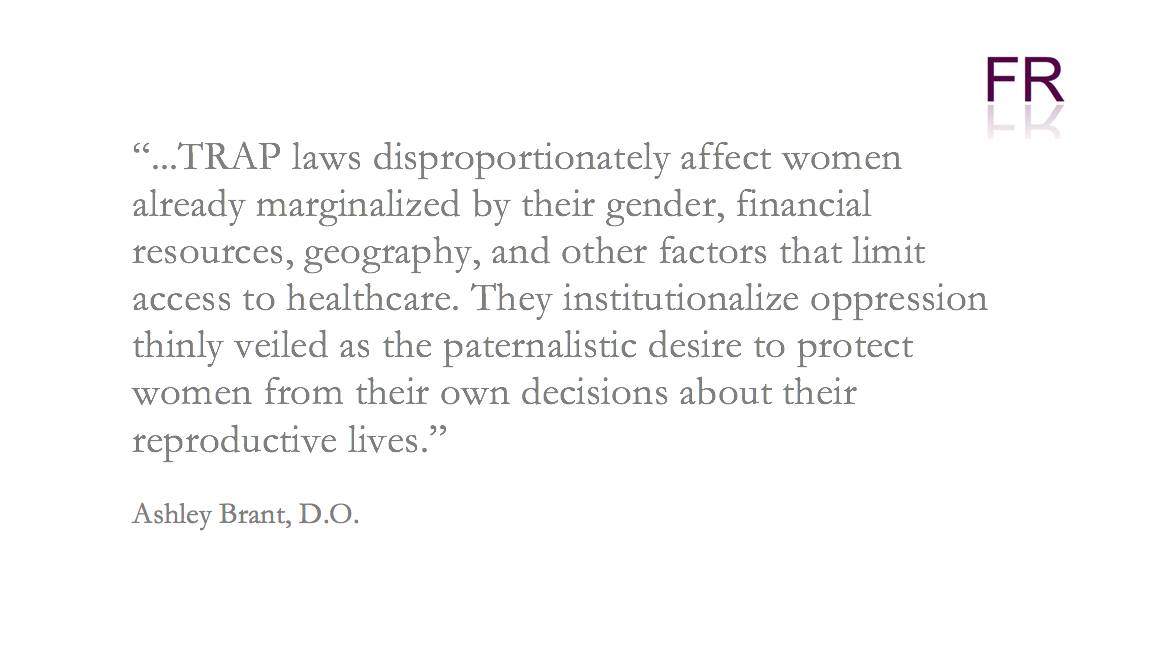
In the Supreme Court case Whole Woman’s Health v. Hellerstedt, the physician admitting privilege and surgical facility requirements of H.B.2 were challenged. The petitioners, a group of Texas abortion providers, argued that H.B.2 created an undue burden on the right of women to obtain abortion. The defendants argued that the bill was necessary to protect women’s health. Justice Ginsberg got to the heart of the issue when she said “Don’t we know…that the focus must be on the ones who are burdened?” She pointed to the fact that TRAP laws disproportionately affect women already marginalized by their gender, financial resources, geography, and other factors that limit access to healthcare. They institutionalize oppression thinly veiled as the paternalistic desire to protect women from their own decisions about their reproductive lives.

brant quoteWith a 5-3 vote, SCOTUS ruled that H.B.2 created an undue burden for the women of Texas. And the female justices played a major role in shaping the course of the oral arguments on the case. Justice Bryer wrote the majority opinion, stating that the requirements of H.B.2 “vastly increase the obstacles confronting women seeking abortions in Texas without providing any benefit to women’s health.” TRAP laws in other states are likely to be challenged as a result of the SCOTUS decision, with defendants having to demonstrate they benefit rather than create burdens on women’s health. TRAP laws, which have been one of the most successful methods of regulating women’s reproductive choices in the last decade, may be on unstable ground. This is a momentous victory for reproductive rights.

______________________________

Brant_headshotAshley Brant, DO, MPH is an obstetrician-gynecologist and abortion provider. She completed her residency at Baystate Medical Center in western Massachusetts. Her research focuses on contraceptive access and medical education. She currently practices in Washington, DC.
 

Originally posted at Inequality by (Interior) Design.

We’ve read some of the tributes to the feminist sociological genius of Joan Acker.  And much of that work has celebrated one specific application of her work.  For instance, Tristan posted last week on Acker’s most cited article—“Hierarchies, Jobs, Bodies: A Theory of Gendered Organizations” (1990)—which examined the ways that gender is so embedded in the structure of organizations that we often fail to appreciate just how much it shapes our lives, experiences, and opportunities.  But, this specific piece of her scholarship was actually her applied work. It was an application of a theoretical turn she was suggesting all sociologists of gender follow.  And we did.  Acker was involved in an incredibly important theoretical debate that helped shape the feminist sociology we practice today.

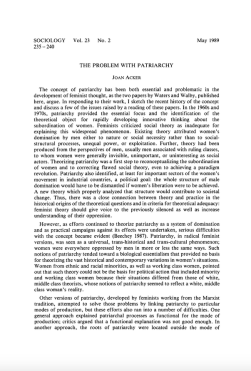
“Patriarchy” is a concept that is less used today in feminist social science than it was in the late-1970s and 1980s.  The term has a slippery and imprecise feel, but this wasn’t always the case. There were incredibly nuanced debates about patriarchy as a social structure or as one part of “dual systems” (capitalism + patriarchy) and exactly what this meant and involved theoretically. Today, we examine “gender.”  Indeed, the chief sociological publication is entitled Gender & Society, not Patriarchy & SocietyAcker - The Problem with PatriarchyBut in the 1970s and 1980s, patriarchy was employed theoretically much more often.  Feminist scholars identified patriarchy to focus the critique of existing theoretical work that offered problematic explanations of the subordination of women.  As Acker put it in “The Problem with Patriarchy,” a short article published in Sociology in 1989: “Existing theory attributed women’s domination by men either to nature or social necessity rather than to social structural processes, unequal power, or exploitation” (1989a: 235). The concept of patriarchy offered a focus for this critique.

Joan Acker was among a group of scholars concerned about the limitations of this focus; in particular, patriarchy was criticized for being a universal, trans-historical, and trans-cultural phenomenon—“women were everywhere oppressed by men in more or less the same ways” (1989a: 235).  Concluding that patriarchy could not be turned into a generally useful analytical concept, Acker proposed that feminist social science move in a different direction—a route that was eventually largely accepted and taken up.  It’s no exaggeration to suggest that Acker was among a small group of feminist scholars who shifted the conversation in an entire field.  We’ve been relying on their suggestion ever since.

Bridges and Messerschmidt quoteAcker’s short 6-page article was published in the same journal that had published Raewyn Connell’s article, “Theorizing Gender” (1985), which spelled out her initial delineation of the problems with sex role theory and what she labeled “categoricalism.” Connell was also concerned with how feminist theories of patriarchy failed to differentiate among the categories of “women” and “men”—that is, femininities and masculinities. Judith Stacey and Barrie Thorne’s “The Missing Feminist Revolution in Sociology” (in Social Problems) was published that year as well (1985), specifically criticizing sociology for solely including gender as a variable but not as a theoretical construct. Acker (1989a) explained why feminist social scientists ought to follow this trend and shift their focus from patriarchy to gender relations and the construction of gender in social life.  As Acker wrote, “From asking about how the subordination of women is produced, maintained, and changed we move to questions about how gender is involved in processes and structures that previously have been conceived as having nothing to do with gender” (1989a: 238).  And in another piece published in the same year—“Making Gender Visible” (1989b) in the anthology, Feminism and Sociological Theory—Acker argued for a paradigm shift that would place gender more centrally in understanding social relations as a whole. Acker suggested a feminist theoretical framework that was able to conceptualize how all social relations are gendered—how “gender shapes and is implicated in all kinds of social phenomena” (1989b: 77). Today, this might read as a subtle shift.  But it was monumental when Acker proposed it and it helped open the door too much of what we recognize as feminist sociology today.
Acker published what became her most well-known article—“Hierarchies, Jobs, Bodies”—in Gender & Society (1990) as an illustration of what the type of work she was proposing would look like.  She was concerned with attempts that simply tacked patriarchy onto existing theories which had been casually treated as though they were gender-neutral.  She explained in detail how this assumption is problematic and limits our ability to understand “how deeply patriarchal modes are embedded in our theorizing” (1989: 239).  And Acker illustrated this potential in her theorizing about gender in organizations.  But her suggestion went far beyond organizational life.

And by all measures, we took up Acker’s suggestion:  “Gender,” “gender relations,” and “gender inequality” are now the central foci of sociological theory and research on gender.  But Acker also concluded her short 1989 article with a warning.  She wrote,

[T]here is a danger in abandoning the project of patriarchy.  In the move to gender, the connections between urgent political issues and theoretical analysis, which made the development of feminist thought possible, may be weakened.  Gender lacks the critical-political sharpness of patriarchy and may be more easily assimilated and coopted than patriarchy. (1989a: 239-240)

Certainly, Acker’s concern leads us to honestly ask: Will shifting the theoretical conversation from patriarchy to gender eventually result in simply a cursory consideration of gendered structured inequality? Will the shift to gender actually loosen our connections with conceptualizations of gendered power? We don’t think so but one way to commemorate the legacy of Joan Acker is to both celebrate gender diversity while simultaneously visualizing and practicing gender equality.  This means continuing to recognize that inequality is perpetuated by the very organization of society, the structure of social institutions, and the historical contexts which give rise to each.

___________________________
References
Acker, Joan. 1989a. “The Problem with Patriarchy.” Sociology 23(2): 235-240.
Acker, Joan. 1989b. “Making Gender Visible.” Pp. 65-81 in Wallace, P.A., Ed., Sociological Theory and Feminism. Newbury Park, CA: Sage.
Acker, Joan. 1990. “Hierarchies, Jobs, Bodies: A Theory of Gendered Organizations.” Gender & Society 4(2): 139-158.
Connell, Raewyn. 1985. “Theorising Gender.” Sociology 19(2): 260-272.
Stacey, Judith and Barrie Thorne. 1985. “The Missing Feminist Revolution in Sociology.” Social Problems 32(4): 301-316.

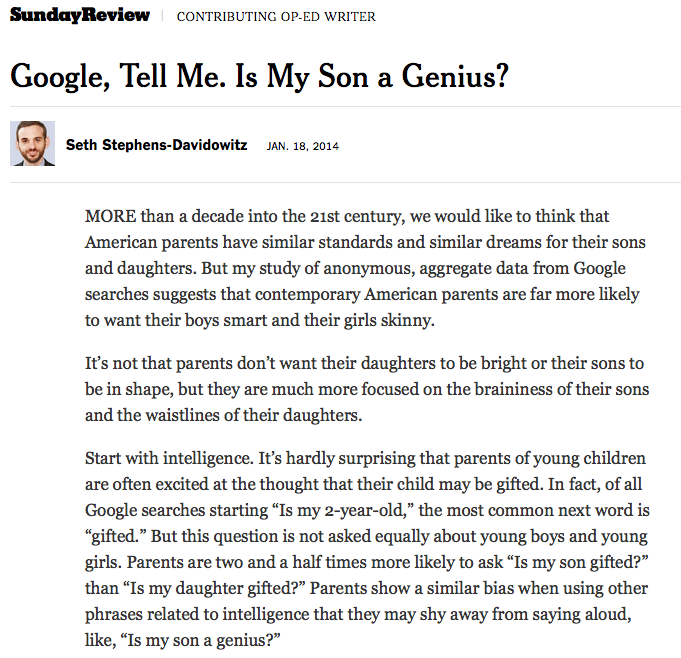
Screen Shot 2016-06-01 at 3.40.39 PMIn 2014, a story in The New York Times by Seth Stephens-Davidowitz went viral using Google Trend data to address gender bias in parental assessments of their children—“Google, Tell Me. Is My Son a Genius?”  People ask Google whether sons are “gifted” at a rate 2.5x higher than they do for daughters.  When asking about sons on Google, people are also more likely to inquire about genius, intelligence, stupidity, happiness, and leadership than they are about daughters.  When asking about daughters on Google, people are much more likely to inquire about beauty, ugliness, body weight, and just marginally more likely to ask about depression.  It’s a pretty powerful way of showing that we judge girls based on appearance and boys based on abilities.  It doesn’t mean that parents are necessarily consciously attempting to reproduce gender inequality.  But it might mean that they are simply much more likely to take note of and celebrate different elements of who their children are depending on whether those children are girls or boys.

To get the figures, Stephens-Davidowitz relied on data from Google Trends. The tool does not give you a sense of the total number of searches utilizing specific search terms; it presents the relative popularity of search terms compared with one another on a scale from 0 to 100, and over time (since 2004).  For instance, it allows people selling used car parts to see whether people searching for used car parts are more likely to search for “used car parts,” “used auto parts,” or something else entirely before they decide how to list their merchandise online.  I recently looked over the data the author relied on for the piece.  Stephens-Davidowitz charted searches for “is my son gifted” against searches for “is my daughter gifted” and then replaced that last word in the search with: smart, beautiful, overweight, etc.

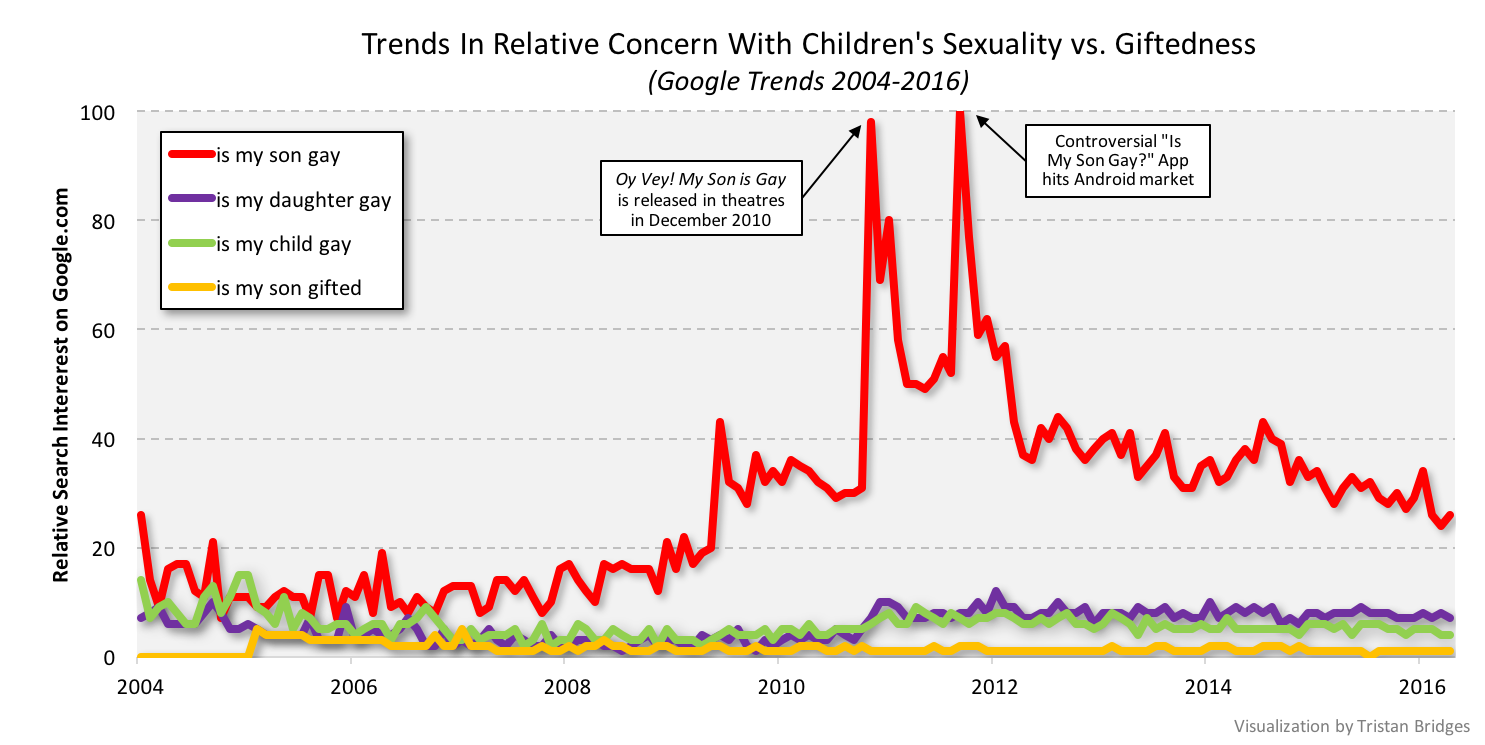
And while people are more likely to turn to Google to ask about their son’s intelligence than whether or not their daughters are overweight, people are much more likely to ask Google about children’s sexualities than any other quality mentioned in the article.  And to be even more precise, parents on Google are primarily concerned with boys’ sexuality.  Below, I’ve charted the relative popularity of searches for “is my son gay” alongside searches for “is my daughter gay,” “is my child gay,” and “is my son gifted.”  I included “child” to illustrate that Google searches here are more commonly gender-specific.  And I include “gifted” to illustrate how much more common searches for son’s sexuality is compared with searches for son’s giftedness (which was among the more common searches in Stephens-Davidowitz’s article).

Picture1

The general trend of the graph is toward increasing popularity.  People are more likely to ask Google about their children’s sexuality since 2004 (and slightly less likely to ask Google about their children’s “giftedness” over that same time period).  But they are much more likely to inquire about son’s sexuality.  At two points, the graph hits the ceiling.  The first, in November of 2010, corresponds with the release of the movie “Oy Vey! My Son is Gay” about a Jewish family coming to terms with a son coming out as gay and dating a non-Jewish young man.  The second high point, in September of 2011, occurred during a great deal of press surrounding Apple’s recently released “Is my son gay?” app, which was later taken off the market after a great deal of protest.  And certainly, some residual popularity in searches may be associated with increased relative search volume since.  But, the increase in relative searches for “is my son gay” happens earlier than either of these events.

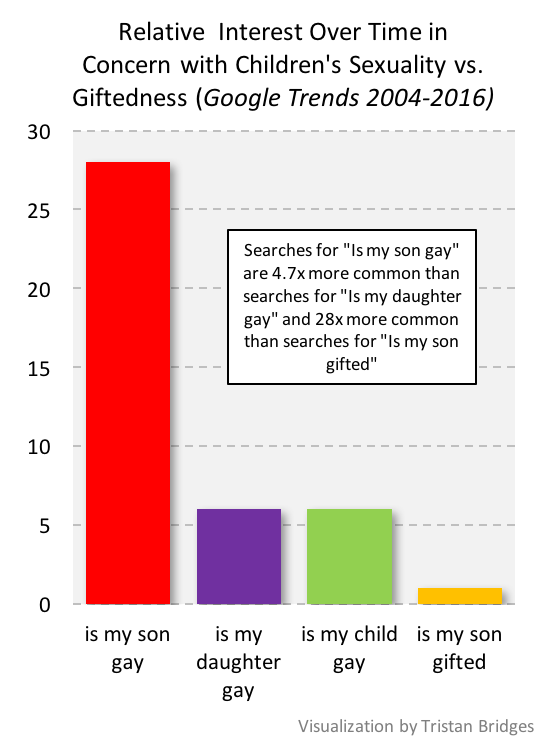
Relative Search PopularityIndeed, over the period of time illustrated here, people were 28x more likely to search for “is my son gay” than they were for “is my son gifted.”  And searches for “is my son gay” were 4.7x more common than searches for “is my daughter gay.”

Reading Google Trends is a bit like reading tea leaves in that it’s certainly open to interpretation.  For instance, this could mean that parents are increasingly open to sexual diversity and are increasingly attempting to help their children navigate coming to terms with their sexual identities (whatever those identities happen to be).  Though, were this the case, it’s interesting that parents are apparently more interested in helping their sons navigate any presumed challenges than their daughters.  It could mean that as performances of masculinity shift and take on new forms, sons are simply much more likely to engage with gender in ways that cause their parents to question their (hetero)sexuality than they used to.  Or it could mean that parents are more scared that their sons might be gay.  It is likely all of these things.

I’m not necessarily sold on the idea that the trend can only be seen as a sign of the endurance of gender and sexual inequality.  But one measure of that might be to check back in with Google Trends to see if people start asking Google whether their sons and daughters are straight.  At present, both searches are uncommon enough that Google Trends won’t even display their relative popularity.


It was “Latino night” at a gay club. When the story finally broke, that’s all I heard. Orlando’s tragedy at the Pulse puts Latina/o, Latin American, Afro-Latinos, and Puerto Ricans and other Caribbean LGBT people front and center. Otherness mounts Otherness, even in the Whitewashing of the ethno-racial background of those killed by the media, and the seemingly compassionate expressions of love by religious folk. The excess of difference—to be Black or Brown (or to be both) and to be gay, lesbian, bisexual, or transgender (or queer, as some of us see ourselves) serves to shock, through difference, how news are reported. Difference – the very basis of feminist and ethnic politics in the 20th century – has been co-opted and ignored, sanitized even, to attempt to reach a level of a so-called “humanity” that is not accomplishable. We know this, but we don’t talk about it.

Don’t get me wrong: empathy is essential for most social codes of order to functionally sustain any given society. To pay one’s respects for others’ losses, however, does not mean that we think of those lost as equals. Liberal people demanding that sexuality be less important in the news (and thus removed from the coverage) is an inherent violence toward those who partied together because there was real love among them, in that club, for who they were – and are. Religious righters may spread hate while trying to give the illusion of compassion, but they do so in a clear hierarchical, paternalistic way –that is hypocrisy, and we must call it out every chance we get. But this goes beyond liberal notions and conservative hypocrisy – even while Anderson Cooper wept when reading the list of those killed, he knows the distance between himself and many of those at the club is enough to build a classed, raced, and social wall between them. Clearly, empathy is not enough.

To be Latina/o in the US – increasingly another Latin American country, again – is to breathe in hate, to face retaliation, to be questioned at every turn about our allegiances, tested on our sense of citizenship, pushed in our capacity to love the nation and thus hate “like the rest” (a testament to the masculinity of the nation). At a minimum, to be Latina/o guarantees one to be looked at oddly, as if one was out of place, misplaced, inappropriately placed. Simply by being, Latinas/os rupture the logics of normalcy in USAmerica. To be Latina/o and LGBT is to disrupt the logics of racial formation, of racial purity, of the Black and White binary still ruling this country – all while de-gendering and performing an excess (of not only gender, but sexuality) that overflows and overwhelms “America.” In being Latino and queer, some of us aim to be misfits that disrupt a normalcy of regulatory ways of being.

A break between queer and América erupted this past weekend – in Orlando, a city filled with many Latin Americans; a city that, like many others, depends on the backs of Brown folk to get the work done. Put another way, Orlando’s tragedy created a bridge between different countries and newer readings of queerness – Orlando as in an extension of Latin América here. Queer-Orlando-América is an extension of so many Latin American cities as sites of contention, where to be LGBT is both celebrated and chastised – no more, or less, than homophobia in the US.

Enough has been said about how the Pulse is a place where people of color who desired others like themselves, or are trans, go dance their fears away, and dream on hope for a better day. Too little has been said about the structural conditions faced by these Puerto Ricans, these immigrants, these mixed raced queer folks – some of whom were vacationing, many of whom lived in Florida. Many were struggling for a better (financial, social, political—all of the above) life. Assumptions have also been made about their good fortune as well. Do not assume that they left their countries seeking freedom—for many who might have experienced homophobia back home, still do here; though they have added racism to their everyday lived experience. Of course, there are contradictions on that side of queer-Orlando-América, too; yet same sex marriage was achieved in half a dozen countries before the US granted it a year ago. This is the world upside down, you say, since these advances – this progress – should have happened in the US first. Wake up. América is in you and you are no longer “America” but América.

You see, this is how we become queer-Orlando-América: we make it a verb, an action. It emerges where the tongues twist, where code switching (in Spanish/English/Spanglish) is like a saché-ing on the dance floor, where gender and race are blurry and yet so clear, where Whiteness isn’t front and center – in fact it becomes awkward in this sea of racial, gendered, and sexual differences. This queer-Orlando-América (a place neither “here,” nor “there,” where belonging is something you carry with you, in you, and may activate in some dance floor given the right people, even strangers, and real love – especially from strangers) was triggered – was released – by violence. But not a new violence, certainly not a Muslim-led violence. Violence accumulated over violence – historically, ethnically, specific to transgender people, to Brown people, to effeminate male-bodied people, to the power of femininity in male and female bodies, to immigrants, to the colonized who speak up, to the Spanglish that ruptures “appropriateness,” to the language of the border. And in spite of this, queer-Orlando-América has erupted. It is not going down to the bottom of the earth. You see us. It was, after all, “Latino night” at a gay club. You can no longer ignore us.

Vidal-Ortiz FR quote Queer-Orlanda-AméricaAs the week advanced, and fathers’ day draws closer, I have already noticed the reordering of the news, a staged dismissal so common in media outlets. Those queer and Brown must continue to raise this as an issue, to not let the comfort of your organized, White hetero-lives go back to normal. You never left that comfort, you just thought about “those” killed.  But it was “Latino night” at a gay club. I do not have that luxury. I carry its weight with me. Now the lives of those who are queer and Latina/o have changed – fueled with surveillance and concerns, never taking a temporary safe space for granted. Queer-Orlando-América is thus a “here and now” that has changed the contours of what “queer” and “America” were and are. Queer has now become less White – in your imaginary (we were always here). América now has an accent (it always had it – you just failed to notice).  Violence in Orlando did this. It broke your understanding of a norm and showed you there is much more than the straight and narrow, or the Black and White “America” that is segmented into neatly organized compartments. In that, Orlando queers much more than those LGBT Latinas/os at the club. Orlando is the rupture that bridges a queer Brown United States with a Latin America that was always already “inside” the US – one that never left, one which was invaded and conquered. Think Aztlán. Think Borinquen. Think The Mission in San Francisco. Or Jackson Heights, in NYC. Or the DC metro area’s Latino neighborhoods. That is not going away. It is multiplying.

I may be a queer Latino man at home, at the University, at the store, and at the club. That does not mean that the layered account of my life gets acknowledged (nor celebrated) in many of those sites – in fact, it gets fractured in the service of others’ understandings of difference (be it “diversity,” “multiculturalism” or “inclusion”). But it sure comes together on the dance floor at a club with a boom-boom that caters to every fiber of my being. It is encompassing. It covers us. It is relational. It moves us – together. So, even if I only go out once a year, I refuse to be afraid to go out and celebrate life. Too many before me have danced and danced and danced (including those who danced to the afterlife because of AIDS, hatred and homophobia), and I will celebrate them dancing – one night at a time.

We are not going away – in fact, a type of queer-Orlando-América is coming near you, if it hasn’t arrived already, if it wasn’t there already—before you claimed that space. No words of empathy will be enough to negotiate your hypocrisy, to whitewash our heritage, or make me, and us, go away. If anything, this sort of tragedy ignites community, it forces us to have conversations long overdue, it serves as a mirror showing how little we really have in common with each other in “America” – and the only way to make that OK is to be OK with the discomfort difference makes you experience, instead of erasing it.

We must never forget that it was “Latino night” at a gay club. That is how I will remember it.

________________________

Salvador Vidal-OrtizSalvador Vidal-Ortiz (Ph.D.) is associate professor in the sociology department at American University (AU), in Washington, DC; he also teaches for their Women’s, Gender, and Sexuality Studies program. He coedited The Sexuality of Migration: Border Crossings and Mexican Immigrant Men (NYU Press, 2009) and Queer Brown Voices: Personal Narratives of Latina/o LGBT Activism (University of Texas Press, 2015). Aside from his Fulbright-supported research on forced migration/internal displacement and LGBT Colombians, he is now engaged in a new project, with Juliana Martínez, also from AU, on “Transgendering Human Rights: Lessons from Latin America.” He is currently writing a manuscript on Santería, tentatively titled: An Instrument of the Orishas: Racialized Sexual Minorities in Santería, as well as a book he is co-authoring with two of his former students: Brandon A. Robinson (UT-Austin) and Cristina Khan (U-Conn) titled Race and Sexuality (to be published with Polity Press).