feminism

This is the second half of a two-post series on the pro-feminist and activist Chris Norton at Feminist Reflections by Michael A. Messner. The first half of “Learning from Chris Norton over three decades—Part I” can be found HERE.

Flash forward to 2010. I was now a tenured full professor, pushing 60, a number of books under my belt. I was working with two young male Ph.D. students who in some ways reminded me of myself thirty years earlier—inspired by feminism, wanting to have an impact on the world. Both Tal Peretz and Max Greenberg had, as undergrads, gotten involved in campus-based violence prevention work with men. Unlike three decades ago, this work had become pretty much institutionalized; a guy like Tal or Max now can plug in to a campus or community organization, be handed an anti-violence curriculum, and get to work with boys and men. I figured this was a great opportunity to do a study with these two guys, tapping in to the roots of men’s work against gender-based violence in the 70s and 80s, and contrasting it with the work being done today.
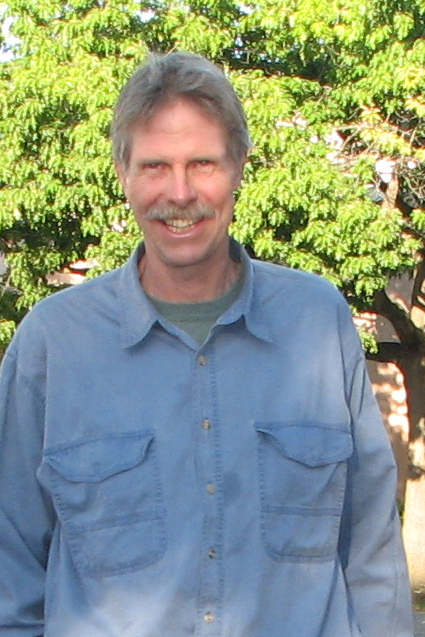
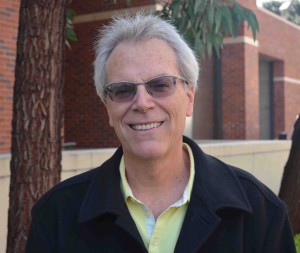
NortonCropOf course, I thought of Chris Norton and MASV. I located Chris online. Ever generous, he agreed to be interviewed. In December of 2010, I drove to his house in Sebastopol, and as I knocked on his door, I wondered how different he’d look or be. After all, I had morphed from a long-haired, bearded youngster thirty years ago to clean-shaven gray-haired, gradually balding, stooped-shouldered guy. I spied him through the window as he came to the door, and as he opened it I was mildly astonished to see that he looked pretty much the same—bristly mustache and full head of hair—reddish, but with some gray mixed in. He also still had the same warm smile, accented now by smile lines around his eyes that, if anything, made him appear even more warm and friendly than before.

We went out to lunch, and did what older guys do: caught up on each others’ lives, shared our hopes, fears, and challenges we’d faced with our kids, commiserated about our ageing bodies. On this latter topic, Chris had more serious news to share than I. He was facing, with strength and optimism, a liver transplant in the near future.

We returned to his home, and settled in for the interview in a cozy cabin-like structure behind his and Mary’s home. We fell right in to a nice conversation, and I used bits of the transcript of my 1980 interview with Chris to prod his memory, and to probe ways in which he’d changed, or not, since then.   Most interesting to me were his reflections on the work that MASV had done so many years ago. He joined the several other MASV men whom I would eventually also interview in saying that he was very proud of the work the group had done. But in retrospect, he said he wondered how effective they’d been, and figured that if the group had it to do all over again, they might have done their work differently:

I don’t think I would go at it at all the way we did then, ‘cause I think in some ways, … I think we were doing something to prove something to ourselves and other people of our age group, and I don’t think we were thinking about, like, what’s it like to be a teenage boy in high school, and what are these images going to do to you when they’re shown up on a screen, and is it going to have any of the effect that we’re hoping to have? And I think it would have been really good to kind of get guys to talk about, well, there’s issues of bullying, issues of, you know, being popular, not popular. I mean, it seems like there could be a lot of things that could have been much more valuable, ‘cause in some ways, I think we almost had this stick and we’re going to beat you over the head with this thing. And… perhaps if they felt like they were more understood, maybe they could be more understanding of women and, and where women are coming from. And I think that would be more the way I would go about it now.

[Back then], we were really just making it up, I mean, it was the seat of our pants… we felt like we should be doing something. We were feeling like we need to be also talking about the same things that the women were talking about—but we basically just took their analysis and presented it. You know, it didn’t—it didn’t feel like it was coming from our core, you know, from who we were, other than maybe from our guilt

And, and you know, I think—having more of a positive vision of what a man should be, rather than going in there and telling men what they shouldn’t be doing—having a more pro-active, having a more kind of like, basically creating an ethic of, “This is what a man should do.” You know, this is, this is a positive thing for a man to do, and also like, what does a man want? You know, rather than like, “Oh, you shouldn’t be bad,” but…you wanna have a good relationship, you wanna have a relationship with someone that’s based on some degree of equality, on some degree of, of mutual respect, of everyone having opportunities, or people feeling good about their lives, about who they are. And, that presupposes having some degree of, of understanding of who you are yourself and what you want. And I felt like we weren’t, back then, we weren’t coming at it from that—it was more sort of like, you know, men are bad—Andrea Dworkin told us this—we know men are bad, we are bad, we’re gonna’ go and tell the high school boys that they’re bad too, for looking at pornography, and that pornography’s gonna’ make them badder than they already are. And, there wasn’t that—I think there’s gotta’ be a positive vision. And you have to have, I mean, you don’t want to be blind to the bad stuff that goes on, but there has to be kind of some upside for doing this, ‘cause I don’t think otherwise people are gonna’ really pay any attention or wanna listen to you.

Chris’s statement very neatly encapsulated about thirty years of change in the ways that men now approach doing violence prevention work with boys and men. In Some Men, the book that Max Greenberg, Tal Peretz and I wrote from this research, we chronicle the grassroots of this activism—set in place in the 70s and 80s by community groups like MASV—in part because it is important to honor the foundations of positive social change. But it’s also important because today’s younger activists, however savvy and pragmatic they may be about the ways they approach boys and men with their message, may also have lost something very important that earlier activists like Chris Norton had: a grounding in a larger view of social change that viewed their efforts to stop sexist violence against women as intricately connected with efforts to humanize and bring justice to the world.   For groups like MASV, feminist work with boys and men, Chris explained, was an integral part of a larger transformative movement:

… an important way of sort of humanizing socialism, or getting rid of some of the hard-edged more Stalinistic tendencies that some socialist movements could have. And it also just made a lot of sense [for] those of us too, who also were rejecting militarism and the traditional terms of being masculine or man, and were looking for some kind of a new way—when I came to Berkeley initially I was involved in the anti-war movement, and lived in communal houses, and we’d gotten involved in the food conspiracy, and—it was all part of this whole, you know, sort of community, alternative society in a way that we kinda’ felt like we were creating it back then.

In retrospect, like many radicals of his generation, Chris expressed frustration with the current prospects for transformative social change.

I think I’ve retreated some degree from utopianism. But I do feel that it’s definitely possible to have a far more egalitarian society than we do. And I just, I feel like—and that’s part of my frustration too, is those of us who feel that way haven’t found ways to be very effective in putting forward that vision and, and making that vision something that’s attractive to people, and making people realize that what we’re living under is not actually that great for a lot of people, and it’s very difficult for a lot of people.

Part of my goal in writing Some Men with Max and Tal was to encourage today’s anti-violence activists to re-connect to that larger vision. It is stories from this generation of activists like Chris Norton that help to keep alive this larger vision.

The community bonds that sustain that vision were palpable when I attended Chris Norton’s memorial service in 2012, after he had succumbed to cancer.  Included among the scores of family and friends celebrating Norton’s life were a handful of MASV men—guys who in their youth had pioneered anti-violence work. Now considerably older, they shared a sense of pride in what they had accomplished so many years ago. Following MASV’s demise, they had gone on to do other progressive work: Chris Anderegg worked for years helping women’s DV shelters with their finances; Larry Mandella created workshops for fathers; Santiago Casal did community organizing to get a memorial built in Berkeley for civil rights leader Cesar Chavez. All of them, in their own ways, were clearly in it for the long haul.

Still today, I am not and probably never will be much of an activist. But I hope that my research and writing makes some small contribution to progressive thinking, and progressive social change, a contribution that both honors and learns from the brave and important work that’s been done in the past by the doers of the world, like Chris Norton, whom I so admire, and whose collective work helps to make the world a better and more just place.

_____________________________
Messner2013cMichael A. Messner is professor of sociology and gender studies at the University of Southern California, and author (with Max Greenberg and Tal Peretz) of Some Men: Feminist Allies and the Movement to End Violence Against Women (Oxford University Press, 2015).
This is the first half of a two-post series on the pro-feminist and activist Chris Norton at Feminist Reflections by Michael A. Messner. The second half of “Learning from Chris Norton over three decades” will be published on May 21, 2015 @ 9:00am EST (and linked here).

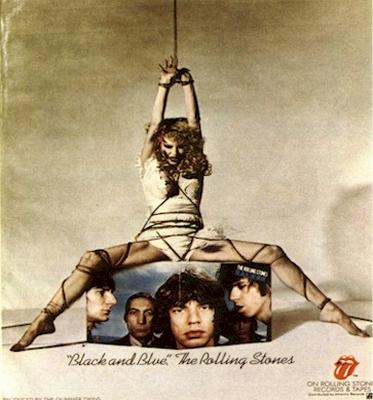
The guy at the front of the room was saying stuff I’d never heard a man say before, especially to a room full of young college guys.   Through my basketball-player-eyes, I sized him up to be at least 6’5” with the broad shoulders of a power forward. He had medium-length reddish hair and a ruddy face dominated by a bristly mustache that left his mouth a bit of mystery. And what words emerged from this mouth! With a style that seemed simultaneously gentle and passionate, he urged these young guys to think critically about their own relationship to pornography. BlackBlueBacked up with a slideshow that depicted popular album covers (The misogynist public billboard promoting The Rolling Stones’ album Black and Blue was one of them), he pointed to the links between sexual objectification of women, men’s use of pornography, and men’s violence against women.
This stuff was hard to hear for young men—and I include myself in this. It was 1980. I was 28 and in recent years had come to define myself as a “pro-feminist man.” I’d even been in a men’s consciousness-raising group in Santa Cruz. But like many younger men like me who were awakening to feminism, I was still struggling with my own deeply engrained erotic attachments to conventional sexualized imagery of women, as depicted not only in Playboy and Penthouse, but pretty much everywhere around me. So here was this giant guy standing up there, calling us out—calling me out—on my shit. What struck me most, and what made it possible to hear what he was saying, was how he spoke as one of us—self-reflexively talking about his own immersion in a culture of eroticized sexism and violence against women, how it affected and continued to affect him. He revealed that he was part of a group of men, Men Against Sexist Violence (MASV), that did educational work on sexism with boys and men—in schools, on the radio, in prisons—while also supporting each other to become pro-feminist men. (As I watched him in action, the punster in me wondered with a private chuckle whether the other members of his group were so, well, massive.)

I agreed with everything this guy said in his presentation and I admired his courage. I wanted to talk with him, maybe become friends with him, and for sure I wanted to interview him for my new research project for grad school—in-depth interviews with men in pro-feminist men’s groups. After the talk, I introduced myself. He greeted me warmly and immediately agreed to allow me to interview him.

Chris Norton was his name, and it turned out he was a guy of middle class origin who had moved to Berkeley in recent years, taken up work as a carpenter while also immersing himself in the progressive politics of the time. I had initially imagined he might become a basketball buddy, but we were only two minutes into our interview before he assuaged me of that illusion. When I asked him about his boyhood relationship to masculinity, he said,

…in sports, I didn’t feel like being aggressive often times and for instance I’m tall and was supposed to be good at basketball, to stand under the hoop and get all the rebounds, and it just didn’t work out—and people’d get pissed off at me for not getting all the rebounds—and then we wouldn’t end up winning and I’d get resentment back, and frustration from people, because I wasn’t doing what I was expected to do and then I’d feel bad about myself and think, “Well I guess I’m a failure, I’m not strong enough or not aggressive enough, maybe there’s something wrong with me or wrong with my masculinity; I’m not a man.”

Norton3
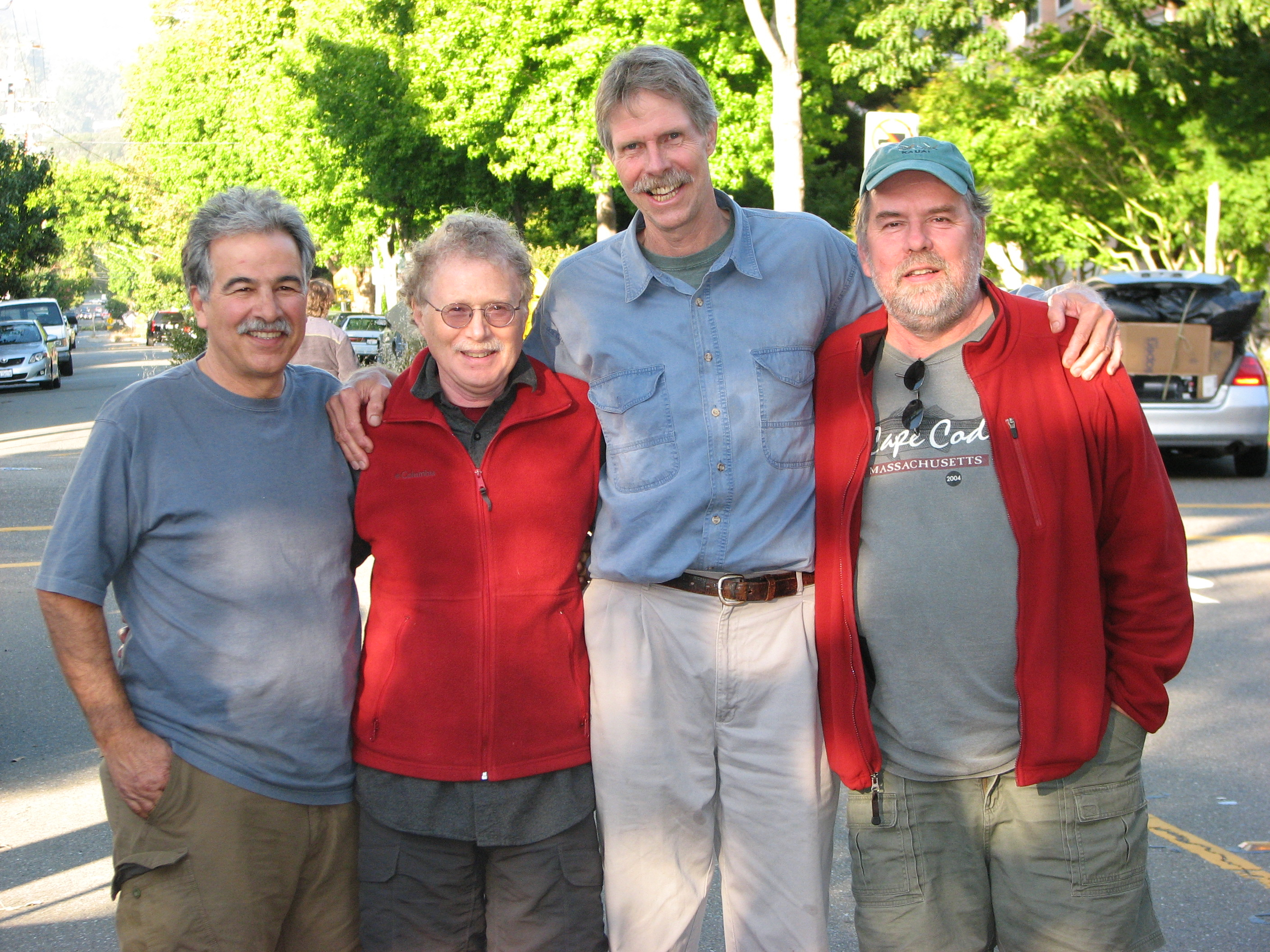
Longtime comrades and SF Bay Area pro-feminist pioneers: L-R, Larry Mandella, Men Against Sexist Violence (MASV); Tom Berry, Berkeley Men’s Counseling Center; Chris Norton, MASV; Dana Francis, Men Overcoming Violence (MOVE).

My 1980 interview with Chris Norton not only helped me to complete a study toward the goal of getting my Ph.D.   It also helped to me begin to clarify the sort of person I am. Over the years, I’ve enjoyed thinking of myself variously as a socialist, a radical, a feminist, a progressive, an advocate for social justice. But mostly I don’t do much with these political commitments. Oh, I’ve marched in a few protests and paid dues in some progressive organizations, but I can’t stomach meetings and I hate the grind of building and sustaining organizations. I live so much inside my own head; I read, I write, and the most public thing I do is to lecture and occasionally write an op-ed on some social issue. But this guy, Chris Norton, though he had nearly identical politics as mine, was an opposite character type, a type I admired, even romanticized—a doer, a man committed to acting in the world rather than sitting around thinking about things.

In our interview, Chris spoke of the tensions of being a pro-feminist man, of struggling with how to integrate his commitments to feminism with his daily life as a carpenter, where he worked with men who didn’t always share those commitments. He spoke of MASV’s internal discussions of sexism and pornography, and of his own complicated relationship to feminism and other progressive politics. When I asked him if he called himself a feminist, his response revealed his ongoing self-criticism at his own internalized sexism, while also telegraphing what would become his next major political commitment:

I used to; I don’t know if I do right now. Just because I think I’ve been seeing a lot of limitations to feminism or some of the lacks that it has as far as dealing with class and other things… Some feminists, a certain branch of middle class feminists are sort of like “I want more of the pie” and as someone who’s real interested in changing class relationships and in a more thorough-going revolution I don’t really want to identify with that and I don’t feel real supportive of women executives and women in those positions… In my experience in Latin America, seeing the need to deal with class relationships—I see that as a real difference. The starting point of feminist consciousness between the U.S. and Latin America is really different. I think that any kind of revolutionary movement in the US has to pay a lot of attention to women’s issues, just because that’s where we are. But I think there’s like a bourgeois women’s movement that’s really self-centered and on some level I don’t think I’d call myself a feminist—I think I feel guilty about using that term when I have so much (This whole thing about looks)—I feel guilty because I have so much of this stuff that feels unresolved in myself—It’d be dishonest to call myself a feminist.

It’s two different things. On one level I have objections to some of the tendencies that feminism has and on the other hand I don’t think I’m good enough to call myself a feminist. When we were in the radio collective we called ourselves “pro-feminists,” [which] means that you’re supporting feminism, but not being women, we couldn’t be feminists.

Chris continued working with MASV for the next couple of years, but was shifting his attentions to Latin American solidarity work. I got together with him—maybe around 1983 or 1984 or so—and he told me he was planning to go to El Salvador to work as a freelance journalist, covering the brutal U.S. war that was attempting to suppress a popular uprising. At the time, following the 1979 Sandinista revolution in Nicaragua, there was good reason to believe in the possibility of a succession of victorious liberation movements in Latin America. It was the mid-80s now, and Chris wanted to be a part of this history. He told me he dreamed of being in San Salvador when the victorious FMLA marched in.

I wanted to help—to support Chris, to contribute to the revolution—but of course I’d not stray too far from the local comfort of my oak desk, the very same one upon which I now rest my hands as I write, more than three decades later. I organized a big launch party for Chris at my rambling old rented house in the flatlands of Berkeley. The idea was to gather Chris’s friends and political comrades, as well as some of my own, for a fund-raiser to help Chris get to El Salvador and begin his work as a freelance writer. We cooked up industrial-sized vats of spaghetti for the event, and Chris presented an inspiring El Salvador slide show that outlined the political struggles and stakes. As it turned out, Chris and I had lots of friends; the house was packed to the gills with supporters. And, as it turned out, Chris and I had very few friends who had any money. The pittance we raised may have paid for Chris’s first handful of notebooks.

But he got there. During the latter half of the 1980s, Chris wrote from San Salvador, freelancing for the Christian Science Monitor and other magazines and papers. When I would see Chris’s byline in the CSM I would smile and shake my head in admiration. During those years, still glued to my desk, I wrote my dissertation, prepared articles for academic journals that would hopefully secure me a job, and started my salaried faculty job at USC. Oh, I attended anti-Reagan demonstrations in the early 80s, protested U.S. interventions, donated tiny amounts of money to Latin American solidarity and other progressive organizations—but never did I put my body on the line in the way that Chris Norton did. My admiration for Chris grew… but somewhere starting in the early 1990s, I lost track of him. Immersed in my academic career, building a family in L.A. with Pierrette and our young sons Miles and Sasha, Chris’s life and mine headed in different sorts of directions. I’d think of Chris occasionally, wondering what he was up to.

Part II will be posted on May 21st, 2015 at 9:00am EST and linked here.

_____________________________

Messner2013cMichael A. Messner is professor of sociology and gender studies at the University of Southern California, and author (with Max Greenberg and Tal Peretz) of Some Men: Feminist Allies and the Movement to End Violence Against Women (Oxford University Press, 2015).


When my daughter went into her final year of college, I started feeling a sense of trepidation about what would come next. She was a Sociology major (yay!), was into the arts (yay again), and had lived in New Orleans for four years (cool). Fortunately, she lined up an internship her senior year and now two years later, things have worked out pretty well.

But you never know. In an economy that rewards those in STEM fields and business, the seniors I now teach are predictably in panic mode as they face a very uncertain future. Regardless of all the internships and community service experiences they are accruing, there’s no avoiding the dour statistics for young college graduates. When one student came to me, asking for advice about applying for a consulting job that was way beyond her reach, I found myself counseling her about the virtues of working in a coffee shop. So what if she’s an international relations major!

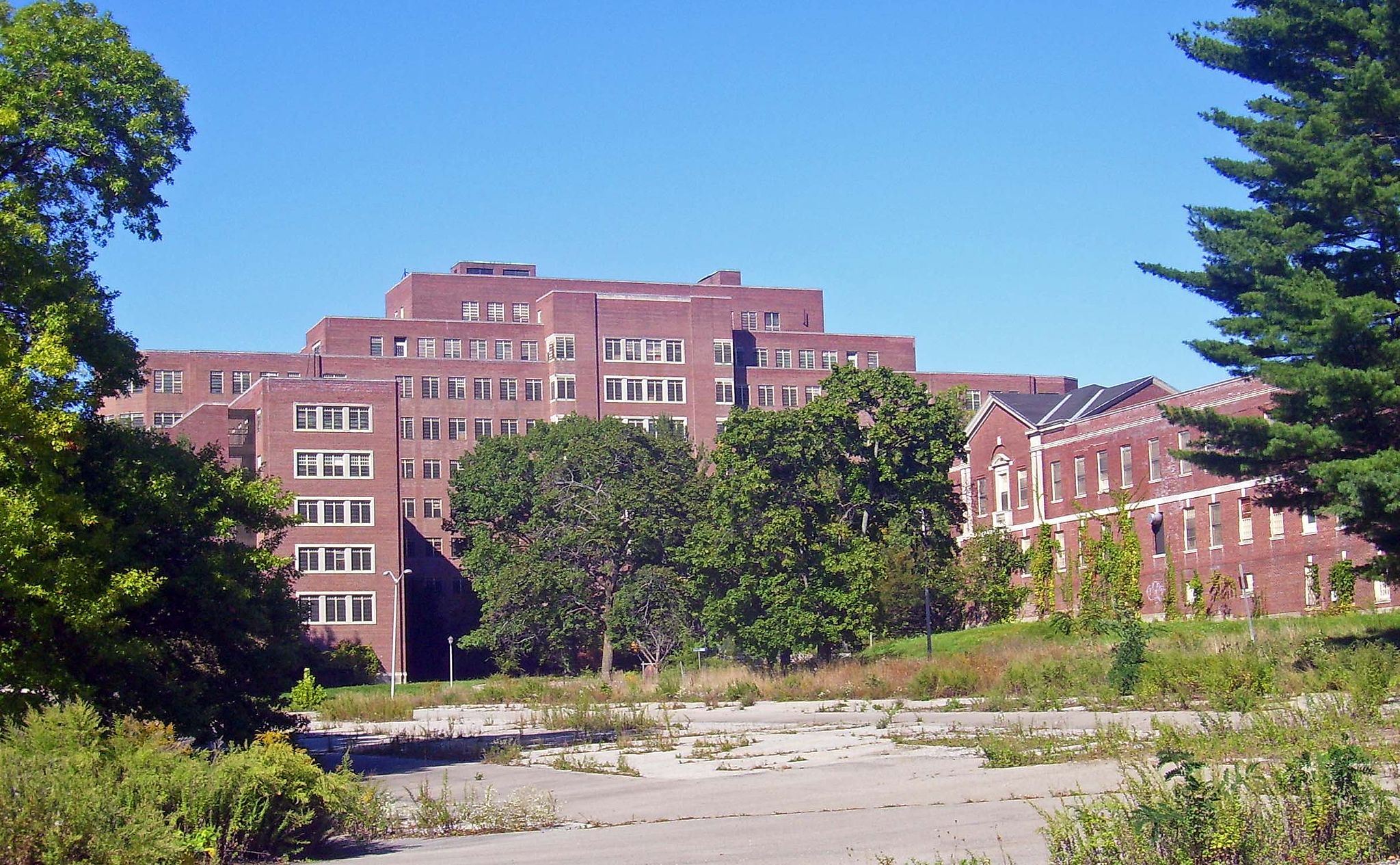
Hudson River Psychiatric Center
State Psychiatric Center

My first “real” job after graduating from  college was working in a state psychiatric hospital. This seemed like a “natural” place to be, since one whole side of my family was riddled with serious psychiatric disorders. Between an aunt with agoraphobia who never left her house, an aunt and an uncle who had “manic-depression” (now called bipolar disorder, a more “respectable” name), and a mother who struggled with clinical depression and alcoholism, I was quite at home working in an institution for people with severe mental health problems.

When I graduated, the state psych hospital was hiring tons of young college graduates. This was in the early ‘70s, when thousands of patients, people who had spent years, sometimes decades, living in inside the walls of state hospitals, were released into the community in a move to “de-institutionalize” them. The motive was humanitarian, but the reality for many of the patients was downright cruel because many of them were unprepared for life on the outside. Nonetheless, it did mean that a lot of my friends and I had jobs when we graduated.

I was hired as the institution’s dance therapist. I had been a dancer for many of my young years, and my professional goal – if one could call it that – was to somehow combine my interest in helping people with my passion for dance. I lucked out, since the field of dance therapy was just emerging, and one of the first certified dance therapists in the U.S. was willing to train me during my senior year of college.

I worked with people who were still living “inside” the institution, as well as out-patients who were being transitioned into a day treatment program. Because I was a professional dancer in a mental hospital, many of the institution’s rules did not seem to apply to me. Or at least that’s what I thought and how I behaved… More than once, I led a group of patients in a snake line through the hallways, wearing a leotard and tights. We seemed off-limits to criticism, as this “crazy” activity was “therapy”! It felt downright revolutionary!

While working in an institution wasn’t where I “landed” professionally, it was nothing short of a profound experience for a 21-year-old. I fell in love with schizophrenics who were smart and spoke in metaphors that seemed poetic and deep. I’ll never forget one of my out-patients, a diminutive woman named Ruth, who spent her entire adult life in the psych hospital. Ruth held her body like a tight fist, and stood all day, rocking rhythmically back and forth. I feel teary when I think about her. Another person seared in my mind is a tall, broad gentleman in a perpetual cowboy hat. People called this man of few words, “the Captain”. One of my most glorious days was when I took “the Captain” for a drive in the country, with two other patients. Outside it was minus forty degrees – this was Central New York in winter – but inside the car, with sun shining through the windows, it felt warm and protective. He said little throughout the drive, just smiled…

By the time I was hired to work as a dance therapist at the state psych center, sociologist Erving Goffman had already published his seminal book Asylums: Essays on the Social Situation of Mental Patients and Other Inmates. One of Goffman’s greatest contributions was his critique of what he called “total institutions”, which included mental hospitals and prisons, those institutions with a high degree of regimentation, and an elaborate privilege system. He described relations between staff and patients (or inmates) as caste-like, with detailed “rules” of deference and demeanor.

I knew nothing of Goffman while I was working in that first post-college job. But after studying this brilliant sociologist in graduate school and using his analyses in a class I now teach, it all comes back to me. I lived what Goffman described. Drawing upon those earlier experiences, I could now understand his theoretical frameworks. One of my favorite co-workers, a friendly and clever guy named Willie who was the janitor, surely understood Goffman’s analysis when he changed his first name from Willie to “Doctor”. Whenever anyone wanted his services, they would yell “Doctor”. He always came running with a smirk on his face.

Despite the draw of my first job, I realized within a year that I wasn’t going to last. I was too young, too inexperienced, too overwhelmed with it all. While I found the people interesting, I had no real training. And even though I was a good listener, I fought back tears every time a “client” expressed sadness or joy. Ultimately, what drove me to work at the psych hospital – working with really troubled people – became the reason I had to leave. It wasn’t the right fit, even though it seemed so at the beginning. With a far more robust economy than we have today, I saved up enough cash that year to travel Europe for nearly a year, so that’s what I did!

As my father used to say, everything we do in life accrues and has meaning. This has to be true, as well, for college students who are saddled with debt and graduating to a lousy economy and a dearth of employment opportunities that “fit” with their majors. A number of my friends are living at “home” (where they grew up) and working in unpaid internships that they hope will lead to a paid job. I know one person who dropped out of college in her freshman year and learned how to do organic farming. Now she’s running a business where she creates peace gardens for interested clients. I know one person who couch-surfed for a few months, and then got a job sailing someone’s boat to the Virgin Islands. At one point, during an intense storm, he wondered if he was even going to make it… I can imagine that he’s not the only one feeling that way, although perhaps for different reasons.

When I think about my own daughter – and all the young people I encounter these days – what I wish for them is the courage to follow their passion, and then feel okay about whatever job or internship (or whatever) they find, knowing that those things may not be the same thing. At least for now…

The floor plan of the White House recently made headlines because of a subtle change that’s caused a bit of a stir: it now features a gender-neutral restroom. Just one. But one was enough to make headlines. Many people don’t think twice about which restroom to use in public. Some people’s choice, however, is more of a dilemma than you might assume. Many transgender individuals struggle with the restroom issue in public settings. And this is an issue that forces cis-gender folks to confront deeply held beliefs about a gender-segregated setting—beliefs some may not fully realize they hold and many may be ill-equipped to discuss.

Making use of a public restroom is not often understood as a political act. Yet, a group of transgender folks in the U.S. and Canada are participating in a bit of digital activism by doing just that. It’s a quiet social movement, but it’s already gained some media attention. Pictures posted alongside the hashtags #Occupotty, #WeJustNeedToPee, and less often #LetMyPeoplePee on all manner of social media are starting a much-needed conversation about gender in and around public restrooms.

Brae Carnes
Brae Carnes, a transwoman in Victoria, depicted here using a men’s public restroom to raise awareness about what discriminatory legislation associated with “bathroom bills” would actually look like in practice.

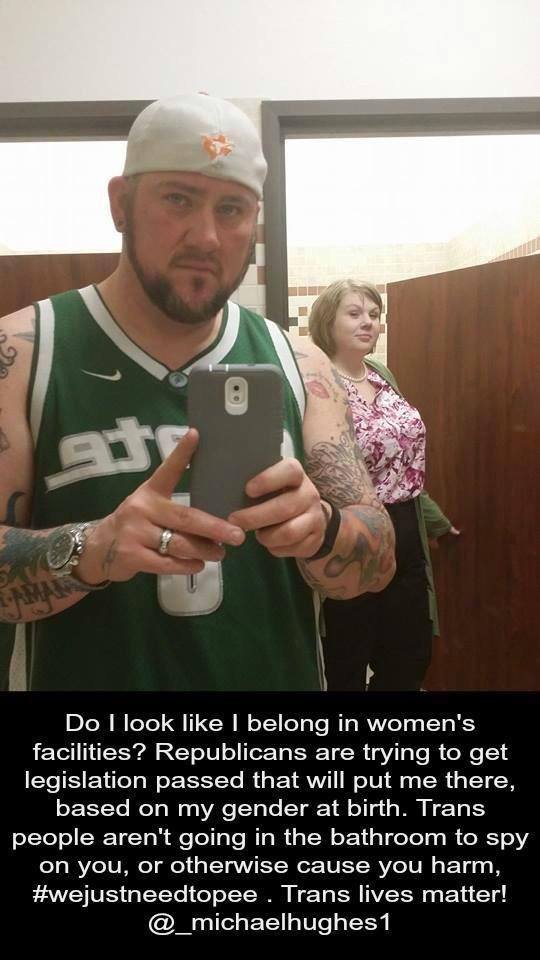
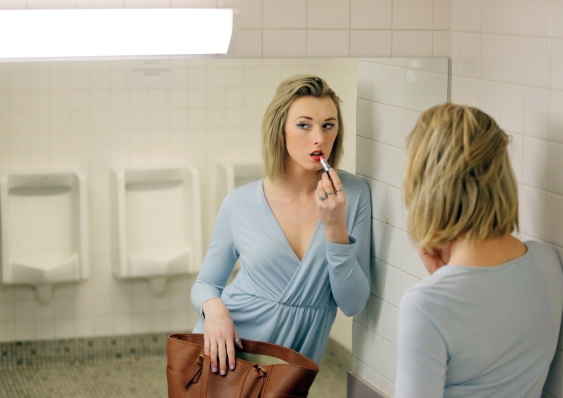
Brae Carnes is a transgender woman living in Victoria, Canada whose photo-activism went viral when she posted an image of herself applying lipstick in a public restroom with a line of urinals against the wall behind her (see left). Brae told reporters at the Times Colonist, “I’m giving them what they want… I’m actively showing them what it would look like if that became law and how completely ridiculous it is” (here). And Brae is not alone. Michael Hughes, a transgender man living in Minnesota, also caused some digital waves when he posted a series of pictures of himself in women’s restrooms with captions like: “Do I look like I belong in women’s facilities?” (see below). Brae and Michael are part of a vocal group of trans* rights activists opposing legislation that would force transgender people to use the public restroom facilities associated with their birth gender (the sex they were assigned at birth). So-called “bathroom bills” are being introduced in the U.S. and abroad, and #Occupotty is an important challenge to the proposed legislation.

B_6vNpGUQAAm_bgThose introducing bathroom bills most often justify them as being about “protection,” “public safety,” and as attempts to reduce violence and assault. The bills rely on the transphobic myth that transgender individuals are sexually perverse and that they are likely to be sexual predators.  Thus, defenders of these bills often claim that they are about protecting cis-gender people. This avoids the troubling truth that transgender individuals are far more likely to have violence committed against them than they are to commit this kind of violence against others. Indeed, Media Matters found no evidence to substantiate the claim that restroom sexual assaults were higher in trans-inclusive jurisdictions.  One survey of transgender and gender non-conforming individuals in Washington D.C. found that 70% of respondents reported having been either harassed in, assaulted in, or denied access to public restrooms (see here).   It’s an important issue and Brae Carnes and Michael Hughes are helping to draw more attention to the lives that hang in the balance.

Bathroom bills portray trans* persons as sneaky and deviant and as attempting to trick the rest of us into using a restroom with them. But, as Mic.com reported, there have been zero reported attacks on cis-gender people by transgender people in public bathrooms. All of the documented attacks victimized trans* persons. So, why is the conversation about transgender people committing violence rather than about protecting transgender folks from cis-gender violence?

This is an instance of what Laurel Westbrook and Kristen Schilt call a “gender panic”—situations in which people collectively react to challenges to biology-based ideologies about what gender is and where it comes from by attempting to reassert those ideologies. Bathroom bills produce just this type of ideological collision where biology-based ideologies and identity-based ideologies are pitted against each other in public discourse. Inside this ideological discord, we gain new information about the gender binary, gender inequality, and how our beliefs about gender difference take a lot more work to uphold than we may assume.

Bathrooms are intensely gendered spaces. The belief that men and women, boys and girls, ought to relieve themselves in separate rooms is a powerful illustration of our collective investment in gender differences. But, sex-segregated bathrooms are a matter of social preference and organization rather than being recommended by our biology. And when we attempt to resolve this gender panic by resorting to biology (such as introducing legislation mandating the criteria of “birth gender” for public restroom use), we continue an awful tradition of putting transgender people at risk of violence under the guise of protecting “us” from “them.”  But, social scientific research shows that we are in far greater need of policies that protect “them” from “us.”

Bathroom segregation is a political issue and one that deserves academic and public feminist support. The proposed legislation relies on myths associated with cis-gender and transgender people alike. Whether motivated by hate or misunderstanding, these laws fail to acknowledge well-documented facts about violence against transgender people, and in doing so, play a role in perpetuating continued violence and discrimination against transgender people. #Occupotty is a political statement and a request for recognition and rights. But these brave digital activists are doing more than that, too. They are exposing a set of myths that also work to justify gender and sexual inequality. Whether openly acknowledged or not, it is for this reason that #Occupotty meets resistance and it is for this reason that it deserves more support.

#TransLivesMatter


This article was republished on Wonder Anew, an ongoing project born from an idea that personal positive change (finding the best in ourselves) is a way to gain insight and wisdom to live a better life, that sharing our personal changes lifts others’ spirits, and that listening to others’ changes can inspire us to be contributors to the world.


Professionals wear many hats. I’m a scholar, author, researcher, editor, educator, analyst, speaker, evaluator, advisor, collaborator, investigator, advocate, and consultant. I’m also a yoga instructor. In addition to my advanced degree in social science, I’ve logged more than 300 hours of formal yoga training and taught more than 400 hours of public classes.

Parivrtta Hasta Padangusthasana - Big Bend National Park
Parivrtta Hasta Padangusthasana – Big Bend National Park

Yoga, derived from the Sanskrit root “yuj” means “yoke” or “union.” The practice uses a variety of movements, breathing exercises, meditation, and relaxation techniques to help the practitioner achieve union (balance) between the mind, body, and spirit. Although yoga can be traced back thousands of years, modern yoga has morphed into a variety of new styles that incorporate classical and contemporary philosophies and methods. It may be practiced as a form of religion, lifestyle, leisure, or fitness. Americans spend $6 billion a year on yoga classes, equipment, clothing, workshops, videos, books, and more. Yoga has become so popular as a health modality, with about 17 million practitioners in the United States alone, that doctors are starting to recommend yoga to their patients to improve health and enhance allopathic medicine.

Many modern practitioners (70 percent of whom are women) do yoga specifically to improve their health. I started practicing more than 15 years ago for that same reason. Since then, yoga has become more than a pastime for me. It is the singular item I resist from crossing off my ever-expanding “to-do” list. It is the activity I seek out within the nooks and crannies of passing time. Yoga gives me a chance to breathe, to balance in perilous positions, to stand on my head and quite literally experience the world from a different perspective. Yoga calms me down; it helps keep me sane. Yoga informs my being, my living, and my work.

I’ve practiced yoga for thousands of hours. I’ve taught outdoors in parks and on rooftops, and indoors in living rooms, lounges, classrooms, dance halls, yoga studios, and occasionally in the session rooms at academic conferences. Yoga has been this thing in the periphery of my professional life. But every time I teach a class I witness a palpable shift in the room, a sense of calm that sweeps in and through, from beginning to end.

I used to think my yoga practice was more tangential to my work, but upon reflection I realize that is not the case. I now see that yoga is also a body project that has the potential to engage feminism and inspire feminist consciousness. It is neither a necessary condition nor a guaranteed outcome. But the body has long been the beating heart of copious feminist work.

Feminist Theory and the Body

Early western feminists didn’t always consider the body to be central to women’s empowerment. Women have been equated with the body (not the mind) throughout history, and this helped to justify the treatment of women as property, objects, and commodities. Some feminists therefore believed that equality between men and women rested upon the notion that rationality (reasoning) was the universal human capacity that could render neutral the seemingly fundamental biological differences that promoted gender inequality. Simone De Beauvoir’ radical exploration of such inequality in The Second Sex brought the relation between the body and the self to the center of feminist theorizing. Unlike the history of (dualist) western intellectual tradition in which the body was absent or dismissed as irrelevant, feminism’s second wave argued that the body matters; materially, discursively, performatively, and phenomenologically.

Corporeality is entangled in culture and biology, meaning and substance, identity and lived experience, mind and matter. Yoga can be a window into these varied dimensions of feminist conceptualization.

Culture and Biology: Yoga provides an opportunity to participate in an ancient, though modified, cultural tradition while experiencing the rhythm of life through the synchronization of breath and movement.

Meaning and Substance: As the body breathes and energy flows, mindful attention to the positioning of the body in physical space (in the shape of a cobra, an eagle, a triangle, a wheel, a warrior, a mountain, a corpse) allows awareness of oneself, as corporeal and beyond the body, to surface.

An actor and an observer at the same time, a yoga practitioner may become aware that sensory activities give rise to perceptions and judgments that may be based in reason (e.g., pulling weeds all weekend contracted my shoulders, limiting my range of motion) or may transcend both reason and experience (e.g., I’m not strong). Through the practice, we can learn that perception is not purely sensation; nor is it purely interpretation. Consciousness is a process that includes sensing as well as reasoning.

Identity and Lived Experience: Practicing yoga with others perhaps inches away and planted, firmly or precariously, on their own plot of imagined earth (often delineated by a 2’ x 6’ sticky mat) places the individual in relation, in an orchestrated flow of energy and motion. Unlike many social interactions we simultaneously experience ourselves with, and apart from, others. On a level we know, too, that we are an element of their perceptions just as they are a component of ours.

Mind and Matter: With regular practice, yogis may experience equanimity: a perfect, unshakable balance of mind. Researchers at Massachusetts General Hospital in Boston define it as “an even-minded mental state or dispositional tendency toward all experiences or objects, regardless of their origin or their affective valence (pleasant, unpleasant, or neutral).” It is the essence of well-being, the foundation for clarity, neutrality, and insight.

Why does the mind-body-spirit of yoga matter for feminism?

Much of feminist organizing focuses on informational empowerment and structural change to improve human conditions. This is vital. Yet the body still matters. It is a source of meaning, identity, empowerment, and connection. It is part of life. It is life. Yet, the body is judged, controlled, politicized, medicalized, contaminated, and abused. The body is objectified, commodified, marked in accord with perceived social value, and exploited for its labor. The body remains a site of inequality and therefore must remain a feminist project.

For me, yoga is a way to remember that I am not a brain on a stick. Being in my body, and connected through yoga and meditation reveals an inner potency and respect of self. I am strong yet vulnerable. I am in my body, of my body, and beyond my body. And when I find equanimity in my yoga practice, the unity of mind-body-spirit provides healthy fodder for my feminist work and the life I want to live.

Additional Resources:

Leonard Nimoy attended University of California, Los Angeles in 1971 to study photography. He had already filmed the original Star Trek television series, which didn’t develop a cult following until reruns of the show aired in the 1970s. His love of photography, however, predates his portrayal of the half-Vulcan, Spock.

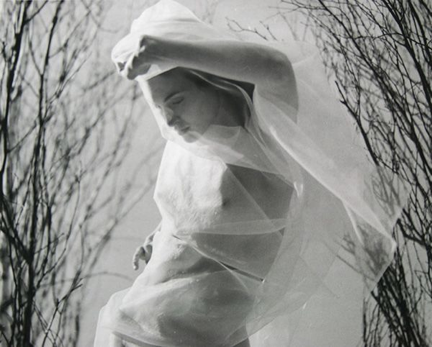
While this role is what most people are sure to remember Nimoy by, I will always think of him as a skilled photographer who engaged cultural rhetoric on the gendered and sexual body. Perhaps his most controversial work is titled Shekhina, which is his attempt to capture divinity in a “feminine” form. Shekhina, he explains here, is a Jewish “deity”—one so luminous that men in synagogue have to look down, away, or otherwise shield their faces. As a child, he wondered, “Why hide the face? Why can’t we look?”

Spending seven years searching for Shekhina through his photography, Nimoy produced images he describes here as a “crossover between sensuality and religion.” Consequently, he was asked to not show his photographs at a Seattle synagogue where he had been scheduled to talk about his work. The controversy around this censorship arose because of a religious discomfort with sexual portrayals of women—as sexually desirable and perhaps as sexually desiring—and the association of women with power. Nimoy saw his work as a “very strong feminist statement” partly because “to some degree, in the orthodox community, that makes people uncomfortable—the idea that god is a woman.”

Shekhina
Shekhina. Leonard Nimoy/R. Michelson Galleries

Nimoy’s Shekhina series at times conflates femininity with desirability, but it also challenges us to think of women as corporeally and inherently powerful. He captures the simultaneous idolization of femininity and invisibility of the female body in religion, specifically in Judaism. And the looking away from Shekhina speaks to her ideological incandescence as well as to the way religion is structured around gender dichotomies, whereby women are cast within an androcentric institution as heterosexually alluring and men as driven by primitive roots—or by what Martha McCaughey refers to in her book, The Caveman Mystique, as Darwinian ideas about sex.

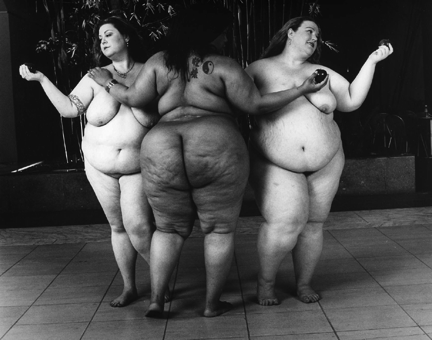
At the same time Nimoy challenges the invisibility of a powerful, deific femininity, he also privileges hegemonic corporeal norms, situating in his frames thin, white women with long hair who often peer down. [When they look directly at the viewer, the images take to task representations of women as meek]. Nimoy recognized this, noting that it was not until he began work on The Full Body Project that he realized very specific bodies and definitions of beauty dominated his work. A large-bodied model contacted him to see if he was interested in photographing her precisely because she represented a different sort of body than he was used to shooting.

Joan Jacob Brumberg’s book on The Body Project looks historically to demonstrate the ways social norms have turned women’s bodies into all consuming projects. At any given time, women’s bodies are defined as malleable and docile, evoking Michel Foucault’s notion of the panopticon, by which women internalize narrow, sexist bodily expectations. To take on work that captures an alternative image of beauty, Nimoy said he had to ask himself, “Will you do something that scares you?” In other words, could he do justice to a woman who challenged him to rethink how he was portraying beautiful bodies and women’s sexuality?

Nimoy’s relationship with the model evolved into a larger venture as he found that when he showed his photography, it was pictures of this full-bodied woman that “got the attention. So I thought, there’s something going on there in our culture about this kind of body.” Nimoy appeared to know he was engaging larger conversations about the misogyny of fat-shaming and problematic definitions of what counts as a beautiful and thus culturally valued woman. He found a San Francisco burlesque group called The Fat-Bottom Revue that was happy to pose for him; the women were comfortable in their own skin and used the art of dance and theater to do body-positive activism. Along with these women, Nimoy highlighted bodies as cultural symbols that are constrained by gendered structures but also vehicles of agency through which we experience the world around us and develop intellectual, emotional, and physical relationships with others. [For more on The Full Body Project, see here and here].

The Full Body Project. Leonard Nimoy/R. Michelson Galleries
Leonard Nimoy
Leonard Nimoy. Seth Kaye Photography.

As a gender scholar who studies issues of masculinity, I can’t help but wonder where the masculine body is in Nimoy’s work. Why not capture sensual photos of large bodied men? Or of female masculinity? Focusing on femininity and female bodies relegates “beauty” to feminine identified bodies, but it also keeps women at the center of a discussion of bodies and structures of power. [In my own research, I explore men’s relationship to beauty and the beauty industry. See here]. What Nimoy does so well in his photography is acquaint us with images of bodies that beget conversations about gender, sexuality, and social hierarchies. As Nimoy noted, his photos put us in touch “with something beyond what you see in the image;” and he saw his work as not about any particular model or group of models, but rather about “feminine power.”

_____________________

Barber_PhotoKristen Barber is an Assistant Professor of Sociology and a Faculty Affiliate in Women, Gender, and Sexuality Studies at Southern Illinois University, Carbondale. She teaches courses on gender, inequality, work, and qualitative methods and is on the Gender & Society Editorial Board. Her book on women working in the men’s grooming industry is forthcoming with Rutgers University Press.


old crazy

Why are mental health and disabilities fields that sociologists seem to neglect?

Historically, medical sociologists studied mental health and institutions. But there are few sources in the recent sociological literature on women and mental health. Feminist psychologists have done most of the research on these topics. With our intersectional frameworks, concern for social justice, and examination of structural oppression and intertwined institutions and identities, it is crucial for feminist sociologists to study gender and mental health (and disabilities).

We need to examine how women living with mental illness, and those with mental illness or disabilities in general, are labeled, viewed, and reacted to in a society that devalues emotions, lacks equity in access to quality mental health care, and criminalizes those with mental illness instead of supporting them. Even more necessary is perspective and insight on mothers who are living with mental illness, especially to give voice to women who may be afraid to speak about their experiences because of stigma.

David Karp is one of the few sociologists who has published on the experience of mental illness. In his book, Speaking of Sadness: Depression, Disconnection, and the Meanings of Illness, he states:

“Given the pervasiveness of depression, it is not surprising that both medical and social scientists have tried to understand its causes and suggest ways of dealing with…… As valuable as these studies might be, something crucial is missing. My view is that to really understand a human experience, it must be appreciated from the subjective view of the person undergoing it. …Underneath the rates, correlations, and presumed causes of behavior are real human beings who are trying to make sense of their lives” (p.11).

As sociologists we need to move away from the debate on ‘what causes mental illness’ and make room for understanding the experience of those living with it, especially for women and mothers. As David Karp notes in his work, the etiology of mental illness is complex. Sociologists can add to this research on causes, but we cannot pretend we have the grand answer. Our focus seems to be on critiques of the pharmaceutical industry and how diagnosis can be a form of social control. These are important issues, but by focusing on critiques, we neglect the stories of those who experience mental illness.

Does this mean that we are saying mental illness is not real? From the stories of women living with mental illness, we can still understand the structural forces that shape the experience, without denying that experience, and hopefully decreasing the stigma surrounding it.

To support this idea, and as an introduction to my new research on maternal mental health, I share stories, in this post, and the work of those who are using stories to dismantle the stigma that women and mothers living with mental illness experience. mom pic art

Motherhood and Mental Illness-Master Status

The blog post “Mothers and Mental Illness” written by Karen Spears Zucharias, author of Mother of Rain, tells the story of her friend who suffered from postpartum psychosis. (While this is something that can happen, it is rare. However, we may hear more about it because of the tragic events associated with it such as the death of a child.) Karen speaks volumes about mental health in this country including how we treat people with mental illness and how they may feel. These relate to sociological concepts of statuses, identity, labeling, and stigma. Karen states:

“People look at you differently when you’ve suffered from mental illness. Even when you’ve healed, there remains the nagging “what ifs” in the minds of others.”

Mental illness becomes your “master status.” With this being the case, do you ever get to have an emotion or make a mistake without your actions labeled as part of the mental illness, without the stigma? And more so, what are the consequences of this stigma, those negative sanctions that might include ending up handcuffed because of your mental illness?

A Mother in Handcuffs handcuffs

Dyane Harwood, a mother of two who lives with the mental illness bi-polar, writes about a horrendous experience in her blog post “Handcuffed and Lactating.” When her husband called 911 when she was in a manic-episode, symptomatic of her bi-polar disorder, four police offers showed up at her house to transport her to the Behavioral Health Unit. Although she was being compliant, they handcuffed her.

In her words, from the poem that begins her post:

“To this day, I can’t believe it

Why a lactating mother of two would be such a threat

I needed treatment, but I complied; I was willing to leave

My children for the hospital, near the street where I conceived

I didn’t need handcuffs – I had to laugh a bit

I wasn’t armed with a gun…what a bunch of bullshit!

I hope no other mother who’s manic and admits it

Doesn’t go through the humiliation of being treated like a convict.”

Is it any wonder why mothers, especially those living with mental illness, are afraid to ask for help? Mental illness is not a crime, nor is being a mother with a mental illness. And handcuffs do not heal. These stories are real, but we do not hear them. We do not have a space for women and mothers to share them, save for a few blogs and websites.

Stories To Tell voice

The website Stigmama, founded by Walker Karraa, PhD, focuses on the perspectives of mothers and women living with mental illness, along with those who live with them. She argues that these personal perspectives make a difference and advocates that we use the term mental ‘difference’ instead of mental ‘illness.’ Dr. Karraa express this in a powerful way in the introduction to the website:

“I have always believed in the power of women, especially those who have been touched by mental illness or mental difference, to create change. We are different. We see what others don’t, write what others won’t, and give beauty to the deepest experiences of motherhood and the human soul. I created Stigmama for mothers of all ages to do just that. To speak their truths in a non-judgmental, supportive, creative community. We need the wisdom and support of others to unpack stigma of mental difference in motherhood.”

This relates to another quote from Karp, speaking to the importance of giving voice to those who rarely get to have a voice.

“The essential problem with nearly all studies of depression is that we hear the voices of a battalion of mental health experts (doctors, nurses, social works, sociologists, psychologists, therapists) and never the voices of depressed people themselves. We do not hear what depression feels like, what it means to receive an “official” diagnosis, or what depressed individuals think of therapeutic experiences. Nor do we learn the meanings that patients attach to taking psychotropic medications, whether they accept illness metaphors assessing their condition, how they establish coping mechanisms, how they understand depression to affect their intimate relationships, or how depression influences their occupational strategies and career aspirations” (pp. 11-12).

We need safe spaces for women living with mental illness to tell their stories and safe spaces, such as Feminist Reflections, to discuss the need for this research.

Moving Forward: A Call For Feminist Sociologists To Examine Mental Health

Like our fore-mothers in sociology, many of us as contributors and readers of Feminist Reflections want to make positive social change and give voice to those who are oppressed. While there is fabulous work done by sociologists on issues of race, gender, poverty, LGBTQ issues, and related identities and inequalities, we seem to forget about the hidden stigma and oppression of mental illness. Maybe we see it is as the psychologists’ domain as it deals with the mind. Or, we quickly turn to our critiques of medication and the pharmaceutical industry or diagnosis as a tool of social control. Maybe it is just too personal for some to study.

Whatever the reasons, I am pushing for feminist sociologists to study mental illness, especially women and mothers who suffer from mental illness. It is real for those who experience it— what we call the social construction of reality. Through women’s stories, we can deepen our understandings about the relationships among gender, motherhood, and mental health. And hopefully, we can help to decrease the stigma.

Read More:


Part 5 in a Series

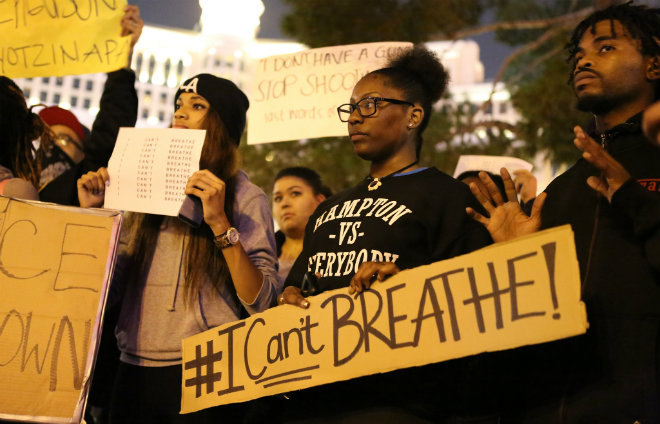
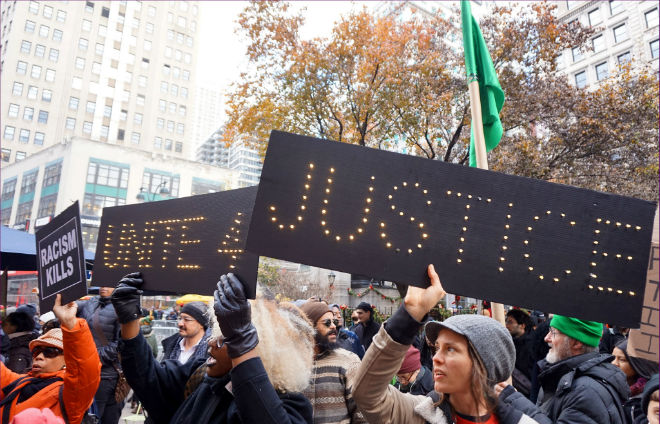
The systematic oppression of black people has been thrust into national consciousness because of the visibility of recent police brutality against black men.

Black Lives Matter (BLM), the emerging social movement challenging this violence and the institutionalized inequalities that underlie and uphold it, started as a hashtag by three black queer women activists. Now it has become a national call to action that has brought thousands of people of diverse racial and cultural backgrounds into the streets to demand immediate changes in police policies and practices.

Pacific Standard, Dec. 19, 2014

blacklivesmatter_genderOn December 18th (2014), Associate professor Adia Harvey Wingfield of Georgia State University wrote an analysis of the gendering of BLM for the Pacific Standard (PS). We wrote an article the next day, also in PS, on how social scientists can do more to end racial subjugation. Together, these articles offer both a feminist perspective on the movement and a concrete set of ways social scientists can take action.

Professor Wingfield’s analysis demonstrates how the BLM protests are important not only because they draw attention to ongoing acts of racial persecution, but because they reveal how gender shapes police violence and those who are victimized by it.

  • It’s safe to say that the most well-known victims of police (and self-appointed vigilante) violence are black males….
  • Black men have historically been and continue to be cast as dangerous, threatening, and inclined to violent behavior. This stereotype has its roots in the post-slavery era when such “violence” was used as a justification for lynching black men.
  • The stereotype of black male criminality may have the unintended consequence of making criminal activity more difficult to curtail.

Black women are an untold side of this story.

  • The act of protesting itself is a gendered activity, also involving covert forms of protest.
  • If police violence is seen as a black men’s issue, then black female victims are easily overlooked and the problem persists.
  • Depictions of black men as the primary victims of police violence may make black women reluctant to involve law enforcement.

Read the full article: “Gendering #BlackLivesMatter: A Feminist Perspective” by Adia Harvey Wingfield, Pacific Standard, Dec. 18, 2014.


sws_protestOn December 19th (2014) we argued, too, that using our knowledge of social systems, all social scientists—black or white, race scholar or not—have an opportunity to challenge white privilege. As social scientists, our job is to understand the social structures within society that reproduce inequities. We can, in tangible ways, bring our sociological imaginations to bear on the eradication of racial repression.

We can:

  1. Listen and follow the lead of this black-led movement to confront racial injustice.
  2. Assess the critical role of law enforcement.
  3. Create space in our classrooms for dialogue about white privilege and anti-black racism.
  4. Support social action among our students.
  5. Incorporate a race lens into our research and writing, and include research on race in our syllabi.
  6. Share our findings with other colleagues, activists, and our broader communities.
  7. Open our eyes, look around, and “interrupt oppression” when we see it.
  8. Talk about the Black Lives Matter movement and engage in critical dialogue to transform our institutions.
  9. Mobilize anti-racist white people.
  10. Help to change the system.

Racial justice requires fundamental changes to a system with deep historical roots, one that structurally disadvantages black people as a group. At this critical time, we all have an opportunity to examine ourselves and to support those seeking transparency, accountability, and safety in their communities.

Read the full article: “Social Scientists Can Do More to Eradicate Racial Oppression” by Gayle Sulik and Mindy Fried, Pacific Standard, Dec. 19, 2014.


Read the entire Black Lives Matter Series on Feminist Reflections

Part 4 in a Series

I know racism exists everywhere in the U.S., but as a newer person to the South, I have observed that segregation and racism are more visible and verbal here.

Prior to moving here, I lived in the inner-city of a metro area in the Upper Midwest where I observed racism in more covert ways:  minority youth afraid of police, wedges between different racial/ethnic groups in the community, and  strategies to work on these issues from “Facing Race” trainings and community-police relationship building, to the police force trying to hire more minorities. From a vantage point of moving from the Upper Midwest to the Deep rural South, racism can be seen differently.

“Standpoint” is not a new concept to sociologists, nor to people of color who have lived in both regions. And certainly all ways that racism is expressed and experienced is unacceptable. However, some folks I have talked to who moved to the North from the South have said that when racism is more overt, it is sometimes easier to deal with because you know what people think. Whatever the form, racism is something we shouldn’t have to fight. But as I share my observations to talk about why black lives matter, I see clearly that racism is not dead.

In this post, I am going to take a different stance from my co-bloggers on Feminist Reflections to share stories that demonstrate racism in everyday interactions, rather than the local or national protests currently underway. Organized protests are the manifestations of years and year of oppression; a build-up of blatant racist acts experienced by people of color. With permission, I share the following stories from one of my students. My student “Bob” (not his real name) is currently finishing his internship under my supervision. It is my ethical decision to write more generically about my student and some events to protect identities of persons and organizations.

Pickin’ Cotton: My Student’s Story

Cotton Field  Photo by  Kimberly Vardeman via flickr.com.
Cotton Field

Bob is a large black man. Bob knows he is large. Bob also knows how people may perceive him, given the stereotypes about back men. Indeed, he’s told me about numerous times in his life of being pulled over by the police and the interactions that have happened. But the reason I want to talk about Bob is to point to issues about language and micro-aggressions as a form of racism occurring in everyday lives. Everyday interactions, including our language, whether people “intend” to be racist or not, are embedded in structural racism.

In a meeting discussing his internship, Bob told me about something that happened with a man who answered the phones at his internship site. While waiting to meet with another person at the organization, they engaged in small talk. After a rant about how people claim their race and ethnicity, the man told Bob that he could not call himself African American, charging that Bob could not trace his ancestry back to slavery or to Africa. Bob was shocked that this man had the audacity to make such a ridiculous claim. In trying to keep his cool while also advocating for himself, Bob gave the man “a short history lesson.” But while doing so, Bob had to maintain professionalism as an intern, despite what he had just heard, which of course upset him.

There were other stories Bob shared. Since we live in the rural South, we are surrounded  by many cotton fields. When Bob was talking to another person at the organization, the guy told Bob “to go pick cotton.” A cotton field was, literally, behind them. Joking or not, why would he say that? Did he fail to realize that the remark harkens back to slavery? Why did the receptionist at Bob’s internship think he could tell Bob what racial or ethnic term he can or cannot claim or use?

Why did these people express these particular words and types of sentiments to Bob?

Slave Family  Photo uploaded by Blofeld Dr. via http://kaufmann-mercantile.com
Slave Family

Rest assured, Bob handled the situations with professionalism and dignity. He brought the issues to the person in charge of the organization, who was concerned and took action.

However, as Bob and I talked about his experiences and I thought about them for days, the question about who tells a black person to go pick cotton kept coming to back to my mind. Language matters. Symbolism matters. If someone doesn’t understand why telling a black person to go pick cotton is not okay, that person may want to re-visit history.

The issues were taken care of internally before I had to get involved as a faculty internship adviser. But hearing about these daily micro-aggressions Bob was experiencing made me angry. If I had to get involved, what would have I said? I would have to use the language of treating my student with respect, in which racism will not be tolerated. But “who tells a black person to go pick cotton?” This is the question to ask in these kinds of circumstances.

Slaves picking cotton Uploaded by Infrogmation on http://en.wikipedia.org/wiki/Wage_slavery
Slaves picking cotton

My student may be “privileged” in that he is attending college, but this does not erase his race, the discrimination he may face because of it, nor his feelings when racial aggressions occur. He knows that in a professional setting in which many things are at stake including the security of his internship, which may be a stepping stone to a job and/or letters of recommendation for his future, he must tread lightly. As sociologists have shown, if a black person gets angry it is often viewed stereotypically as typical behavior, helping to reproduce the cycle of racism. Bob advocated for himself, but realized that he had to do so within the constraints of his professional setting.

While this interaction is not at the same level as the Ferguson or related cases, it shows how micro level interaction racism exists in overt ways. A black person carries the burden of experiencing racism in everyday life.

Moving Forward

Beyond advocacy and social action through protests, rallies, and so forth, we must also listen and acknowledge the experiences of  students and people of color that happen in everyday interactions. It is through some of these everyday experiences where we can see the ways in which racism is experienced on a daily basis by people of color.

These stories show the power of language, part of our (racist) culture. Micro-aggressions, including language and symbols, are symptoms of structural racism and perpetuate racism, intentionally or not. Intent is not the same thing as impact. And Bob is one of many students who have told me about these kinds of everyday racist interactions. Language matters. Unfortunately, language is often ignored.

I have encouraged my students to write about their experiences. My students have told me that they want to make a difference in the world and work for social justice in their careers and volunteer activities. Many of them in fact work or volunteer with student organizations, multicultural centers, and/or do internships at organizations that work with diverse and oppressed clientele. By documenting and reflecting on their experiences (sadly including the “isms” they experience or see others experience), using their sociological training, and reflecting on current ways of addressing inequality they witness, I hope we can find effective ways to work together to advocate for social justice. While I firmly believe that the oppressed should not have to teach their oppressors, I do think it is important for us as allies to listen and learn from the perspectives of people of color.

Often in our quest for public and feminist sociology, we do not hear from students or from those who experience everyday racism. I have invited my students to write their stories and reflect on how they conceive of advocacy and social change. We’ll share some of these on Feminist Reflections in the future to highlight student voices that exemplify feminist sociological principles. Activism through rallies, protests, and other forms of collective organizing are incredibly important, and so is listening and being there for our students.

In conclusion, please remember:

ear

    We cannot forget to be allies by LISTENING, leaning from, and supporting our own students whose lives have been affected by structural racism and experience micro-aggressions and every day, often overt, racism.


Related:

When Will the North Face Its Racism? by Isabel Wilkerson, The New York Times, Jan. 10, 2015


Read the entire Black Lives Matter Series on Feminist Reflections


Image source: http://www.thebolditalic.com/articles/6235-the-lumbersexual-is-here-to-chop-down-metrosexuals

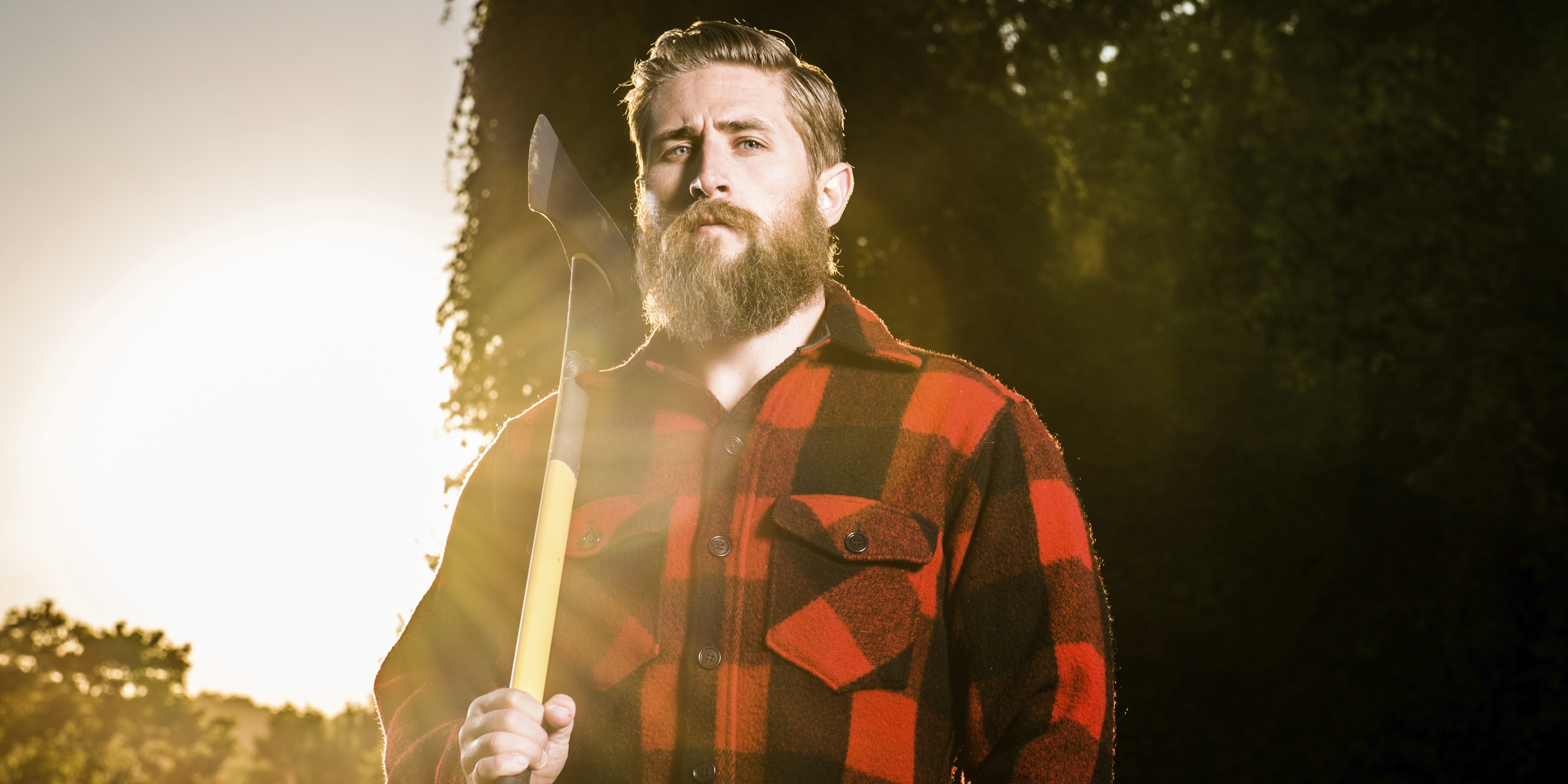
“Lumbersexual” recently entered our cultural lexicon. What it means exactly is still being negotiated. At a basic level, it’s an identity category that relies on a set of stereotypes about regionally specific and classed masculinities. Lumbersexuals are probably best recognized by a set of hirsute bodies and grooming habits. Their attire, bodies, and comportment are presumed to cite stereotypes of lumberjacks in the cultural imaginary. However, combined with the overall cultural portrayal of the lumbersexual, this stereotype set fundamentally creates an aesthetic with a particular subset of men that idealizes a cold weather, rugged, large, hard-bodied, bewhiskered configuration of masculinity.

Similar to hipster masculinity, “lumbersexual” is a classification largely reserved for young, straight, white, and arguably class-privileged men. While some position lumbersexuals as the antithesis of the metrosexual, others understand lumbersexuals as within a spectrum of identity options made available by metrosexuality. Urbandicionary.com defines the lumbersexual as “a sexy man who dresses in denim, leather, and flannel, and has a ruggedly sensual beard.”

One of the key signifiers of the “lumbersexual,” however, is that he is not, in fact, a lumberjack. Like the hipster, the lumbersexual is less of an identity men claim and more of one used to describe them (perhaps, against their wishes). It’s used to mock young, straight, white men for participating in a kind of identity work. Gearjunkie.com describes the identity this way:

Whether the roots of the lumbersexual are a cultural shift toward environmentalism, rebellion against the grind of 9-5 office jobs, or simply recognition that outdoor gear is just more comfortable, functional and durable, the lumbersexual is on the rise (here).

Many aspects of masculinity are “comfortable.” And, men don’t need outdoor gear and lumberjack attire to be comfortable. Lumbersexual has less to do with comfort and more to do with masculinity. It is a practice of masculinization. It’s part of a collection of practices associated with “hybrid masculinities”—categories and identity work practices made available to young, white, heterosexual men that allow them to collect masculine status they might otherwise see themselves (or be seen by others) as lacking. Hybridization offers young, straight, class-privileged white men an avenue to negotiate, compensate, and attempt to control meanings attached to their identities as men. Hybrid configurations of masculinity, like the lumbersexual, accomplish two things at once. They enable young, straight, class-privileged, white men to discursively distance themselves from what they might perceive as something akin to the stigma of privilege. They simultaneously offer a way out of the “emptiness” a great deal of scholarship has discussed as associated with racially, sexually, class-privileged identities (see here, here, and here).

The lumbersexual highlights a series of rival binaries associated with masculinities: rural vs. urban, rugged vs. refined, tidy vs. unkempt. But the lumbersexual is so compelling precisely because, rather than “choosing sides,” this identity attempts to delicately walk the line between these binaries. It’s “delicate” precisely because this is a heteromasculine configuration—falling too far toward one side or the other could call him into question. But, a lumbersexual isn’t a lumberjack just like a metrosexual isn’t gay. Their identity work attempts to establish a connection with identities to which they have no authentic claim by flirting with stereotypes surrounding sets of interests and aesthetics associated with various marginalized and subordinated groups of men. Yet, these collections are largely mythologies. The bristly woodsmen they are ostensibly parroting were, in fact, created for precisely this purpose. As Willa Brown writes,

The archetypal lumberjack—the Paul Bunyanesque hipster naturalist—was an invention of urban journalists and advertisers. He was created not as a portrait of real working-class life, but as a model for middle-class urban men to aspire to, a cure for chronic neurasthenics. He came to life not in the forests of Minnesota, but in the pages of magazines (here).

Perhaps less obviously, however, the lumbersexual is also coopting elements of sexual minority subcultures. If we look through queer lenses we might suggest that lumbersexuals are more similar to metrosexuals than they may acknowledge as many elements of “lumberjack” identities are already connected with configurations of lesbian and gay identities. For instance, lumbersexuals share a lot of common ground with “bear masculinity” (a subculture of gay men defined by larger bodies with lots of hair) and some rural configurations of lesbian identity. Arguably, whether someone is a “bear” or a “lumbersexual” may solely be a question of sexual identity. After all, bear culture emerged to celebrate a queer masculinity, creating symbolic distance from stereotypes of gay masculinities as feminine or effeminate. Lumbersexuals could be read as a similar move in response to metrosexuality.

Lumbersexual masculinity is certainly an illustration that certain groups of young, straight, class-privileged, white men are playing with gender. In the process, however, systems of power and inequality are probably better understood as obscured than challenged. Like the phrase “no homo,” hybrid configurations of masculinity afford young straight men new kinds of flexibility in identities and practice, but don’t challenge relations of power and inequality in any meaningful way.

_____________________________

*We would like to thank the Orange Couch of NOLA, Urban Outfitters, the rural (&) queer community, and Andrea Herrera for suggesting we tackle this piece. Additional thanks to C.J. Pascoe and Lisa Wade for advanced reading and comments.