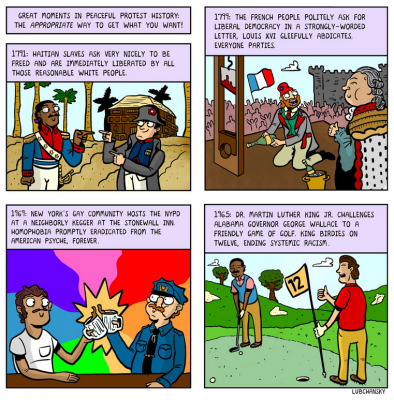
A few editorial cartoons offering a counterpoint perspective to the cultural sentiments and media portrayals that denounce the Baltimore “riots” as politically unproductive, ethically unjustifiable hooliganism have achieved viral status. One particularly prominent cartoon illustrates alternative histories in which once denied freedoms and equities were achieved without systemically disruptive uprisings (see image above). In one panel an 18th century Haitian slave cordially informs a French Imperialist that he and his fellow slaves would rather be free. The receptive overseer responding in an equally kind fashion decides to abolish the system of slavery that legitimizes his very authority. In another panel an 18th century French revolutionary asks King Louis XVI to abdicate his power as well as dissolve the monarchy to make way for democratic rule and, like in the previous example, history is comically rewritten to suggest that the powers that be were enthusiastically and progressively responsive to such a request. more...

 To the questions posed in the title of the panel “Whose Knowledge? Whose Web?”, the answer has too often, and too simplistically, been “everyone’s.” Among Web 2.0’s most strident enthusiasts, the rise of user-generated content is heralded as the reclaiming of knowledge production from entrenched institutions, allowing a brave new world of pluralist democracy to find expression online. These digital evangelists speak of the emancipatory promise of the Internet in language usually reserved for that of markets. In both cases, the prescription is the same: progress is a matter of access. Hence, the “digital divide” has become a discussion about disparities in connectivity rather than one about the expressions and reproductions of social inequalities online.