pplkpr

We’ve all been there. Sweaty palms, racing heart, left eye that winks at involuntary intervals. You’re emotionally fraught and having a physiological response. It could be an upcoming exam, a big presentation, or that one friend who can’t stop telling you about their fantastic job/spouse/kids/new shoes while wondering out loud how you manage living in such messy quarters.

Our bodies are key sources of information and guidance. Bodied reactions, coupled with culturally situated reflexive analyses, help us make sense of day-to-day events and make behavioral decisions. Feel like you’re going to vomit every time that colleague stops by your office? Maybe they’re toxic. Maybe you’re in love. The bodily response prompts you to do something, and how you interpret that response tells you what that something is.

This relationship between bodily responses, their interpretation, and potential behavioral outcomes, is the principle behind self-quantification, or the tracking of bodily trends for the purpose of self-reflection and aspirational change. Self-quantification relies on a host of technological devices, each of which measures, reports, and aggregates body-data, helping the quantifier tell hirself a story, about hirself. Although self-quantification often pertains to physical health, many use tracking technologies to record variations in affect and mood.

A new iOS app extends this logic, and helps quantifiers tell themselves stories about themselves, in affective relation to specific others. The pplkpr (people keeper) uses a smartwatch to measure a user’s heart rate, employing subtle changes to identify emotional states. When triggered by a change, the app prompts the user to record who they were with and how that person was making them feel. The app then aggregates this information, revealing who is calming, toxic, or arousing. Based on this information, it initiates messages and invitations to those who make the user feel “good,” and blocks those who make the user feel “bad.” From the app’s website:

 pplkpr implements a complex metric called “heart rate variability” that uses subtle changes in heart rhythm to determine your emotional state. This data is correlated with the people you interact with to determine who should be auto-scheduled into your life and who should be removed.

In short, the app treats bodily flows as raw data, which it translates into an ostensibly meaningful report. The app uses these data to quantify the affective experiences of users’ relationships, and pushes users into “healthy” pairings. But it does more than this. It does not just push users to reflect on relationships and make tangible moves on the user’s behalf (though it certainly does both of these things), it also becomes part of the relationship dynamic; it produces those relationships that it helps the user analyze. And this productive force relies upon a particular set of values and assumptions, built into the device in the form of diagnostic criteria. Anxiety is to be avoided; calmness and arousal sought out.

That is, pplkpr is a definitively prosumptive technology, and one with a deeply valued agenda. The user both produces and consumes hir data, and with this, produces and consumes relationship meanings. The pplkpr forces the user to confront hir bodied reactions—but only those bodied reactions deemed relevant by the app developers—interpret them, and act towards them in some way. That way may be to acquiesce to the data, or resist its message, but the data seeps into relationships with an inevitable shaping effect.

If we are already data-selves, with pplkpr, we create a data-us; our relationships tied to calculable metrics, and these metrics granted legitimacy and authority—A heart flutter or it isn’t love.

The implications of metric-based relationship evaluation are widespread and certainly extend outside the bounds of my speculation. Perhaps it will improve widespread mental health and abusive relationships will become a thing of the past. Perhaps we’ll all become wooden dopes, incapable of feeling outside of our numbers. Probably nothing as extreme as either of these scenarios will come to pass. I do know that it all exposes an interesting tension, one in which truth is found in data, produced with, but not directly through, the body.

Follow Jenny on Twitter @Jenny_L_Davis

Headline Image: Source

*An excellent student brought pplkpr to my attention. Thank goodness for regular access to college students.

Barack Obama

In Tuesday’s State of the Union address, President Obama proposed a radical shift in the structure of education at the national level. With a tone of idealism, he set forth the intention to provide all students in good standing two free years of community college. In response to this highly anticipated announcement, half of the room stood in applause, while the other half sat firmly in their seats. Unsurprisingly, standers and sitters divided along party lines, with democrats welcoming the proposal and republicans opposed.

In theory (and in general) I’m with the standers on this issue. In practice, the issue is complicated and I have some deep concerns— concerns that stem from troubling trends within higher education. If I had to locate myself among the split-level congressional crowd, I would be out of my seat, but remain in an awkward and uncomfortable squat.

My discomfort stems from what I see as a larger trend in higher education: a move towards credentializing at the expense of educating. It is this credentializing shift that is also at the heart of my conflicted feelings about “online” colleges and universities. And I have little doubt, universal access to college will require digital mediation.

Let me be clear about a few things. I am not against digitally mediated educational opportunities. More than that, I fully support a highly educated public, and I am more than willing to pay through tax dollars, increased teaching loads, and fewer personal resources, in order to make education accessible to everyone who seeks it. I believe with all of my heart and mind that two free years of college education is a noble cause, and would love to see us implement this in a meaningful way.

And yet, I remain unwilling to stand and applaud. Through my first hand experience within higher education, however modest (I’m in my second year of a tenure-track job, having finished my PhD in 2013), I’ve noticed a distinct trend—a focus on the product rather than the process. Jobs require credentials, colleges and universities are supposed to provide these credentials. In an environment where resources are relatively scarce, finite, and zero sum, institutions of higher education are incentivized to crank out degrees, more so than cultivate sophisticated and thoughtful citizens.

The implications of this incentive structure have played out across the higher education landscape. Grade inflation acts as a simple but powerful metric of this trend. On a personal level, I recently spoke with a graduating senior at my university who was writing her first full-length paper. It wasn’t even for a regular course. It was for me, through an independent study. In this vein, my qualifying exams as a PhD student were significantly less rigorous than those of my committee members. I answered questions only from my areas of specialty, while foregoing a general theory/methods exam[1]. But it is in the (often for-profit )online education market that credentializing is taken to its logical extreme.

Credentializing is the open secret of the online education market. It is the justification for hiring low-paid adjuncts and mechanizing the job of teaching, requiring instructors to use pre-selected textbooks and pre-made lectures. It is behind the problem of online universities’ struggle to place their students into sustainable full-time jobs. It is what drives the threat of lost accreditation, a lurking potential for a large host of online schools which hang onto education—as opposed to credentializing— by mere threads.

My fear is that the implementation of subsidized community college will follow the trend of credentializing more generally, and in practice, most closely follow the online education model. The threads that save institutions of education from falling fully into institutions of credential distribution can be all too easily cut.

This is not to say that digitally mediated teaching and learning is inherently deficient. On the contrary, the sorry state of online education is neither natural nor inevitable. Digitally mediated learning harbors strong potentials for access, enrichment, and personal and cultural advancement. And indeed, digital tools can—must—be integral in expanding access to education.

But I remain squatting. Not just uncertain, but primed to jump—into debate, into protest, into planning meetings, and, always, into classrooms of all types.


Follow Jenny Davis on Twitter @Jenny_L_Davis

Pic: Source


[1] Qualifying exams are essay-based tests that PhD students take at the end of course work, before starting their dissertations. The requirements vary greatly across universities, between departments, and even between individual faculty members within a department. My experiences, however, and those in and around my cohort, are generally less strenuous than those of the generations before.

cultural studies

For those of us in the Academy, mid-January is bittersweet. As Winter Break turns into Spring Semester, we  shrug off the Gross that comes along with 12 hour Netflix marathons, rush to meet conference/journal deadlines, and prepare for a new set of students. For me, this means finally starting my Cultural Studies of New Media course–what I not so humbly announced as the Best. Class. Ever!!

Some regular readers may remember that upon this announcement, I asked for content suggestions. Those suggestions were wonderful and I spent many hours sorting through the comments on that post, as well as threads that proliferated on Twitter. Seriously, you guys are the best. Below I’ve copied a link to the final version of the syllabus.

Feel free to use/share/borrow/critique any and all of it. There is TONS of stuff that I would have loved to include, but had to make decisions based on variety and level. The good news is that there’s a lot on deck for me to suggest to students as they work on end of semester projects, and a reserve of readings ready to be put in next time I teach the course. Ya know, to keep things spicy for me.  Thanks for all of the help. Here we go (project descriptions are at the bottom):  Cultural Studies of New Media Syllabus


Follow Jenny on Twitter @Jenny_L_Davis

Pic: Source


happy

The end of a year is an introspective time. We reflect on the past 365 days and lay plans for the year to come. This is a time of remembering, analyzing, hoping, and figuring. Helping us through this introspective process is Facebook’s Year in Review.  This app compiles the “highlights” of each user’s year through images, events, and status updates. It then displays this compilation for the user, and gives the option to share the review with Friends.  The default caption reads: “It’s been a great year! Thanks for being part of it[i].”

Quickly, the app garnered negative attention when web designer Eric Meyer blogged about his heart wrenching experience of facing pictures of his 6 year old daughter who passed away not long ago. There was no trigger warning. There was no opt-in. There was simply an up-beat video picturing his daughter’s face when he logged into his Facebook account. He aptly attributes this experience to “inadvertent algorithmic cruelty.”

Although the cruelty was indeed inadvertent, it was none-the-less inevitable. It reflects a larger issue with the Facebook platform: its insistent structure of compulsory happiness. This insistence is reflected in a “Like” button, without any other 1-click emotive options; it is reflected in goofy emoticons through which sadness and illness are expressed with cartoon-like faces in cheerful colors; it is reflected in relationship status changes that announce themselves to one’s network. And as users, we largely comply. We share the happy moments, the funny quips, the accomplishments and #humblebrags, while hiding, ignoring, or unFriending those with the audacity to mope; to clog our newsfeeds with negativity. But we do not comply ubiquitously nor condone/censure unanimously. Sometimes we perform sadness, and sometimes we support each other in this.

Facebook’s Year in Review’s does not mean to be cruel. In most cases, it is not. Facebook is quite intentional, however, in its perpetuation of the happiness presumption. Meyer writes in his blog:

And I know, of course, that this is not a deliberate assault.  This inadvertent algorithmic cruelty is the result of code that works in the overwhelming majority of cases, reminding people of the awesomeness of their years, showing them selfies at a party or whale spouts from sailing boats or the marina outside their vacation house

Facebook’s Year in Review tries to play back for us the happy performance it structurally worked to elicit. Its algorithms pick from available content, assuming the content will be of a particular, cheerful, affective tenor. But the world is not always happy. People are not always happy. And this platform, this corporate entity, has become a central medium through which people engage social life and social relationships. A Year in Review, decorated with confetti, imaged with dancing figures, populated by our own words and pictures, forces this happiness—realized or not—into our line of view.

There is no structure for grief on Facebook, no structure for struggle. Although users find ways around the structure of compulsory happiness, this structure—like all structures—pushes back.

Follow Jenny Davis on Twitter @Jenny_L_Davis
Headline Pic: Source

[i] Check out Sarah Wanenchak’s excellent post on the story telling aspects of Year in Review

the-interview

Does anyone else feel like the terms ‘cyber-attack’ and ‘cyber-terrorism’ should always be accompanied by cold-war style red flashing lights?  Maybe I’m just watching too much mainstream news. In any case, I argue below that the ‘cyber’ prefix is not only dated and dualist, but imprecise. I suggest ‘data’ as an alternative. This relies on the assumption that we don’t have data, we are data; an attack on our data is therefore, an attack on us.

Cyber-war, terrorism, attack, etc. has been a central topic of conversation among news outlets since North Korean hackers breached Sony’s network and then threatened a physical attack in response to The Interview, a comedy about assassinating Kim Jong-Un[i]. Sony controversially responded by canceling the film’s release. Of significance, U.S. intelligence showed that the physical threat was largely unsubstantiated. And yet, Sony pulled the film. The ‘cyber’ breach, it seems, was dangerous enough. This breach not only exposed information, but was a means by which an enemy gained access to data; a means by which an enemy infiltrated. This was powerful by the very fact that we don’t have data, but are data.

The data breach was not just symbolic, but held material consequences. It spoke, loudly declaring ‘we have access to you.’

And indeed, they do have access to us.  The hack was not only a breach of data, but a violation of the people who populate the Sony network, and a reminder to us—all of us data-selves—of our own vulnerability.

We don’t have data, we are data.

And because of this, we are vulnerable. We leave pieces of our data—pieces of our selves—scattered about. We trade, sell, and give data away.  Data is the currency for participation in digitally mediated networks; data is required for involvement in the labor force; data is given, used, shared, and aggregated by those who care for and heal our bodies. We live in a mediated world, and cannot move through it without dropping our data as we go.

We don’t have data, we are data.

This is why threats of ‘cyber-terrorism’ and ‘cyber-war,’ are better named ‘data-terrorism’ and ‘data-war.’ The cyber prefix, relying on a dated spatial metaphor, carries with it assumptions of separation between the digital and the real. On the contrary, attacks on the digital are very real. Not just symbolically, and not even just in their consequences, data attacks are real as violations of persons, communities, and potentially nations.

These are not attacks in ‘cyberspace,’ but attacks on networks. And networks are populated by people; networks are populated by us. These forms of aggression therefore threaten not only infrastructure, but populations. A data-breach is an act of unexpected, undesired, violative exposure.  A data-attack is not just an aggression, it is a violent aggression, and a clear means of access for those with nefarious intentions. It is a deeply personal tool of war. And it is a tool of war that works, a tool that makes sense, because we are our data.

Follow Jenny Davis on Twitter @Jenny_L_Davis


[i] North Korea now declines involvement and proposes a joint investigation into the breach. The U.S. authorities maintain that North Korea is the responsible party, and are continuing as though this is the case.

Facebook remembers

Facebook announced this week that it will add a new search feature to the platform. This search feature will, for the first time, allow users to type in keywords and bring up specific network content. Previously, keyword searches lead to pages and advertisements.  Now, it will bring up images and text from users’ News Feeds. Although search results currently include only content shared with users by their Friends, I imagine including public posts in the results will be a forthcoming next step.

Facebook, as a documentation-heavy platform, has always affected both how we remember, and how we perform. It is the keeper of our photo albums, events attended, locations visited, and connections established, maintained, and broken. It recasts our history into linear stories, solidifying that which we share into the truest version of ourselves. And of course, the new search feature amplifies this, stripping users of the privacy-by-obscurity that tempered (though certainly did not eliminate) the effects of recorded and documented lives.

The search feature also does something interesting and new. It aggregates. For the first time, users can take the temperature of their networks on any variety of topics. Music, movies, news events and recipes can be called up, unburied from the content rubble and grouped in a systematic way.

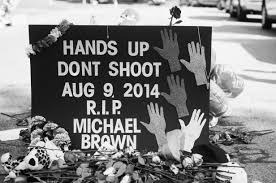
Perhaps because I’ve been able to think of little else lately, I immediately considered what this new feature means for how we will remember the events of Ferguson, Staten Island, and the parade of police violence against young men of color. And relatedly, I considered how we will remember ourselves and each other in regard to these events.

Facebook has always remembered, but now, Facebook actively remembers.

The logical response to police killings of unarmed citizens of color is evidently contestable in this historical moment, but times change, and so do logics.

Those who threw vitriolic accusations at Michael Brown and Eric Garner, posted passionately in defense of the police officers in question, lamented a fallacious emphasis on race, can be called back, individually and en masse, and confronted with their own message. Those who engaged in protest following the shootings, and expressed disgust when the grand juries did not indict, those who insisted that we pay attention to race, power, and how these intersect dangerously in the justice system, will have their messages called back as well.

We have always had to live with our past selves, and the side of history that these selves located us. But memory also used to be more fluid, less confined. With increasingly rigid and document-based forms of remembering, an open question, for me, is if this platform-afforded active remembering will make us more careful and thoughtful in how we perform, or stand stronger in our convictions? Will those who defended the police officers think twice before posting that “Michael Brown is a Thug” meme, or will the knowledge of that posts’ permanence prevent a later evolution of thought?

We come to know the self by seeing what we do, and this knowledge guides our actions. Facebook’s active remembering reminds us, with physical evidence, what we have done.


Follow Jenny Davis on Twitter @Jenny_L_Davis

MB

The mobile phone camera has become an embedded tool of protest. It has given rise to the citizen journalist and is a key mechanism by which surveillance is countered with sousveillance. In a New Media & Society article earlier this year, Kari Andén-Papadopoulos names this phenomena citizen-camera witnessing. This is a ritual through which bodies in space authenticate their presence while proliferating images and truths that contest with the stories told by The State.  The citizen camera-witness is not merely witnessing, but bearing witness, insisting upon articulating, through image, atrocities that seem unspeakable. Indeed, as W.J.T. Mitchell compellingly claims: Today’s wars and political conflicts are to an unparalleled extent being fought on behalf of, against and by means of radically different images of possible futures.

The failure to indict Darren Wilson in the killing of Michael Brown and the protests that continue to follow, set the stage for drastically different futures. The way we tell this story will guide which future is most plausible, most logical, and most likely.  

The key image makers include State representatives, mainstream media, Darren Wilson supporters, and those protesting against the Grand Jury decision. These voices vie for space in the construction of the Michael Brown/Darren Wilson story. The story told by those in the first two categories is largely one of violence and mayhem at the hands of an unruly crowd. The story told by Wilson supporters is similar, but with a clear reverse-racism twinge.  The story of those in the last category is one of systemic oppression, a story in which black bodies—especially black male bodies—are in persistent danger of physical harm, inflicted by those charged with public protection.

I stand with this last category, and am committed to promulgating their version of the story. But in watching this story and in spreading it, I’m struck by the method of its telling. In particular, the citizen-camera witnesses not only point their camera phones at the crowds, at the police, and at the built environment, but also point the camera at themselves. They don’t merely imply their presence through video footage, but explicitly locate themselves—their own bodies—at the heart of the story.

I want to make the case for citizen-camera witnesses to be thoughtful in their use of this videographic tactic. In particular, I call for these witnesses to consider their own bodies, and what it means to have particular kinds of bodies within the imagescape. I argue that the role of protestors with white bodies, those antiracists who stand in solidarity, should be one of quiet support. White voices and faces already overpopulate public discourse. Absolutely turn your camera outward on injustice. Always do this. But think carefully before turning the camera on yourself.

The war for possible futures, fought in images, has far reaching consequences; for some, those consequences are literally life and death.  The stakes are highest for those with bodies of color. These are the bodies in danger. These are the bodies that should be at the center of the story.


Image: Source

Follow Jenny Davis on Twitter @Jenny_L_Davis

 

Via ESA http://www.esa.int/Our_Activities/Space_Science/Rosetta/The_Rosetta_lande


Earlier this month, Science had a big victory. The Rosetta Project landed their spacecraft, Philae, on a comet.  This was a billion Euro and entire careers in the making. This was a huge step in space exploration. The accomplishment is unprecedented and data gleaned from this project are entirely unique. Good job, Science.

Meanwhile down on earth, a #ShirtStorm broke loose. Rosetta Scientist Dr. Matt Taylor gave a television interview about the project. His choice of attire—a naked-lady shirt—was ill conceived. Moreover, he described the project as the “sexiest mission,” feminizing and then validating the probe as “sexy” but not “easy.”

Thank goodness women don’t have a science problem!! Oh, wait…

Quickly, Atlantic writer Rose Eveleth posted this tweet:

shirtgate

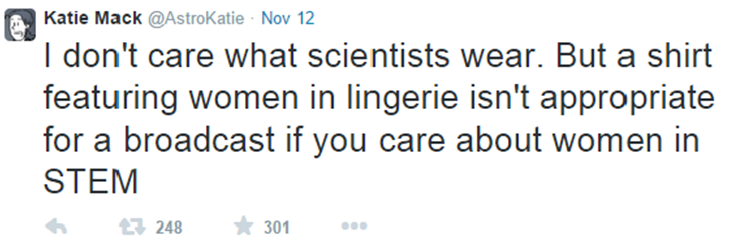
And Astrophysicist Katie Mack said this:

shirtgate1

Bloggers, columnists, and social media micro-pundits shook their heads and called Matt Taylor on the misogynistic implications of his public presentation. Dr. Taylor, in turn, granted a heartfelt apology.

Well, Dr. Taylor, I accept. That thing you did was sexist. You realize that now. You engaged in humility and public repair work. Let’s hug it out and get back to hoping that Philae shifts its position into the path of enough sunlight to regain power.

I am a strong proponent of conversation over accusation, and try to avoid extrapolating the actions of one person to the actions of an entire group. Science didn’t wear a naked-lady shirt, Matt Taylor did, and he apologized. All of the other Rosetta scientists were appropriately (if not stylishly) dressed. But Dudes (and yes, I mean Dudes in the “Bro” sense of the word), you’re making it difficult this time. The vitriolic response AGAINST TAYLOR’S DETRACTORS on both social and mainstream media shines an unflattering fluorescent light upon the cultural depths of misogyny.

Tim Stanley at the Telegraph dubbed November 14th , the day of Taylor’s apology, The Day Political Correctness Went Mad. Glenn Reynolds at USA Today discredited Taylor’s critics as “crazy.” And James Meikle of the Guardian, while not explicitly taking sides, recounts the incident under a title that places “offensive” in quotes. And then there was Twitter:

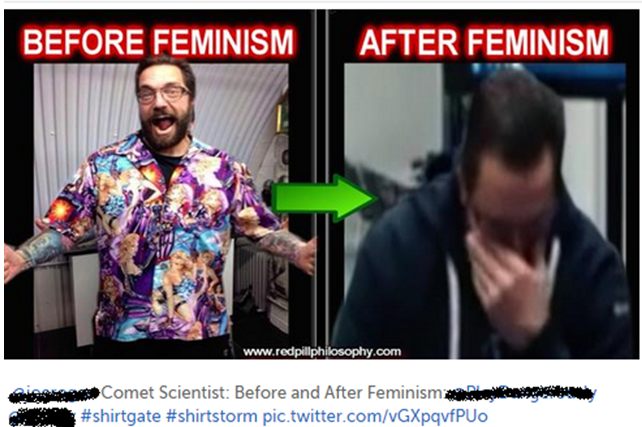
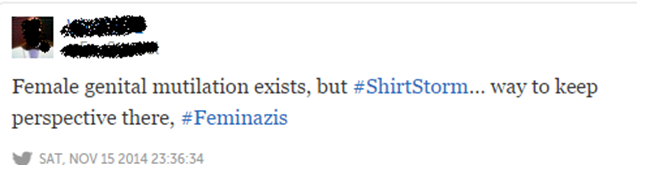
shirtgate3 shirtgate4 shirtgate5

Some quick themes (each represented above): sexism is bidirectional, and men are at least as gender-oppressed as women; there are real problems for women from which #shirtStorm distracts (as though the banality of everyday culture is somehow separate from, rather than constitutive of, the material conditions of violence and inequality); feminists are stupid/whiney/infantile.

My question, as always, is what are you defending? This reaction is so clearly compensatory, stemming from a fear of a changing world, and the implications about how particular kinds of people hold disproportionate power and resources. We feminists would like to get back to the science, if only our opinions didn’t lead to literal threats on our lives.


Follow Jenny Davis on Twitter @Jenny_L_Davis

*Cyborgology maintains a policy of editorial comment moderation. We are purposeful in keeping the conversation productive and intellectually relevant. We don’t approve trolling, personal attacks, or off-topic rants. In the case of this post, however, I am approving all comments. Here, they act as data that illustrate the theoretical argument I pose above*

ProcessProsumption is something of a buzzword here at Cyborgology. It refers to the blurring of production and consumption, such that consumers are entwined in the production process. Identity prosumption is a spin-off of this concept, and refers to the ways prosumptive activities act back upon the prosuming self. Identity prosumption is a neat and simple analytic tool, particularly useful in explaining the relationship between social media users and the content they create and share.

If you’ll stick with me through some geekery, I would like to think through some of the nuances of this humble bit of theory.  

Identity Prosumption

Identity prosumption rests on a key principle of social psychology: people come to know the self by observing what they do, and observing others’ reactions to them.  When a person prosumes content, this content becomes a mirror that reflects back identity meanings. This is particularly useful when making sense of content creation, consumption, and sharing on social media. Users create and share content in a social arena, receive feedback on it (even if that feedback is silence), and utilize the content, now tied to its’ elicited response, to both perform and learn about, the self.

For example, posting a Facebook image of my dogs is not only an outward performance of my affinity for these (incredibly adorable and wuvable) animals, but also a performance for myself. The image becomes a data point with which I come to know myself as a dog lover. This is further reinforced by comments and Likes, through which my network interacts with me as the kind of person who loves (her) dogs.

2013 Thanksgiving - Copy
Look at those sweet faces

Certainly, identity prosumption predates social media. Foucault, for example, has written extensively on self-writing as a form of self-formation, relying on the examples of Greco-Roman Hupomnema and Christian confessions. Other examples include personal correspondence, diaries, and autobiographies. Extending beyond the written form, identity prosumption is well suited to theorize the identity meanings in scrapbooking, photo albums, quilting, and various forms of art.

A digitally connected landscape, however, makes sharing in general, and prosumption in particular, a compulsory and public activity. Identity prosumption is not just a component of the social media experience, it is a central component. And with an increasing prevalence of social media as part of everyday sociality, identity prosumption becomes an integral component in processes of the self. To better understand identity prosumption, I want to try to break it down into integrated but distinct parts.

Prosuming Identity through Process and Artifact

To prosume is an act. That is, the prosumer is doing something. The result of this doing is an object. That is, the prosumer is making something. Both the act itself, and the consequent object, work back toward the prosumer in identity-constructive ways. I refer to these parts of identity prosumption as process and artifact.

Process is the doing. The bodily act of punching out a Tweet, or Tumblr post, or Snap, or Status Update, or Ello comment. It is the focus, anxiety, excitement, banality, or fear of creating the content and going live. The actor sees hirself engage these media, sees hirself articulate a message, sees hirself share—perhaps selectively— with hir network. What s/he sees hirself do informs who s/he defines hirself as.

The artifact is the result of this doing. It is the image, the story, the joke, the meme. It stares back at the actor from the glowing screen, evidence of who s/he is and what that means. Though individually relevant, artifacts prosumed through social media take on an aggregate character. In the case of social network sites, artifacts combine into what Hogan refers to as an Exhibition Space, or a curated collection of objects of the self. Even with ephemeral media (e.g., Snapchat), past prosumed artifacts linger in the networked memory, given nuance by their fleeting stay.

Though distinct, process and artifact are entwined. The process anticipates the artifact. The artifact refers back to the process. Both point to the identity meanings of the prosumer.For instance, if I share a funny story about my students, the content of that story (i.e., the artifact) is a means by which I perform—for myself and others—the role identity of academic, and the person identity of witty, or perhaps, cynical. This artifact points to the moments in which I constructed the narrative, decided to share, and agentically crafted this piece of performative content (i.e., the process).

We become subjects through the objects we prosume.  These objects hold identity meanings in their very act of creation, and in the fruit that these acts of creation bear. In an age of digital connectivity, prosumptive activities become a key mechanism of identity performance and identity creation. I’m looking forward to continued exploration into the nooks and crannies of this line of theory.

Follow Jenny on Twitter: @Jenny_L_Davis

Headline Picture: Source

InternetSlowdown_Day

Net neutrality is back in the news. It’s been a minute, so in case you forgot, some broadband providers want to speed up high traffic services (e.g. Netflix), creating a tiered model of delivery speed. In turn, proponents of net neutrality have lobbied the FCC to classify broadband companies as “common carriers,” requiring that all Internet traffic receive equal treatment (i.e., equal speed of delivery).

In light of overwhelming public support for net neutrality, conflicting with strong lobbies from broadband companies, the FCC is still working towards a solution. Some of this work was leaked last week, revealing a sort of hybrid plan, in which broadband companies could sometimes establish “fast lanes” for service providers, but only when they deem it is “just and reasonable” (whatever “just and reasonable” means).

Whitney Erin Boesel does a fantastic job laying out the policy and delineating a strong argument in support of Open Internet. I want to take a bit of a simpler approach, and address one issue which underlies the debate in its entirety: the relationship between speech and money.

What role does money play in free speech?

Proponents of net neutrality criticize Internet deregulation for its coupling of money and speech. Those with more money get a greater proportion of the attention economy. Those with less money get a lesser proportion of the attention economy. That is, one can purchase louder, broader, and more penetrating speech, at the expense of those with fewer resources.

Opponents of net neutrality, however, appeal to the free market and the moral goal of “winning” within this market. Taking a greater proportion of the attention economy is a result of successful business practices, and therefore not only fair, but morally superior under capitalist logic. That is, share in the market economy earns the right to greater share in the attention economy.

As evidenced by the vast public support for a neutral Internet (see link above), citizens overwhelmingly opine with the former. That is, the American public understands speech and money as diametrically opposed. They believe that policies should prevent share in the market economy from determining share in the attention economy. Voice should not depend on Wallet Size.

And yet, those who oppose regulations have precedent on their side, though from an unexpected source: campaign finance. In 2010 the Supreme Court struck down regulations which limited corporate campaign contributions, and further deregulated campaign finance in 2014. In both cases, they argued that limiting campaign contributions equated to limiting free speech. Here is Chief Justice John Roberts on the 2014 case:

Money in politics may at times seem repugnant to some, but so too does much of what the First Amendment vigorously protects. If the First Amendment protects flag burning, funeral protests, and Nazi parades—despite the profound offense such spectacles cause—it surely protects political campaign speech despite popular opposition.

If money is speech, then the poor have the softest voices. A deregulated Internet extends this logic, and cultural logic is what is at stake. The maintenance of net neutrality would exist in tension with the SCOTUS election campaign decision, maintaining a battleground on which the speech-money relationship remains fraught. Net non-neutrality, in whatever form, would combine with the SCOTUS decision, tipping the cultural scales in a sharply capitalistic direction; A direction in which the economic system drives the political system, and rights are things to be earned, bought, and sold.

Image Source

Follow Jenny Davis on Twitter @Jenny_L_Davis