work

Despite substantial increases in married mothers’ employment and the expressed desire of the majority of women and men to share employment and caregiving responsibilities, gender remains the most influential determinant of who does the housework and child care today. Many observers have attributed the seeming unwillingness of men to increase their time in housework and child care as the linchpin of gender inequality, a manifestation of men’s patriarchal power to prioritize activities that provide economic rewards, such as paid work, or enjoyment, such as leisure (Goode 1992; Jackman 1994).

One strain of feminist and academic scholarship holds that men feel no need to do more child care or housework because they reap the benefits of marriage and fatherhood (e.g. marriage and fatherhood wage premiums, living in a clean, well-run household, and children’s performance of filial duties) without having to spend time producing them — cooking, cleaning, or taking on the everyday, physical care of children. Rather, they can expect wives and mothers to shoulder the burden of feeding and caring for children and families, regardless of women’s other time demands. Such an analysis builds on the work of Jessie Bernard, an influential feminist sociologist, who argued that marriage is a gendered institution that privileges men and disadvantages women.

One key assumption of this argument has been that men do not want to become involved with children except when they can have fun with them. But this argument does not hold up when we analyze both the quantitative time diary data on mothers’ and fathers’ child care time and the qualitative literature on what fathers want. Instead, careful examination reveals a more complex story about the interplay between gender, marriage, parenthood, and class-differentiated patterns of childrearing that are more about ensuring upward mobility among children than about gender oppression. more...


Tiring? Never! Photo by Harsha K R via Flickr CC.

In a dramatic shift in attitudes from just 40 years ago, most modern couples want to share the duties and rewards of work and family equally. However, this is particularly difficult for new parents in the U.S. in light of limited governmental support and persistent traditional gender norms. The U.S. offers inadequate paid parental leave and few options for cutting hours at work, while the cost of quality infant child care is exceptionally high. Thus parenthood is especially challenging for U.S. couples—the majority of whom are dual-earners who strive to achieve a work/family balance.

We studied 182 different-sex couples who were expecting their first child. Most were professionals who were well-positioned to equally share housework, parenting, and paid work responsibilities due to their high levels of education and the fact that both partners were working full-time. During the last trimester of the woman’s pregnancy and at 9-months postpartum, we had these men and women keep time diaries, recording every activity they engaged in during a 24-hour workday and non-workday. We also surveyed them about their own attitudes and perceptions of their division of labor at the beginning of our study and again when their child was nine months old.

more...

It is time to quit viewing motherhood as incompatible with employment.

In 2013, hedge fund billionaire Paul Tudor Jones set off a controversy when he remarked that “you will never see as many great women investors or traders as men.” In his experience, Jones claimed, a woman did fine until she had a child. But “as soon as that baby’s lips touched that girl’s (sic) bosom, forget it….”

By virtually every measure, we are closer to gender equality today than we were fifty years ago—with one very big exception. As Joya Misra notes, the majority of the gender gap in wages is now the result of the lower earnings of mothers. This once led Denise Venable of the National Center for Policy Analysis to claim: “When women behave as men do [by not having children], the wage gap between them is small.” But mothers not only earn less than childless women. They earn less than fathers. When women “behave as men do” and have children, the wage gap between fathers and mothers remains large. more...

How does growing economic inequality affect traditional patterns of gender inequality?

It used to be that the most economically successful women earned no more than the typical man, even when they had more education and held more highly skilled jobs. In 1970, the average woman in the top of the women’s distribution (between the 85th and 95th percentiles) made less than the average man who fell in the middle of the men’s distribution (between the 45th and 55th percentiles). The average female college graduate also earned less than the average male high school graduate.

But gender is no longer so predictive of earnings. Being at the top now outweighs being a woman. In 2010, high earning women made more than 1.5 times as much as the typical man. more...

On average, white women earn 81 percent of what white men make. At first glance it may appear that there is more gender equality among minority men and women than among whites. Hispanic or Latina women make 88 percent of what Latinos do and African American women make 90 percent of what their male counterparts make.

But when we add race to gender, these pay gaps become a veritable chasm. African American women earn 36 percent less than white men and Latinas a mere 45 percent. Interestingly, the gap between the earnings of Asian women and white men is smaller, just 12 percent, but that mounts up over a lifetime, and Asian American women earn just 73 percent of what Asian American men make. more...

via Flickr Commons, credit Talk Radio News Service

President Obama recently announced that all federal employees would have access to six weeks of paid leave to care for a new child. He also emphasized the importance of access to affordable childcare in last week’s State of the Union address. Policy initiatives in these areas are an important first step toward bringing the United States up to speed with other nations. Indeed, the United States remains the only country in the industrialized world that does not legislate any form or length of paid family leave, childcare costs remain high, and, for most workers, career success remains contingent on particularly long and/or inflexible work hours.

Many scholars have argued that this current state of affairs is, in large part, responsible for the stalled progress toward gender equity we’ve seen since the late twentieth century: despite their dramatic rise in employment, women still comprise only a small fraction of elite business and government leaders, and they still do the lion’s share of housework and caregiving. This may not be surprising, given that men and women lack access to supportive work-family policies that could otherwise ease the disjuncture between the demands of modern employment—which are currently premised on a worker who is continuously available and who bears few obligations outside of work—and the often intense demands of raising children. Indeed, many women who “opt out” of full-time careers report doing so not because it was their ideal preference, but because the inflexibility of their workplace or the high costs of childcare left them with few options.

However, identifying the extent to which supportive work-family policies may exert a direct effect on individuals’ preferences and choices about how they organize their work and family life has been challenging. Whereas some individuals may make decisions in response to a constrained set of options, others’ decisions may be based on deeply held, and possibly internalized, beliefs and expectations about gender—beliefs which still tend to prescribe men greater responsibility for earning and women greater responsibility for caregiving. Methodologically, disentangling these two possibilities is difficult.

In a new study (pdf),which will appear in the February issue of American Sociological Review, we use a novel technique to shed light on this puzzle. We conducted a survey experiment with a nationally representative sample of unmarried American men and women between the ages of 18 and 32 who do not have children. Each respondent expressed how he or she would ideally prefer to divide work and domestic responsibilities with a future partner. We also varied two aspects of the survey for some subgroups of respondents. Some participants were told to state how they would ideally organize their future work and family responsibilities, assuming that supportive work-family policies—specifically, paid family leave, subsidized childcare, and flexible workplace practices—were in place. For others, we made no mention of such policies, and also removed an egalitarian relationship as an option from the set of choices listed on the survey.

Our results underscore the notion that the current workplace climate fuels the persistently gendered division of labor in employment and in the family. When respondents were simply asked to state what kind of relationship they preferred, the majority of men and women, regardless of their education level, opted to share earning and household/caregiving responsibilities equally with their partner.

Their study found people's "personal" choices varied depending upon workplace policies. (photo Chris Martin via Flickr Commons)
Their ASR study found people’s “personal choices” varied depending upon workplace policies. (photo Chris Martin via Flickr Commons)

Moreover, if told to assume that supportive work-family policies were in place, women were even more likely to prefer an egalitarian relationship and much less likely to want to be primarily responsible for housework or caregiving. This finding shows that supportive work-family policies directly affect the way that young women would prefer to structure their work and family life.

And finally, when participants were not able to select an egalitarian option—a situation that simulates reality for many families in today’s policy environment—they largely favored more traditionally gendered preferences. For example, when respondents could not select an egalitarian relationship – because we had removed it from the survey response options – men gravitated toward a relationship in which they would be primarily responsible for earning, whereas their spouse would be primarily responsible for housework and caregiving.

These findings suggest that, if we were to change the workplace policy environment, we would likely see changes in how people decide to balance work and family life, with fewer women “opting out” and more men taking on a greater share of caregiving responsibilities. At the same time, our results imply that supportive work-family policies are a key mechanism that can promote gender diversity in work organizations—a message that should be of interest to business leaders who now know that such diversity is critically linked to their bottom line.

To be sure, implementing supportive work-family policies that work are an economic and political challenge, and gender inequalities persist even in countries where supportive policies are widespread. But, our findings suggest that these policies do have the power to foster more gender-egalitarian preferences and attitudes, with broad implications for gender inequality in the workplace and the home. In short, such policies may empower people to live the kind of life they would ideally like to live, an ideal that is now more gender-egalitarian than in previous generations, and that is premised on more women “leaning in” at work and more men “leaning in” at home.

Sarah Thébaud is an assistant professor of Sociology at the University of California, Santa Barbara. David S. Pedulla is an assistant professor of  Sociology at University of Texas at Austin.

National surveys and other studies continuously tell us that work is a major source of stress for Americans. A 2005 Work and Families Institute study found that almost 90 percent of workers felt they either never had enough time in the day to do their job or that their job required them to work very hard. A Pew Report from 2013 found that more than half of all working moms and working dads experience work-family conflict. One-third of working moms and dads feel rushed on work-days, and almost 50 percent of working dads (and 25 percent of working moms) say they don’t have enough time with their children. And in a recently completed research project I helped conduct, we found that people report feeling less stressed out on non-work days than on work-days. Home, most of us believe, is where we recover from the stress of the work day. more...

Here’s a reprint of my column on family medical leave, originally posted at GirlwPen; today’s post includes updates of additional studies further highlight the need for paid leave that extends to all workers.

From Flickr Creative Commons.
From Flickr Creative Commons, by Lenneke Veerbeek. Click image for details.

Over 20 years ago Congress passed the Family and Medical Leave Act, and President Bill Clinton signed it into law two weeks after his inauguration in 1993. Remember the optimism? Under the FMLA a qualified employee can take up to 12 weeks of unpaid leave to care for a sick family member or for pregnancy, newborn, newly adopted, or for care of a new foster child. In a good-news bad-news sense, one of the notable features of the FMLA was that it was gender-neutral: men and women equally had no funding for their job-protected leave for up to 12 weeks per year. Otherwise, this policy for helping families has been the weakest compared to other rich countries. At the time, the FMLA was the “foot in the door” for improving the situation of working families. A hint for how FMLA is doing today was offered by Girlwpen’s Susan Bailey earlier this year.

So…how’s that foot in the door now? Several recent studies offer new tools for analysis. In “Expanding Federal Family and Medical Leave Coverage,” economists Helene Jorgenson and Eileen Appelbaum investigated who benefits from FMLA using the 2012 FMLA Employee Survey conducted by the Department of Labor. About one in five qualified employees has used FMLA leave within the past 18 months, according to a new Center for Economic and Policy Research (CEPR) report. The authors found an extensive amount of unmet need for family and medical leave. UPDATE: In June 2014, Jorgensen and Applebaum published “Documenting the Need for a National Paid Family and Medical Leave Program: Evidence from the 2012 FMLA survey.” They reported that,”One-in-four employees needing leave had their leave needs unmet in the past 12 months. Not being able to afford unpaid leave (49.4 percent) and the risk of loss of job (18.3 percent) were the two most common reasons given for not taking needed leave. Employees with children living at home and female employees had the greatest need for leave, but also had the highest rates of unmet leave.”

Several key limitations of the FMLA mean that, in practice, the law doesn’t apply to a large share of the workforce. The FMLA does not cover workers in firms with fewer than 50 employees. As a result, 44.1 percent of workers in the private sector (49.3 million workers) are excluded from protected leave for caring for their sick or vulnerable relations. The FMLA also excludes employees who have been at their current job for less than a year or have worked fewer than 1250 hours in the past year.

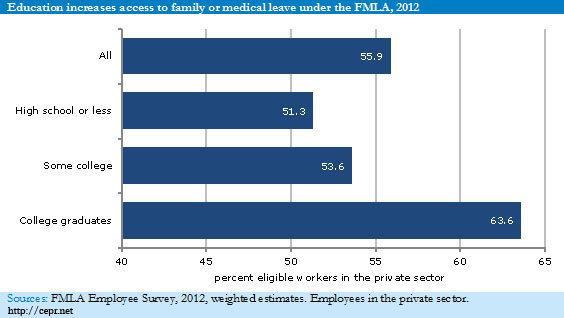
Not everyone with needy kin works in mid-to-large size firms nor has regular employment. So, those limits on access to FMLA do not affect everyone equally. Young workers and Hispanic workers had lower rates of eligibility than other groups. Education level was the strongest predictor of eligibility. People with less than a high school degree were 13.6 percentage points less likely than those with “some college” to have access to unpaid leave for family and medical concerns. Meanwhile, those with a college degree were 10.7 percentage points more likely than those with some college to have access to FMLA leave.

From CEPR’s “Expanding Federal Family and Medical Leave Coverage” (Feb 5, 2014) by Helene Jorgenson and Eileen Appelbaum.


Have there been improvements in the past two decades? Another recent study from CEPR and the Center for American Progress, “Job Protection isn’t Enough: Why America Needs Paid Parental Leave,” by Heather Boushey, Jane Farrell, and John Schmitt, points to no. Analysis of data from the Current Population Survey over the past 20 years revealed two key things: First, women take leave way more than men despite the gender neutrality of the policy. Men have increased from a very low rate, but the ratio in the last five years studied is about nine to one. In addition, over the past two decades there has been essentially no change in women’s rates of leave-taking.

Also, per Boushey and colleagues, guess who is most likely to benefit from leave? Women with college degrees and those in full-time jobs. Commenting on their statistical analysis, the authors state, “Better-educated, full-time, union women are more likely than their otherwise identical counterparts to take parental leave” (p. 12). Not everyone can be in a job that qualifies them for FMLA leave; however once qualified, not everyone has the financial security to use that leave.

These authors—like Jorgenson and Appelbaum—applaud the FMLA and the opportunities it has provided to qualified workers—but their data show that the 1993 Act did not generate a cascade of family-progressive policies for men, women, and families. But one can hope. Jorgenson and Appelbaum demonstrate that a policy that reduced the firm size from 50 to 30 and reduced the hours worked in the past year from 1250 to 750, an additional 8.3 million private sector workers would be eligible for family leave under FMLA. UPDATE: In an April 2014 study, Jorgensen and Applebaum zeroed in on FMLA’s exemptions–such as small firms. They calculated that,”If the FMLA were amended to cover all firms and worksites regardless of size, an estimated 34.1 million private-sector employees would gain access to job-protected family and medical leave, if they otherwise meet the eligibility requirements relating to length of tenure and hours of work.”

There are some pretty great examples of places in the United States where better family leave policies have been put in place and have worked well. California passed a paid family leave act in 2002, and after twelve years, the program has been highly successful. Appelbaum and Ruth Milkman reported in 2011 about the social, family, and economic benefits of the program. Washington State passed similar legislation in 2007 but it has been help up since then. New Jersey did so in 2008, and Rhode Island’s law was implemented in January 2014. Another review of the California paid leave program demonstrates the growth in uptake since its initiation, but reports that uptake continues to be low because while the leave is paid one’s job is not protected.

We just celebrated 50 years of the Civil Rights Act. Last year we celebrated 50 years since the Equal Pay Act. Retrospectives on such landmark legislation includes successes as well as persisting shortfalls. We are at 21 and counting with FMLA. These studies remind us that with FMLA we need to do more to have more success than shortfalls.

The following is a repost in honor of the 51st anniversary of the Equal Pay Act.

The Equal Pay Act is often presumed to be an accomplishment of the feminist movement of the 1960s. In fact, it was spearheaded by female trade unionists, who first introduced the bill in 1945 as an amendment to the 1938 Fair Labor Standards Act. The bill was defeated, largely because of staunch opposition from business interests, but a coalition of labor activists reintroduced it every year until it finally passed in 1963.

The bill originally required “equal wage rates for work of comparable character on jobs the performance of which requires comparable skills,” wording that would have forced employers to pay women in traditionally sex-segregated jobs as much as men with comparable skills in traditionally male occupations. The 1963 act that finally passed was a compromise that instead required equal pay for “equal work.” Given the pervasiveness of job segregation by gender, this weakened requirement for equity ensured that the law had a far more limited impact. more...

Photo by AlisaRyan via Flickr CC.

Everybody loves to talk about stress—including work/family aka work/life balance stress. But it is a tricky topic that can bring casual listeners to the conclusion that something like stress—that is experienced as personally as enhanced heart rates or elevated cortisol levels—must require personal solutions. Sociology points in another direction.

To wit, recently the Council on Contemporary Families shared a briefing report from Penn State sociologist Sarah Damaske about research she and colleagues conducted that showed that working people have higher cortisol levels at home than at work. Though stress is experienced in the body, it is ultimately about context, about policy, not about individual character or family-values sentimentality. more...