
work

Women managing a calendar. “Untitled” by FirmBee licensed by Pixaby

Reprinted from Council on Contemporary Families Brief Report published on May 3, 2023

When we talk about domestic labor, we often talk about the physical activities of doing work around the house and caring for family members. But running a household is more than cooking, cleaning, and transporting kids to practice; it’s also monitoring the pantry to know when groceries are getting low, weighing options about (and deciding on) which vacuum cleaner to buy, and remembering that little league signups are the last week of March and that cleats typically go on sale the week prior to the season.  

Domestic labor therefore is not just the physical activities of doing housework and caregiving, but also anticipating and monitoring family needs, organizing and planning, and making decisions on which courses of action to pursue. These sorts of activities, known as cognitive labor, are often hidden (i.e., a parent might be planning their children’s schedules in their head while doing other tasks) and are never-ending as there are always things to think about and plan.

Most research on housework and childcare focuses on routine physical tasks but does not account for hidden cognitive labor. This is problematic because mothers perform more physical domestic labor than fathers, and this disparity contributes to negative consequences such as to the gender pay gap as well as to greater stress and less leisure time for mothers compared to fathers. Yet, mothers also perform more cognitive labor than fathers, and the constant need to anticipate and monitor family needs may be a significant source of additional stress for mothers. In sum, the lack of attention to cognitive labor may mean that the enduring gender gap in domestic labor—and subsequent inequalities in well-being—may be even larger than often estimated.

Our new study recently published in Society and Mental Health focuses on the division of cognitive labor between mothers and fathers during the pandemic, and the implications of this division for parents’ psychological well-being.  

Using data from the Study on Parents’ Divisions of Labor During COVID-19 (SPDLC) on 1,765 partnered parents, we examined parents’ time in, and division of, cognitive labor in Fall 2020. Popular press articles illustrate how mothers are increasingly overwhelmed and experiencing burnout due to the sheer volume of things they are trying to juggle. Results from our study provide some empirical support for these colloquial ideas. Among parents in the SPDLC, mothers spent over twice as much time per week performing cognitive labor (5 hours) compared to fathers (2 hours). When asked how cognitive labor was divided between themselves and their partners, mothers reported that they did more of this labor. In addition, mothers reported that the division of cognitive labor was more unequal than the division of housework and childcare—suggesting that the gender gap in domestic labor may indeed be even larger than we commonly think it is.

In addition to understanding how cognitive labor was divided among parents, we also wanted to know if there were consequences of performing this hidden labor. The results were striking; being primarily responsible for cognitive labor was associated with psychological consequences for mothers. Specifically, mothers who were more responsible for cognitive labor reported being more stressed and more depressed. The combination of mothers being primarily responsible for all of these hidden tasks and spending more time doing them means that cognitive labor may act as a chronic stressor that increases mothers’ risk of experiencing psychological distress.

But what about fathers? Do fathers who perform cognitive labor also report negative psychological consequences? Based on our study, the simple answer is no. Our findings show that when fathers perform more of the cognitive labor in families, they actually experience lower stress and fewer depressive symptoms. Similarly, mothers’ stress and depressive symptoms were also lower when fathers took on more of the responsibility for cognitive labor. Thus, whereas mothers’ involvement in cognitive labor may reduce their well-being, fathers’ involvement in cognitive labor appears to benefit both their own and their partners’ well-being.

Research on stress shows that the effects of stressors vary by context, and we find that gender conditions the effect of cognitive labor on parents’ psychological well-being. Fathers are not expected to manage the household and constantly monitor family needs. While fathers increasingly desire to be more engaged parents, they do not face strong social pressures to perform domestic tasks. Consequently, fathers may receive praise and positive reinforcement for performing cognitive labor as they are seen as going above and beyond what is expected of them. In contrast, mothers are expected to be primarily responsible for household tasks and may be penalized and judged if they do not meet these expectations. This makes mothers uniquely susceptible to the hidden, enduring burdens of cognitive labor.

Overall, our new findings suggest that gender inequality in housework and childcare extends to hidden domestic tasks, and also that performance of these tasks likely contributes to inequality in well-being between mothers and fathers. As long as gendered norms of care and the parenting double standard persist, gender inequality in domestic labor and well-being will continue. We need to change our cultural expectations about caregiving and provide more structural opportunities for fathers to be more engaged at home (e.g., remote work, paid leave) to reduce the burdens on mothers, reduce mothers’ stress, and promote greater gender equality at home. Increased opportunities for engagement will likely increase fathers’ awareness of family needs and empower them to take ownership in sharing both physical tasks as well as the hidden cognitive labor.

A briefing paper prepared for the Council on Contemporary Families by Richard Petts, Professor, Department of Sociology, Ball State University, and Daniel L. Carlson, Associate Professor, Department of Family and Consumer Studies, University of Utah.

A briefing paper prepared by Koji Chavez, Indiana University, for the Council on Contemporary Families’ Gender Matters Online Symposium (.pdf).

In 2014, leading high technology companies in Silicon Valley began releasing the gender breakdowns of their technical and leadership positions. First Google, then LinkedIn, and then Yahoo, and so on. The numbers revealed what we all expected: Women are vastly underrepresented in many of these organizations’ technical and leadership roles. But focusing on the gender composition of employees or among new hires is just the first step in understanding how gender “works” at work and how to address it. Here I want to highlight a few nuanced ways in which gender plays out in the hiring process.

What do we already know about gender and hiring?

First, we need to appreciate how few women enter the software engineering profession in the first place. In school, stereotypes that women are not as good as men in math and science discourage women from following a technical career path. Women, for instance, underestimate their own technical ability compared to men and have less confidence that they could be successful engineers, both of which lead women away from the software engineering profession. In 2015, only 12.9 percent of engineers were women.

These “supply side” problems, however, do not mean that employers and organizations who hire men and women are off the hook. Research shows that employers and recruiters sort men and women into gendered roles and penalize women, especially mothers, at least in the initial screening stages. Higher socioeconomic status and education do not seem to advantage women seeking entry into elite fields as much as they do men.

Gender also influences hiring in even more subtle ways, as I have learned in my study of software engineering hiring at a midsized high technology firm. At this firm, I find no gender difference in the probability of receiving a job offer once applicants pass the recruiter phone screen. Pretty good, right? But if we look more closely at the process by which men and women get through the initial screening, and the reasons they are hired after they do, we find that gender still skews the hiring process in important ways.

Outsourcing bias.

For one thing, gender bias does not always originate within the bounds of an organization. It may originate in other organizations on which the firm relies. To wit: a common practice is for firms to contract contingency recruitment firms to supplement their applicant pool. This inter-firm reliance can introduce what I call “outsourced bias”: A firm itself may not be gendered biased per se, but by relying on another biased firm, gender bias seeps into the hiring process, often unbeknownst (or at least conveniently unbeknownst) to the firm. When bias originates in another organization on which a firm relies, employers may contribute to gender inequality in hiring without knowing that they are doing it, and without taking responsibility for addressing it.

Even when a firm does attract female candidates and hires them at the same rate as men, another even more subtle bias often creeps in. My research suggests that decision makers tend to hire male engineers more for their perceived technical skills and female engineers more for their perceived “people” skills. In other words, gender stereotypes inform the very reasons men and women are hired for the same position. The main point is this: Gender influences not only who gets hired but what they get hired for – with potential long-term consequences for people’s careers. If men and women are hired for the same job, but men are seen as good at the technical aspects of that job and women good at the social aspects, no wonder we see women getting funneled into more “people” focused positions and men into more technical (typically higher paying) ones once in the organization.

In sociology, we think of gender as a fundamental structure of inequality, meaning that it frames how we think about others and ourselves, how we structure our institutions and lives, and how we interact with one another. Gender permeates the social world. It is no surprise that in a fundamentally social process like hiring we find gender exerting its influence in subtle and surprising ways. So, if we are serious about attacking women’s underrepresentation in tech, it is important for academics and employers alike to understand the nuanced ways that gender influences who gets hire and why.

FOR MORE INFORMATION, PLEASE CONTACT:

Koji Chavez, Assistant Professor of Sociology at Indiana University, kochavez@indiana.edu. Professor Chavez is author with Adia Harvey Wingfield of “Racializing Gendered Interactions” in the Handbook of the Sociology of Gender.


A briefing paper prepared by Alison T. Wynn and Shelley J. Correll, Stanford University, for the Council on Contemporary Families’ Gender Matters Online Symposium (.pdf).

Research consistently shows that unconscious or implicit gender biases systematically hinder women’s advancement in the workplace. Such biases operate outside of conscious awareness, which makes them particularly difficult to detect and combat. Even people who are not explicitly sexist or racist are susceptible to subtle, unconscious biases, such as weighing a man’s opinion as more credible than a woman’s, which can unconsciously affect our judgments and, ultimately, the rewards men and women earn in settings like workplaces.

In recent years, organizations have become interested in reducing these biases by training their employees. For example, in the wake of an incident where employees called the police on two Black customers for actions that were ignored when engaged in by white customers, Starbucks recently closed its 8,000 U.S. stores to provide unconscious bias trainings to its 175,000 employees.

While unconscious bias trainings are an important first step, research finds that organizations must do more if they want to produce sustainable change. Unconscious bias trainings, while helpful, can wear off over time, or can even risk exacerbating bias by painting it as something normal and unavoidable. Specifically, organizations must alter the conditions that are known to enable and exacerbate bias.

The Small Wins Model.

At the Clayman Institute for Gender Research at Stanford University, researchers are collaborating with companies to engage in such change efforts. Using a “small wins model” of organizational change, we first educate employees about unconscious bias and then work with them to develop and assess new processes and tools to get beyond bias.

For example, at one large technology company, we collaborated with managers to improve gender equality. When we began our work, the company had a less-than-stellar reputation for gender equality and no consistent performance management process in place. Through a targeted intervention, we worked with managers to reduce the ambiguity in their performance assessment processes, since ambiguity is known to exacerbate bias. Research has found that when the criteria for evaluation are not clearly defined or spelled out, they leave room for unconscious biases to have a particularly robust impact on people’s judgments. In our intervention, managers developed new clear, measurable criteria to assess employees; ensured that the same criteria were being applied to all employees; and allotted equal amounts of time for discussing each employee during their calibration meetings. Prior to these changes, women were more likely than men to receive criticisms about their personality, and they were more likely to have their performance ratings downgraded in calibration meetings. After the intervention, these differences were no longer significant.

These small wins inspired other changes at the company, including reworking their job ads to be more appealing to women and other groups. Today, half the entry-level engineers hired are women, and the company has since been named one of the top workplaces for women in tech.

FOR MORE INFORMATION, PLEASE CONTACT:

Alison T. Wynn, Stanford University, atp5@stanford.edu. Shelley J. Correll, Stanford University, scorrell@stanford.edu. They are authors of “Combating Gender Bias in Modern Workplaces” in the Handbook of the Sociology of Gender.

This briefing paper, prepared for the Council on Contemporary Families, was originally released on January 16, 2019.

Although many sexist prejudices have weakened over time, gender stereotypes still influence employers’ decisions during the hiring process, and those stereotypes disadvantage both women and men. In a forthcoming article in Social Forces, I show that employers continue to assume that men and women have “naturally” different skills and preferences that make members of each sex better or less suited for different types of jobs. They associate men with physical prowess, leadership, mechanical aptitude, and competitiveness, whereas they associate women with nurturance and “people skills” such as tact, patience, cooperation and communication. Women are assumed to be less capable or interested in the first set of qualities and men are assumed to be less capable or interested in the second set.

We have long known that sexist stereotypes hurt women’s hiring prospects in the labor market, but my research shows that it hurts some women more than others and that it also hurts men. I find that employers tend to discriminate against female and male applicants when either applies for a job typically associated with the other sex. Think of a woman applying to a manufacturing job, or a man applying to an administrative support position. Surprisingly, however, I found no discrimination against women in the early hiring phases when they applied for male-dominated middle-class jobs, at least in the mid-status, entry-level positions that I tested. By contrast, working-class women applying for traditionally male-dominated working-class jobs faced significant discrimination, while men applying for jobs that have traditionally been staffed by women faced discrimination in both working-class and middle-class contexts.

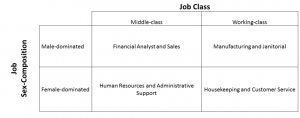
Using a field experiment, I submitted fictitious male and female resumes to openings for more than 3,000 jobs. Specifically, I sent resumes for male-dominated and female-dominated jobs in both middle-class and working-class occupations, as indicated in the chart below. The middle-class jobs were entry-level, required a bachelor’s degree, and paid well above minimum wage but well below high-paying professions. The working-class jobs paid minimum wage or higher and had few educational requirements. In each class of jobs, the average pay rate varied by gender, with jobs that mainly employ men typically paying more than the jobs that mainly employ women.

Each job opening received one male resume and one female resume. The male and female resumes were comparable in education, skill, and work experience. I then recorded the callbacks that the male and female applicants received from real employers for a job interview.

Discrimination against Female Applicants

My findings show that employers discriminated against female applicants for working-class jobs primarily occupied by men. For example, in manufacturing and janitorial positions, male applicants were 44 percent more likely than equally qualified female applicants to receive a callback from employers. Discrimination was particularly pronounced when male-dominated working-class jobs also emphasized masculine attributes in their job ads, such as requiring job seekers to demonstrate physical strength or mechanical aptitude. In these cases, male applicants’ probability of a callback for an interview was double that of female applicants (.10 versus .05).

By contrast, I found no discrimination against female applicants during the early hiring process in middle-class male-dominated jobs, likely because these jobs stress attributes, such as general cognitive ability, that have become less exclusively associated with men. As late as the 1960s, most Americans did not view women and men as equally capable of rationality and critical-thinking. This seems to be one area in which sexist prejudices have been greatly reduced, to the benefit of women seeking entry into jobs that require educational credentials. In contrast, masculine cultures in working-class employment continue to stress attributes that are stereotypically linked to men, such as mechanical aptitude or physical strength. This is true even when few real differences exist in requirements. For example, female applicants faced hiring discrimination in janitorial work even though a female-dominated working-class job such as a house cleaner often requires similar strength and stamina.

Despite the fact that women of all education levels have incentives to enter male-dominated jobs because they pay significantly more than comparable female-dominated jobs, only women with bachelor degrees or higher have done so in significant numbers. The fact that working-class employers exclude women from initial job-candidate pools might help explain why many working-class jobs remain as segregated today as they were in the 1950s.

Discrimination Against Male Applicants

Male applicants also faced discrimination during the hiring process due to sexist gender stereotypes surrounding men’s fit with female-oriented work, and in this case, discrimination occurred in both working-class and middle-class occupations during early hiring processes. I found that regardless of the occupational class or educational requirements of a job, employers were significantly less likely to extend an interview invitation to a male applicant compared to a female applicant for a job in a female-dominated occupation. Female applicants were 52 percent and 21 percent more likely than male applicants to receive a callback in middle-class and working-class contexts, respectively. So, in contrast to my findings about women, discrimination against men entering female-dominant occupations was highest in middle-class jobs.

Male applicants were particularly disadvantaged when a job was both female-dominated and the job ad emphasized feminine attributes. For example, when a middle-class female-dominated job emphasized supposedly feminine attributes, such as friendliness and good communication skills, in the job ads, a female applicant was almost twice as likely as the male applicant to receive a callback (.10 versus .06).

One possible reason for this discrimination is that “women’s work” is generally considered beneath men, suggesting that there might be something “wrong” with a man who wants to do it, or raising suspicion that the man would leave as soon as he got a better, more “masculine” job. Indeed, research shows that men in female-dominated jobs have a higher turnover rate, tending to leave soon after their entry.

Alternatively, employers may assume (or fear that customers will assume) that the stereotypes associated with masculinity will make a man less competent at the work and that he will be less patient, less tactful, less nurturing, and so forth.

Sexism thus limits men’s career choices as well as women’s. Although restricting men’s entry into female-dominated jobs, which are typically lowerpaying, is less costly than barring women from typically higher-paying male-dominated jobs, such discrimination could be increasingly problematic for men, since industries dominated by women, such as service and healthcare, are projected to add the most jobs in the future.

Still, it does not follow that men are now more disadvantaged by sexism than women. For one thing, once men do gain entry to female-dominated jobs, they continue to earn higher wages than similarly qualified women, and in some cases are actually promoted more quickly. So while men may struggle to get an interview, these disadvantages often quickly dissipate (particularly for White men) if they land a job in a female-dominated field.

Second, it is important to note that although women have had success entering middle-level jobs that were traditionally occupied by men, they have had limited success entering or being promoted equally in elite male-dominated jobs. Coupled with my findings about discrimination against women entering male-dominated working-class jobs, this suggests that women are still discriminated against in work thought to require any of the physical OR mental prowess, leadership, and status traditionally associated with men.

Conclusion

In conclusion, gender stereotypes and biases during the hiring process limit both men’s and women’s career options. For women applying to male-dominated jobs, hiring inequality seems to be most pronounced at both the bottom of the occupational hierarchy and at the very top, where rewards are exceptionally high. For men applying to female-dominated jobs, hiring inequality exists across the occupational structure. Although this discrimination is less costly than the kind experienced by women, it may hamper working-class men in particular from adjusting to the changing occupational structure of America, as blue-collar jobs continue to shrink. And until we stop prejudging people’s interests and capacities on the basis of sexist stereotypes, we will continue to steer men and women into different and unequal jobs, denying them the opportunity to develop a well-rounded combination of human, as opposed to gender-specific, capacities.

By Jill Yavorsky, Assistant Professor of Sociology and Organizational Science, University of North Carolina at Charlotte, jyavorsk@uncc.edu. CCF advisory available here.


Reposted from Psychology Today

Tammy Duckworth is the first senator to give birth while in office. And she did so with great fanfare and a demand that her breastfeeding infant be able to accompany her to the Senate floor. The mayor of DC adopted a baby, and almost immediately began juggling motherhood and politics, with barely any time away from the public eye. Millennial mothers are running for office and  advertising their breastfeeding babies in campaign photos. Women are demanding that their status as mothers, with babies, be accommodated. It’s about time.

And yet, why now?  Professional women have been in careers for over 50 years. What is new now?  A sociological concept of “the economy of gratitude” helps explain these newly vocal demands by today’s mothers. The demands of employed mothers have definitely changed since the 20th Century. Women like me, middle class white baby boomers who fought to join the ranks of the professionally employed, were happy that we had broken into the boys club. We were grateful to be there. As Gloria Steinem so aptly explained, we wanted to be the men we were supposed to marry. We wanted was to influence the world, to make our own way, to be independent. In my generation, we wanted to be someone in our own right, not somebody’s wife, but to be that somebody. To do that, we put up with sexual harassment, lower wages, and the mommy wars. We were breaking new ground for married middle class women, who had been raised to be wives. My parents wanted me to train to be a nurse or a teacher just, as they would say, “in case your husband ever leaves you.” With that kind of parental ambition, I was grateful to have fought to carve out a life that included my work and my family. I felt lucky to have escaped the domestic life my mother and her friends lived.

Today’s young mothers, Millennial women, are not grateful for being allowed to be in their jobs, to be somebody. They take that for granted, thanks to their grandmothers and mothers who fought those battles. In my new book, Where the Millennials Will Take Us: A New Generation Wrestles with the Gender Structure (Oxford, 2018), I interviewed 116 Millennials and nearly all of them, including very conservative “true believers” in gender differences, expected women to spend their adult lives in the labor force, whether or not they were mothers. There is simply no endorsement for the idea that in heterosexual marriage husbands are breadwinners and women wives. And the quantitative data agree. There is almost no one left that doesn’t believe women should have equal rights in the public world of politics and work.

So today’s young mother doesn’t feel any gratitude, as we did, for being allowed into the workplace. And the daughters of working class women and women of color have always had role models who were both mothers and workers. So nearly all American women today take it for granted that paid work is the responsibility of women and men, mothers and fathers. Women just presume they have a right to be at work. Thank goodness for that! Today’s new mother has usually been in the workplace for several years, and is used to competing with men as equals, knowing, of course, that she’s more than equal since women are held to higher standards and presumed incompetent until we prove otherwise. Motherhood now comes with a shock to many successful women. For the first time, perhaps in their post-feminist era lives, the rules are so clearly, so obviously, stacked against them.

We have no male/female job listings but we still have schools that dismiss small children at 3:00 pm, and workplaces that presume workers are available full-time during the day and 24/7 online, with just a few weeks off per year. Such school hours clearly presume children have one parent (read mother) at home. And workplaces that reward workers who have no competing care-taking  demands are affirmative action programs for (usually) white men with wives. The next step in feminism is to create a world where men, as well as women, have moral and practical responsibilities for caring for other people. Perhaps then our society will begin to root out the patriarchy upon which it has been built, and workplaces will begin to realize that all workers also have someone to take care of, if only themselves.

But for now, let’s hear this generation of Millennial women roar. Let’s applaud as they demand our workplaces accommodate women’s role in reproduction, so that infants can breastfeed while their mothers rule the world. But this too is only one more step forward. Let’s hope in the near future their husbands — maybe that’s daydreaming, perhaps instead it will be their sons — will lead the charge for paid parental leave for all Americans, to allow fathers and mothers more time at home with infants, so no one has to bring their baby to the office. Such radical change may just take generations but no one ever promised that the feminist revolution would be easy.

Barbara J. Risman is a Distinguished Professor of Sociology in the College of Liberal Arts & Sciences at the University of Illinois at Chicago.  She is also a Senior Scholar at the Council of Contemporary Families.

Picture by CC0 Creative Commons

Originally published in the Harvard Business Review

Few people today call a doctor when they feel a bout of nostalgia coming on. But for 200 years, nostalgia was considered a dangerous disease that could trigger delusions, despair, and even death. A 17th-century Swiss physician coined the word to describe the debilitating algos (pain) felt by people who had left their nostos (native home). In the U.S. during the Civil War, Union Army doctors reported 5,000 serious cases of nostalgia, leading to 74 deaths. In Europe, physicians anxiously debated how to treat home-sickness and contain its spread.

Alarm waned toward the end of the 19th century, as experts came to believe that “modern industry” and “rapid communications” were making people more open to change and hence more resistant to the disease. And by the 20th century, researchers had begun to recognize a milder form of nostalgia that is actually quite healthy: a longing to reproduce a feeling once experienced with friends or family, rather than to literally return to another place or time. This kind of nostalgia makes people feel warmer themselves and act more warmly toward others, including strangers.

In recent decades, however, we have seen a revival of the more pernicious form of nostalgia, what we might call past-sickness. This is the longing to reproduce an idealized piece of history. When people are collectively nostalgic about their past experiences as members of a group or as inhabitants of an era, rather than individually nostalgic for their personal experiences, they start to identify more intensely with their own group and to judge members of other groups more negatively. They become less optimistic about their ability to forge new connections — and more hostile to people perceived as outsiders. When such nostalgia gets politicized, it can lead to delusions about a mythical, magical Golden Age of the homeland, supposedly ruined by interlopers.

Collective nostalgia invariably involves a denial of the racial, ethnic, and family diversity of the past, as well as its social injustices, creating romanticized myths that are easily refuted by anyone willing to confront historical realities. But the cure to the pathologies of past-sickness does not lie in the equally romanticized vision of modernization and innovation we have been offered for the last 40 years — something that might be called future nostalgia, or modernization-sickness.

For much of the 20th century, it was possible to argue that the inequities of life stemmed from the incomplete expansion of technology, industry, and the market, and would be resolved by further modernization. But for several decades it’s been clear that the gains of modernization for some have produced substantial losses for others. While the innovations of the past 40 years have opened more opportunities for professionals and affluent entrepreneurs than they have closed off, that’s not the case for many working-class, small-town, and rural men and women. The failure of policy makers and opinion leaders to acknowledge their losses has left the pain of the “losers” to curdle into a toxic mix of nationalism, racism, and conspiracy theories across Europe and the U.S.

Despite institutionalized discrimination, working-class Americans of all races made significant economic progress in the 35 years following World War II. While it’s true that white male workers were given preference over minorities and women in hiring and pay, most of the gains made by white working-class men in that era came not from their advantages over minorities but from their greater bargaining power vis-à-vis employers. The greater prevalence and power of unions was a huge factor, and although minority and female workers were only gradually admitted to those, strong unions tend to pull up wages in other sectors of the economy and act as a counterweight to business influence over government policy.

In that environment, labor took home a much larger share of economic growth than it does today. From 1947 to the start of the 1970s, every successive cohort of young men earned, on average, three times as much in constant dollars as their fathers had at the same age. And in every single economic expansion in those same years, 70% to 80% of the income growth went to the bottom 90% of the population. Economic disparities between big urban centers, small towns, and rural areas steadily narrowed.

Since the late 1970s, a very different set of trends has prevailed. Between 1980 and 2007, even before the Great Recession hit, the median real earnings of men age 25 to 34 with a high school diploma declined by 28%. Since 1980 every cohort of young men has earned less, on average, than their fathers did at the same age. Meanwhile, in periods of economic expansion the top 10% of earners have taken 95% or more of income growth. Similar increases in inequality have occurred in Europe and elsewhere. A new Oxfam study reports that the richest 1% of the world cornered 82% of the wealth created in 2017.

The reaction of the “creative classes” to these trends has been cavalier to say the least. Despite the clear signs of working-class distress in the 1980s and early 1990s, most pundits insisted that the real story of the era was “the explosion” of new and ever-cheaper consumer conveniences produced by technological advances and globalization. Economist Robert Samuelson dismissed worries about job losses and wage cuts as “alarmist hype” that had American families “feeling bad about doing well.” Conservative columnist George Will speculated that modern affluence had produced so much “leisure, abundance, and security” that our brains, which evolved to deal with constant hazards, had gotten “bored.” Even the socially conscious Microsoft founder Bill Gates was complacent: “Entire professions and industries will fade. But new ones will flourish….The net result is that more gets done, raising the standard of living in the long run.”

During the Great Recession, pundits briefly discovered that “average” increases in income often mask serious inequalities, but that went out the window as soon as the economy started growing again. Last fall the chief global strategist at Morgan Stanley brushed aside worries about job losses due to automation, arguing that “when new technology destroys, it leaves behind a layer of ash in which new jobs grow.” This January, after yet another year of global job gains without wage gains, a writer in Bloomberg News breezily announced that “brisk growth that’s not shared by all is better than no growth at all.” Besides, “there’s basically no country in the world where the consumer is not doing well,” added Bart van Ark, chief economist at The Conference Board.

As for the people who actually provide those affordable consumer goods and services? In the U.S., the “recovery” exacerbated the 40-year rise in economic inequality and insecurity. A survey of the job and business gains in the U.S. between 2011 and 2015 found that most were confined to the wealthiest 20% of zip codes in the country. The bottom 60% of zip codes together got just one in four of the new jobs created in those years. And the 20% of zip codes that were most distressed before the recession continued to lose jobs and businesses throughout the “recovery.” In 2007 the bottom 90% of the population held 28.6% of America’s total wealth. As of 2016, that had fallen to 22.8%.

 Despite futurist predictions that the information revolution would lead to the “death of distance,” a few coastal enclaves and political or technical centers have continued to garner a disproportionate share of resources, reversing the 40 years of economic convergence among regions that occurred after 1940. The average per capita income advantage of Washington, DC and New York City over the rest of the country doubled between 1980 and 2013. Average airfares per mile to “loser” regions are now often nearly twice as high as to the “winners,” while many towns have lost rail service altogether.

Like nostalgia epidemics of the past, our recent outbreak was triggered by an understandable sense of loss and disorientation. But there’s an interesting difference between past and present in the groups most vulnerable to the disease. From the 17th to the 19th century, pathological nostalgia was seen most often among people who moved away from the communities in which they had been raised — often bettering themselves materially but feeling lost and isolated in their new surroundings. Today the upwardly and geographically mobile have easy access to new technologies, professional networks, and flexible work and consumption techniques that allow them to navigate unfamiliar territory and make themselves at home wherever they go.

Those same innovations, however, have marginalized individuals whose identity, security, and livelihood depend on their familiarity with a particular place and set of skills, and their placement within long-standing personal networks that involve relations of mutual dependence and reciprocity. These include industrial workers who get jobs at a local factory because a relative puts in a good word with the foreman; farmers, feed suppliers, and farm equipment mechanics who rely on clients or employees who are also neighbors; and local businesses that depend on personal connections with their customers.

Today the most debilitating nostalgia is found among those who cannot or do not want to move — and should not have to — but see the traditional sources of security that their native land, or nostos, once provided being dismantled or relocated, while their habits, skills, and social relationships are devalued. Instead of leaving their homes behind, they feel left behind in their homes.

As always, working-class African Americans, Latinos, and Native Americans suffer disproportionately from job losses, wage cuts, and increased volatility. Zip codes where most residents are racial or ethnic minorities are twice as likely as predominantly white zip codes to be in economic distress. Still, whites account for a significant portion — 44% — of the more than 52 million Americans in the most distressed communities. This shared exclusion from the rewards of modernization ought to be a source of solidarity, not division, but division is what happens when one group romanticizes where we’ve come from and another romanticizes where we’re going, instead of carefully examining the gains, losses, and hard trade-offs of the here-and-now.

To cure this outbreak of past-sickness, the winners in this system must stop pretending that the answer is more of the same, with a little more diversity at the top. To make modernization work for all, we must take a more critical look at how we measure economic and technological progress. Self-driving cars and delivery drones may save some people time and money, but they take away other people’s livelihoods. To stem the contagion of pathological nostalgia, we need to inoculate ourselves with a dose of the healthy nostalgia that spurs us to integrate the best values and ideas of the past into the improvements and advances we promote.

One of those values is the traditional democratic belief that the people who grow our food, make our coffee, fix our cars, educate our children, nurse our sick, and pick up our garbage are at least as essential to a healthy society as the people who invent new algorithms for stock trading, social media, and marketing. They deserve to live in thriving communities, send their kids to good schools, earn a living wage, and get home in time to enjoy dinner with whomever they count as family.

Stephanie Coontz is the CCF Director of Research and Education and a Professor of History at The Evergreen State College.

picture by louda2455 via pixabay

Assortative mating – the tendency of people to marry those similar to themselves – has become a popular explanation for increased economic inequality across American families (see the NYT, the Economist, or the NYT Upshot).

The idea is that if people are increasingly matching with partners who have similar economic prospects, families will be increasingly divided between those who pool two large paychecks and those who pool two small paychecks. More assortative mating increases spouses’ economic similarity, which in turn increases inequality.

Our research, however, shows that assortative mating has played a minor role in the increase of spouses’ economic similarity and its impact on inequality. More important than changes in whom people marry are changes in what happens after they marry. In particular, the well-known and dramatic increase in wives’ employment within marriage are responsible for the bulk of the effects of increased spousal economic resemblance on inequality.

That is, the rise of spouses’ economic similarity increased inequality not because there are more “power couples” who match with one another, but because both wives and husbands today are more likely to realize their economic potential during marriage, whereas in the past only one (usually the man) would do so.

Explaining increased spousal economic resemblance

The appeal of assortative mating as an explanation for spousal economic resemblance and inequality is based on well-known social and economic shifts. Declines in gender inequality in education and the workplace mean that women’s socioeconomic standing is increasingly similar to men’s. For instance, it is easier for a man with a PhD to match with a female PhD today than in 1970. These compositional shifts alone may drive increases in assortative mating.

In addition, men’s and women’s preferences for partners have shifted towards valuing similarities rather than differences, rising income gaps between college and non-college workers imply that individuals can lose more by “marrying down”, and growing residential segregation by income restricts opportunities to meet partners outside ones’ own income bracket.

This focus on assortative mating, however, has tended to overlook what happens after couples match, that is, how families organize their economic life: who is bringing money in, how much, who is dropping out of the labor force, and for how long? Overlooking these questions is surprising given the magnitude of changes in the economic organization of families.

The rise of wives’ and mothers’ employment since the 1960s shifted the modal division of paid labor from breadwinner/homemaker to dual-earner. As women are participating in the labor force for more time than in the past, their earnings are closer to men’s for more of their married lives. These shifts have the potential to increase the economic similarity of spouses, even without any increase in assortative mating.

The importance of these changes suggests that the rise of spouses’ economic resemblance could largely be a function of what happens after marriage, not the sorting process that happens before marriage.

And this is exactly what our study finds.

Contrary to what has often been assumed, we show that the contribution of assortative mating to the inequality-generating effects of spouses’ economic similarity is very small. This is because there is no evidence that economic assortative mating has substantially increased in the last four decades; newlyweds are not more economically similar today than they were in the 1970s.

Instead, couples have become more economically similar during marriage, due to the increase in wives’ labor force participation. This shift in couples’ division of paid labor is the driving force behind the rise of spouses’ economic similarity and its impact on inequality.

Implications

We underscore two implications of this finding. One is that more attention should be paid to the effects of the economic organization of families on inequality. There is a lot more to be unpacked about how and why shifts in the division of paid labor during marriage can increase inequality. For instance, is it about “power couples” being more able to sustain the dual-earner model during parenthood? Is it because those with more education tend to have fewer children than those with less education?

Another implication is that it is necessary to follow couples through their married lives to distinguish what family-level processes contribute to inequality. Researchers often measure assortative mating using averages across all couples in the population, thereby lumping together variation that exists at the time of marriage and variation that evolves during marriage. This might not be problematic for measures that do not change much over individuals’ lives, like education or race, but it is clearly misleading for measures that vary systematically over time, such as labor supply or earnings.

In sum, the division of paid labor within families is key to understanding the future of inequality across American families. Assortative mating on earnings has been the focus of prior work, but has played only a small role shaping the economic resemblance of spouses and its contribution to inequality.

Pilar Gonalons-Pons is an Assistant Professor in the Department of Sociology at the University of Pennsylvania. Christine Schwartz is a Professor in the Department of Sociology at the University of Wisconsin-Madison.

This article summarizes findings fromTrends in Economic Homogamy: Changes in Assortative Mating or the Division of Labor in Marriage?in Demography. For a free, pre-publication version of the article, click here. This post was published on 10/17/17 at Work in Progress.

Photo by Wokandapix via pixabay

On August 26, 2017, Women’s Equality Day Turned 44.

 A fact sheet compiled for the Council on Contemporary Families by Nika Fate-Dixon and Stephanie Coontz, The Evergreen State College. Executive summary/advisory available.

Ninety-seven years ago on Saturday, August 26, Congress certified the 19th Amendment to the Constitution, granting American women the vote. Since 1973, August 26th has been designated as Women’s Equality Day, offering a chance to assess the current status of gender equity. The past three decades have seen continued gains in women’s educational and occupational achievements and a striking increase in egalitarian arrangements on the home front. But progress has not been the same for women of color as for white women; it has stalled for parents; and there have been serious setbacks in the political realm. Additionally, class differences among women have widened. The latest research on trends in education, work, family, and political directions raises new questions about where we are headed.

EDUCATION AND WORK: Gains in Education, Occupations, and Pay. Substantial Inequalities Connected to Race, Class, and also to Sexist Work Cultures

 Overall, the wage gap has improved significantly. In 2015, according to a Pew analysis of median hourly earnings of both full-and part-time U.S. workers, women earned 83 percent of what men earned. This 17-cent gap is half what it was in 1980 (36 cents then).

But how do we interpret these numbers? Comparisons of yearly salaries can understate roll backs in gender discrimination when they don’t take into account differences in the number of hours men and women work. Comparing hourly pay also has its limits but suggests more steady progress, particularly for young women (ages 25 – 34). In 1980, their hourly wages were just 67 percent of their male peers’. Thirty-five years later, they have reached 90 percent.

The raw ratios in some ways overstate progress. An analysis of the Current Population Survey newly conducted for this report by University of Maryland sociologist Philip Cohen, suggests that women have made gains largely by increasing their education level relative to men. Among people age 25 to 54 who worked at least half time and half the year, 44 percent of women in 2016 have a BA or higher education, compared with 37 percent of men – an advantage for women that has opened up since 2001. His analysis of the wage gap among those same workers shows that for those with a BA or more, women earn 80 percent of men’s wages, when statistically controlling for age, race/ethnicity, marital status, and the presence of children. That is unchanged since 1992. For those with less than a BA degree, women have made slight progress during that time, from 77 percent to 79 percent. Despite important exceptions, then, the overall narrowing of the wage gap since the early 1990s is partly a function of women’s increasing education levels rather than greater equality among workers with comparable levels of education. (For details of the analysis see this.)

Additionally, despite men’s continued pay advantage, their wages have been declining since 1979 and this decline accounts for almost a quarter of the reduction in the gender wage gap. According to 2016 data of median hourly wages, women today earn almost a third more than women did in 1979, while men today earn 4 percent less. For men with a high school degree, real wages have fallen by more than 14 percent since 1979. Women’s earnings started from such a much lower base that they remain below those of men doing the same or comparable jobs and with the same levels of educational achievement. But high-earning women (discussed below) have greatly increased the gap between themselves and low earners of both sexes.

Persistence of racial inequalities means the gender wage gap is not same for all groups. The earnings of women across all races and ethnicities lag behind those of white men as well as those of men in their own racial or ethnic group, but white and Asian women have narrowed the wage gap with white men to a much greater degree than have black and Hispanic women. Between 1980 and 2015, the gap in median hourly earnings between white men and white women narrowed by 22 cents. In comparison, the gap between black women and white men declined by only 9 cents: Black women earned 65 cents for every dollar white men earned in 2015. Hispanic women fared worse, narrowing the gap by just 5 cents during that time. As of 2015, the average Hispanic woman earned 58 cents for every dollar the average white man took home. Asian women, by contrast, made 87 cents for every dollar earned by a white man.

These patterns of racial inequality differ by gender. The wage gap between white men and black and Hispanic men, unlike that between men and women of all races combined, has not narrowed since 1980. As of 2015, black men earned the same 73 percent share of white men’s hourly earnings as they did in 1980, and Hispanic men earned slightly less — 69 percent of white men’s earnings in 2015, compared to 71 percent in 1980. On the other hand, Asian men now earn more per hour than white men, although this is largely driven by differences in the percentage of highly-educated individuals in each group.

Class and income inequality complicates the picture. Despite the huge gains high-earning women have made in comparison to people at the middle and bottom, the largest gender pay gap is between the highest earning men and women (see page 3 and Table 1 in linked document). In the early 80s, women in high-paid jobs lagged behind men less than women in middle-wage occupations. Since 2010, however, women’s pay relative to men’s among top earners has been considerably less than that of women in the middle (and bottom) of the distribution (also on page 3). These developments reflect the growing advantage among the top ten, one, and 0.1 percent of earners, most of whom are men. So even as the earnings of women in the top 20 percent have not, overall, kept up with those of men in the same earnings category, their position relative to middle-earning men has greatly improved. It used to be that the highest-earning woman earned no more than the average-earning man. Today, however, women at the top make more than 1.5 times as much as the typical man.

Gender gap among high-earners is about sexism more than choice. The gender wage gap between high-earning men and women is often blamed on the fact that women tend to major in subjects that lead to less lucrative jobs, such as those in teaching and social work. But women actually outnumber men in the biosciences and there is little to no gender difference in the social sciences and mathematics. The only STEM fields of study in which men hugely outnumber women are computer science and engineering, which are more than 80 percent male.

We cannot attribute the low representation of women in technology and engineering to women’s preferences in majors. For one thing, recent studies find that teachers start favoring boys over girls as early as first grade. These and other subtle discriminatory messages lead to early declines in girls’ confidence in their intellectual abilities.

Even more important is the pervasive culture of sexism and an exceptionally lopsided rewards system in many male-dominated occupations; women under 25 in the tech industry earn, on average, 29 percent less than their male counterparts, and women of all ages receive lower salary offers than men for the same job at the same company more than 60 percent of the time. Such factors discourage women from persisting. While women obtain nearly 20 percent of engineering degrees, only 11 percent of practicing engineers are women. Women tech workers are twice as likely as men to quit their jobs.

Low wages follow women around. For all the attention to the glass ceiling in high-earning fields such as finance, law, and technology, the fact is that the typical woman is three times as likely as the average man to work in occupations with poverty-level wages. Women constitute 57 percent of workers paid under $15 per hour and are the majority of low-wage workers in every state.

Considerable research shows that this is not just because women are channeled into low-paying jobs. One study compared the relative pay of different jobs between 1950s and 2000, using national data on hundreds of occupations. The researchers found that when the percentage of female workers in the occupation increased, the same job paid less, suggesting that employers were assessing the job’s value not by its actual demands but by the gender of those doing it.

MARRIAGE, HOUSEWORK, SEX, AND PARENTHOOD: It got better, but inequities persist for moms

For the past 15 years, there has been much hand-wringing about the tensions in dual-earner heterosexual marriages, especially now that one in five wives comes to marriage with higher educational degrees or earnings than their husbands. Pundits have warned women that if they make too many gains in the public world or expect too much of their partners at home, they will not be able to sustain satisfying romantic relationships. For years, many researchers believed that women in dual-earner marriages worked a “second shift” when they came home, and that men who earned less than their wives compensated by doing even less around the house.

Today, however, childless couples divide household labor pretty much equally. In fact, rather than women in such couples coming home to a second shift, men average a slightly longer work week when we count both paid and unpaid hours. Marriage has ceased to have any effect in propelling men into more traditional roles. Marriages in which the wife has more education than her husband are no longer more likely to end in divorce. And, recently the added risk of divorce when women earn more than their husbands has also evaporated. Additionally, new research shows  that such women do not, as previously observed, do extra housework to compensate for any “threat” to their husbands, nor do their husbands do less housework or childcare as a reaction to gender status threat.

The gender workload gets more uneven after the birth of a child, despite the fact that fathers have nearly tripled the time they spend with their children, from 2.5 hours in 1965 to 7.3 hours per week today. This includes doubling the developmental care they do (think reading or playing games) and tripling the daily routine physical care that most dads used to leave almost entirely to mothers. Men also spend five more hours per week on household chores than their 1965 counterparts.  Furthermore, today’s dads are just as likely as moms to say that parenting is extremely important to their identity.

In sum, dads are pitching in more than ever, yet on average mothers still do more housework and childcare than fathers. Even couples who shared paid work and domestic work equally before having children, and thought they were sharing it equally afterwards, turn out to backslide into more traditional roles. One study of such couples found that they were fully egalitarian before parenthood, and believed they were working the same total hours of work after the birth of a child—but they weren’t. Time diaries revealed that the women had added 22 hours of childcare to their work week while maintaining the same amount of housework and paid work as before. Men had added 14 hours of childcare, eight hours less than their partners, while reducing their housework by five hours.

Ironically, however, the minority of coupled parents who do equally share childcare and housework report higher levels of sexual and marital satisfaction than couples who divide the work less equally. Overall, American couples in the early 2010s report having sex, on average, nine fewer times per year  than couples did in the 1990s. But parents who share housework are, on average, having sex more frequently than a quarter of a century ago.

Similar advantages accrue to sharing paid work more equally. Research confirms that the busiest husbands and wives, those who spend more time on housework and paid work, have the most sex. However, the lack of family-friendly work policies and affordable quality childcare in the United States leads many couples, who might otherwise prefer to share breadwinning and childrearing more equally, to fall back into more traditional arrangements.

We are getting mixed messages about how the next generation of parents will handle the tension between the widespread expectation of shared work and family duties and the restricted availability of family-friendly support systems. Some polls suggest a revival of support for traditional family and power relations among high school seniors, although others show strong support among young adults for gender equity. A poll of 14- to 24-year-olds commissioned by MTV found that 92 percent of men and 94 percent of women believed that men and women should not be treated differently because of their gender. On the other hand, women put a higher priority on sharing household responsibilities than did men, and a full 30 percent of men, compared to less than 20 percent of women, said there was little use in pursuing more gender equality because inequalities between men and women will always exist.

POLITICS AND POLICY: Setbacks in Reproductive Rights, Supports for Families with Children, Resources for Single Mothers – While Anti-Female Sentiments Get Louder and More Outrageous

A dramatic setback for women’s rights in recent years has been the steady erosion of reproductive choice. One poll taken this month found that two-thirds of voting age adults support women having access to reproductive health care in their community. Yet the Trump Administration plans to halt funding for a successful national teen pregnancy prevention program, with the 2018 budget including funds solely for abstinence-only sex education.

The August poll also found that six in ten (61 percent) adults would support a federal law, like the Women’s Health Protection Act, that would safeguard abortion care and prevent restrictions that make abortion access increasingly out of reach. Yet over the last six years, states have passed 369 laws mandating such restrictions (see page 1 of linked document).

Although the Trump administration has proposed a six-week paid parental leave program, which would help many families, the deepest cuts projected in the Trump Administration’s 2018 Federal Budget Request target programs that are especially essential to families and to women. Many of these cuts threaten the well-being of men, women, and children alike. They will be especially devastating to single mothers, who are already much more likely to be poor in the United States than in other wealthy countries. The budget slashes $1.7 trillion over the next ten years from programs that support families, including deep cuts to Medicaid, the Children’s Health Insurance Program (CHIP), and the Special Supplemental Nutrition Program for Women, Infants and Children (WIC). Since women comprise two-thirds of all adult Medicaid recipients and almost half of American children get their health care from Medicaid or CHIP, this proposal represents a major setback.

Finally, we cannot ignore the increased visibility and volume of sexist sentiments, from the “grab them by the pussy” tape released during the campaign to the new prominence of Breitbart News, known for headlines such as “Birth Control Makes Women Unattractive and Crazy,” “Would You Rather Your Child Have Feminism or Cancer?” and  “The Solution to Online ‘Harassment’ Is Simple: Women Should Log Off”.

It is still an open question as to whether such sexism will reinvigorate the movement for gender equality or encourage others to express even more hostility toward women. But it’s worth noting how extreme the newly invigorated neo-Nazis can be, as in the reaction of Andrew Anglin, editor of the Daily Stormer, to the death of Heather Heyer, the 32-year-old paralegal who was mowed down by a Nazi sympathizer during the August 12 white supremacist demonstration in Charlottesville. Anglin wrote that Heyer’s death relieved society from tolerating yet another “fat, childless, 32-year-old slut… who had failed to do her most basic duty – her only real duty, in fact – and reproduce.”

Most Americans are rightly horrified by such sentiments, but some disturbingly similar sentiments lie behind the attacks on Planned Parenthood and the demonization of feminists made by more cagey social conservatives. So August 26 should not be a day for complacency, even as we recognize the progress women have made.

***

Nika Fate-Dixon is a CCF research intern and a graduate of The Evergreen State College.

Stephanie Coontz is Professor of History at The Evergreen State College and Director of Research and Education for the Council on Contemporary Families. For further information, contact coontzs@msn.com.

Families at all levels of income are struggling in our economy simply because it does not allow congenial coexistence of work and family life. Lives have become busier and busier and policies have not changed to reflect that. In her book, Finding Time: The Economics of Work-Life Conflict (Harvard University Press), Heather Boushey thoughtfully and comprehensively explains the problems with work-life conflict for women. Her book presents a set of solutions, too, that could make work-life conflict a thing of the past. While the story leads with the tale of what happens to women, Boushey takes the very issues that working women with families face and shows how these dilemmas are not about being a woman, they are about economics, and are shackling our entire economy. A valuable contribution is her portrait of contrasting work-life conflicts across income groups and family composition. She uses data as a skilled economist—which is her discipline—yet builds sensitively from history and social theory in a compelling book. Ultimately, her grounded arguments deliver detailed explanations as to why family policy needs to change and change quickly. Boushey, who is Executive Director and Chief Economist at the Washington Center for Equitable Growth, has decades of work bringing careful research to bear on key policy issues—and is successful at making the research and policy issues understandable to people who are really affected by the policies.
DUAL EARNING FAMILY DEPENDENCE

Boushey sets the table with locating economics in social context. The deal with capitalism is that by design the economy is ever-changing. Since the 1970s it has become heavily dependent upon women’s earnings. Families can no longer get by on the earnings of just one parent as they could before around 1979. So if our economy is so dependent upon a dual income family, then why aren’t there policies that support families’ need to manage work and family care? In Boushey’s words: “The hodgepodge of work and family policies that has evolved over the years does not address how people can have the time to deal with conflicts between work and home life” (p. 250). Finding Time explains the factors that determine what needs to change and how that change can happen.

COMPOSITION OF THE FAMILY IS CHANGING

The composition of families, Boushey reminds readers, are a lot different now than they used to be. While in the past families typically consisted of a mother, a father, and children, families now are more complex and could be classified in a burgeoning array. Single parent families make up about 27 percent of families today, for example. While in the past families could survive off of one parent being the breadwinner, that is nearly impossible now, especially for single parent families. She explains that single parent families are more likely to be low-income than families that have two (married) parents. Where are U.S. policies that make single-parent families able to thrive? Yes, they are already at a disadvantage with only one income, but policies that work will empower single parents to earn money and do the carework, which are two key things parents need to do.

WHO WILL BE THE “SILENT PARTNER” NOW?

Boushey makes a great point when she explains that women have always been the “silent partner” to businesses. Starting with the 19th century “family wage” and ending somewhere after the 1950s boom, men could go to work and not have to worry about their family because they knew their wives would be taking care of it. Businesses never had to take family into account because men never had to worry about theirs. In Boushey’s phrase, women were the “silent partners” to business. However, now that women’s incomes are key to family survival, the country is still not doing anything to lessen the burden of the work-family conflicts. Meanwhile, businesses reap benefits from having more capable workers in a larger labor pool, for whom wages are stagnant.

HOW CAN WE BE HERE, THERE, PROVIDE CARE, AND MAKE SURE ITS FAIR?

Women do not have a “silent partner.” But Boushey has a recommendation to fix this. She found that there is not one sure-fire way to fix the work-life conflict that families are facing. She argues that we need solutions in four areas that she calls Here, There, Care, and Fair.

Here: Policies for when women need to be Here (in the home). These policies include paid sick leave for medical needs and other time that would need to be spent with children.

There: Policies to make sure that the amount of hours that women are working leaves room for managing their family so that they do not always need to be There (at work).

Care: Policies regarding high-quality Care for children and aging family members.

Fair: Overall, policies need to be fair for everyone. This means that no matter what your income or familial composition is, you are still afforded the same work-family policies and no added responsibilities should hinder that.

Not only would adding this support make it less stressful for families to balance work and life, but such supports decrease costly turnover rates and increase productivity.

FINAL THOUGHTS

Women (and men!) need family policy as our silent partner to help us provide for our families. The “family policy” men had in the past was a housewife—and this policy is out of date. The economy has grown with the growth of women’s participation in the work force. It is time, Boushey demonstrates, that this growth should extend to benefits for women and their familial responsibilities.

This book was a great read. Along with clear explanations of economic concepts, Boushey uses her personal experience growing up in a working-class, union family in Washington State along with her knowledge of economics and history to show that to grow our economy and bring us out of the doldrums, working women need family-friendly policies. As a young woman looking ahead to a life of work-life conflict, I gained clarity and direction for my own work. Work-life conflict is a topic that needs recognition and Boushey is helping to spread knowledge and awareness. Boushey’s book still left me wondering how race may factor into this work-life conflict, maybe in a future addition we will be given some insight!

Originally posted 7/29/2016

Molly McNulty is a former CCF public affairs intern at Framingham State University. She graduated in May, 2017, as a Sociology and Education major.

A briefing paper prepared for the Council on Contemporary Families Online Symposium on Gender and Millennials, originally released March 31, 2017.

Overview. In their briefing paper, “Trending toward Traditionalism?” Pepin and Cotter report on a remarkable reversal of the attitudes held by U.S. high school seniors about gender in families: While subsequent cohorts exhibited increasingly egalitarian attitudes until the mid-1990s, they moved back towards more conservative opinions afterwards. Fate-Dixon found similar trends among 18-to-25 year olds.

Despite these findings, I think that the big structural trends are still pushing towards more gender equality in the U.S. as well as elsewhere in the West. Generations coming of age in the late 20th or early 21stcentury still grew up in a world that was largely dominated by men, certainly in politics and the economy. However, this is changing among the generations being born in the early 21st century. While couples these days are most likely to have the same level of education, there is a new pattern among the roughly 40 percent who don’t match. According to a U.S. 2012 study, a woman’s educational achievement is now slightly more likely exceed her husband’s than vice versa, a trend that seems to be accelerating in many countries. This means that new generations of women are sometimes better educated than their husbands. If that is the case, they are also more often the main breadwinners of their families than in comparable couples where the wives are less or equally educated. While attitudes about gender may stall or even exhibit some conservative backlash, structural forces continue to push towards more gender equality.

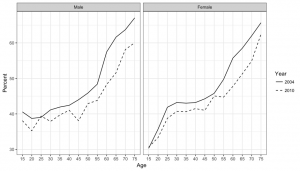
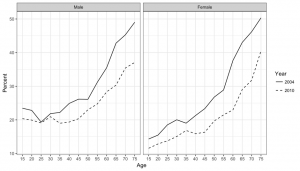
U.S. versus Europe. Full-fledged comparison of the American findings by Pepin and Cotter with European attitudes is not possible because the equivalent data for Europe are lacking. Yet, as far as the evidence goes, we see no signs that attitudes about gender are turning less rather than more conservative among Europeans, whatever their age. Figures 1 and 2 below plot the proportion of respondents in the European Social Survey agreeing with each of the following two statements: “Men should have more right to a job than women when jobs are scarce”; and “Women should be prepared to cut down on paid work for sake of family.” We give separate graphs for male and female respondents, and we plot the proportions of people agreeing at different ages, ranging from 15 to 75 year olds, and in two different years (2004 and 2010).

The most striking feature of both figures is that the lines go up dramatically from left to right, implying that younger men as well as women tend to agree much less with conservative statements about gender. Second, in the more recent round of the European Social Survey, in 2010, the responses tended to be less conservative and more gender egalitarian than six years earlier, in 2004 – as indicated by the fact that the dashed line is almost always below the solid line; otherwise, the lines just touch, indicating stability over time. While 15 to 20 year-old men tend to agree more often with the conservative statement than 20 to 25 year-old men, the most recent cohort of men below age 20 has taken a more, not less, gender egalitarian stance.

Figure 1. Percentage of Europeans agreeing with the statement “Men should have more right to a job than women when jobs are scarce”; responses in the European Social Survey in 2004 (solid lines) and 2010 (dashed lines), men (left) and women (right) aged 15 to 75

Figure 2. Percentage of Europeans agreeing with the statement “Women should be prepared to cut down on paid work for sake of family”; responses in the European Social Survey in 2004 (solid lines) and 2010 (dashed lines), men (left) and women (right) aged 15 to 75

As far as the evidence goes, the European trends in attitudes do not seem to move in the same direction as was found among high school seniors and 18-to-25-year-olds in the U.S. Despite the turn towards more conservative gender attitudes found by Pepin and Cotter and Fate-Dixon in the latter group, there are good reasons to expect that actual practices and behavior will continue to move towards more gender equality in the U.S. as well as in Europe.

Europe doesn’t have the reversal—but what does it mean? In earlier generations, if there was a difference in educational attainment level between mom and dad, it was typically dad who had the higher degree. This was the case in the United States until about 2012. In recent generations of high school graduates who were raised in double-earner families, the father usually had the higher degree in education, giving him the higher income potential, and in fact earning most of the family income. While the mother also typically went out to work for pay and contributed to the family income, her role as economic provider was typically secondary, supportive of his status as the main earner.

Recent studies showed that this is changing, not only in the West but globally. As populations across the globe become more educated, women tend to accumulate more education than men, leading to a reversal of the gender gap in education to the advantage of women.[1] This holds also on the couple level: In countries with a reversed gender gap in education, it is more common that the wife has more education than the husband, rather than the other way around.

When women are better educated than men, they may also have higher earnings potential. Yet, the gender gap in earnings still remains to men’s advantage. Among other things, this is related to the fact that women choose less lucrative study subjects and occupations and that women typically face a motherhood penalty on earnings while men rather receive a fatherhood bonus. As explained by Pepin and Cotter, the cultural orientation of gender essentialism may be the explanation, i.e. the idea that men and women hold innately and fundamentally different in interests and skills.

Yet a recent study indicates that the gender gap reversal in education has the potential to undermine the motherhood penalty. When a wife has a higher degree than her husband, not only are the chances clearly higher that she can become the main earner of the family but it also offsets the motherhood penalty, especially in countries that make it easier for women to combine careers and parenthood.[2] In Europe, when both partners have a college degree, the share of couples where she earns more than he does is around one in three among childless couples, while it is only around one in five among couples with school-aged children. However, when a wife has a college degree but her husband doesn’t, the share of coupled parents where the wife earns more than her husband is just as high as among childless college-educated couples, i.e. around one in three. This suggests that earnings potential and work experience may start to outweigh any cultural preferences of women to cut back at work after having children.

Furthermore, a female advantage in education or earnings (or both) is no longer associated with lower marital stability. This was the case in the past, but this is changing. One study found that the wife’s employment was still associated with a higher risk of divorce in the U.S., but not in European countries nor in Australia. In fact, in Finland, Norway, and Sweden, wives’ employment even predicted a lower divorce risk compared to couples where the wife stayed home.[3] More detailed study of time trends in the U.S. recently showed that while couples where she was more educated than he or where she earned more than he were more at risk of divorce in the past, but not anymore today.[4]

Why have attitudes among American youths shown a more conservative trend in recent years? An obvious explanation could be a romantic kind of backlash. These are the first kids who grew up with two working parents, if not with a single mother, with all the stressful situations this entails, particularly in a society whose institutions and companies are not quite adjusted to the new gender roles yet. Youngsters may romanticize the male breadwinner, female homemaker model, which they may still see in the movies and on television. Their mothers were typically doing extra housework shifts after their work commitments, which may not look like an attractive future for younger generations, especially when despite two working parents the income of the middle classes stopped growing[5] and many families faced difficulties keeping up with the increasing demands of consumer culture.

Even so, it remains to be seen whether the stall or even backlash observed in attitudes in the U.S. will continue. As I noted above, the recent shift in relevant attitudes observed in Europe are still moving in the direction of support for more gender equality. If I had to put my money on it, as the current American high school seniors and under-25 youths grow older, they will experience that their own families will be better off if they can pool and share resources rather than having the wife specializing in unpaid household work and the other in paid market work. As a result, I would expect that the attitudes will adjust to the reality, which is moving in the direction of more gender equality.

Jan Van Bavel is a Professor of Sociology at University of Leuven.