
work

Tiring? Never! Photo by Harsha K R via Flickr CC.

In a dramatic shift in attitudes from just 40 years ago, most modern couples want to share the duties and rewards of work and family equally. However, this is particularly difficult for new parents in the U.S. in light of limited governmental support and persistent traditional gender norms. The U.S. offers inadequate paid parental leave and few options for cutting hours at work, while the cost of quality infant child care is exceptionally high. Thus parenthood is especially challenging for U.S. couples—the majority of whom are dual-earners who strive to achieve a work/family balance.

We studied 182 different-sex couples who were expecting their first child. Most were professionals who were well-positioned to equally share housework, parenting, and paid work responsibilities due to their high levels of education and the fact that both partners were working full-time. During the last trimester of the woman’s pregnancy and at 9-months postpartum, we had these men and women keep time diaries, recording every activity they engaged in during a 24-hour workday and non-workday. We also surveyed them about their own attitudes and perceptions of their division of labor at the beginning of our study and again when their child was nine months old.

In our initial interviews, these couples told us that they believed in sharing household responsibilities equally—and our time diaries confirmed that in fact they successfully did so before the baby was born. On average, both women and men perceived they were doing about 60 hours of work, including paid work and housework, per week. The time-diary data we collected, which are more accurate than retrospective survey data on how people spend their time, supported their perceptions. Women and men reported about 15 hours of housework and between 42 and 45 hours of paid work per week. This means that before the babies were born, most couples had achieved a balanced division of labor.

When we surveyed these expectant couples about their future, most said they wanted to continue to equally share housework and childcare after their baby was born. More than 95 percent of both men and women agreed that “men should share with child care such as bathing, feeding, and dressing the child” and that “it is equally as important for a father to provide financial, physical, and emotional care to his children.”

When their babies were 9 months old, both parents felt that parenthood had increased their workload by about 30 hours a week. Their time diaries revealed that their perceptions did not match their realities.

We surveyed the couples again when their babies were 9 months old, asking them how much time they were now spending in paid work, housework, and child care. Both the men and the women reported that they were each performing 90 hours of work per week, including housework, childcare, and paid labor. That is, they both felt that parenthood increased their workload by about 30 hours a week. Men reported that they were doing 35 hours of housework, 15 hours of child care, and 41 hours of paid work per week. Women reported that they were doing 27 hours of housework, 28 hours of child care, and 35 hours of paid work per week.

This time, however, their perceptions did not match their reality. Using our detailed time diaries, we were able to construct a much more accurate account of their work weeks than they retrospectively estimated in the surveys, and the results were quite different than the parents reported to us. Women performed 15 ½ hours of physical child care per week, including physical child care (changing diapers, feeding the baby)—12 hours less than they thought they were performing. They also performed 6 hours of child engagement (playing and reading with the baby), but we did not survey them on their perceptions of the time spent engaging with their child. Women spent 42 hours doing paid work—six hours more than they thought they spent in their jobs—and 13.5 hours doing housework—14 hours lessthan what they thought they were doing.

Men did about 10 hours of physical child care—5 fewer hours than they thought they were doing. Men put in 46 hours of paid work—5 hours more than they thought they put in at work. Their estimates of housework diverged especially sharply from what they recorded in their time diaries. The time diaries revealed that on average the men did just 9 hours of housework—only one-fourth as much as they thought they were doing (men estimated that they performed 35 hours of housework).

In other words, on average, 9 months after the transition to parenthood, women added 22 hours of childcare (physical and engagement) to their work week while doing the same amount of housework and paid work as before. Men added 14 hours of childcare to their work week, but did 5 fewer hours of housework after the baby’s birth.

Before the baby was born, a man’s average work week (paid and unpaid hours combined) was three hours longer than his partner’s. But after the birth of their child, the man’s total workload averaged about 8 and half hours less per week than his partner’s. Women’s total weekly workload increased from 56 to 77 hours across the transition to parenthood, while men’s increased from 59 to 69 hours.

Thus, over the course of a year, our calculations indicate that parenthood increased women’s total workload by about 4 ½ weeks of 24-hour days, whereas parenthood increased men’s total workload by approximately 1 ½ weeks—a 3-week per year gender gap.

Parenthood is a time-consuming activity that changes the rhythm of daily life, but new parents perceive the work as even more time-consuming than it actually is.

Parenting an infant is a time-consuming activity that changes the rhythm of daily life. But it is especially fascinating that new parents, and particularly men, perceive the work of parenthood to be even more time-consuming than it actually is. Parenthood does result in increased work, but men and women are not actually working 30 hours more per week after their babies are born. Women come close—working 21 more hours per week after the birth of their first child. Men do much less than they—or their wives—perceive: parenthood only adds 13 hours of work for men.

It is possible that fathers will become more involved in physical childcare and engagement as the babies grow into running and talking toddlers. But we would argue that men and women should openly confront the workload inequities that develop in their child’s first nine months because renegotiating the division of labor once routines are established is really difficult.

Furthermore, if these inequities are not addressed early, some women may feel compelled to leave or reduce their hours in the labor force, diminishing their own career opportunities as well as the family’s ability to save for college and retirement. In turn, women’s “opting out” of paid work may result in men’s opting out of even more family work. Thus, children may miss out on the benefits of involved fathering for their social, emotional, and cognitive development.

New parents who desire equality over the long haul might be well-advised to address rather than deny the inequalities that develop in the early months of parenthood. Couples who recognize that the transition to parenthood is a “magic moment” and split family work evenly will enjoy the benefits—more satisfying relationships and more economic resources and security.

Originally posted 6/22/15

Jill Yavorsky is in the sociology program at The Ohio State University, where Claire Kamp Dush is a professor of human sciences and sociology and chair of the graduate program in human development and family science and Sarah Schoppe-Sullivan is a professor of human sciences and psychology and the director of the Crane Center for Early Childhood Research and Policy.

Re-posted from Urban Wire

photo credit: Alicia Campbell via pixabay

Worldwide, only about one in two women work, compared with three in four men. In some low-income countries, such as Zimbabwe and Madagascar, the labor force participation rate for women has reached 90 percent, but these women are often underemployed. Hard economic circumstances often force them to be self-employed or work in small enterprises that are unregulated and unregistered.

About 83 percent of all domestic workers in the world are women, most of whom work in precarious conditions. Women also do much more unpaid work than men, including caring for children, the elderly, and people with disabilities; contributing to family farms or businesses; and performing household chores such as collecting water or gathering firewood. Improving women’s livelihoods constitutes basic human rights protection.

But could including more women in the labor force also stimulate economic growth, enhance business competitiveness, and improve well-being?

We recently conducted a review of evidence to answer that question and found that reducing the gender pay gap and equalizing access to economic opportunities and resources are good for economic, social, and business development. For example, some firms that purposefully reduced gender discrimination and supported family-friendly policies attracted more talented workers, improved retention rates, and decreased employee stress, resulting in enhanced productivity.

But women face significant barriers to improving their lives, such as fear of victimization and violence, lack of child care, and legal and informal discrimination. Removing those barriers could help draw women into higher-productivity sectors and improve family, community, and national prosperity.

We found evidence that broad-based and gender-specific policies can enable women’s economic empowerment; that is, improving women’s ability to make decisions and affect outcomes important to themselves and their families. Here are six of those policies.Broad-based policies

Broad-based policies

  • Promote economic growth: In countries experiencing rapid economic growth, increasing demand for labor and the availability of better-paying jobs ensures that women’s economic empowerment does not become a zero-sum game between men and women. When the economy demands more workers, women will not replace men if more women participate in the labor market.
  • Invest in public services, infrastructure, and women-friendly public spaces and transportation: The quality of and access to public services, including basic utilities such as water and sanitation, improves all-around well-being through greater economic productivity and growth, but may be especially beneficial for women. For example, because women do most household work, electricity and tap water can free up their time, enabling greater labor market participation. Access to speedy and reliable transportation can reduce safety concerns that discourage women from entering the labor force or limit them to working at home.
  • Promote innovation and technology: Information and communications technology can help increase women’s inclusion in the economy, particularly in high-productivity service sectors. Greater access to information and technology can also stimulate changes in social norms and attitudes toward women’s roles in society, potentially improving access to education and political involvement.

Gender-specific policies

  • Provide child care: Evidence suggests that the availability of child care is strongly associated with an increase in women’s labor force participation and productivity. Child care, particularly high-quality child care, is one of the most important enablers of women’s economic empowerment and can have a positive impact on children’s learning.
  • Change laws that limit women’s economic independence: Reforming inheritance and family law to lift prohibitions on daughters’ legacies and to reduce husbands’ power over wives’ economic activity can have positive economic effects, going beyond the specific outcomes they are intended to address.
  • Improve or reduce work in the informal sector: Women are concentrated in the informal sector, which includes jobs that are unregulated and insecure, like street vending. Policies designed to move workers from the informal sector to the formal sector can significantly benefit women. Working in the formal economy is more likely to empower women because it is associated with more control over their own incomes than they would have in informal work. Evidence suggests that strengthening the collective bargaining capacity of women workers in this sector and improving awareness of women’s rights is important to ensuring that income levels and working conditions improve in the formal economy.

Enacting these policies will not only empower women, but will also benefit their families and communities. The United Nations’ recently formed High-Level Panel on Women’s Economic Empowerment will bring needed attention to these issues and, we hope, begin to bring about needed change.

Elizabeth H. Peters is a Council on Contemporary Families Board Member, Director of the Center on Labor, Human Services, and Population at the Urban Institute, and coeditor of the book Marriage and Family: Perspectives and Complexities

discuss-1702638__180
photo credit: jamesoladujoye via pixabay

Revisiting a NICE WORK column at Girlwpen, written in 2012 during the last presidential campaign.

What to do when I read a study that so appeals to my worldview that I want to shout it out? Should I just kinda act cool, not let on that I wanna say, I knew it! See? SEE?!!!! That is how it is. We all have biases and preferences and a worldview that shape how we process information. And we all have choices about what to do with them. And that brings me to a study about how dudes in traditional marriages have traditional views that influence their judgments at work, too.

In a new working paper called “Marriage Structure and Resistance to the Gender Revolution in the Workplace” (.pdf), three business school professors investigate why, despite notable progress, the gender revolution appears to have “petered out.”  (An accessible overview of just this puzzle from the Council on Contemporary Families is in Gender Revolution? Or Not So Much.)

The new paper is novel: it asked, is it is possible that there are well-placed pockets of resistance in the workplace that help account for impeded progress? The authors hypothesized that, perhaps, men in cross-sex marriages with stay-at-home wives might have a different view of women in the workplace than married men with full-time working wives.

They hypothesized correctly. In particular, they found that (1) men in traditional marriages (MITM) had more negative attitudes towards working women (controlling for selection!); (2) MITM perceived the workplace as running less smoothly when more women worked there; (3) MITM also found more gender-egalitarian organizations less attractive; and (4) MITM, when asked to rate the quality of workers who were exactly equivalent, rated women lower than men. They controlled for selection (or the way it might be that sexist guys at work choose traditional marriages rather than guys being influenced by their traditional marriages to have traditional views at work) and for education (more educated guys espouse more ostensibly feminist views).

The study excited me because it provided support for that sinking feeling that some of us can have when working with guys who lead traditional private lives. At work, it can seem, they just don’t “get it.” Hard to put one’s finger on it. But they keep doing stuff like thanking their wives for all they do at home, thinking that this shows their respect for women.

The study also excited me because it was an example of the kind of research that I was talking about when I wrote about the neglect of men as focal points for research on gender, and my suspicion that the neglect stems from a sneaky sensibility that men’s vantage point is natural and therefore can go without examination. But without investigating the impact traditional marriages on work practices (instead of the more common investigation of egalitarian marriages on home practices), we are at risk of naturalizing “traditional” just as we naturalize “men.” To understand how gender operates, it helps to look at men at the center of power not just those at the margins. And this study did so.

Perhaps now you see the irony that I felt when I noticed my enthusiasm. The study shows how worldview lines up with personal life. This might influence your judgment at work. Back in the day, feminists said the personal is political. Thing is, the personal is political for everyone, including those who follow conventions. Even for those who don’t believe in this stuff. That means the personal is political, too, for MITM (the M is silent, by the way).


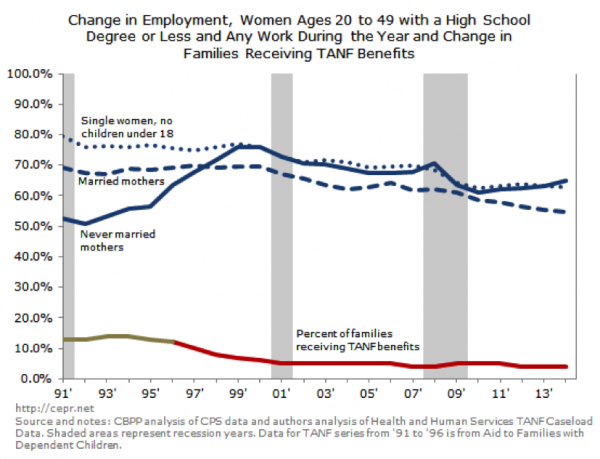
Welfare reform hit 20 last month. The Center for Economic and Policy Research has done much work examining how full employment in the 1990s shaped employment, income, and poverty. In observation of this 20th anniversary, CEPR prepared a graph that tells an important, often neglected, piece of the story:

CCF Barber Rutter Fig 1

Using data from the Current Population Survey and Department of Health and Human Services TANF Caseload report, the figure tells a simple story. Never-married mothers with a high school degree or less increased their rate of work from the early to the late 1990s by nearly 30 percentage points. As Philip Cohen also discusses, this trend began well before the 1996 welfare reform, suggesting that the policy was not the source of the rise, but that other macroeconomic forces were helping these families do better.

As the graph also demonstrates, the rise in employment is associated with a decline in reliance on the welfare program, Temporary Aid to Needy Families (TANF). The line at the bottom of the chart shows a steady decline in the late 1990s that corresponds to the rise in women’s work in the line above.

Here’s the catch: Employment stopped rising, and began to fall by the early 2000s. Yet, TANF, as part of the so-called safety net, did not move upwards as less-skilled jobs disappeared. Instead, the TANF rolls continued to decline, as Shawn Fremstad details in his report on millennial parents.

What does this mean? CEPR director Dean Baker has written extensively about how to fight poverty through full employment. This chart suggests that the current system of welfare is not part of the solution, and stands as a reminder that data, not ideology, will help us reduce poverty.

Alan Barber is the Director of Domestic Policy at the Center for Economic and Policy Research. Virginia Rutter is a sociologist at Framingham State University. For more information, please contact Dr. Barber at barber@cepr.net.

Illustration by Bill Strain, Flickr CC.

Part 1 of the Council on Contemporary Families’ Symposium on Welfare Reform at 20

The welfare reform bill that emerged in 1996, after a back-and-forth struggle between President Bill Clinton and the Congress (both houses of which were controlled by Republicans), imposed a two-year continuous term limit, and a five-year lifetime limit, on poor cash welfare recipients. It ended Aid to Families with Dependent Children (AFDC), an entitlement program, and replaced it with Temporary Assistance to Needy Families, a state block-grant program. The policymakers who engineered this change took advantage of a growing popular expectation that mothers should be in the labor force. There was widespread resentment against those (perceived to be mostly Black) who used welfare payments to shirk the obligation to work, choosing dependence on the state rather than getting married or refraining from childbearing.

This policy reform, motivated and supported at least in part by racist ideas and stereotypes, set out to fundamentally alter the relationship between work, parenthood, and marital status for U.S. women. Instead, despite some increase in employment rates, it mostly increased the hardship – and reduced the support – for poor families and their children, who are disproportionately people of color. Reflecting on this anniversary, it now appears this was a tragic misdirection, and we lost an important opportunity to change work family policy for the benefit of all women and poor families. more...

Photo via VelvetTangerine, Flickr CC.

Reprinted from Beggruen Insights, Issue 4, with permission.

Nostalgia often arises out of a real experience of loss. It needs to be addressed and redirected, not ridiculed or denounced. And that applies to the nostalgia that motivates a considerable number of Trump supporters.

I have spent most of my career pointing out the dangers of imagining a Golden Age in the past that we should try to recapture. Nostalgia offers a warped explanation of what actually did work in the past and airbrushes out what did not. It leads to the scapegoating of those who supposedly ruined “the good old days” while providing no tools for coping with the new realities that underlie contemporary challenges.

That said, nostalgia often arises out of a real experience of loss. It needs to be addressed and redirected, not ridiculed or denounced. And that applies to the nostalgia that motivates so many Trump supporters.
more...

finding time book coverFamilies at all levels of income are struggling in our economy simply because it does not allow congenial coexistence of work and family life. Lives have become busier and busier and policies have not changed to reflect that. In her book, Finding Time: The Economics of Work-Life Conflict (Harvard University Press), Heather Boushey thoughtfully and comprehensively explains the problems with work-life conflict for women. Her book presents a set of solutions, too, that could make work-life conflict a thing of the past. While the story leads with the tale of what happens to women, Boushey takes the very issues that working women with families face and shows how these dilemmas are not about being a woman, they are about economics, and are shackling our entire economy. A valuable contribution is her portrait of contrasting work-life conflicts across income groups and family composition. She uses data as a skilled economist—which is her discipline—yet builds sensitively from history and social theory in a compelling book. Ultimately, her grounded arguments deliver detailed explanations as to why family policy needs to change and change quickly. Boushey, who is Executive Director and Chief Economist at the Washington Center for Equitable Growth, has decades of work bringing careful research to bear on key policy issues—and is successful at making the research and policy issues understandable to people who are really affected by the policies.

DUAL EARNING FAMILY DEPENDENCE

Boushey sets the table with locating economics in social context. The deal with capitalism is that by design the economy is ever-changing. Since the 1970s it has become heavily dependent upon women’s earnings. Families can no longer get by on the earnings of just one parent as they could before around 1979. So if our economy is so dependent upon a dual income family, then why aren’t there policies that support families’ need to manage work and family care? In Boushey’s words: “The hodgepodge of work and family policies that has evolved over the years does not address how people can have the time to deal with conflicts between work and home life” (p. 250). Finding Time explains the factors that determine what needs to change and how that change can happen.

COMPOSITION OF THE FAMILY IS CHANGING

The composition of families, Boushey reminds readers, are a lot different now than they used to be. While in the past families typically consisted of a mother, a father, and children, families now are more complex and could be classified in a burgeoning array. Single parent families make up about 27 percent of families today, for example. While in the past families could survive off of one parent being the breadwinner, that is nearly impossible now, especially for single parent families. She explains that single parent families are more likely to be low-income than families that have two (married) parents. Where are U.S. policies that make single-parent families able to thrive? Yes, they are already at a disadvantage with only one income, but policies that work will empower single parents to earn money and do the carework, which are two key things parents need to do.

WHO WILL BE THE “SILENT PARTNER” NOW?

Boushey makes a great point when she explains that women have always been the “silent partner” to businesses. Starting with the 19th century “family wage” and ending somewhere after the 1950s boom, men could go to work and not have to worry about their family because they knew their wives would be taking care of it. Businesses never had to take family into account because men never had to worry about theirs. In Boushey’s phrase, women were the “silent partners” to business. However, now that women’s incomes are key to family survival, the country is still not doing anything to lessen the burden of the work-family conflicts. Meanwhile, businesses reap benefits from having more capable workers in a larger labor pool, for whom wages are stagnant.

HOW CAN WE BE HERE, THERE, PROVIDE CARE, AND MAKE SURE ITS FAIR?

Women do not have a “silent partner.” But Boushey has a recommendation to fix this. She found that there is not one sure-fire way to fix the work-life conflict that families are facing. She argues that we need solutions in four areas that she calls Here, There, Care, and Fair.

Here: Policies for when women need to be Here (in the home). These policies include paid sick leave for medical needs and other time that would need to be spent with children.

There: Policies to make sure that the amount of hours that women are working leaves room for managing their family so that they do not always need to be There (at work).

Care: Policies regarding high-quality Care for children and aging family members.

Fair: Overall, policies need to be fair for everyone. This means that no matter what your income or familial composition is, you are still afforded the same work-family policies and no added responsibilities should hinder that.

Not only would adding this support make it less stressful for families to balance work and life, but such supports decrease costly turnover rates and increase productivity.

FINAL THOUGHTS

Women (and men!) need family policy as our silent partner to help us provide for our families. The “family policy” men had in the past was a housewife—and this policy is out of date. The economy has grown with the growth of women’s participation in the work force. It is time, Boushey demonstrates, that this growth should extend to benefits for women and their familial responsibilities.

This book was a great read. Along with clear explanations of economic concepts, Boushey uses her personal experience growing up in a working-class, union family in Washington State along with her knowledge of economics and history to show that to grow our economy and bring us out of the doldrums, working women need family-friendly policies. As a young woman looking ahead to a life of work-life conflict, I gained clarity and direction for my own work. Work-life conflict is a topic that needs recognition and Boushey is helping to spread knowledge and awareness. Boushey’s book still left me wondering how race may factor into this work-life conflict, maybe in a future addition we will be given some insight!

Molly McNulty is a CCF public affairs intern at Framingham State University. She is a senior Sociology and Education major.

A new study of Quebec’s recent non-transferable parental leave for fathers demonstrates just how effective this generous benefit is in getting fathers more involved at home. With new benefits, fathers increased their participation in parental leave by 250 percent. In households where men were given the opportunity to use this benefit, fathers’ daily time in household work was 23 percent higher, long after the leave period ended. Background and details of economist Ankita Patnaik’s innovative study are provided in this briefing report, prepared for CCF.

This briefing is based on a study by Dr. Ankita Patnaik. The original paper is available here and is forthcoming in the Journal of Labor Economics. This research was funded by Cornell University.

more...

It’s Almost Mothers’ Day: Why is pay for caregiving work so low relative to other jobs with similarly low requirements for formal education?

And, of course, pay me---equally. DFAT/Jeremy Miller Flickr CC
And, of course, pay me—equally. DFAT/Jeremy Miller Flickr CC

Two of the lowest paid groups of employees in the American economy are child care workers and personal care aides, according to a report just released by the US Census Bureau on February 25, 2016, providing the latest (2014) figures on how much men and women earn in each occupation.

Many of the organizations and political leaders honoring International Women’s Day last Tuesday have made a “pledge for parity,” promising to promote gender equity in pay. When most people think about what parity means, their “go to” question is whether men and women earn the same when they work in the same job and perform equally well. But we should also think about whether differences in pay between occupations are equitable. To keep the focus just on between-occupation differences, let me give some figures just for women.

Women who were child care workers in 2014 had median earnings of only $20,452 for the year. If we assume that means 50 weeks a year and 40 hours per week, those child care workers made just $10.22/hour. Personal care aides earned $21,459 a year. Many food service workers have similarly low salaries. more...

the way we never wereAnother Quarter Century of Family Change and Diversity

Editor’s note: In 1992—the year the U.S. presidential campaign erupted into a culture war over family values—Stephanie Coontz published The Way We Never Were: American Families and the Nostalgia Trap. The title itself offered the pithy concept, and the book demonstrated that diversity and change have always been hallmarks of American family life: “Leave It to Beaver” was not a documentary. This week (March 29, 2016) Coontz released a substantially revised and updated edition of The Way We Never Were. Below, she provides a brief review of ten things that have changed for the better in the past quarter century, three that have stayed the same, and two that have gotten worse.

In 1992, political leaders and pundits were predicting that changes in family forms and gender roles were leading America into disaster. Were they right? 

  1. Whatever happened to the Super Predators? In the early 1990s criminologists were predicting “a blood bath of violence” unleashed by “tens of thousands of severely morally impoverished juvenile super-predators” – all supposedly a result of rising rates of unwed births. But between 1993 and 2010, sexual assaults and intimate partner violence reported dropped by more than 60 percent. According to the FBI’s Uniform Crime Reporting Statistics, the murder rate in 2013 was lower than at any time since the records began in 1960. Since 1994, juvenile crime rates have plummeted by more than 60 percent, even though the proportion of children born out of wedlock has risen to 40 percent.
  1. How about crack babies? In the 1980s and 1990s, newspapers headlined an epidemic of “crack babies” in the inner city, with kids permanently damaged by their mothers’ use of crack cocaine during pregnancy. This led to a wave of punitive legal actions against such women. But follow-up studies have since revealed that children from the same high-poverty areas who had not been exposed to cocaine in utero were equally likely to have developmental and intellectual delays as babies born with cocaine in their systems. As I documented in The Way We Never Were, the big risk to these children was the pollution, violence, and chronic stress of deeply impoverished and neglected communities – including lead poisoning damage that was going on for years before it hit the headlines in 2016 because of the disaster in Flint.
  1. Did career women start “out-sourcing” their children’s developmental care? As women gained more high prestige jobs in the late 1990s, that’s what many experts feared. In fact, however, even as mothers’ work hours increased, their child-care hours increased too, while fathers’ child-care time tripled. Today, both single and working moms spend more time with their children than married homemaker mothers did back in 1965.

more...