
work

Barbara Risman via UIC.

A debate about just how gender progressive Millennials are has been created by a CCF online symposium. In it, Joanna Pepin and David Cotter report that attitudes toward gender equality are not always consistent: There are different trends in attitudes toward gender equality for the public world of work and the private world of the family. They suggest that while Millennials’ attitudes toward women’s rights in the world of work remain feminist, they are less likely to support equality at home than did the last generation. They use nationally representative data from surveys of high school seniors to support their argument.

We use different data and replicate their argument about the complexity of gender attitudes. But we find no evidence that Millennials are moving backward on their commitment to gender equality. Our analysis is based on attitudinal survey questions on gender questions in the General Social Survey pooled from 1977 to 2014. We then draw on just released 2016 data from the same survey to illustrate the results about Millennials today. In the analysis using data from 1977 to 2014, we measure attitudes toward women in the public sphere with a question that asked whether men are better suited emotionally for politics than are women. We measure attitudes towards women’s role in families with three questions: Is it better if the man is the achiever outside the home and the woman takes care of the home and family; whether a working mother can establish just as warm and secure a relationship with her children as a mother who does not work; and whether a preschool child is likely to suffer if his or her mother works.

We use a different method than did Pepin and Cotter. We let social groups emerge empirically from the data, without pre-determining who would show up in each group (statisticians call this latent class analysis). We label the groups based on their answers to these questions about gender equality and then describe what kinds of people hold what attitudes. We traced the kinds of people in each group over decades and can describe them by race, educational status and sex. Our analysis confirms that there are indeed distinct differences between gender attitudes toward equality in the public sphere and equality within families. But we show this is not a new split. It’s one that is decades old, and our results suggest the split emerged by the 1990s.

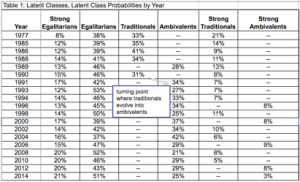
Three major groups were formed by how people’s answers clustered (see Table 1). There were egalitarians who approved of equality in the workplace and the home. There were traditionalists who rejected equality in both the workplace and the family. And then there were the ambivalents who approved of gender equality in the workplace but not in the family. (In our actual analyses each of these groups was furthered divided into those with strong beliefs and those with moderate beliefs and the table below is presented to show that distinction.)

Where have all the Traditionals gone? The big historical story is that there are no more traditionalists. From 1977 to about 1990, about a third of Americans were traditionalists and did not believe women and men should have the same rights and opportunities at work or at home. In that era, there were almost no ambivalents. Everyone was either traditional or egalitarian. But what changed after 1990 was that the traditionalists became ambivalents. That is, by the early 1990s those who used to reject equality totally had accepted women’s right to equality at work but still resisted equality in the family. Americans who have a carte-blanche objection to gender equality in both the workplace and the home have become almost extinct. Score one big win for the feminist revolution. But the victory is partial because those traditionals have not become egalitarians, they have become ambivalents, and this is a reminder that feminist have much work to do before everyone believes in gender equality within the family.

Table 1. Are Millennials Rejecting the Gender Revolution?
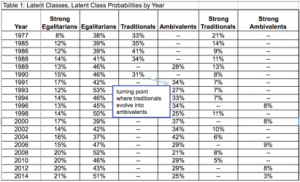
(Authors’ Analysis from General Social Survey data, 1977-2014.)

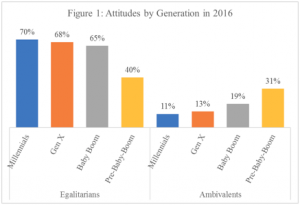
Our next step was to analyze what demographic characteristics were more likely to be associated with being egalitarians vs. ambivalent for each year in the data from 1991 to 2014. We do not include traditionals here because they are almost extinct. To do this, we conducted a multinomial logit latent class regression (the analysis is available upon request). Millennials are as likely to be egalitarians as the generation immediately before them (often called Gen X). We find no retreat from equality but also no statistically significant change toward feminist attitudes among Millennials. Rather, attitudes have leveled off. The biggest generational shifts remain between Baby Boomers and their parent’s generation.

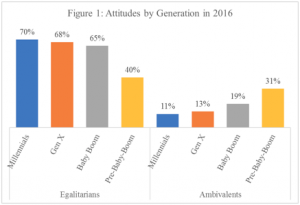
While Americans who believe in gender equality in the workforce but not at home still exist, they are most likely to be pre-Baby-boomer men, without a college education. In the General Social Survey data we find no evidence that Millennials have ambivalence to gender equality, nor that they are more likely to endorse traditional family forms than those in the past. We illustrate this argument with a descriptive summary of the data from the year 2016 (in Figure 1).
Conclusion. The traditionalist who believes women do not belong in the public sphere is now a dinosaur. Almost no one in American society believes women do not deserve equality in the public sphere. But those traditionals did not become egalitarians, rather they held on to traditional beliefs about women’s place in the family.

This is not a new story. The big swing toward more egalitarian attitudes toward women in the family can be traced to the era of the Second Wave of feminism. Our evidence shows that while Baby Boomers were the pioneering feminist birth cohort who experienced a generation gap with their own parents, those after them have inherited egalitarian attitudes but have not pushed the envelope, at least not as represented in this national dataset. Still, there is no evidence in these data of a backward slide among Millennials. It is the oldest generation, the parents of Baby Boomers, who remain the most likely to be ambivalent about gender change. These national survey data suggest that Millennials may not be pushing boundaries on gender attitudes but they do continue the slow march trend toward egalitarianism that Baby Boomers began.

Originally posted 4/18/2017

Barbara J. Risman is Professor of Sociology at the University of Illinois at Chicago and President of the Board of the Council on Contemporary Families. Ray Sin is a behavioral science researcher at Morningstar Inc. and a doctoral candidate at the University of Illinois at Chicago. William Scarborough is a doctoral candidate at the University of Illinois at Chicago.

The Council on Contemporary Families Gender and Millennials Online Symposium presents research on how Millennial men and women are changing—and how they are not changing. Countering the recent trend of ignoring inconvenient facts, this symposium makes it clear that attitudes about gender equality are more complex than either supporters or opponents of feminism often admit. Here’s a quick review of the brief reports.
The Council on Contemporary Families released a Gender and Millennials Online Symposium revealing that young adults have become less supportive of gender equality at home over the past two decades—though not in Europe, where work/family policies are more generous. Yet the benefits of egalitarian marriages, for both partners, have increased during the same time frame.

In this eight-part series, there’s the old news: women and men are more likely to endorse gender equality than ever—and they live lives that express that. Then there’s the not-so-old news: progress toward gender equality has slowed since the 1990s. Some call it a stall. And there’s new news: youthful gender attitudes are more variable than we thought, and at least among younger Millennials, a continued endorsement of equality at work has been accompanied by a dip in support for equality at home. And therein lies the complex set of reports that comprise the Council on Contemporary Families Gender and Millennials Online Symposium, released March 31.

The keynote essay, “Trending Towards Traditionalism? Changes in Youths’ Gender Ideology,” by sociologists Joanna Pepin (University of Maryland) and David Cotter (Union College), reports that when it comes to work and politics, young adults are increasingly egalitarian. But when it comes to home life, the 40-year-long move toward gender equality has stopped or reversed in recent years.

The trends: Specifically, Pepin and Cotter report:

  • In 1994, 42 percent of high-school seniors felt that the best family was one where the man was the outside achiever and the woman took care of the home. In 2014 this had gone up to 58 percent.
  • In 1994, 48 percent of high school seniors said a mother who works cannot establish as warm and secure a relationship with her children as a mother who does not work. In 2014, the share disagreeing went up to about 60 percent.

While young people endorse at rates of 90 percent or higher the idea that men and women should be equal at work, Pepin and Cotter see a trend in greater traditionalism at home. They call this “egalitarian essentialism”—a concept that seems to go a long way in describing the complex trends in gender attitudes presented today. In her overview essay “CCF Gender and Millennials Online Symposium: Overview,” historian Stephanie Coontz defines egalitarian essentialism as combining “a commitment to equality of opportunity with the belief that men and women typically choose different opportunities because men are ‘inherently’ better suited to some roles and women to others.” Coontz explains, “Egalitarian essentialism assumes that as long as women are not prevented from choosing high-powered careers, or forced out of them upon parenthood, their individual choices are freely made and are probably for the best.”

Nika Fate-Dixon identifies similar trends among young people in the 18-25 age group, using data collected since 1977. In “Millennials Rethinking the Gender Revolution? Long-Range Trends in Views of Non-Traditional Roles for Women,” she found that by 1994, 84 percent disagreed with the claim that a woman’s place was in the home. In 2014, however, the percent disagreeing had dropped to three-quarters. While Pepin and Cotter found that the backtracking on gender equality occurred among both men and women high-school seniors, Fate-Dixon found a sharp and growing gender gap among people in their early 20s. As noted below, this was a clear trend through 2014, but the 2016 GSS data no longer follow this pattern. Researchers await more results and analyses.

Politics: Young people—ages 18-30—were by far the strongest supporters of Clinton over Trump in the 2016 Presidential Election. However, according to Kei Kawashima-Ginsberg’s “How Gender Mattered to Millennials in the 2016 Election and Beyond,” only 25 percent of the women Millennial voters and 15 percent of the Millennial men identified as feminists. Furthermore, Kawashima-Ginsberg, Director of Tuft University’s Center for Information and Research on Civic Learning & Engagement (CIRCLE), Millennials’ support for Clinton in 2016 was ten percentage points lower than their vote for Obama in 2008, further evidence for a dip in enthusiasm for gender equality.

Other political research presented by political scientist Dan Cassino (Fairleigh Dickinson University) in “Some men feel the need to compensate for relative loss of income to women. How they do so varies” suggests that some men have reacted negatively to women’s economic gains. During the primaries, male voters who were reminded of women’s growing economic clout became markedly less likely to express a preference for Hillary Clinton. When Cassino studied men who had actually lost income relative to their wives, however, Republicans and Democrats reacted in different ways. Men who were Democrats became more liberal as their share of household earnings fell, while Republican men became more conservative.

Married life: In “A View From Above: How Structural Barriers to Sharing Unpaid Work at Home May Lead to “Egalitarian Essentialism” in Youth,” Dan Carlson, assistant professor of family and consumer studies at the University of Utah, suspects that this backsliding on gender equality is less a product of gender threat than it is due to the absence of work/family policies that make domestic equality possible. Since the 1990s, the historically higher risk of divorce for couples where the wife earns more than her husband has disappeared. And these days, in contrast to the past, couples in which husband and wife equally divide family chores and child-rearing now report higher marital and sexual satisfaction than more traditional couples. Carlson suggests that support for domestic equality continues to strengthen among children of dual-earners when they have access to family-friendly work policies, but that youth who have seen their parents overwhelmed by economic and time pressures may have gotten discouraged.

Research on European countries—where social supports for families are stronger—backs Carlson up. Using European public opinion surveys, Professor Jan Van Bavel (University of Leuven) found no dips in egalitarianism related to home life or work life in “The Reversal of the Gender Gap in Education and the Continued Push towards Gender Equality.” He writes, “In the more recent round of the European Social Survey, in 2010, the responses tended to be less conservative and more gender egalitarian than six years earlier, in 2004.”

Well, maybe “Millennials” isn’t such a great category. In “The Use and Abuse of Millennials as an Analytic Category,” sociologist Frank Furstenberg (University of Pennsylvania) warns against over-generalizations about such a diverse group as the Millennials. He argues that the 18-to-25-year-olds interviewed in 2014 are not really comparable to those interviewed in 1994: They are far less likely to be married or employed in permanent jobs than this age group 20 or 40 years earlier. In her overview essay, historian Coontz notes that CCF Board President Barbara Risman’s research supports this warning against stereotyping a generation. In Risman’s interviews with Millennials for a forthcoming book, she was struck by the contradictory expectations about gender and family life expressed even within a single conversation. Furstenberg and Van Bavel suggest that as youths enter married life, and especially if they gain access to family-friendly work policies, they may well change their views. But Pepin and Cotter warn that this is by no means inevitable.

Update: After this symposium was released last Friday, 2016 data from the General Social Survey became available. The latest numbers show a sharp rebound in young men’s disagreement with the claim that male-breadwinner families are superior. GSS two-year trends are exceptionally volatile, due to the small size of the sample, and the overall decade averages still confirm a rise in traditionalism among 18-to-25-year-olds since the 1990s. But the new data shows that this rise is no longer driven mainly by young men, as it appeared to be in the General Social Survey results from 1994 through 2014. Other evidence for a Millennial gender gap still stands, so stay tuned for more updates on this moving target.

Originally prepared for the Council on Contemporary Families Online Symposium on Gender and Millennials March 31, 2017. Previously posted at Famillies as They Really Are on April 5, 2017. 

This column was prepared for CCF by Virginia Rutter, Professor of Sociology, Framingham State University, and Megan Peterson, CCF Public Affairs and Social Media Intern, Framingham State University.

A debate about just how gender progressive Millennials are has been created by a CCF online symposium. In it, Joanna Pepin and David Cotter report that attitudes toward gender equality are not always consistent: There are different trends in attitudes toward gender equality for the public world of work and the private world of the family. They suggest that while Millennials’ attitudes toward women’s rights in the world of work remain feminist, they are less likely to support equality at home than did the last generation. They use nationally representative data from surveys of high school seniors to support their argument.

We use different data and replicate their argument about the complexity of gender attitudes. But we find no evidence that Millennials are moving backward on their commitment to gender equality. Our analysis is based on attitudinal survey questions on gender questions in the General Social Survey pooled from 1977 to 2014. We then draw on just released 2016 data from the same survey to illustrate the results about Millennials today. In the analysis using data from 1977 to 2014, we measure attitudes toward women in the public sphere with a question that asked whether men are better suited emotionally for politics than are women. We measure attitudes towards women’s role in families with three questions: Is it better if the man is the achiever outside the home and the woman takes care of the home and family; whether a working mother can establish just as warm and secure a relationship with her children as a mother who does not work; and whether a preschool child is likely to suffer if his or her mother works.

We use a different method than did Pepin and Cotter. We let social groups emerge empirically from the data, without pre-determining who would show up in each group (statisticians call this latent class analysis). We label the groups based on their answers to these questions about gender equality and then describe what kinds of people hold what attitudes. We traced the kinds of people in each group over decades and can describe them by race, educational status and sex. Our analysis confirms that there are indeed distinct differences between gender attitudes toward equality in the public sphere and equality within families. But we show this is not a new split. It’s one that is decades old, and our results suggest the split emerged by the 1990s.

Three major groups were formed by how people’s answers clustered (see Table 1). There were egalitarians who approved of equality in the workplace and the home. There were traditionalists who rejected equality in both the workplace and the family. And then there were the ambivalents who approved of gender equality in the workplace but not in the family. (In our actual analyses each of these groups was furthered divided into those with strong beliefs and those with moderate beliefs and the table below is presented to show that distinction.)

Where have all the Traditionals gone? The big historical story is that there are no more traditionalists. From 1977 to about 1990, about a third of Americans were traditionalists and did not believe women and men should have the same rights and opportunities at work or at home. In that era, there were almost no ambivalents. Everyone was either traditional or egalitarian. But what changed after 1990 was that the traditionalists became ambivalents. That is, by the early 1990s those who used to reject equality totally had accepted women’s right to equality at work but still resisted equality in the family. Americans who have a carte-blanche objection to gender equality in both the workplace and the home have become almost extinct. Score one big win for the feminist revolution. But the victory is partial because those traditionals have not become egalitarians, they have become ambivalents, and this is a reminder that feminist have much work to do before everyone believes in gender equality within the family.

Table 1. Are Millennials Rejecting the Gender Revolution?

(Authors’ Analysis from General Social Survey data, 1977-2014.)

Our next step was to analyze what demographic characteristics were more likely to be associated with being egalitarians vs. ambivalent for each year in the data from 1991 to 2014. We do not include traditionals here because they are almost extinct. To do this, we conducted a multinomial logit latent class regression (the analysis is available upon request). Millennials are as likely to be egalitarians as the generation immediately before them (often called Gen X). We find no retreat from equality but also no statistically significant change toward feminist attitudes among Millennials. Rather, attitudes have leveled off. The biggest generational shifts remain between Baby Boomers and their parent’s generation.

While Americans who believe in gender equality in the workforce but not at home still exist, they are most likely to be pre-Baby-boomer men, without a college education. In the General Social Survey data we find no evidence that Millennials have ambivalence to gender equality, nor that they are more likely to endorse traditional family forms than those in the past. We illustrate this argument with a descriptive summary of the data from the year 2016 (in Figure 1).

Conclusion. The traditionalist who believes women do not belong in the public sphere is now a dinosaur. Almost no one in American society believes women do not deserve equality in the public sphere. But those traditionals did not become egalitarians, rather they held on to traditional beliefs about women’s place in the family.

This is not a new story. The big swing toward more egalitarian attitudes toward women in the family can be traced to the era of the Second Wave of feminism. Our evidence shows that while Baby Boomers were the pioneering feminist birth cohort who experienced a generation gap with their own parents, those after them have inherited egalitarian attitudes but have not pushed the envelope, at least not as represented in this national dataset. Still, there is no evidence in these data of a backward slide among Millennials. It is the oldest generation, the parents of Baby Boomers, who remain the most likely to be ambivalent about gender change. These national survey data suggest that Millennials may not be pushing boundaries on gender attitudes but they do continue the slow march trend toward egalitarianism that Baby Boomers began.

Barbara J. Risman is Professor of Sociology at the University of Illinois at Chicago and President of the Board of the Council on Contemporary Families (brisman@uic.edu, @bjrisman). Ray Sin is a behavioral science researcher at Morningstar Inc. and a doctoral candidate at the University of Illinois at Chicago. William Scarborough is a doctoral candidate at the University of Illinois at Chicago.

Keynote brief prepared for the Council on Contemporary Families Online Symposium on Gender and Millennials March 31, 2017.

Overview. We often think that each generation becomes more modern, egalitarian, and tolerant than the last. And frequently this is correct—as it generally has been with changing attitudes about gender, work and family. Recently, though, our research has shown a surprising twist to that pattern. Looking at a survey that for nearly 40 years has asked high school seniors a series of questions about how men and women should be treated at work, what responsibilities at home should look like, and whether mothers’ employment harms their children, we see that on some of those questions the answers have indeed continued to become more egalitarian. But on others, what had been a trend toward equality stopped or even reversed in the mid-1990s.

We focused on youth because their values are important for predicting future trends. Youths’ attitudes capture changing cultural ideals that are less likely to have been reconciled with adulthood realities, such as unpaid maternity leave and the expenses of childcare, making their opinions of gender unique views from below. Although these adolescents have not yet entered the labor force full-time, the youth in our analyses had diverse experiences with their families, including witnessing their mothers’ work pathways and, for many, the dynamics of their parents at home.

The data in three charts. When we looked at the changing patterns of responses among high school seniors from the mid-1970s to today, we found that trends in attitudes about gender equality in the public realm increasingly diverged from those regarding gender relations within families (see Figure 1). In reference to the public sphere—employment opportunities and leadership abilities—youth have indeed become more egalitarian, increasing their support for the idea that men and women have equal abilities and should be afforded equal opportunities. In 1976, 82 percent of high school seniors already agreed or strongly agreed that “women should be considered as seriously as men for jobs as executives or politicians.” By 1994, that had risen to 91 percent, a high that was sustained for the next two decades. Similarly, in 1976, 76 percent agreed that “A woman should have exactly the same job opportunities as a man.” This rose to 89 percent in 1994 and has remained stable through 2014. Essentially, starting in the mid-1970s, youth’s attitudes became more egalitarian and plateaued at a high level of egalitarianism since the mid-1990s.

Young people’s attitudes with regard to employed mothers’ relationship with their children show greater variability over the period (see Figure 2). We observed high school seniors becoming more supportive of employed mothers from 1977 through 1994, with their support slowing for a period thereafter, and then becoming more supportive again in the mid-2000s. When asked whether “a working mother can establish just as warm and secure a relationship with her children as a mother who does not work,” only about half (49 percent) of high school seniors agreed in 1976, but this had risen to more than two-thirds (68 percent) by 1994 and three-quarters (76 percent) by 2014. In 1976, about three-quarters of high school seniors agreed that “a preschool child is likely to suffer if the mother works.” By 1994, however, nearly half (48 percent) disagreed, and by 2014 about 60 percent disagreed. This dramatic change suggests that the “mommy wars” and similar controversies seem to have abated. There appears to be broad and growing acceptance of mothers’ employment.

But a very different and surprising trend is evident in attitudes about gender dynamics in families (in Figure 3). After becoming more egalitarian for almost twenty years, high school seniors’ thinking about a husband’s authority and divisions of labor at home has since become substantially more traditional. In 1976, when they were asked whether “it is usually better for everyone involved if the man is the achiever outside the home and the woman takes care of the home and family,” fewer than 30 percent of high school seniors disagreed. By 1994, disagreement with the claim that the male breadwinner–female homemaker family is the best household arrangement had almost doubled, rising to 58 percent. By 2014, however, it had fallen back to 42 percent—a decline of 16 percentage points since its peak in 1994. In 1976, a majority of high school seniors (59 percent) disagreed with the statement that “the husband should make all the important decisions in the family.” This rose to 71 percent by 1994 but fell back to 63 percent by 2014.

In our analyses of these trends, we found that while young men have consistently been less egalitarian than young women, the relative difference between them has not narrowed on any of the attitudes covered in the surveys. Also, Black youth have consistently been more egalitarian than their White counterparts, but again we saw no evidence of either convergence or divergence between White and Black youths’ beliefs about gender. Black high school seniors exhibited the same initial trend toward more equality in household arrangements and later trend toward more traditional views.

These results are puzzling because population demographics are changing in ways that might be expected to produce greater support for egalitarian principles. The population is becoming more racially and ethnically diverse, and at the same time, religiosity is declining overall. Families are increasingly likely to count on mothers’ employment for economic stability, whether youth grow up in dual-earner households or single-mother families. We expected that as women’s educational attainment and married women’s labor force participation increased in the 1980s and early 1990s, youths would be increasingly exposed to feminist beliefs, leading them to adopt egalitarian attitudes even if their own families maintained conventional arrangements. Yet our findings showed an initial rise in egalitarian beliefs, followed by slippages that we could not explain by accounting for demographic and background factors such as race, region of the country, religiosity, family structure, or the respondent’s mother’s education and employment, as well as contextual factors such as aggregate mothers’ employment and education. Even though youth with more highly educated mothers and/or consistently employed mothers were more egalitarian than their peers, and the percentages of youth with these educated and employed mothers increased over time, this population change did not fully account for the attitude trends.

We are left, then, searching for explanations in the realm of culture. For this we turn to the concept of “egalitarian essentialism” as an emergent framework for understanding shifts in gender ideology. Back in the nineteenth century, as the worlds of “work” and “home” were increasingly spatially separated, a doctrine of “separate spheres” developed to ideologically justify, and reinforce, the division between the masculine public sphere and feminine private sphere. It is telling here that what was considered “work” included only that which took place in the public sphere—waged employment, politics and the like—excluding all of the labor that took place in the home. The tasks of caring for children and maintaining a household were seen as an extension of love and motherhood, with a built-in intrinsic reward for women. This “separate spheres” ideology experienced a resurgence in the post-WWII era and was the primary ideology against which the feminist movements of the 1960s and 1970s reacted.

But the question became what would replace that ideology? Some feminists pushed for a more androgynous conception of equality, disrupting beliefs about the oppositeness of men and women. In the 1980s and early 1990s, people seemed to be moving toward the idea that women and men could work equally well in both the public and private spheres. Yet the narrative that eventually emerged became a hybrid of the two approaches, promoting women’s choice to participate in either sphere while trying to equalize the perceived value of a home sphere that was still seen as distinctively female. The egalitarian essentialist perspective mixed values of equality (men and women should have equal opportunities, gender discrimination is wrong) alongside beliefs about the essential nature of men and women (men are naturally or inherently better suited to some roles and women to others).

The revised kind of egalitarianism that rapidly increased after 1994 is rooted in ideology compatible with American cultural ideals of individualism, beliefs associated more with the public sphere than rooted in families. Tellingly, the pattern of increased though incomplete equality in the workplace and persistent though lessened inequality at home is present not only in the realm of attitudes but also when we look at objective measures like occupational segregation and housework. The percentages of men and women who would have to change occupations for all occupations to have equal numbers of men and women declined from about two-thirds (64 percent) of workers in 1950 to about 50 percent by the 1990s, and has been stalled ever since (authors’ calculations from Census PUMS/ACS). Similarly, the gender gap in time spent in core housework activities (e.g., cooking, cleaning, laundry) steadily declined from the 1960s to the mid-1990s and then stagnated.

One possible reason egalitarian ideology is highly endorsed in the marketplace is that occupational segregation permits the embrace of equal opportunity ideals without challenging beliefs that men and women are innately and fundamentally different. Even though “a woman should have exactly the same job opportunities as a man,” women may be thought to choose different types of work because those occupations feel more consistent with their identity as women. The path to blending a belief in equality with a belief in inherent differences between men and women at home is less obvious, which may explain the return to non-egalitarian gender attitudes within families. For example, arriving at gender parity in time spent in housework may require redefining what counts as “men’s chores” and “women’s chores.” It is notable that most of the narrowing of differences in time spent on chores noted above came from reductions in women’s time spent on these tasks. Achieving equity within families requires men to take on tasks that are culturally devalued (cleaning, laundry, and to a lesser extent cooking). In other words, women entering the workforce felt they were gaining something valuable, just as fathers stepping up participation in parenting felt they were gaining something valuable, but everybody hates housework.

A potential argument against our cultural explanation could be the fact that gender equalization appears to be continuing apace with regard to child-rearing. As noted above, fathers continue to increase their time spent with children  (see Figure 4), even as they lag behind in matching women’s housework time. Mothers’ earnings are increasingly thought of as essential to the family, rather than considered supplemental income. Although we can only speculate, these developments may be better explained by rising economic insecurity than by a continued progression of commitment to androgynous parenting. Economic necessity may be associated with increased support for mothers’ employment, even as more young people began to report a preference for the male breadwinner–female homemaker model starting in the mid-1990s.

It has long been assumed that progress for women in the public sphere would result in improvement for women in the family. However, our findings, along with other scholarship, suggest that advances for women in the public sphere may increase many people’s desire to reinforce gender essentialist ideology in the family. Perhaps surprisingly, we didn’t find a pairing of egalitarian and essentialist ideology among survey respondents, where high school students endorsed the male breadwinner arrangement but also equal decision-making at home. Instead, the increase in agreement with the statement “the husband should make all the important decisions in the family” suggests that a significant minority of youths have reverted to an endorsement of male supremacy, at least within the family realm. So long as essentialist beliefs about innate differences in men and women persist, efforts to equalize women’s standing with men may remain stalled.

Joanna R. Pepin is in the Department of Sociology, University of Maryland. David A. Cotter is Professor & Chair, Department of Sociology, Union College.

The Council on Contemporary Families Gender and Millennials Online Symposium presents new research on how Millennial men and women are changing—and how they are not changing. Countering the recent trend of ignoring inconvenient facts, this symposium makes it clear that attitudes about gender equality are more complex than either supporters or opponents of feminism often admit. Here’s a quick review of the brief reports.

The Council on Contemporary Families has released a Gender and Millennials Online Symposium revealing that young adults have become less supportive of gender equality at home over the past two decades—though not in Europe, where work/family policies are more generous. Yet the benefits of egalitarian marriages, for both partners, have increased during the same time frame.

In this eight-part series, there’s the old news: women and men are more likely to endorse gender equality than ever—and they live lives that express that. Then there’s the not-so-old news: progress toward gender equality has slowed since the 1990s. Some call it a stall. And there’s new news: youthful gender attitudes are more variable than we thought, and at least among younger Millennials, a continued endorsement of equality at work has been accompanied by a dip in support for equality at home. And therein lies the complex set of reports that comprise the Council on Contemporary Families Gender and Millennials Online Symposium, released March 31.

The keynote essay, “Trending Towards Traditionalism? Changes in Youths’ Gender Ideology,” by sociologists Joanna Pepin (University of Maryland) and David Cotter (Union College), reports that when it comes to work and politics, young adults are increasingly egalitarian. But when it comes to home life, the 40-year-long move toward gender equality has stopped or reversed in recent years.

The trends: Specifically, Pepin and Cotter report:

  • In 1994, 42 percent of high-school seniors felt that the best family was one where the man was the outside achiever and the woman took care of the home. In 2014 this had gone up to 58 percent.
  • In 1994, 48 percent of high school seniors said a mother who works cannot establish as warm and secure a relationship with her children as a mother who does not work. In 2014, the share disagreeing went up to about 60 percent.

While young people endorse at rates of 90 percent or higher the idea that men and women should be equal at work, Pepin and Cotter see a trend in greater traditionalism at home. They call this “egalitarian essentialism”—a concept that seems to go a long way in describing the complex trends in gender attitudes presented today. In her overview essay “CCF Gender and Millennials Online Symposium: Overview,” historian Stephanie Coontz defines egalitarian essentialism as combining “a commitment to equality of opportunity with the belief that men and women typically choose different opportunities because men are ‘inherently’ better suited to some roles and women to others.” Coontz explains, “Egalitarian essentialism assumes that as long as women are not prevented from choosing high-powered careers, or forced out of them upon parenthood, their individual choices are freely made and are probably for the best.”

Nika Fate-Dixon identifies similar trends among young people in the 18-25 age group, using data collected since 1977. In “Millennials Rethinking the Gender Revolution? Long-Range Trends in Views of Non-Traditional Roles for Women,” she found that by 1994, 84 percent disagreed with the claim that a woman’s place was in the home. In 2014, however, the percent disagreeing had dropped to three-quarters. While Pepin and Cotter found that the backtracking on gender equality occurred among both men and women high-school seniors, Fate-Dixon found a sharp and growing gender gap among people in their early 20s. As noted below, this was a clear trend through 2014, but the 2016 GSS data no longer follow this pattern. Researchers await more results and analyses.

Politics: Young people—ages 18-30—were by far the strongest supporters of Clinton over Trump in the 2016 Presidential Election. However, according to Kei Kawashima-Ginsberg’s “How Gender Mattered to Millennials in the 2016 Election and Beyond,” only 25 percent of the women Millennial voters and 15 percent of the Millennial men identified as feminists. Furthermore, Kawashima-Ginsberg, Director of Tuft University’s Center for Information and Research on Civic Learning & Engagement (CIRCLE), Millennials’ support for Clinton in 2016 was ten percentage points lower than their vote for Obama in 2008, further evidence for a dip in enthusiasm for gender equality.

Other political research presented by political scientist Dan Cassino (Fairleigh Dickinson University) in “Some men feel the need to compensate for relative loss of income to women. How they do so varies” suggests that some men have reacted negatively to women’s economic gains. During the primaries, male voters who were reminded of women’s growing economic clout became markedly less likely to express a preference for Hillary Clinton. When Cassino studied men who had actually lost income relative to their wives, however, Republicans and Democrats reacted in different ways. Men who were Democrats became more liberal as their share of household earnings fell, while Republican men became more conservative.

Married life: In “A View From Above: How Structural Barriers to Sharing Unpaid Work at Home May Lead to “Egalitarian Essentialism” in Youth,” Dan Carlson, assistant professor of family and consumer studies at the University of Utah, suspects that this backsliding on gender equality is less a product of gender threat than it is due to the absence of work/family policies that make domestic equality possible. Since the 1990s, the historically higher risk of divorce for couples where the wife earns more than her husband has disappeared. And these days, in contrast to the past, couples in which husband and wife equally divide family chores and child-rearing now report higher marital and sexual satisfaction than more traditional couples. Carlson suggests that support for domestic equality continues to strengthen among children of dual-earners when they have access to family-friendly work policies, but that youth who have seen their parents overwhelmed by economic and time pressures may have gotten discouraged.

Research on European countries—where social supports for families are stronger—backs Carlson up. Using European public opinion surveys, Professor Jan Van Bavel (University of Leuven) found no dips in egalitarianism related to home life or work life in “The Reversal of the Gender Gap in Education and the Continued Push towards Gender Equality.” He writes, “In the more recent round of the European Social Survey, in 2010, the responses tended to be less conservative and more gender egalitarian than six years earlier, in 2004.”

Well, maybe “Millennials” isn’t such a great category. In “The Use and Abuse of Millennials as an Analytic Category,” sociologist Frank Furstenberg (University of Pennsylvania) warns against over-generalizations about such a diverse group as the Millennials. He argues that the 18-to-25-year-olds interviewed in 2014 are not really comparable to those interviewed in 1994: They are far less likely to be married or employed in permanent jobs than this age group 20 or 40 years earlier. In her overview essay, historian Coontz notes that CCF Board President Barbara Risman’s research supports this warning against stereotyping a generation. In Risman’s interviews with Millennials for a forthcoming book, she was struck by the contradictory expectations about gender and family life expressed even within a single conversation. Furstenberg and Van Bavel suggest that as youths enter married life, and especially if they gain access to family-friendly work policies, they may well change their views. But Pepin and Cotter warn that this is by no means inevitable.

Update: After this symposium was released last Friday, 2016 data from the General Social Survey became available. The latest numbers show a sharp rebound in young men’s disagreement with the claim that male-breadwinner families are superior. GSS two-year trends are exceptionally volatile, due to the small size of the sample, and the overall decade averages still confirm a rise in traditionalism among 18-to-25-year-olds since the 1990s. But the new data shows that this rise is no longer driven mainly by young men, as it appeared to be in the General Social Survey results from 1994 through 2014. Other evidence for a Millennial gender gap still stands, so stay tuned for more updates on this moving target.

Originally prepared for the Council on Contemporary Families Online Symposium on Gender and Millennials March 31, 2017. 

This column was prepared for CCF by Virginia Rutter, Professor of Sociology, Framingham State University, and Megan Peterson, CCF Public Affairs and Social Media Intern, Framingham State University.

Years ago, the Council on Contemporary Families (CCF) gave the United States a “Gentleman’s C” in terms of family policy, and not much has changed since then. CCF scholars have used the international variation in work-family policy to look at how families are doing – inside and outside of the United States. For International Women’s Day, here is a review of CCF research using international populations and the international media that reported on the research.

Supportive work-family policies foster women’s entrepreneurship

UC-Santa Barbara sociologist Sarah Thébaud’s investigation into “What Helps Women Entrepreneurs Flourish?” found that women in countries with more generous work-family policies like subsidized childcare and paid parental leave have more successful entrepreneurial endeavors: they “employ more workers, express more ambitious growth intentions, and are more likely to report introducing a brand new product or service to the market” than in countries without such benefits. There are higher numbers of women entrepreneurs in countries without progressive work-family policies, like the United States, but they don’t really succeed like those in the more generous countries. Their lack of success led Thébaud to conclude that these were cases of entrepreneurship as a “fallback” option in situations where balancing work and family was not possible otherwise.

Supportive work-family policies help men and women split up housework and childcare:

Economist Ankita Patnaik reports in “’Daddy’s Home!’ Increasing Men’s Use of Paternity Leave,” that in Quebec, after the implementation of a new non-transferrable, paid five-week paternity leave policy that paid parents seventy percent of their income (Quebec Parental Insurance Plan), fathers were more likely to take advantage of paternity leave than were fathers in Quebec before the policy implementation in 2006 or in provinces without the new policy. Eighty percent of fathers eligible for the Quebec Parental Insurance Plan utilized it, compared to less than twenty percent of those taking advantage of the previous policy, which paid fifty-five percent of income and was transferrable from fathers to mothers. After participants’ paid paternity leave had finished, participating fathers and mothers had a more egalitarian division of household and market labor than couples in which the father did not take the paid paternity leave. This research was profiled to Canadian readers in the National Post, and to Sri Lankan readers in Viva Lanka.

Patnaik’s encouraging finding is important, because in the United States – where paid paternity leave is not guaranteed—parents tend to revert to “traditional” family roles after the birth of a child. Arielle Kuperberg’s research, outlined in the CCF brief “First comes love, then comes…housework?” was profiled in the Australian edition of the International Business Times. Kuperberg, a sociologist at UNC-Greensboro, reported that it was not the transition to marriage, but the transition to parenting that increased gender inequality in household labor among couples.

Balancing market and non-market work leads to happier couples and families:

What are the implications of policies that allow parents to share work and family obligations? Well, for one, couples who share housework have more sex, and couples who share childcare have better sex, according to Cornell’s Sharon Sassler in her CCF brief, “A reversal in Predictors of Frequency and Satisfaction in Marriage.” This report was covered by The Daily Mail in the U.K., The Sydney Morning Herald in Australia, and Edizione Italiana in Italy, among others.

More broadly, variation in work-family policy accounts for the “happiness gap” between parents and non-parents. Jennifer Glass (UT-Austin), Robin Simon (Wake Forest University), and Matthew Andersson (Baylor University), in “Parenting Happiness in 22 Countries,” review that in the United States, where work-family policies are lacking, the happiness gap is wide – parents tend not to be as happy as non-parents. But in countries with “good parental policy ‘packages,’” made up of paid parental leave, guaranteed time off, affordable childcare, and “work schedule flexibility,” the differences are less stark. In Norway and Hungary, where there are generous parental policy packages, parents are even happier than non-parents. In addition to many English language articles around the world, this report was covered in a Spanish-language article entitled ““La paternidad y la infelicidad” at Proexpanción, and in “Un buon welfare può rendere felici i genitori,” in the Italian news outlet Internazionale.

Braxton Jones is a graduate student in sociology at the University of New Hampshire, and serves as a CCF Graduate Research and Public Affairs Scholar.

Re-posted from Urban Wire

photo credit: Alicia Campbell via pixabay

Worldwide, only about one in two women work, compared with three in four men. In some low-income countries, such as Zimbabwe and Madagascar, the labor force participation rate for women has reached 90 percent, but these women are often underemployed. Hard economic circumstances often force them to be self-employed or work in small enterprises that are unregulated and unregistered.

About 83 percent of all domestic workers in the world are women, most of whom work in precarious conditions. Women also do much more unpaid work than men, including caring for children, the elderly, and people with disabilities; contributing to family farms or businesses; and performing household chores such as collecting water or gathering firewood. Improving women’s livelihoods constitutes basic human rights protection.

But could including more women in the labor force also stimulate economic growth, enhance business competitiveness, and improve well-being?

We recently conducted a review of evidence to answer that question and found that reducing the gender pay gap and equalizing access to economic opportunities and resources are good for economic, social, and business development. For example, some firms that purposefully reduced gender discrimination and supported family-friendly policies attracted more talented workers, improved retention rates, and decreased employee stress, resulting in enhanced productivity.

But women face significant barriers to improving their lives, such as fear of victimization and violence, lack of child care, and legal and informal discrimination. Removing those barriers could help draw women into higher-productivity sectors and improve family, community, and national prosperity.

We found evidence that broad-based and gender-specific policies can enable women’s economic empowerment; that is, improving women’s ability to make decisions and affect outcomes important to themselves and their families. Here are six of those policies.Broad-based policies

Broad-based policies

  • Promote economic growth: In countries experiencing rapid economic growth, increasing demand for labor and the availability of better-paying jobs ensures that women’s economic empowerment does not become a zero-sum game between men and women. When the economy demands more workers, women will not replace men if more women participate in the labor market.
  • Invest in public services, infrastructure, and women-friendly public spaces and transportation: The quality of and access to public services, including basic utilities such as water and sanitation, improves all-around well-being through greater economic productivity and growth, but may be especially beneficial for women. For example, because women do most household work, electricity and tap water can free up their time, enabling greater labor market participation. Access to speedy and reliable transportation can reduce safety concerns that discourage women from entering the labor force or limit them to working at home.
  • Promote innovation and technology: Information and communications technology can help increase women’s inclusion in the economy, particularly in high-productivity service sectors. Greater access to information and technology can also stimulate changes in social norms and attitudes toward women’s roles in society, potentially improving access to education and political involvement.

Gender-specific policies

  • Provide child care: Evidence suggests that the availability of child care is strongly associated with an increase in women’s labor force participation and productivity. Child care, particularly high-quality child care, is one of the most important enablers of women’s economic empowerment and can have a positive impact on children’s learning.
  • Change laws that limit women’s economic independence: Reforming inheritance and family law to lift prohibitions on daughters’ legacies and to reduce husbands’ power over wives’ economic activity can have positive economic effects, going beyond the specific outcomes they are intended to address.
  • Improve or reduce work in the informal sector: Women are concentrated in the informal sector, which includes jobs that are unregulated and insecure, like street vending. Policies designed to move workers from the informal sector to the formal sector can significantly benefit women. Working in the formal economy is more likely to empower women because it is associated with more control over their own incomes than they would have in informal work. Evidence suggests that strengthening the collective bargaining capacity of women workers in this sector and improving awareness of women’s rights is important to ensuring that income levels and working conditions improve in the formal economy.

Enacting these policies will not only empower women, but will also benefit their families and communities. The United Nations’ recently formed High-Level Panel on Women’s Economic Empowerment will bring needed attention to these issues and, we hope, begin to bring about needed change.

Originally posted 11/14/16

Elizabeth H. Peters is a Council on Contemporary Families Board Member, Director of the Center on Labor, Human Services, and Population at the Urban Institute, and coeditor of the book Marriage and Family: Perspectives and Complexities

Re-posted from Harvard Business Review

photo credit: Unsplash via pixabay

We all know by now that despite winning nearly 3 million more votes than Donald Trump, Hillary Clinton lost three key states — Wisconsin, Pennsylvania, and Michigan — by a total of about 80,000 votes. That was just enough to hand Trump the electoral college victory, and the election. Given Trump’s narrow margin of victory in these manufacturing-heavy, traditionally Democratic states, it’s understandable that the post-election conversation has focused on whether his campaign promise to help the working class by generating more manufacturing jobs is feasible. But for many voters in these states — namely, single mothers — other issues, such as tax policy and childcare costs, may be much more instrumental.

Single mothers are falling further behind despite doing more and more to catch up. My in-press research with colleagues Jenifer Bratter and Adrianne Frech found that single mothers were, on average, more educated in 2010 than in 2000, but despite these gains, they were also more likely to be unemployed in 2010. Even when they found full-time jobs, they were at higher risk of poverty — in fact, single mothers are the group of full-time workers most likely to be in poverty. And that’s even though working single mothers log longer weekly hours than breadwinning dads and or working parents in dual earner couples.

And although white single mothers remain less at risk of poverty than their black and Latina peers, their relative economic advantage declined over the decade. By 2010, nearly 34% of white single mothers lived in poverty. This is a shift that may have made Trump’s message more appealing to them — while we don’t have detailed data, the exit polls suggest that Clinton did not fare nearly as well among single women overall as Barack Obama did.

As a result of the obstacles they face, many single mothers often don’t have the money to afford basic needs. In my interviews with those who have recently lost jobs in Pennsylvania, single mothers were the most likely to report being unable to cover things like food. One, Jodi, reported, “I definitely can’t buy as healthy, because the healthier foods are more expensive, so I’ve had to adjust. I’ve had to cut back on our total food and, you know, there’s less money to eat.”

Good federal policy would result in women like Jodi having more cash to spend on their families. And yet President-elect Trump’s tax plan seems designed to financially penalize single mothers by eliminating the head of household filing status. If this proposal becomes reality, it will mean that single mothers will have to pay tax rates and receive deductions at the same levels as single people with no children instead of having rates that are in between singletons and married couples.

Instead, what is needed is to expand and reform sensible existing tax policies that would benefit single mothers. In 2015, the Earned Income Tax Credit kept 3.3 million children out of poverty and decreased the severity of poverty for another 7.7 million children. The EITC has also been shown to be good for our economy, as workers put most of the money back into the economy, buying necessary goods and household items. Yet only 80% of eligible tax-payers claim the EITC, so one positive step the new administration could take would be to increase the number of those participating in the program.

A lack of affordable childcare keeps some single mothers from taking full-time jobs. While Mr. Trump has made much of his plans, created with daughter Ivanka Trump, to expand the childcare tax credit, these changes are likely to benefit wealthier and married families instead of single mothers and their children. A better plan would be to do as the Center for Equitable Growth suggests and expand the Child Tax Credit so that more low-income families are eligible to receive the entire value of $2,000 for each child. Doing so would allow more mothers to be full-time workers who could better support themselves and their children.

The full $2,000 credit may not seem like a lot of money at a time when the cost of daycare for upper middle-class families can come close to college tuition according to sociologist Joya Misra. But Jodi and her family (and families like hers) are unlikely to use expensive formal care options — they are much more likely to rely on informal care, paying friends, kin, or in-home daycare operators. A 2009 report by Joan Williams and Heather Boushey found that, on average, low and middle income families paid between $2,300 to $3,500 annually. For these families, expanding access to the full value of the Child Tax Credit would make a real difference.

The past decade has not been kind to single mothers of any color. Most, like Jodi, just want to find work — and earn enough money to provide food and shelter for their kids. The best tax policies to pull these mothers out of poverty would be those like the EITC and the Child Tax Credit that both promote their ability to work and result in more money in their pocketbooks. Jodi concluded her interview by noting, “Like I said, I’m usually working… I’m not one to want help, but I hope that there is always the government to help me somehow, you know, if I need it.” I hope so, too.

Sarah Damaske is a CCF member and Assistant Professor of Labor and Employment Relations and Sociology at Pennsylvania State University.


Screenshot courtesy Letta Page

Over at Families as They Really Are, Erin Anderson has posted about men’s lagging uptake of family leave when it is available. Over here, we have prepared a round-up on how men are doing in families by looking back at papers from the Council on Contemporary Families.

An issue related to use (or not) of family leave has to do with the underlying security of jobs: In the CCF June 2013 Symposium on the Equal Pay Act, economist Heidi Shierholz wrote about the erosion of men’s wages in the past few decades. She explains, “In the late 1970s, after a long period of holding fairly steady, the gap in wages between men and women began improving. In 1979, the median hourly wage for women was 62.7 percent of the median hourly wage for men; by 2012, it was 82.8 percent. However, a big chunk of that improvement—more than a quarter of it—happened because of men’s wage losses, rather than women’s wage gains.” Read more here.

Some models show how to change men’s behavior. Anita Patnaik wrote this spring about Quebec’s non transferrable leave program and the positive results. In particular, the study demonstrates just how effective this generous benefit is in getting fathers more involved at home. With new benefits, fathers increased their participation in parental leave by 250 percent. In households where men were given the opportunity to use this benefit, fathers’ daily time in household work was 23 percent higher, long after the leave period ended. Background and details of economist Ankita Patnaik’s innovative study are provided in this briefing report.

Men’s engagement is looking pretty good, too, to several international scholars.Oriel Sullivan and colleagues compare national patterns in gender equity and housework, and note in their 2015 CCF brief, that the trend of men’s engagement with family is fundamentally forward and upward. “We argue that like most momentous historical trends, we shouldn’t expect progress towards gender equality to happen in an uninterrupted way. Just as we still see cold snaps within a process of longer-term climatic warming, the progress of gender equality should be seen as a long-term, uneven process, rather than as a single, all-at-once revolution.” You can read more here.

Arielle Kuperberg, also writing in a 2015 CCF brief, highlights good news about men in families more recently, too. In a report on cohabitation trends and best methods for studying those trends, she finds that marriage doesn’t have the kind of traditionalizing impact on participants than it has in the past. In reviewing some of the 21st century data (versus data from the 1990s), she noted, “By 2001-3, however, men who had lived together before marriage and men who were living together without marriage and thought they would marry their partner were doing the same amount and the same type of housework. This suggests that marriage had ceased to have any effect in making men feel that they ought to play more traditional roles, or can opt out of less traditional ones.” She notes, however, that when children arrive, some of this ground is lost. Read her report here.

Originally posted 9/30/15

The Equal Pay Act is often presumed to be an accomplishment of the feminist movement of the 1960s. In fact, it was spearheaded by female trade unionists, who first introduced the bill in 1945 as an amendment to the 1938 Fair Labor Standards Act. The bill was defeated, largely because of staunch opposition from business interests, but a coalition of labor activists reintroduced it every year until it finally passed in 1963.

The bill originally required “equal wage rates for work of comparable character on jobs the performance of which requires comparable skills,” wording that would have forced employers to pay women in traditionally sex-segregated jobs as much as men with comparable skills in traditionally male occupations. The 1963 act that finally passed was a compromise that instead required equal pay for “equal work.” Given the pervasiveness of job segregation by gender, this weakened requirement for equity ensured that the law had a far more limited impact.

Historic photo via Cornell University Kheel Center.

Had the unionists gotten their way, the gains for women workers since 1963 would have been more evenly distributed along class lines. Whereas for elite professionals and many other college-educated workers, job segregation by gender has been substantially reduced in the past half-century, the extent of segregation in working-class jobs is just as high as it was in 1963.

Most non-college educated women remain trapped in the pink-collar ghetto, working as waitresses, child care and eldercare workers, or as clerical and retail sales workers. In such jobs women are typically paid at or near the minimum wage, often without even basic benefits like paid sick days, and with few opportunities for advancement. If the Equal Pay Act required equal pay for comparable work, child care workers, a traditionally female-dominated job, could not be paid less than zookeepers, for example.

Although female unionists led the campaign for the Act, at the time they were woefully underrepresented in the organized labor movement. In 1960, 24 percent of U.S. workers were unionized, but women made up only 18.3 percent of union members. Half a century later, in 2012, women make up nearly half (48.3 percent) of the U.S. workforce and nearly as large a proportion (45.0 percent) of all union members. Yet at the same time, the power and reach of unions have declined dramatically. Today, only 11 percent of American workers are union members, and in the private sector, the figure is below seven percent.

The simultaneous decline in union power and rise in female representation among unions reflects the massive expansion – starting in the 1960s and 1970s – of public-sector unionism, alongside the massive contraction of private-sector unionism over the same period. Women are overrepresented in public sector employment, making up a large majority of workers in fields like education, health care, and government administration- all now highly unionized sectors. In contrast, private-sector union membership is far more male-dominated, with strongholds in sectors like construction, utilities, transportation and manufacturing.

The labor movement has fought to improve women workers’ situation throughout American history. Today, women have a bigger stake than ever in the survival of unions.

Employers have successfully attacked private-sector unionism in the past few decades, and unionization rates have fallen apace. By contrast, until very recently public-sector unions remained largely intact. But starting in 2011, a wave of state-level legislation weakening collective bargaining rights for public sector workers has directly targeted teachers and other unionized female-dominated occupations. These attacks will roll back many of the gains women made since the 1960s. In 2012, the average hourly earnings of unionized women stood at $24.18, compared to $18.74 for nonunion women workers. Unionized workers also are much more likely than their nonunion counterparts to have access to benefits like employer-sponsored health insurance, paid sick days, and pensions. And union workers have more job security as well.The labor movement has fought to improve women workers’ situation throughout American history. And today, women have a bigger stake than ever before in the survival of unions – which now face unprecedented attacks and are virtually threatened with extinction. As we commemorate the 50th anniversary of the Equal Pay Act, we should not only recall the history of women in unions but also consider the potential impact of ongoing union decline on women working today.

Originally posted 6/23/14

Ruth Milkman is a sociologist of labor and labor movements who has written on a variety of topics involving work and organized labor in the United States, past and present. She is currently a Distinguished Professor of Sociology at the CUNY Graduate Center and at the Joseph S. Murphy Institute for Worker Education and Labor Studies, where she teaches Labor Studies and also serves as Research Director.