social construction: social problems

My gut reaction was that nobody is actually eating the freaking Tide Pods.

Despite the explosion of jokes—yes, mostly just jokes—about eating detergent packets, sociologists have long known about media-fueled cultural panics about problems that aren’t actually problems. Joel Best’s groundbreaking research on these cases is a classic example. Check out these short video interviews with Best on kids not really being poisoned by Halloween candy and the panic over “sex bracelets.”

[youtube]https://www.youtube.com/watch?v=Bav01pAZrNw[/youtube]

In a tainted Halloween candy study, Best and Horiuchi followed up on media accounts to confirm cases of actual poisoning or serious injury, and they found many cases couldn’t be confirmed or were greatly exaggerated. So, I followed the data on detergent digestion.

It turns out, there is a small trend. According to a report from the American Association of Poison Control Centers,

…in 2016 and 2017, poison control centers handled thirty-nine and fifty-three cases of intentional exposures, respectively, among thirteen to nineteen year olds. In the first fifteen days of 2018 alone, centers have already handled thirty-nine such intentional cases among the same age demographic.

That said, this trend is only relative to previous years and cannot predict future incidents. The life cycle of internet jokes is fairly short, rotating quickly with an eye toward the attention economy. It wouldn’t be too surprising if people moved on from the pods long before the panic dies out.

Evan Stewart is an assistant professor of sociology at University of Massachusetts Boston. You can follow his work at his website, or on BlueSky.

Originally Posted at Discoveries

After the 2016 Presidential election in the United States, Brexit in the UK, and a wave of far-right election bids across Europe, white supremacist organizations are re-emerging in the public sphere and taking advantage of new opportunities to advocate for their vision of society. While these groups have always been quietly organizing in private enclaves and online forums, their renewed public presence has many wondering how they keep drawing members. Recent research in American Sociological Review by Pete SimiKathleen BleeMatthew DeMichele, and Steven Windisch sheds light on this question with a new theory—people who try to leave these groups can get “addicted” to hate, and leaving requires a long period of recovery.

Photo by Dennis Skley, Flickr CC

The authors draw on 89 life history interviews with former members of white supremacist groups. These interviews were long, in-depth discussions of their pasts, lasting between four and eight hours each. After analyzing over 10,000 pages of interview transcripts, the authors found a common theme emerging from the narratives. Membership in a supremacist group took on a “master status”—an identity that was all-encompassing and touched on every part of a member’s life. Because of this deep involvement, many respondents described leaving these groups like a process of addiction recovery. They would experience momentary flashbacks of hateful thoughts, and even relapses into hateful behaviors that required therapeutic “self talk” to manage.

We often hear about new members (or infiltrators) of extremist groups getting “in too deep” to where they cannot leave without substantial personal risk. This research helps us understand how getting out might not be enough, because deep group commitments don’t just disappear when people leave.

Evan Stewart is an assistant professor of sociology at University of Massachusetts Boston. You can follow his work at his website, or on BlueSky.

Medical professionals often have the final say in deciding what counts as a “defect.” Often, their decisions exceed the bounds of medicine, addressing bodies that may deviate from “normal” or “average,” but do not actually cause medical problems.

An alternative might be to allow the patient to decide if his or her body is acceptable, but in doing so they risk allowing people’s deeply subjective and often dysmorphic perceptions of their own bodies determine whether they undergo a risky procedure.

Is there another way?

Pediatric surgeon Norma Ruppen-Greeff and hers colleagues thought so. Pediatric physicians often correct hypospadias: a condition in which the meatus, or opening of the urethra, doesn’t quite make it to the top of the penis during fetal development, such that the urethra exits the penis somewhere along the shaft. This is generally corrected surgically, but physicians found that some men returned to them as adults with concerns that their penis still appeared abnormal.

Instead of dismissing men’s concerns or jumping with a knife, they decided to ask women if they noticed. They had 105 women fill out a questionnaire and rate which aspects of penile appearance were important to them. And, lo and behold, the shape and placement of the meatus was the least important. No need for surgery, plus they can reassure the guys that they’re okay. (Someone should follow up and ask gay and bisexual men; anyone for an awesome senior thesis?)

This is a great way to measure the sociocultural value of a surgery. Whereas we’re used to thinking about surgical issues as psychological (someone wants it) or medical (someone needs it), these physicians asked a distinctly sociological question. They measured how penises are widely perceived and which parts are socially constructed as important. That’s a pretty neat way to incorporate sociological realities into surgical practice.

Cross-posted at Pacific Standard.

Lisa Wade, PhD is an Associate Professor at Tulane University. She is the author of American Hookup, a book about college sexual culture; a textbook about gender; and a forthcoming introductory text: Terrible Magnificent Sociology. You can follow her on Twitter and Instagram.

At Everyday Sociology, sociologist Karen Sternheimer made a nice observation about the problem of teen drinking. It’s not our biggest alcohol problem.

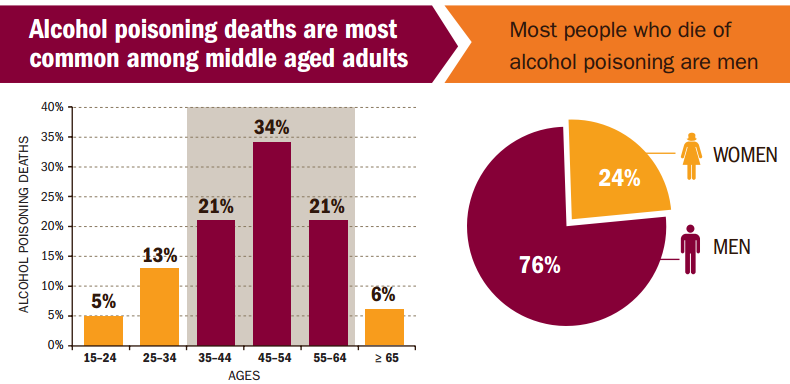
According to the CDC, the age group most likely to die from binge drinking is people 35-64 years old. In fact, three out of every four alcohol poisoning deaths are in this age group — 4.5 out of a total of 6 a day — and 76% of them are men, especially ones who earn over $70,000 a year.777

So why all the PSAs aimed at teens?

Sternheimer argues that the focus on teens has to do with who what groups are identified as problematic populations. In the 1800s and early 1900s, she points out, laws were passed in several states making it illegal for African Americans and Native Americans to drink alcohol. Immigrants were also targeted.

Young people weren’t targeted until the student rebellions of the 1960s and ’70s. Like the “protest psychosis” attributed to black Civil Rights activists, the anti-establishment activism of young people was partly blamed on drug and alcohol use.

Today, she observes, the National Institute of Alcohol Abuse and Alcoholism focuses its attention on young people, minorities, women, and people with HIV.

It’s about power. She writes:

White, middle-class men over thirty typically have more social power than the groups commonly targeted as problems. They also vote, and no sane politician is going to campaign warning of the danger some of these men cause and how we can control them.

Not to mention, she says, how the alcohol industry would feel about the government telling their richest customers to curb their drinking. They much prefer that PSAs focus on young people. “This industry can well afford the much-touted ‘We Card’ programs,” says Sternheimer, “because teens usually don’t have the money for the expensive stuff that their parents can buy.”

The industry’s marketing to wealthy, white men, then, goes unchecked.

Lisa Wade, PhD is an Associate Professor at Tulane University. She is the author of American Hookup, a book about college sexual culture; a textbook about gender; and a forthcoming introductory text: Terrible Magnificent Sociology. You can follow her on Twitter and Instagram.

I don’t yet have a copy of Matt Richtel’s new book, A Deadly Wandering: A Tale of Tragedy and Redemption in the Age of Attention. Based on his Pulitzer-prize winning reporting for the New York Times, however, I’m afraid it’s unlikely to do justice to the complexity of the relationship between mobile phones and motor vehicle accidents. Worse, I fear it distracts attention from the most important cause of traffic fatalities: driving.

A bad sign

The other day Richtel tweeted a link to this old news article that claims texting causes more fatal accidents for teens than alcohol. The article says some researcher estimates “more than 3,000 annual teen deaths from texting,” but there is no reference to a study or any source for the data used to make the estimate. As I previously noted, that’s not plausible.

In fact, only 2,823 teens teens died in motor vehicle accidents in 2012 (only 2,228 of whom were vehicle occupants). So, I get 7.7 teens per day dying in motor vehicle accidents, regardless of the cause. I’m no Pulitzer-prize winning New York Times journalist, but I reckon that makes this giant factoid on Richtel’s website wrong, which doesn’t bode well for the book:

1 (2)

In fact, I suspect the 11-per-day meme comes from Mother Jones (or someone they got it from) doing the math wrong on that Newsdaynumber of 3,000 per year and calling it “nearly a dozen” (3,000 is 8.2 per day). And if you Google around looking for this 11-per day statistic, you find sites like textinganddrivingsafety.com, which, like Richtel does in his website video, attributes the statistic to the “Institute for Highway Safety.” I think they mean the Insurance Institute for Highway Safety, which is the source I used for the 2,823 number above. (The fact that he gets the name wrong suggests he got the statistic second-hand.) IIHS has an extensive page of facts on distracted driving, which doesn’t have any fact like this (they actually express skepticism about inflated claims of cellphone effects).

After I contacted him to complain about that 11-teens-per-day statistic, Richtel pointed out that the page I linked to is run by his publisher, not him, and that he had asked them to “deal with that stat.” I now see that the page includes a footnote that says, “Statistic taken from the Insurance Institute for Highway Safety’s Fatality Facts.” I don’t think that’s true, however, since the “Fatality Facts” page for teenagers still shows 2,228 teens (passengers and drivers) killed in 2012. Richtel added in his email to me:

As I’ve written in previous writings, the cell phone industry also takes your position that fatality rates have fallen. It’s a fair question. Many safety advocates point to air bags, anti-lock brakes and wider roads — billions spent on safety — driving down accident rates (although accidents per miles driven is more complex). These advocates say that accidents would’ve fallen far faster without mobile phones and texting. And they point out that rates have fallen far faster in other countries (deaths per 100,000 drivers) that have tougher laws. In fact, the U.S. rates, they say, have fallen less far than most other countries. Thank you for your thoughtful commentary on this. I think it’s a worthy issue for conversation.

I appreciate his response. Now I’ll read the book before complaining about him any more.

The shocking truth

I generally oppose scare-mongering manipulations of data that take advantage of common ignorance. The people selling mobile-phone panic don’t dwell on the fact that the roads are getting safer and safer, and just let you go on assuming they’re getting more and more dangerous. I reviewed all that here, showing the increase in mobile phone subscriptions relative to the decline in traffic accidents, injuries, and deaths.

That doesn’t mean texting and driving isn’t dangerous. I’m sure it is. Cell phone bans may be a good idea, although the evidence that they save lives is mixed. But the overall situation is surely more complicated than TEXTING-WHILE-DRIVING EPIDEMIC suggests. The whole story doesn’t seem right — how can phones be so dangerous, and growing more and more pervasive, while accidents and injuries fall? At the very least, a powerful part of the explanation is being left out. (I wonder if phones displace other distractions, like eating and putting on makeup; or if some people drive more cautiously while they’re using their phones, to compensate for their distraction; or if distracted phone users were simply the worst drivers already.)

Beyond the general complaint about misleading people and abusing our ignorance, however, the texting scare distracts us (I know, it’s ironic) from the giant problem staring us in the face: our addiction to private vehicles itself costs thousands of lives a year (not including the environmental effects).

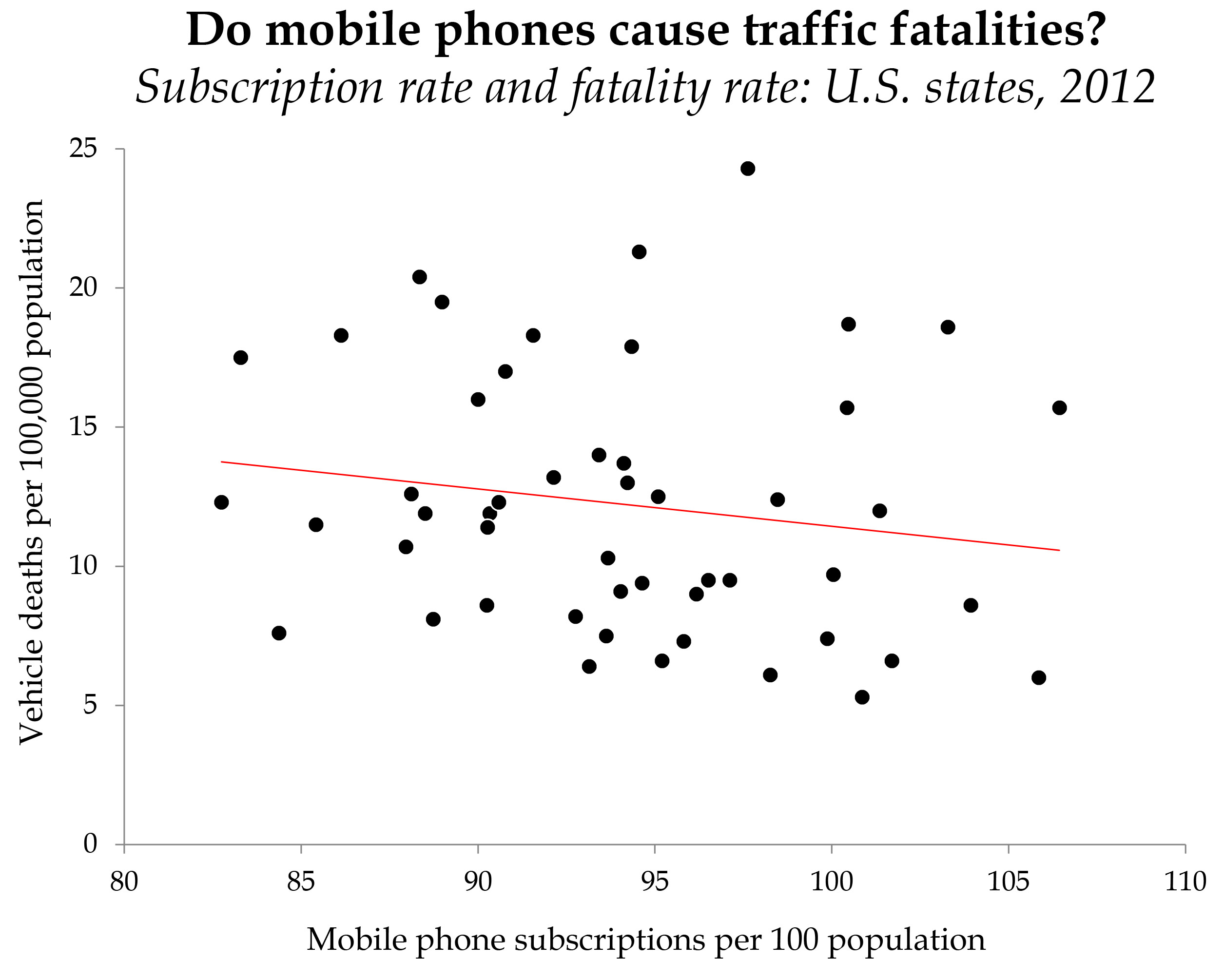
To illustrate this, I went through all the trouble of getting data on mobile phone subscriptions by state, to compare with state traffic fatality rates, only to find this: nothing:

cellphones traffic deaths with NEJM.xlsx

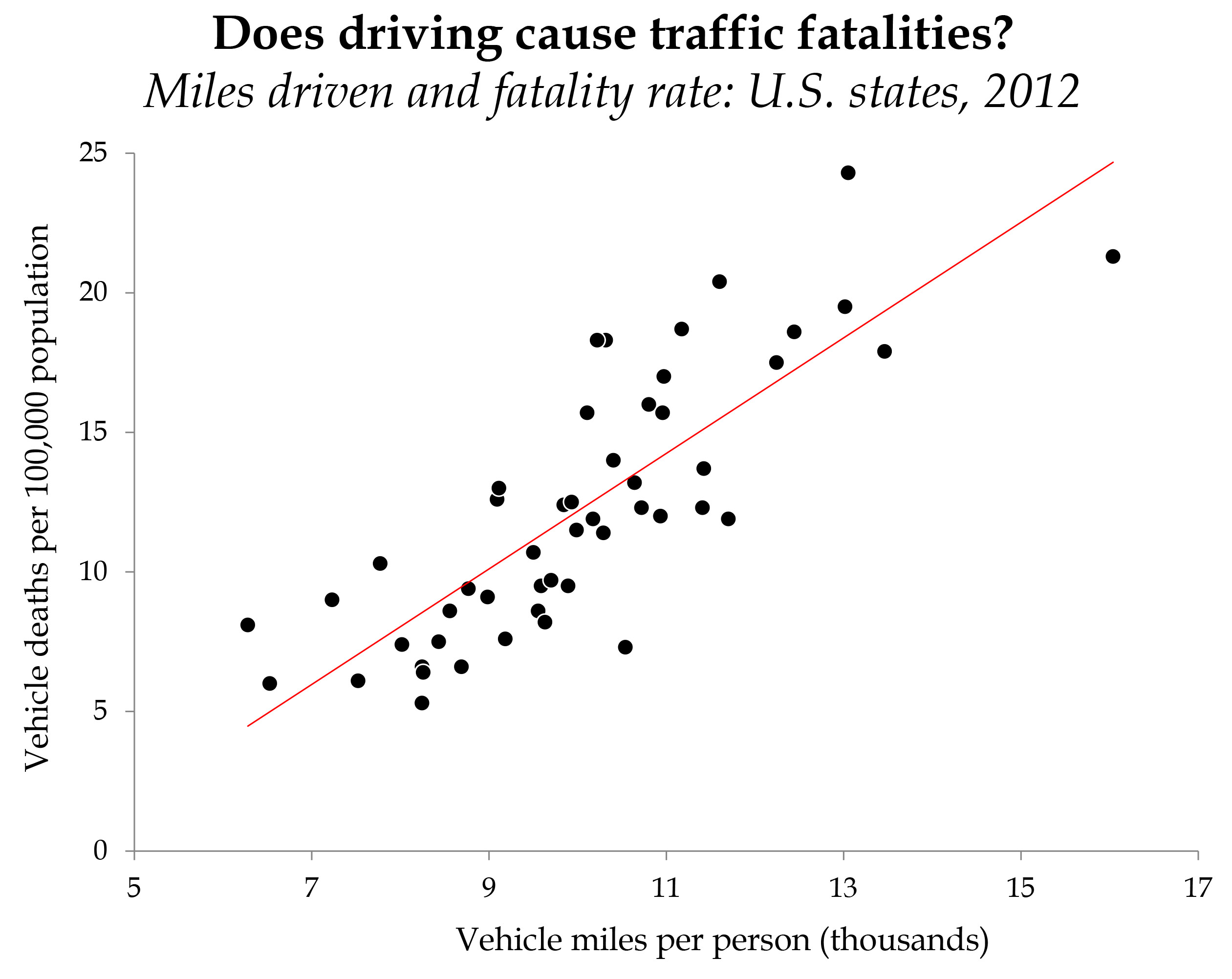
What does predict deaths? Driving. This isn’t a joke. Sometimes the obvious answer is obvious because it’s the answer:

cellphones traffic deaths with NEJM.xlsx

If you’re interested, I also put both of these variables in a regression, along with age and sex composition of the states, and the percentage of employed people who drive to work. Only the miles and drive-to-work rates were correlated with vehicle deaths. Mobile phone subscriptions had no effect at all.

Also, pickups?

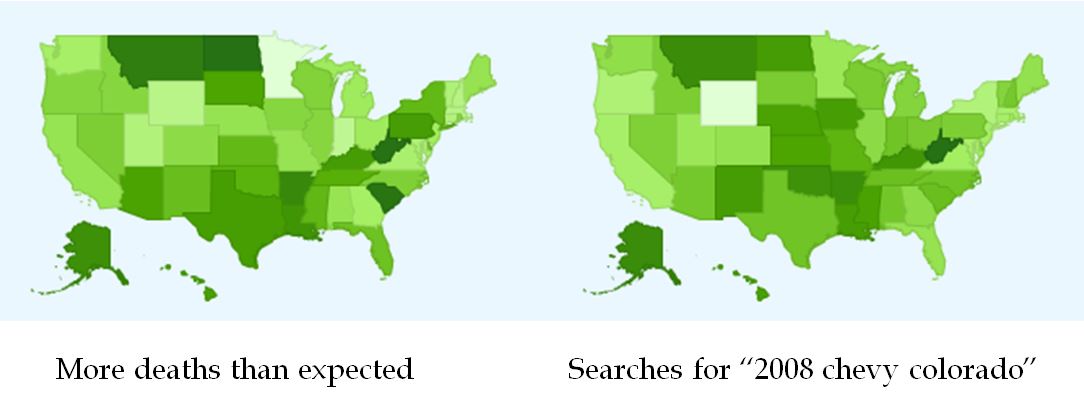
Failing to find a demographic predictor that accounts for any of the variation after that explained by miles driven, I tried one more thing. I calculated each state’s deviation from the line predicted by miles driven (for example Alaska, where they only drive 6.3 thousand miles per person, is predicted to have 4.5 deaths per 100,000 but they actually have 8.1, putting that state 3.6 points above the line). Taking those numbers and pouring them into the Google correlate tool, I asked what people in those states with higher-than-expected death rates are searching for. And the leading answer is large, American pickup trucks. Among the 100 searches most correlated with this variable, 10 were about Chevy, Dodge, or Ford pickup trucks, like “2008 chevy colorado” (r = .68), shown here:

1 (4) - Copy

I could think of several reasons why places where people are into pickup trucks have more than their predicted share of fatal accidents.

So, to sum up: texting while driving is dangerous and getting more common as driving is getting safer, but driving still kills thousands of Americans every year, making it the umbrella social problem under which texting may be one contributing factor.

I used this analogy before, and the parallel isn’t perfect, but the texting panic reminds me of the 1970s “Crying Indian” ad I used to see when I was watching Saturday morning cartoons. The ad famously pivoted from industrial pollution to littering in the climactic final seconds:

Conclusion: Keep your eye on the ball.

Philip N. Cohen is a professor of sociology at the University of Maryland, College Park, and writes the blog Family Inequality. You can follow him on Twitter or Facebook.

Last year the Journal of the American Medical Association released a study aiming to determine the relationship between body mass index and the risk of premature death. Body mass index, or BMI, is the ratio between your height and weight. According to the National Institutes of Health, you are “normal weight” if your ratio is between 18.5-24.9.  Everything over that is “overweight” or “obese” and everything under is “underweight.”

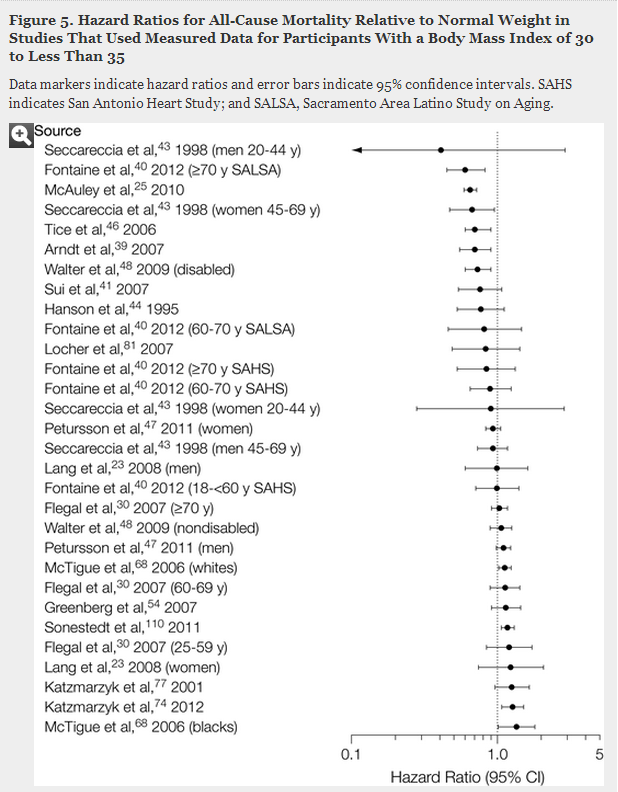
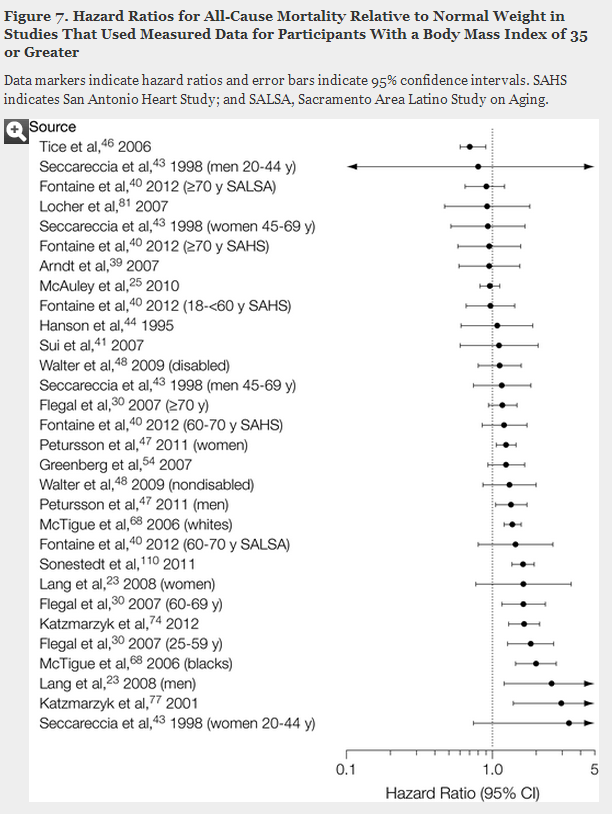
This study was a meta-analysis, which is an analysis of a collection of existing studies that systematically measures the sum of our knowledge.  In this case, the authors analyzed 97 studies that included a combined 2.88 million individuals and over 270,000 deaths.  They found that overweight individuals had a lower risk of premature death than so-called normal weight individuals and there was no relationship between being somewhat obese and the rate of early death. Only among people in the high range of obesity was there a correlation between their weight and a higher risk of premature death.

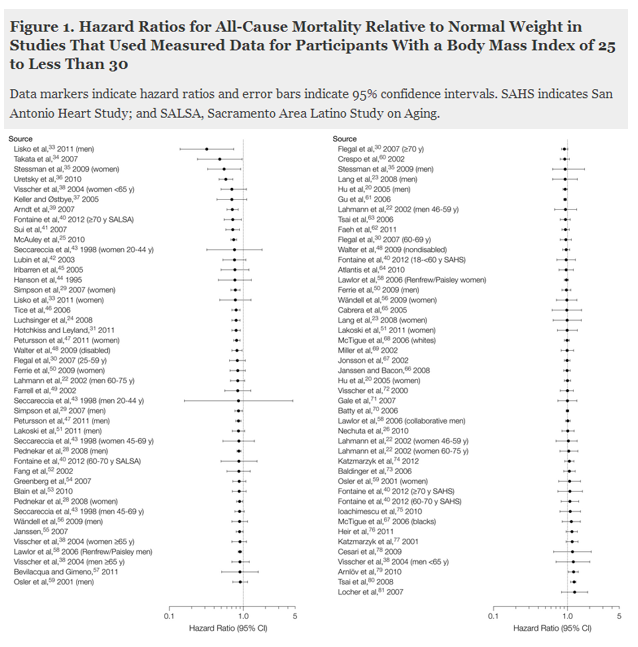
Here’s what it looked like.

This is two columns of studies plotted according to the hazard ratio they reported for people.  This comparison is between people who are “overweight” (BMI = 25-29.9) and people who are “normal weight” (BMI = 18.5-24.9).  Studies that fall below the line marked 1.0 found a lower rate of premature death and studies above the line found a higher rate.

25-29

Just by eyeballing it, you can confirm that there is not a strong correlation between weight and premature death, at least in this population. When the scientists ran statistical analyses, the math showed that there is a statistically significant relationship between being “overweight” and a lower risk of death.

Here’s the same data, but comparing the risk of premature death among people who are “normal weight” (BMI = 18.5-24.9) and people who are somewhat “obese” (BMI = 30-34.9).  Again, eyeballing the results suggest that there’s not much correlation and, in fact, statistical analysis found none.

30-34.9

Finally, here are the results comparing “normal weight” (BMI = 18.5-24.9) and people who are quite “obese” (BMI = 35 or higher). In this case, we do see a relationship between risk of premature death in body weight.

35

It’s almost funny that the National Institutes of Health use the word normal when talking about BMI. It’s certainly not the norm — the average BMI in the U.S. falls slightly into the “overweight” category (26.6 for adult men and 25.5 for adult women) — and it’s not related to health. It’s clearly simply normative. It’s related to a socially constructed physical ideal that has little relationship to what physicians and public health advocates are supposed to be concerned with.  Normal is judgmental, but if they changed the word to healthy, they have to entirely rejigger their prescriptions.

So, do we even have an obesity epidemic? Perhaps not if we use health as a marker instead of some arbitrary decision to hate fat.  Paul Campos, covering this story for the New York Times, points out:

If the government were to redefine normal weight as one that does not increase the risk of death, then about 130 million of the 165 million American adults currently categorized as overweight and obese would be re-categorized as normal weight instead.

That’s 79%.

It’s worth saying again: if we are measuring by the risk of premature death, then 79% of the people we currently shame for being overweight or obese would be recategorized as perfectly fine. Ideal, even. Pleased to be plump, let’s say, knowing that a body that is a happy balance of soft and strong is the kind of body that will carry them through a lifetime.

Cross-posted at Adios Barbie.

Lisa Wade, PhD is an Associate Professor at Tulane University. She is the author of American Hookup, a book about college sexual culture; a textbook about gender; and a forthcoming introductory text: Terrible Magnificent Sociology. You can follow her on Twitter and Instagram.

I am so pleased to have stumbled across a short excerpt from a talk by Alan Watts, forwarded by a Twitter follower.  Watts makes a truly profound argument about what money really is.  I’ll summarize it here and you can watch the full three-and-a-half minute video below if you like.

Watts notes that we like to talk about “laws of nature,” or “observed regularities” in the world.  In order to observe these regularities, he points out, we have to invent something regular against which to compare nature. Clocks and rulers are these kinds of things.

All this is fine but, all too often, the clocks and the rulers come to seem more real than the nature that is being measured.  For example, he says, we might think that the sun is rising because it’s 6AM when, of course, the sun will rise independently of our measures.  It’s as if our clocks rule the universe instead of vice versa.

He uses these observations to make a comment about wealth and poverty. Money, he reminds us, isn’t real. It’s an invented measure.  A dollar is no different than a minute or an inch.  It is used to measure prosperity, but it doesn’t create prosperity any more than 6AM makes the sun rise or a ruler gives things inches.

When there is a crisis — an economic depression or a natural disaster, for example — we may want to fix it, but end up asking ourselves “Where’s the money going to come from?”  This is exactly the same mistake that we make, Watts argues, when we think that the sun rises because it’s 6AM.  He says:

They think money makes prosperity. It’s the other way around, it’s physical prosperity which has money as a way of measuring it.  But people think money has to come from somewhere… and it doesn’t. Money is something we have to invent, like inches.

So, you remember the Great Depression when there was a slump?  And what did we have a slump of?  Money.  There was no less wealth, no less energy, no less raw materials than there were before. But it’s like you came to work on building a house one day and they said, “Sorry, you can’t build this house today, no inches.”

“What do you mean no inches?”

“Just inches!  We don’t mean that… we’ve got inches of lumber, yes, we’ve got inches of metal, we’ve even got tape measures, but there’s a slump in inches as such.”

And people are that crazy!

This is backward thinking, he says.  It is allowing money to rule things when, in reality, it’s just a measure.

I encourage you to watch:

Lisa Wade, PhD is an Associate Professor at Tulane University. She is the author of American Hookup, a book about college sexual culture; a textbook about gender; and a forthcoming introductory text: Terrible Magnificent Sociology. You can follow her on Twitter and Instagram.

“For many of us, quicksand was once a real fear,” write the producers at Radio Lab:

It held a vise-grip on our imaginations, from childish sandbox games to grown-up anxieties about venturing into unknown lands. But these days, quicksand can’t even scare an 8-year-old.

Interviewing a class of fourth graders, writer Dan Engber discovered that most understood the concept, but didn’t find it particularly worrisome.  “I usually don’t think about it,” said one.  They were more afraid of things like aliens, zombies, ghosts, and dinosaurs.  But they understood that it was something that people used to be afraid of: “My dad told me that when he was little his friends always said ‘look out that could be quicksand!'”

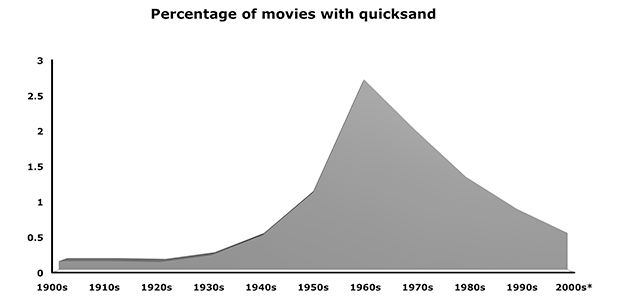
Engber became fascinated with what happened to quicksand.  He found a source of data — compiled by, of all things, quicksand sexual fetishists — that included every movie scene that involved quicksand from the 1900s to the 2000s.  Comparing this number to the total number of movies produced allowed him to show that quicksand had a lifecourse.  It rose in the ’40s, skyrocketed in the ’60s, and then fell out of favor.

1.jpg

Why?

Engber found a pattern in the data.  In quicksand’s early years, the movie scenes featured quicksand as a very serious threat.  But, after quicksand peaked, it became a  joke.  In the ’80s, quicksand even made it into My Little Pony and Perfect Strangers.  Later, in discussions about plot lines for Lost, the idea of quicksand was dismissed as ridiculous.

I guess it’s fair to say that quicksand “jumped the shark.”

In sociology, we call this the social construction of social problems: the fact that our fears don’t perfectly correlate with the hazards we face.  In this case, media is implicated. What is it making us fear today?

Lisa Wade, PhD is an Associate Professor at Tulane University. She is the author of American Hookup, a book about college sexual culture; a textbook about gender; and a forthcoming introductory text: Terrible Magnificent Sociology. You can follow her on Twitter and Instagram.