Tag Archives: gender: marriage/family

Most Women Would Rather Divorce Than Be a Housewife

Cross-posted at Ms.PolicyMic, and The Huffington Post.

Here’s some great news.  The vast majority of young people – about 80% of women and 70% of men across all races, classes, and family backgrounds — desire an egalitarian marriage in which both partners share breadwinning, housekeeping, and child rearing.  The data come from Kathleen Gerson‘s fabulous 2010 book, The Unfinished Revolution.

In practice, however, egalitarian relationships are difficult to establish.  Both work and family are “greedy institutions,” ones that take up lots of time and energy.  Many couples find that, once children arrive, it’s impossible for both to do both with equal gusto.

With this in mind, Gerson asked her respondents what type of family they would like if, for whatever reason, they couldn’t sustain an equal partnership.  She discovered that, while men’s and women’s ideals are very similar, their fallback positions deviate dramatically.

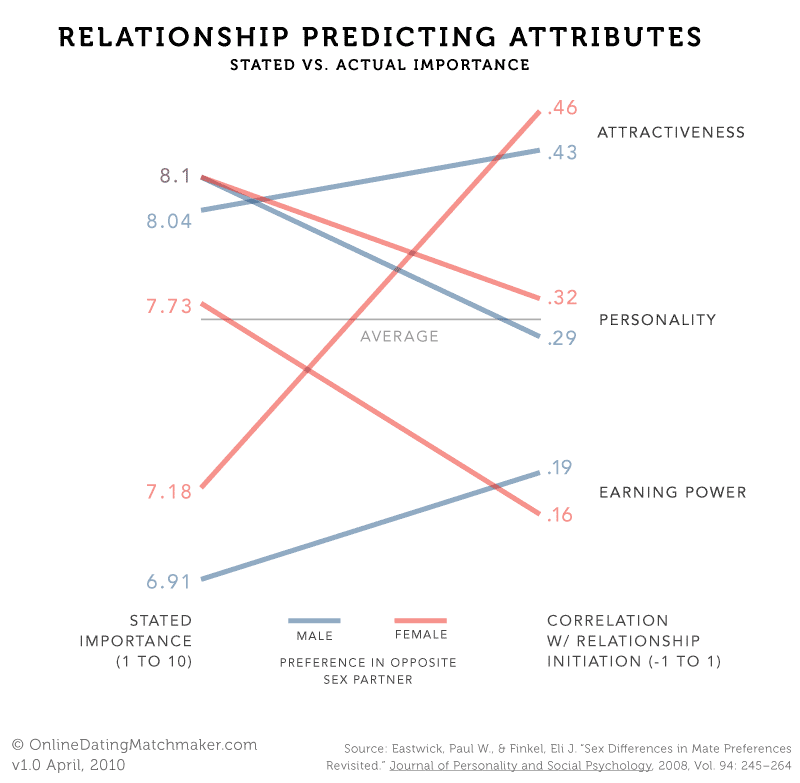
Men’s most common fallback position is to establish a neotraditional division of labor: 70% hope to convince their wives to de-prioritize their careers and focus on homemaking and raising children.  Women?  Faced with a husband who wants them to be a housewife or work part-time, almost three-quarters of women say they would choose divorce and raise their kids alone.  In fact, despite men’s insistence on being breadwinners, women are more likely than men to say they value success in a high-paying career.

Look at this absolutely stunning data (matching ideals on the left; clashing fallback positions on the right):

One of Gerson’s interviewees, Matthew, exemplifies the egalitarian willing to fallback on a neotraditional family form:

If I could have the ideal world, I’d like to have a partner who’s making as much as I am—someone who’s ambitious and likes to achieve.  [But] if it can’t be equal, I would be the breadwinner and be there for helping with homework at night.

And this is what women think of that:

My mother’s such a leftover from the fifties and did everything for my father. I’m not planning to fall into that trap. I’m really not willing to take that from any guy at all.

Alas, what appears to be a happy convergence between men’s and women’s ideals — both are egalitarians — can turn into an intractable situation: a man who won’t give up his role as the breadwinner and a woman who would rather do anything than be a housewife.

Lisa Wade is a professor of sociology at Occidental College. You can follow her on Twitter and Facebook.

Media’s Misillustration of Older Mothers

Cross-posted at Family Unequal.

As I wrote about the older-birth-mothers issue recently (first, and then), I didn’t comment on the photo illustrations people are using with the stories. But when an alert reader sent this one to me, from Katie Roiphe’s post in Slate, I couldn’t help it:

Something about that picture and “women in their late 30s or 40s” rubbed my correspondent the wrong way, or rather, led her to write, “Late 30s or early 40s?!?”

Since this was from a legit website that credits its stock agency, I was able to visit Thinkstock and search for the photo. Sure enough:

Of course, it’s not news, so the title “Middle-aged woman holding her newborn grandson” doesn’t make it a less true illustration of the older-mother phenomenon than one captioned “Desperate aging woman clings to feminist myth that it’s OK to delay childbearing.” But it gives you an idea of what the Slate editor was looking for in the stock photo.

I looked around a little, and found one other funny one. Another Slate essay,this one by Allison Benedikt, was reprinted in Canada’s National Post, and they laid it out like this:

When I visited the Getty Images site, I discovered this picture was taken in China. Here’s how it’s presented:

This one, which is a picture of real people, looks like it could be a grandmother, or maybe more likely a caretaker. Regardless, it’s sold as an illustration of a story about China’s elderly having too few grandchildren to take care of them, which is vaguely related to the content of the story, but that’s not what the Post’s caption points to:

It’s true that older parents are more established and experienced but many of those experiences are, from a genetic point of view, negative, says Allison Benedikt.

Anyway, there were others where the women looked pretty old for the story, but I couldn’t find them in the catalogs, so I stopped.

This is all relevant to one of my critiques of these stories, which is that they make it seem like having children at older ages has become more common than it was in the past. That’s true compared with 1980, but not 1960. The difference is it’s more likely to be their first child nowadays. So Benedikt is way off when she writes,

Remember how there was that one kid in your high school class whose parents were sooooo old that it was weird and creepy? That’s all of us now. Oops.

As I showed, 40-year-old women are less likely to have children now than they were when she was a kid. And when Roiphe writes of the “50-year-old mother in the kindergarten class [who] attracts a certain amount of catty interest and disapproval,” she should be aware that the disapproval — which I don’t doubt exists — is not about the increased frequency of older mothers, but about how people think about them.

Philip N. Cohen is a professor of sociology at the University of Maryland, College Park, and writes the blog Family Inequality. You can follow him on Twitter or Facebook.

The Bachelor Pad: Myth and Reality

For the last week of December, we’re re-posting some of our favorite posts from 2012. Originally cross-posted at Inequality by Interior Design.

There is not actually a great deal of literature on “man caves,” “man dens,” and the like–save for some anthropological and archeological work using the term a bit differently.  There is, however, a substantial body of literature dealing with bachelor pads.  The “bachelor pad” is a term that emerged in the 1960s.  It was a style of masculinizing domestic spaces heavily influenced by “gentlemen’s” magazines like Esquire and Playboy.  Originally referred to as “bachelor apartments,” “bachelor pad” was coined in an article in the Chicago Tribune, and by 1964 it appeared in the New York Times and Playboy as well.

It’s somewhat ironic that the “bachelor pad” came into the American cultural consciousness at a time when the median age at first marriage was at a historic low (20.3 for women and 22.8 for men).  So, the term came into usage at a time when heterosexual marriage was in vogue.  Why then?  Another ironic twist is that while the term has only become more popular since it was introduced, “bachelorette pad” never took off–despite the interesting finding that women live alone in larger numbers than do men.  I think these two paradoxes substantiate a fundamental truth about the bachelor pad–it has always been more myth than reality (see herehereherehere, and here).

The gendering of domestic space had been a persistent dilemma since the spheres were separated in the first place.  Few men were ever able to afford the lavish, futuristic and hedonistic “pads” advertised in Esquireand Playboy.  But they did want to look at them in magazines.

A small body of literature on bachelor pads finds that they played a significant role in producing a new masculinity over the course of the 21st century.  As Bill Ogersby puts it, “A place where men could luxuriate in a milieu of hedonistic pleasure, the bachelor pad was the spatial manifestation of a consuming masculine subject that became increasingly pervasive amid the consumer boom of the 1950s and 1960s” (here).  The really interesting thing is that few men were actually able to luxuriate in these environments.  Yet Playboy – along with a host of copycat magazines — spent a great deal of money, time, and effort perpetuating a lifestyle in which few men engaged.  Indeed, outside of James Bond movies and the Playboy Mansion, I wonder how many actual bachelor pads exist or ever existed.

In the 1950s — despite a transition into consumer culture — consumption was regarded as a feminine practice and pursuit.  Bachelor pads — and the magazines that sold the images of these domestic spaces to men around the country — helped men bridge this gap.  More than a few have noted the importance of Playboy’s (hetero)sexual content in helping to sell consumption to American men.  Barbara Ehrenreich said it this way: “The breasts and bottoms were necessary not just to sell the magazine, but to protect it” (here).  Additionally, the masculinization of domestic space took many forms in early depictions of bachelor pads with ostentatious gadgetry of all types, beds with enough compartments and features to be comparable to Swiss Army knives, and each room designed in anticipation of heterosexual conquest at a moment’s notice.

Paradoxically, bachelor pads seem to have been produced to sell men thehistorically “feminized” activity of consumption.

I’m guessing that many of the “man caves” I’ll see in my research wouldn’t necessarily fit the image most of us conjure in our minds.  But the ways men with caves talk about them are replete with images not yet fully realized by men who are most often economically incapable of architecturally articulating domestic spaces without which they may never feel “at home.”

———————

Tristan Bridges is a sociologist of gender and sexuality.  He starts as an Assistant Professor of Sociology at the College at Brockport (SUNY) in the fall of 2012.  He is currently studying heterosexual couples with “man caves” in their homes.  Tristan blogs about some of this research and more at Inequality by (Interior) Design.  You can follow him on twitter @tristanbphd.

Lisa Wade is a professor of sociology at Occidental College. You can follow her on Twitter and Facebook.

Class Privilege and Parental Leave

For the last week of December, we’re re-posting some of our favorite posts from 2012. Cross-posted at Pacific Standard and Global Policy TV.

The United States is unusual among developed countries in guaranteeing exactly zero weeks of paid time-off from work upon the birth or adoption of a child. Japan offers 14 weeks of paid job-protected leave, the U.K. offers 18, Denmark 28, Norway 52, and Sweden offers 68 (yes, that’s over a year of paid time-off to take care of a new child).

The U.S. does guarantee that new parents receive 12 weeks of non-paid leave, but only for parents who work in companies that employ 50 workers or more and who have worked there at least 12 months and accrued 1,250 hours or more in that time.  These rules translate to about 1/2 of women.  The other half are guaranteed nothing.

Companies, of course, can offer more lucrative benefits if they choose to, so some parents do get paid leave.  This makes the affordability of having children and the pleasure and ease with which one can do so a class privilege.  A new report by the U.S. Census Bureau documents this class inequality, using education as a measure.  If you look at the latest data on the far right (2006-2008), you’ll see that the chances of receiving paid leave is strongly correlated with level of education:

Looking across the entire graph, however, also reveals that this class inequality only emerged in the early 1970s and has been widening ever since.  This is another piece of data revealing the way that the gap between the rich and the poor has been widening.

Just to emphasize how perverse this is:

  • People with more education, who on average have higher incomes, are often able to take paid time off; but less-economically advantaged parents are more likely to have to take that time unpaid.  During the post-birth period, then, the economic gap widens.

There’s more:

  • Many less-advantaged parents can’t afford to take time off un-paid, so they keep working.  But even this widens the gap because their salary is lower than the salary the richer person continues to receive during their paid time off of work.  So the rich get paid more for staying home than the poor get for going to work.

We often use the minimizing word  “just” when  describing what stay-at-home parents do.  “What are you doing these days?” asks an old friend at a class reunion.  “Oh, just staying home and taking care of my kids,” a parent might say, as if raising kids is “doing nothing.”  We trivialize what parents do.  But, in fact, raising children is a valuable contribution to the nation.  We need a next generation to keep moving forward as a country.  Unfortunately the U.S. continues to treat having kids like a hobby (something its citizens choose to do for fun, and should pay for themselves).  Without state support for early parenting, being present in those precious early months is a class-based privilege, one that ultimately exacerbates the very class disadvantage that creates unequal access to the luxury of parenting in the first place.

Lisa Wade is a professor of sociology at Occidental College. You can follow her on Twitter and Facebook.

Gender and the Dual Career Academic Couple

For the last week of December, we’re re-posting some of our favorite posts from 2012.

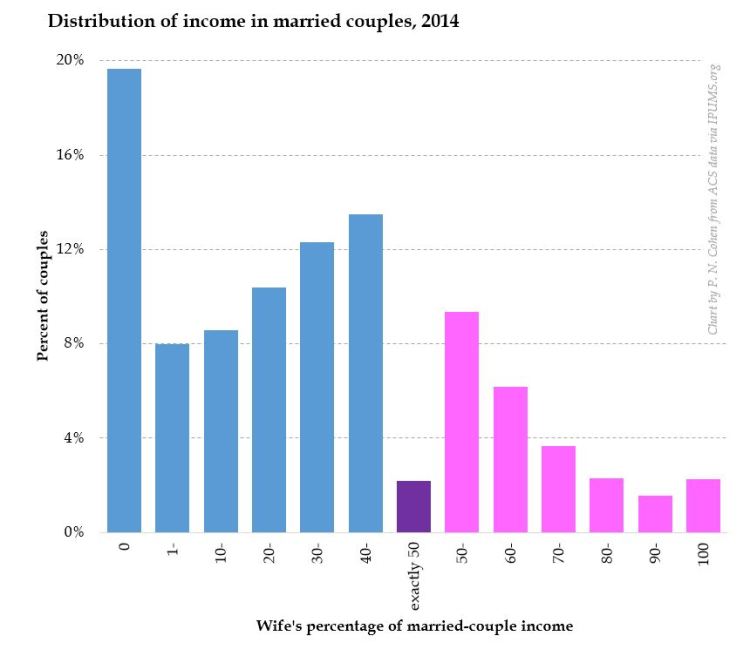
In an effort to map the shape of the dual career challenge, the Clayman Institute for Research on Gender at Stanford University did a survey of 30,000 faculty at 13 universities. The study was headed by Londa Schiebinger, Andrea Henderson, and Shannon Gilmartin.

When academics use the phrase “dual career,” they’re referring to the tendency of academics to marry other academics, making the job hunt fraught with trouble.  Most institutions are not keen to hire someone’s partner just because they exist.  Meanwhile, the academic job market is tough; it’s difficult to get just one job, let alone two within a reasonable commute of one another.

So, what did the researchers find?

More than a third of professors are partnered with another professor:

When we break this data down by gender, we see some interesting trends.  Female professors are somewhat more likely to be married to an academic partner (40% of women versus 34% of men), they are twice as likely to be single (21% are single versus 10% of men; racial minority women are even more likely), and they are only 1/4th as likely to have a stay-at-home partner:

On the one hand, since women are more likely to have an academic partner, the problem of finding a job for a pair of academics hits women harder.  On the other hand, the fact that they are more often single makes choosing a job simpler for a larger proportion of women than men.  (On anther note, if you’ve ever wondered why fewer female than male academics have children, there are several answers in the pie charts above.)

For women who are partnered with another academic, the data is starker than the 6 point difference above would suggest.  The researchers asked members of dual-career academic couples, whose job comes first?  Half of men said that theirs did, compared to only 20% of women.  When it comes to balancing competing career demands, then, women may be more willing to compromise than men.

There is a lot more detailed information on academic couples and what institutions think of them in the report. Or, listen to Londa Schiebinger and the other researchers describe their findings:

Lisa Wade is a professor of sociology at Occidental College. You can follow her on Twitter and Facebook.

When “Intensive Mothering” Meets Special Needs

For the last week of December, we’re re-posting some of our favorite posts from 2012.

In Mother-Blame in the Prozac Nation, sociologist Linda Blum describes the lives of women with disabled children.  While mothers are held to an essentially impossibly high standard of motherhood in the contemporary U.S. and elsewhere, mothers of disabled children find themselves even more overwhelmed.

The daily care of their child is often more intensive but, in addition to that added responsibility, mothers were actively involved in getting their children needed services and resources.  The need for mothers to be proactive about this was exacerbated by the fact that they had to negotiate different social institutions, each with an interest in claiming certain service spheres, but also limited budgets.  ”While each system claims authoritative expertise,” Blum writes, ” either system can reject responsibility, paradoxically, when costs are at issue.”  Because they often had to argue with service providers and find ways to beat a system that often tried to keep them at bay, they had to become experts in their child’s disability, of course, but also public policy, learning styles, the medical system, psychology/psychiatry, pharmaceutics, manipulation of jargon and law, and more.

Mothers often felt that they were their child’s only advocate, with his or her health and future dependent on making just one more phone call, getting one more meeting with an expert, or trying one more school. Accordingly, they were simultaneously exhausted and filled with guilt.  I wondered, when I came across this Post Secret confession, if this mother was experiencing some of the same things:

Lisa Wade is a professor of sociology at Occidental College. You can follow her on Twitter and Facebook.

Holidays: A Time for Men to Buy Themselves Stuff

‘Tis the season where women’s workloads expand because they are held disproportionately responsible for the cleaning, decorating, cooking, card sending, gift buying, and gift wrapping involved with the holidays (e.g., you need 12 mums and 6 arms to make it all happen).

In light of that, this “survival tip” from Ace Hardware encouraging men to buy things for themselves is especially obnoxious.  Thanks to Martha J. for sending it to us!

—————————

Lisa Wade is a professor of sociology at Occidental College. You can follow her on Twitter and Facebook.

5-Hour Energy Acknowledges the Second Shift

Sociologists Arlie Hochschild and Anne Machung used “the second shift” to refer to the responsibilities of childcare and housework borne disproportionately by women, in addition to their paid labor.

A student in Will LaSuer’s class at the University of Akron noticed that a 5-Hour Energy ad explicitly references this idea of a second shift for women. A harried mom with an armful of groceries enters a home full of yelling kids. She talks about getting home from her first job to start her second job, and how worn out this can make her:

Of course, the ad doesn’t actually critique this arrangement or the organization of household duties. The second shift is taken for granted, an unavoidable burden. Consumption provides the answer: buy a product that gives you more energy so you can tackle that second job when you get home. Problem solved!

Gwen Sharp is an associate professor of sociology at Nevada State College. You can follow her on Twitter at @gwensharpnv.