Tag Archives: deviance

Examining Cultural Change: Children’s Tattoo Toys

Cross-posted at Cyborgology.

As part of my research into the popularization of tattooing, I have accumulated quite a few interesting links on tattoo toys for children. I don’t mean those temporary tattoos we all used to get from the vending machines at popular chain restaurants. This toys I am talking about have drawn flack from parents as being “inappropriate” for kids, creating an example of a burgeoning “moral panic”. Some examples include: tattoo inspired toddler weartattoo machines for kids, and of course, tattooed Barbie dolls.

The most recent children’s tattoo toy to come under attack is the collector’s edition “Tokidoki Barbie,” which features prominent arm, chest, and neck tattoos. This is the first Barbie to come out of its packaging with tattoos already applied. The first tattooed Barbie called “Totally Stylin’ Tattoo Barbie” was interactive and designed for children, allowing them to paste the temporary tattoos (actually stickers) on themselves or the doll. This new “Tokidoki Barbie” is not a toy so much as a collector’s item, meant to capture a particular historical moment in time and to be exchanged between collectors (the doll is now auctioning for roughly $500 each). With a hefty $500 price tag, I do not see many children playing with this doll. It is also not sold in stores, and is only available online.

Tokidoki Barbie:

Toys like these have been released every few years since the 1990s, when tattooing was ranked as the 6th fastest growing industry in the country (Vail 1999). But we are now seeing more children’s tattoo toys spring up, dovetailing with the increasing popular interest in the craft. We may very well be observing a second Tattoo Renaissance (Rubin 1988), especially given the expansion of the industry and the artistic flowering that has occurred since the tattoo reality TV shows first emerged in summer 2005. 

I believe we are we observing a cultural paradigm shift (Kuhn 1962) regarding tattooing.  Cultural trends are slowly reshaping popular conceptions of tattooing, turning them from “marks of mischief” (Sanders 1988) into an “ironic fad” (Kosut 2006) of consumer capitalism. Whereas tattooing was once largely reserved for working-class men, sailors, carnival performers, and exotic dancers, we have since seen the practice become widely popular amongst all races, genders, and classes.

G8 Tat2 Maker by Spin Master Toys:

Beginning with the Tattoo Renaissance of the 1960s (Rubin 1988) and more recently with the expansion into reality television (Lodder 2010), we have seen the cultural cache of tattooing shift in favor of middle-class notions of identity work (Atkinson 2003); that is, towards seeing the body as a vehicle for expressing oneself, towards actively controlling and crafting the body as a form of empowerment, and towards the development of “distinctive individualism” through appearance (Muggleton 2002). The highly narrative focus of tattooing contained in popular reality TV shows like “LA Ink” or “NY Ink” only bolster these trends, as new tattoo enthusiasts invest deeply-held meanings into each tattoo.

But these trends do not mean that tattoo toys aimed at children are any less offensive to some. Largely, it appears to be a generational divide: youth are much more supportive (in fact, largely celebratory) towards body art like tattoos and piercings, but the baby boomers continue to view tattoos through the lens of deviance.

For people of my parents generation, tattoos continue to be a symbol of deviant proclivities. Some have even called it a “disease” plaguing the youth of today. I have taken issue with such an interpretation of tattooing, especially by social scientists who continue to conceptualize the practice as an indicator of mental pathology or emotional instability, and have proposed a “pro-social” conception of contemporary body modifications like tattooing and piercing [you can read my work here]. In my opinion it is just a matter of time before prominent and visible tattoos become commonplace in professional and public settings, tattooed Barbie notwithstanding.

——————————

David Paul Strohecker (@dpsFTW) is a PhD student at the University of Maryland, College Park. He studies issues of intersectionality, consumption, and popular culture. In addition to his work on the popularization of tattooing, a project on the revolutionary pedagogy of public sociology, and more theoretical work on zombie films as a vehicle for expressing social and cultural anxieties. He previously wrote for the blog Racism Review and currently blogs at Cyborgology.

For more from Strohecker, see his posts on facial tattoos, the origins of zombies, QR codes and the digital divide, and laughing at disability.

If you would like to write a post for Sociological Images, please see our Guidelines for Guest Bloggers.

The Last Sideshow Fat Man

I like this post. And it’s the two-year anniversary of Bruce Snowdon’s death. So, here’s my toast to the last sideshow fat man.

He’s so big and so fat it takes four girls to hug him and a box car to lug him.  When he dances you’ll swear he must be full of jelly, cause jam don’t shake that way.  And you know girls!  He is single and lookin’ for a wife, he’ll make some lucky girl a fine husband, why he’s so big and fat, he’ll provide you with a lot of shade in the summertime, keep you nice and warm in the winter time and give you lots of good heavy lovin’ all of the time!

– Carnival Spiel by Ward Hall

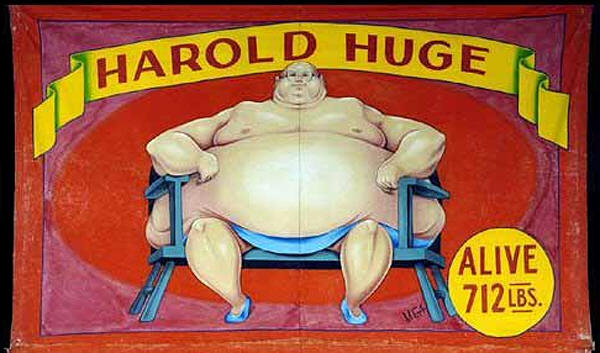
On Nov. 9th 2009, Harold Huge, a man billed as the very last sideshow fat man, died.  He weighed 607 pounds or so.

Harold’s real name was Bruce Snowdon.  He had degrees in paleontology, anthropology and chemistry. In 1977, he found himself bored with his work and stumbled across the idea of being a Fat Man:

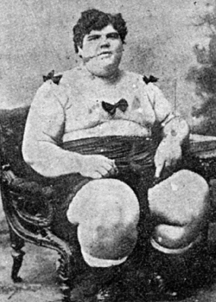
I had put on a lot of weight between the time I was 20 and 25. I was up to about 450 in those days. I went to the local library, and I was poking through some old circus books and I see this one picture about a sideshow, maybe circa 1905, and I’m looking at this fat man and I’m saying to myself, “He can’t weigh more than 350 pounds.”

Now, I ask myself, how the hell would I go about getting into a sideshow? I’d never even seen a sideshow in my lifetime. In the late ’70s the industry was a very pale ghost of its former self. Instead of thousands, there were maybe dozens left then. So I figured, logically, there’s got to be some sort of trade journal for the carnival industry. It’s Amusement Business. And I’m looking through the AB. Taking a lucky stab, I wrote the editor, Tom Powell. And Tom Powell happens to be a very good friend of Ward Hall. Bingo. I had the job.

Bruce, 1978:

In an interview with James Taylor (from which the above quote is also taken), Snowden explained:

I don’t mind being enormously fat… I come from a long line of fat people. My old man tortured himself for 40 years going from 200 to 300 [pounds] and back again. He eventually lost the weight, but he also lost his mind.

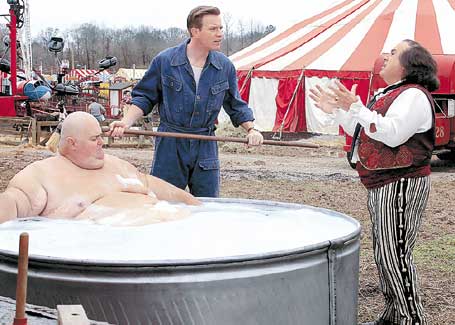
Snowdon played Harold Huge for 26 years.  The year of his retirement, in 2003, he played himself in the movie, Big Fish:

After retirement, he raised chickens:

So the sociological question I would like to pose is: Why is Snowdon the last fat man?

Marc Hartzman suggests that fat men and woman became less of a curiosity because “waistlines expanded and obesity became less of a laughing matter.  As the years went by, spotting a man who weighed more than quarter of a ton was not that unusual…”  So there’s two  hypotheses: (1) we see fat people everywhere and so it’s no longer a curiosity and (2) obesity has become a very serious matter, not to be played with at sideshows or elsewhere.

Another hypothesis might involve (3) a growing distaste for objectifying and dehumanizing those who are unusual.   As the human rights era evolves, we increasingly embrace difference and promote tolerance.

(4) Perhaps sideshows themselves are simply out-of-fashion, a drab alternative to Avatar in 3D or a Wii.  Or, (5) maybe the internet has made all curiosity easier to quench.  With a click of the button, we can see DD breasts, thalidomide babies, and cats playing the piano… who needs a sideshow?

I can think of reasons to endorse and reject all of these hypotheses.

So, in honor of Snowdon’s 26 years of service and delightful sense of humor (“If there’s a bitchy type of human being, it’s somebody on a diet”), let’s speculate.

Sources: Sideshow World, AOL News, Shocked and Amazed, Randall Levenson photography, and Shapely Prose.

Lisa Wade is a professor of sociology at Occidental College and the co-author of Gender: Ideas, Interactions, Institutions. You can follow her on Twitter and Facebook.

The Power of Conformity


In The Lucifer Effect: Understanding How Good People Turn Evil, Philip Zimbardo tries to explain how seemingly ordinary, average people can become involved in, or passively fail to oppose, evil acts. Zimbardo is the researcher who designed the (in)famous 1971 Stanford prison experiment,  in which students were randomly assigned as “prisoners” or “guards” for an experiment on how prison affects human behavior. The experiment, meant to last two weeks, had to be called off after 6 days because of the extreme negative effects on, and brutality emerging among, the participants. Zimbardo’s study, as well as others such as Milgram’s obedience experiment, highlighted the role of conformity to social norms and obedience to apparent authority figures in leading people to engage in actions that would seem to be so ethically unacceptable that any decent person would refuse.

Dolores R. sent in a Candid Camera clip from 1962 that illustrates the power of conformity:

As Zimbardo says on his website,

We laugh that these people are manipulated like puppets on invisible strings, but this scenario makes us aware of the number of situations in which we mindlessly follow the dictates of group norms and situational forces.

From Open Culture, via Boing Boing.

Do Explicit, Enforceable Policies Matter?

Cross-posted from Family Inequality.

The Supreme Court’s decision in the Dukes v. Wal-Mart case, Justice Scalia acknowledged that Wal-Mart’s many local managers had a lot of discretion in their personnel decisions, even though the company had a written policy against gender discrimination (who doesn’t?). But he gave the company credit for a vague policy and let it off the hook for a systematic pattern of disparity between men and women. So, when does a toothless, vague policy with wide discretion lead to a bad outcome, and is failing to prevent it the same as causing it?

A path-breaking sociological analysis of organizational affirmative action outcomes has shown that the companies that successfully diversify their management are most likely to have policies with teeth – where accountability is built into the diversity goal. In light of the Wal-Mart case, this led to a rollicking debate about how to think about “corporate culture” versus policies, and when to blame whom, legally or otherwise – which even divided sociologists.

Smoking in the movies

Here’s an interesting, at-least-vaguely related case. Positive depictions of smoking in the movies are widely understood to be harmful. Yet, smoking is also glamorous, artistic, and popular – representing both anti-adult rebellion and maturity. So, what to do? The Centers for Disease Control, in the always-riveting Morbidity and Mortality Weekly Report, has published a fascinating report on this topic. They report the number of tobacco incidents* in top-grossing, youth-rated (G, PG, PG-13) movies, and divide them between those that implemented an anti-tobacco policy and those that didn’t — helpfully cutting the movie industry roughly in half — and provide a simple before-and-after tabulation:

From 2005 to 2010, among the three major motion picture companies (half of the six members of the Motion Picture Association of America [MPAA]) with policies aimed at reducing tobacco use in their movies, the number of tobacco incidents per youth-rated movie decreased 95.8%, from an average of 23.1 incidents per movie to an average of 1.0 incident. For independent companies (which are not MPAA members) and the three MPAA members with no antitobacco policies, tobacco incidents decreased 41.7%, from an average of 17.9 incidents per youth-rated movie in 2005 to 10.4 in 2010, a 10-fold higher rate than the rate for the companies with policies. Among the three companies with antitobacco policies, 88.2% of their top-grossing movies had no tobacco incidents, compared with 57.4% of movies among companies without policies.

The difference is dramatic, as indicated by this image about the images. (Because I turned the columns into cigarettes, this is not just a graph, but an infographic):


The policies provide what may be an ideal mix of accountability and responsibility, short of a simplistic ban.

[The policies] provide for review of scripts, story boards, daily footage, rough cuts, and the final edited film by managers in each studio with the authority to implement the policies. However, although the three companies have eliminated depictions of tobacco use almost entirely from their G, PG, and PG-13 movies, as of June 2011 none of the three policies completely banned smoking or other tobacco imagery in the youth-rated films that they produced or distributed.

Maybe this formula is effective because there already has been a strong cultural shift against smoking — as strong, even, as the shift against excluding women from management positions?

Graphic addendum (disturbing image below)

Whether smoking in movies actually encourages young people to take up smoking is of course a not a settled issue — especially on websites sponsored by tobacco sellers, as seen in this ironic screen-shot from Smokers News:


One reason to have an explicit policy is that it’s easy to assume viewers will see through the glamour to the negative outcomes. “Surely no one will want to be like that character…” But people – maybe especially young people? – have an amazing capacity to celebrate selectively from the characters they see. I have learned from experience that, in children’s stories, even those who get their comeuppance in the end still manage to emerge as role models for their bad behavior. So maybe some people want to relive this from Pulp Fiction…

…and aren’t put off by this:

—————————–

* “A new incident occurred each time 1) a tobacco product went off screen and then back on screen, 2) a different actor was shown with a tobacco product, or 3) a scene changed, and the new scene contained the use or implied off-screen use of a tobacco product.”

Slovenly or Sick? The Medicalization of the Messy

My wife introduced me to two television shows, both built on a similar premise but with radically different results.

First, check out this clip from Clean House, airing on the Style Network.

Now, compare that to this ad for Hoarders, airing on the A&E Network.

This is a wonderful example of medicalization. We have people engaging in almost the exact same behavior, but their actions are interpreted in two diametrically opposed ways. Clean House generally (though not exclusively) frames their subjects as having poor habits that, with a little tough love, can be corrected. Hoarders, on the other hand, frames their subjects as having serious mental illnesses. Indeed, they regularly bring in clinicians to treat their subjects. The former invokes judgment (note the eye-rolling and smirking in the first clip), while the latter invokes sympathy (hear the dire music).

Our behaviors do not come with meaning necessarily embedded in them. We have to made sense of them, and the way that we ultimately do so has consequences. We did this in the past with the behavior of children, particularly of little boys. Is Johnny being rambunctious? There once was a time when Johnny was sent to the principal’s office for a spanking, but today, he is much more likely to be diagnosed with ADHD and given a pill. As we medicalize more and more in our society, our acceptance of and reaction to our behaviors change.

————————

Bradley Koch, PhD, is an assistant professor of sociology at Georgia College. Brad primarily studies religion but is also interested in sexuality, stratification, teaching and learning, and higher ed. Brad muses, appropriately enough, at Brad’s Blog.


If you would like to write a post for Sociological Images, please see our Guidelines for Guest Bloggers.

Police Raids and the Stonewall Riots

Originally posted Feb. 11, 2009.  Reposted in honor of the anniversary of the Stonewall Riots.

I found a collection of images relating to gay and lesbian studies put together at Columbia University, including this scan of a NYT article on what came to be known as the Stonewall Riots, when crowds reacted violently when police attempted to raid a club on June 28, 1969 (skirmishes continued for several days):

1times1a

Graffiti from the Stonewall Riots (published in the Village Voice):

voice2

There are also some other good photos unrelated to Stonewall such as this one, from 1962, of entertainers at a drag club being hauled off by police after a raid:

1dub3

The database might be useful if you’re interested in what is generally seen as the start of the gay rights movement.

The Racialization of Mental Illness

Cross-posted at Jezebel and AOL’s Black Voices.

In a new book called “The Protest Psychosis: How Schizophrenia became a Black Disease,” psychiatrist and cultural critic Jonathan Metzl draws on a variety of sources — patient records, psychiatric studies, racialized drug advertisements, and popular metaphors for madness — to contend that schizophrenia transformed from being a mostly white, middle-class affliction in the 1950s, to one that identified with blackness, volatility, and civil strife at the height of the Civil Rights movement.

The racialized resonance between emerging definitions of schizophrenia and anxieties about black protest seem clear in pharmaceutical advertisements and essays appearing in leading American psychiatric journals during the 1960s and 70s.  For instance, the advertisement for the major tranquilizer Haldol that ran in the Archives of General Psychiatry shows an angry, hostile African American man with a clenched, inverted, Black Power fist.

The deranged black figure literally shakes his fist at the assumed physician viewer, while in the background a burning, urban landscape appears to directly reference the type of civil strive that alarmed many in the “establishment” at that time.  The ad compels psychiatrists to conflate black anger as a form of threatening psychosis and mental illness.  Indeed the ad seems to play off presumed fears of assaultive and belligerent black men.

As the urban background suggests, this fear extended beyond individual safety to social unrest.  In a 1969 essay titled “The Protest Psychosis,” after which Metzl’s book is named, psychiatrists postulated that the growing racial disharmony in the US at the height of the Civil Rights Movement, reflected a new manifestation of psychotic behaviors and delusions afflicting America’s black lower class.  Accordingly, “paranoid delusions that one is being constantly victimized” drew some men to fixate on misguided ventures to overthrow the establishment.  Luckily, pharmaceutical companies proposed that chemical interventions could directly pacify the masculinzed, black threat depicted in advertisements like the above.  “Assaultive and belligerent?” it asks.  “Cooperation often begins with Haldol.”

Moreover, ads for Thorazine and Stelazine during this period often conjured up images of the “unruly” and “primitive” precisely at a time when the demographic composition of this diagnosis was dramatically shifting from a mostly white clientele, to a group of predominately black, confined, mental patients.  It is telling that within this context, the makers of Thorazine would choose to portray the drug’s supposed specificity to schizophrenia in their advertisements by displaying a variety of war staffs, walking sticks, and other phallic artifacts from African descent.

The below ad for Thorazine, for example, exclaims western medicine’s superiority in treating mental illness with modern pharmaceuticals, by contrasting the primitive tools used by less enlightened cultures.

Notably, these claims of superiority and medical efficacy drew from a particular set of pejorative ideas of the “primitive” that were already well established within some sectors of psychiatry that equated mental illness with primitive, animalistic and regressive impulses.   As Metzl contends in his book:

…pharmaceutical advertisements shamelessly called on these long-held racist tropes to promote the message that social “problems” raised by angry black men could be treated at the clinical level, with antipsychotic medications.

These adds are in sharp contrast to previous marketing campaigns that framed schizophrenia in the 1950s as a mental condition affecting mostly middle class patients, and especially women.  Also shown below, ideas of schizophrenia were at that time an amorphous collection of psychotic and neurotic symptoms that were thought to afflict many women who struggled to accept the routines of domesticity.

While schizophrenia is certainly a real, frightening, debilitating disease, Metzl reminds us that cultural assumptions of the “other” shape how psychiatry understands and treats the condition.

————————

Arturo Baiocchi is a doctoral student in Minnesota interested in issues of mental health, race, and inequality.  He is writing his dissertation on how young adults leaving the foster care system understand their mental health needs.  He is also a frequent contributor to various Society Pages podcasts and wanted to post something related to a recent interview he did about the racialization of mental illness.

If you would like to write a post for Sociological Images, please see our Guidelines for Guest Bloggers.


The Deconstruction of Indulgence (NFSW)

Cross-posted at Ms.

Growing up in America, we learn that sweets and junk food are “guilty pleasures.” Women, especially, are supposed to refrain from such indulgences.  And, if they cannot — if they, for example, desire more than that modest slice of cake served to each birthday guest — then they should feel not only guilt, but shame.  For overindulging is grotesque and it, accordingly, should be hidden and kept secret.

This is the cultural background to Lee Price‘s realist paintings of women (mostly her) eating sweets and junk food.  She draws two contrasts.  First, she makes very public something we are supposed to do only in private.  Not only do the paintings literally display the transgression, the birds eye view and frequent nudity exaggerates the sheer display of the indulgence.  And, second, she takes something that is supposedly disgusting and shameful and presents it in a medium associated with (high) art, challenging the association of indulgence with poor character and a lack of refinement.  Fascinating.

Jelly Doughnuts:

Refuge:

Cherry Cheesecake II:

The next two are not safe for work because of nudity, so they’re after the jump:

(more…)

Lisa Wade is a professor of sociology at Occidental College and the co-author of Gender: Ideas, Interactions, Institutions. You can follow her on Twitter and Facebook.