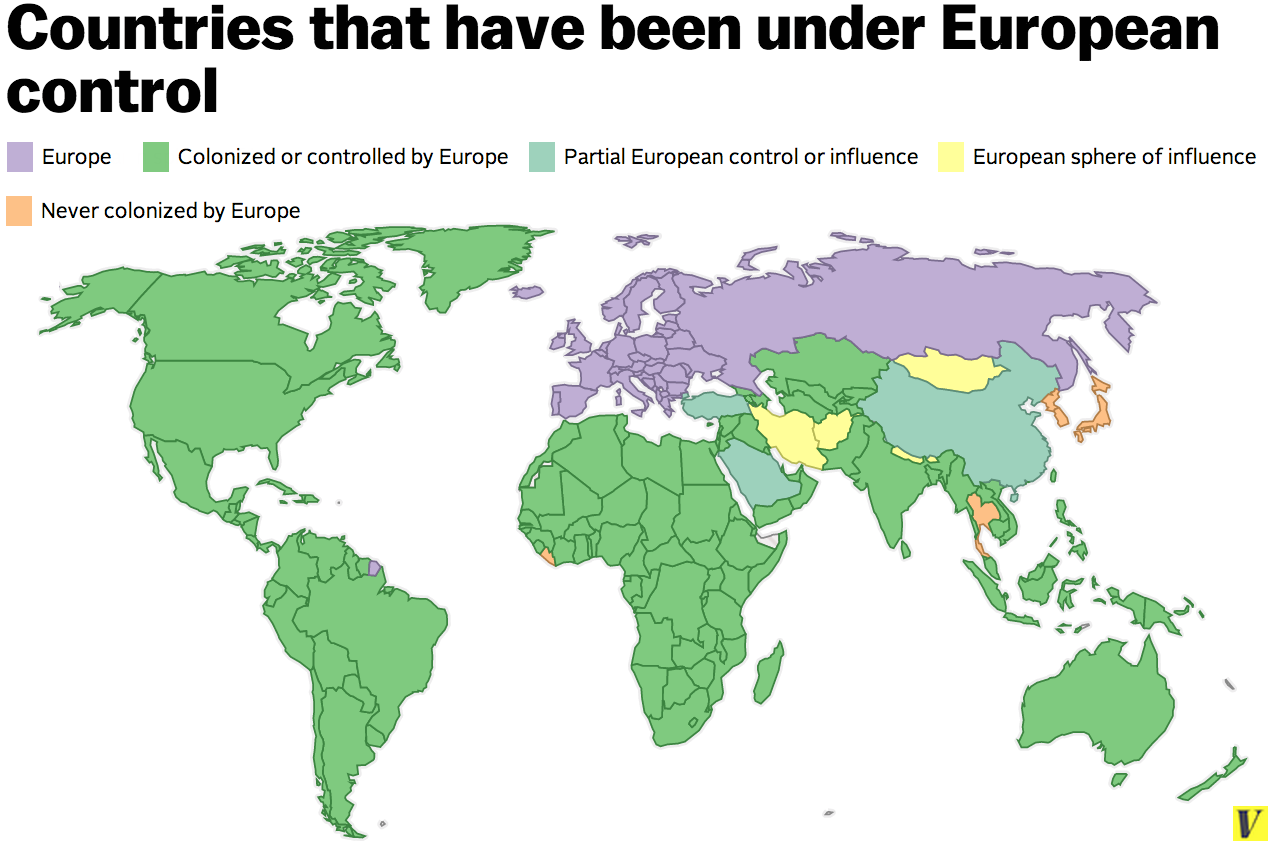
This is a map of the countries Europe colonized, controlled, or influenced between 1500 and 1960. The purple is Europe. The orange countries are ones never under European rule. Almost the entire rest of the map — all the green, blue, and yellow — were dominated by Europe to some extent. “Influenced” is pretty much a euphemism and often not all that different than outright domination.
There are only four countries that escaped European colonialism completely. Japan and Korea successfully staved off European domination, in part due to their strength and diplomacy, their isolationist policies, and perhaps their distance. Thailand was spared when the British and French Empires decided to let it remained independent as a buffer between British-controlled Burma and French Indochina…
Then there is Liberia, which European powers spared because the United States backed the Liberian state, which was established in the early 1800s by freed American slaves who had decided to move to Africa.
Lauren Kascak with Sayantani DasGupta MD MPH on December 29, 2014
An article in The Onion mocks voluntourism, joking that a 6-day visit to a rural African village can “completely change a woman’s facebook profile picture.” The article quotes “22-year old Angela Fisher” who says:
I don’t think my profile photo will ever be the same, not after the experience of taking such incredible pictures with my arms around those small African children’s shoulders.
It goes on to say that Fisher “has been encouraging every one of her friends to visit Africa, promising that it would change their Facebook profile photos as well.”
I was once Angela Fisher. But I’m not any more.
***
I have participated in not one but three separate, and increasingly disillusioning, international health brigades, short-term visits to developing countries that involve bringing health care to struggling populations.
Such trips – critically called voluntourism — are a booming business, even though they do very little advertising and charge people thousands of dollars to participate.
How do they attract so many paying volunteers?
Photography is a big part of the answer. Voluntourism organizations don’t have to advertise, because they can crowdsource. Photography – particularly the habit of taking and posting selfies with local children – is a central component of the voluntourism experience. Hashtags like #InstagrammingAfrica are popular with students on international health brigades, as are #medicalbrigades, #globalhealth, and of course the nostalgic-for-the-good-days hashtag #takemeback.
It was the photographs posted by other students that inspired me to go on my first overseas medical mission. When classmates uploaded the experience of themselves wearing scrubs beside adorable children in developing countries, I believed I was missing out on a pivotal pre-med experience. I took over 200 photos on my first international volunteer mission. I modeled those I had seen on Facebook and even premeditated photo opportunities to acquire the “perfect” image that would receive the most “likes.”
Over time, I felt increasingly uncomfortable with the ethics of those photographs, and ultimately left my camera at home. Now, as an insider, I see three common types of photographs voluntourists share through social media: The Suffering Other, The Self-Directed Samaritan, and The Overseas Selfie.
The Suffering Other
In a photograph taken by a fellow voluntourist in Ghana (not shown), a child stands isolated with her bare feet digging in the dirt. Her hands pull up her shirt to expose an umbilical hernia, distended belly, and a pair of too-big underwear. Her face is uncertain and her scalp shows evidence of dermatological pathology or a nutritional deficiency—maybe both. Behind her, only weeds grow.
Anthropologists Arthur and Joan Kleinman note that images of distant, suffering women and children suggest there are communities incapable of or uninterested in caring for its own people. These photographs justify colonialist, paternalistic attitudes and policies, suggesting that the individual in the photograph…
…must be protected, as well as represented, by others. The image of the subaltern conjures up an almost neocolonial ideology of failure, inadequacy, passivity, fatalism, and inevitability. Something must be done, and it must be done soon, but from outside the local setting. The authorization of action through an appeal for foreign aid, even foreign intervention, begins with an evocation of indigenous absence, an erasure of local voices and acts.
The Self-directed Samaritan
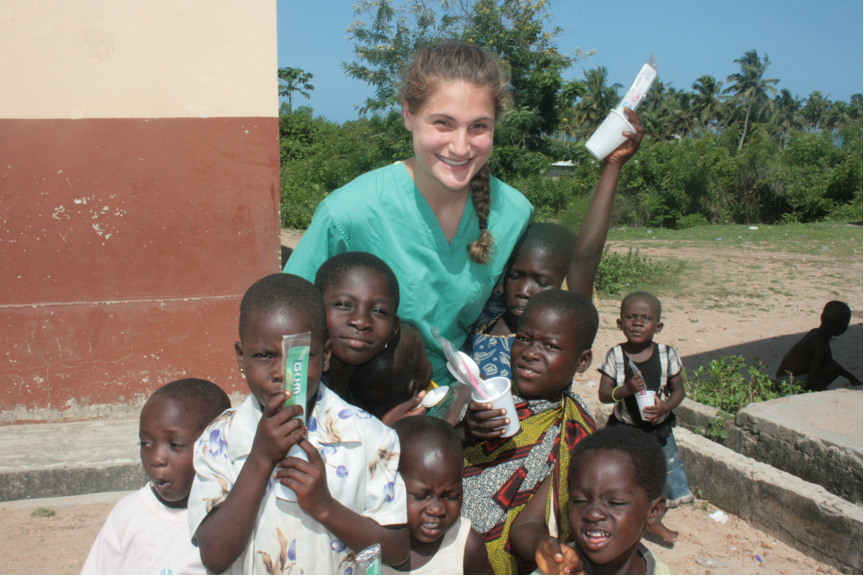
Here we have a smiling young white girl with a French braid, medical scrubs, and a well-intentioned smile. This young lady is the centerpiece of the photo; she is its protagonist. Her scrubs suggest that she is doing important work among those who are so poor, so vulnerable, and so Other.
The girl is me. And the photograph was taken on my first trip to Ghana during a 10 day medical brigade. I’m beaming in the photograph, half towering and half hovering over these children. I do not know their names, they do not know my name, but I directed a friend to capture this moment with my own camera. Why?
This photograph is less about doing actual work and more about retrospectively appearing to have had a positive impact overseas. Photographs like these represent the overseas experience in accordance with what writer Teju Cole calls the “White Savior Industrial Complex.”
Moreover, in directing, capturing, and performing in photos such as these, voluntourists prevent themselves from actually engaging with the others in the photo. In On Photography, Susan Sontag reminds us:
Photography has become almost as widely practiced an amusement as sex and dancing – which means that…it is mainly a social rite, a defense against anxiety, and a tool of power.
On these trips, we hide behind the lens, consuming the world around us with our powerful gazes and the clicking of camera shutters. When I directed this photo opportunity and starred in it, I used my privilege to capture a photograph that made me feel as though I was engaging with the community. Only now do I realize that what I was actually doing was making myself the hero/star in a story about “suffering Africa.”
The Overseas Selfie
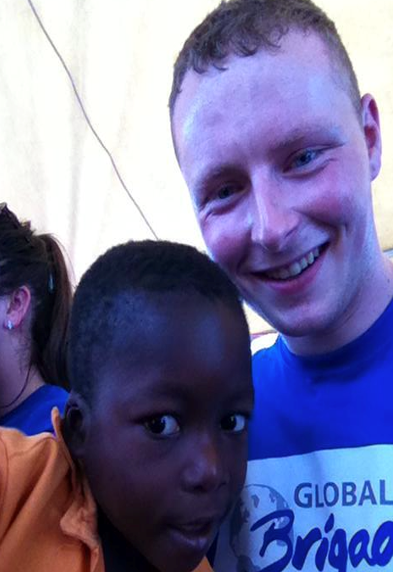
[Photo removed in response to a request from Global Brigades.]
In his New York Times Op-Ed, that modern champion of the selfie James Franco wrote:
Selfies are avatars: Mini-Me’s that we send out to give others a sense of who we are … In our age of social networking, the selfie is the new way to look someone right in the eye and say, “Hello, this is me.”
Although related to the Self-Directed Samaritan shot, there’s something extra-insidious about this type of super-close range photo. “Hello, this is me” takes on new meaning – there is only one subject in this photo, the white subject. Capturing this image and posting it on the internet is to understand the Other not as a separate person who exists in the context of their own family or community but rather, as a prop, an extra, someone only intelligible in relation to the Western volunteer.
***
Voluntourism is ultimately about the fulfillment of the volunteers themselves, not necessarily what they bring to the communities they visit. In fact, medical volunteerism often breaks down existing local health systems. In Ghana, I realized that that local people weren’t purchasing health insurance, since they knew there would be free foreign health care and medications available every few months. This left them vulnerable in the intervening times, not to mention when the organization would leave the community.
In the end, the Africa we voluntourists photograph isn’t a real place at all. It is an imaginary geography whose landscapes are forged by colonialism, as well as a good deal of narcissism. I hope my fellow students think critically about what they are doing and why before they sign up for a short-term global volunteer experience. And if they do go, it is my hope that they might think with some degree of narrative humility about how to de-center themselves from the Western savior narrative. Most importantly, I hope they leave their iphones at home.
While preparing a lecture on sex tourism, I ran across this video about men who have sex with female tourists in the Caribbean:
There’s a lot of interesting stuff going on there, no? I was fascinated by the female hotel owner who talks about the men “preying” on the female tourists, clearly placing the power in the hands the men who, she argues, use the female tourists for money but don’t really care about them. I tried to imagine someone talking similarly about female sex workers “preying” on foreign men’s need for affection and attention.
This might make for a great discussion about perceptions of sexual agency: how do gendered sexual norms, economic differences, and the different races and nationalities of the individuals involved affect how we think of their interactions and who we see as the victim?
In her chapter on sex tourism in Race, Ethnicity, and Sexuality), sociologist Joane Nagel discusses the role of racialized sexualities in making some groups attractive tourists looking for an ethnosexual adventure. In the Caribbean, dark-skinned men with dreads are particularly attractive to some female tourists because of stereotypes of Black men as extremely sexual and masculine, which plays into fantasies of being swept away by a strong, skilled lover. At the same time, White Western women may represent the possibility of a better life (through continued gifts of money even after the vacation is over) and sexualized adventures to the men they sleep with while on vacation. Nagel argues that these encounters generally reinforce, rather than challenge, existing racial and gender inequalities, since they play on stereotypes of sexualized Others as animalistic, primitive, and, in the case of men, as super-masculine (and super-endowed).
Then again, Nagel also questions whether any relationship between tourists and “local” men should count as sex work. The individuals involved don’t necessarily think of their interactions in those terms. And who is to decide if a particular situation is “sex tourism” as opposed to a “real” relationship? How does that assumption invalidate the possibility that Black men and White women might have real, meaningful relationships? Or primarily sexual relationships, but with both partners respecting the other?
Originally posted in 2009.
Gwen Sharp is an associate professor of sociology at Nevada State College. You can follow her on Twitter at @gwensharpnv.
Eyelid surgery is the third most common cosmetic procedure in the world. Some are necessary for drooping eyelids that interfere with vision, others are undertaken in order to enable people to look younger, but many people choose these surgeries to make their eyes look more Western or whiter, a characteristic often conflated with attractiveness.
Recently Julie Chen — a TV personality and news anchor — revealed that she had undergone eyelid and other surgeries almost 20 years ago in order to comply with the standards of beauty and “relatability” demanded of her bosses. She released these photos in tandem with the story:
Chen said that she was torn about whether to get the surgeries. Her entire family got involved in the conversation and they split, too, arguing about whether the surgeries represented a rejection of her Chinese ancestry.
Ultimately, though, Chen was under a lot of pressure from her bosses. One told her “you will never be on this anchor desk, because you’re Chinese.” He went on:
Let’s face it, Julie, how relatable are you to our community? How big of an Asian community do we have in Dayton? ‘On top of that, because of your heritage, because of your Asian eyes, sometimes I’ve noticed when you’re on camera and you’re interviewing someone, you look disinterested, you look bored.
Another man, a “big time agent,” told her: “I cannot represent you unless you get plastic surgery to make your eyes look bigger.”
While cosmetic surgeries are often portrayed as vanity projects, Chen’s story reveals that they are also often about looking “right” in a competitive industry. Whether it’s erotic dancers getting breast implants, waitresses getting facelifts, or aspiring news anchors getting eyelid surgery, often economic pressures — mixed with racism and sexism — drive these decisions.
Below is a remarkable commercial in which a white woman is told that if she buys Pampers, the company will donate vaccines to children in other countries. Thanks to Kenjus W. for the submission.
It is an example of “activism by purchase,” which we have discussed at length on this blog. Apparently Pampers will only help keep babies alive if you buy their product. How nice of them.
It’s also a fascinating example of the way in which white Westerners are seen as rescuing the rest of the world. This white mother with her white baby represent the West (erasing the diversity of people who live there). And she and her baby are counterposed to all the other mothers and their babies representing different racial groups (which are assumed to be coherent categories, even continents).
In the narrative of this commercial, all women are bonded by virtue of being natural nurturers of babies (and I could take issue with that, too), but the white Western woman is the ultra-mother. They may be sisters, but there are big and little sisters in this narrative. The babies run to her as if drawn to her ultra-motherhood and she treats them all, just for a moment, as if they were her very own.
Pampers wants you to think, of course, that when you buy a pack of Pampers, you are “helping” Other mothers and can save those Other babies.
This is just another manfestation of an old colonial belief, the white man’s burden, or the belief that white men had to take care of the rest of the world’s people because they were incapable of taking care of themselves.
Apparently universities are issuing guidelines to help professors consider adding “trigger warnings” to syllabi for “racism, classism, sexism, heterosexism, cissexism, ableism, and other issues of privilege and oppression,” and to remove triggering material when it doesn’t “directly contribute to learning goals.” One example given is Chinua Achebe’s “Things Fall Apart” for its colonialism trigger. This from New Republic this week.
I have no desire to enter the fray of online discussions on trigger warnings and sensitivity. I have used trigger warnings. Most recently, I made a personal decision to not retweet Dylan Farrow’s piece in the New York Times detailing Woody Allen’s sexual abuse. I was uncomfortable shoving a very powerful description at people without some kind of warning. I couldn’t read past the first three sentences. I couldn’t imagine how it read for others. So, I referenced the article with a trigger warning and kept it moving.
But, I’m not sure that’s at all the kind of deliberation universities are doing with their trigger warning policies. Call me cynical, but the “student-customer” movement is the soft power arm of the neo-liberal corporatization of higher education. The message is that no one should ever be uncomfortable because students do not pay to feel things like confusion or anger. That sounds very rational until we consider how the student-customer model doesn’t silence power so much as it stifles any discourse about how power acts on people.
I’ve talked before about how the student-customer model becomes a tool to rationalize away the critical canon of race, sex, gender, sexuality, colonialism, and capitalism.
The trigger warned syllabus feels like it is in this tradition. And I will tell you why.
In the last three weeks alone: a college student has had structural violence of normative harassment foisted on her for daring to have sex (for money), black college students at Harvard have taken to social media to catalog the casual racism of their colleagues, and black male students at UCLA made a video documenting their erasure.
It would seem that the most significant “issue” for a trigger warning is actual racism, sexism, ableism, and systems of oppression. Cause I’ve got to tell you, I’ve had my crystal stair dead end at the floor of racism and sexism and I’ve read “Things Fall Apart.” The trigger warning scale of each in no way compares.
Yet, no one is arguing for trigger warnings in the routine spaces where symbolic and structural violence are acted on students at the margins. No one, to my knowledge, is affixing trigger warnings to department meetings that WASP-y normative expectations may require you to code switch yourself into oblivion to participate as a full member of the group. Instead, trigger warnings are being encouraged for sites of resistance, not mechanisms of oppression.
At for-profit colleges, strict curriculum control and enrollment contracts effectively restrict all critical literature and pedagogy. We elites balk at such barbarism. What’s a trigger warning but the prestige university version? A normative exclusion as opposed to a regulatory one?
Trigger warnings make sense on platforms where troubling information can be foisted upon you without prior knowledge, as in the case of retweets. Those platforms are in the business of messaging and amplification.
That is an odd business for higher education to be in… unless the business of higher education is now officially business.
In which case, we may as well give up on the tenuous appeal we have to public good and citizenry-building because we don’t have a kickstand to lean on.
If universities are not in the business of being uncomfortable places for silent acts of power and privilege then the trigger warning we need is: higher education is dead but credential production lives on; enter at your own risk.
Tressie McMillan Cottom is a PhD candidate in the Sociology Department at Emory University in Atlanta, GA. Her doctoral research is a comparative study of the expansion of for-profit colleges. You can follow her on twitter andat her blog, where this post originally appeared.
You absolutely must find three minutes to watch Aamer Rahman defend the idea of reverse racism. Yes, he says, of course reverse racism is possible: “All I would need is a time machine…” The rest is glorious.
Sociological Images encourages people to exercise and develop their sociological imaginations with discussions of compelling visuals that span the breadth of sociological inquiry. Read more…