visibility

Content Warning: Descriptions of anti-trans violence and transmisogyny

In the 1990 documentary Paris is Burning, ball scene queen Pepper Labeija opines that realness is “to be able to blend…[to] not give away that you’re gay, that’s what’s real…to look as much as possible like your straight counterpart.” In this, realness is an imaginative take, in the safe space of the ball, on passing, either in terms of one’s gender or sexuality. Contestants can masquerade, lampoon, subvert, enact, or actualize those identities denied to them in the outside world. What Paris is Burning also illuminates, however, are the violent repercussions when one’s performative identity is read against their intention, when they don’t pass. The most heinous example in the documentary being the murder of trans performer Venus Xtravaganza before the film was completed. In this, passing is quite literally embodied survival praxis.

more...

10478531_709285209106941_4100531665819266605_n

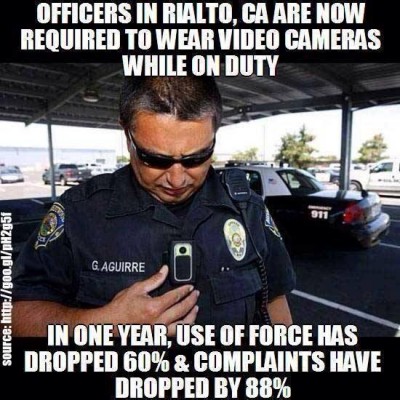
The murder of Mike Brown by Ferguson police officer Darren Wilson has catalyzed an already fast-growing national conversation about outfitting police officers with cameras like the one shown above. These cameras, the logic goes, will keep officers on their best behavior because any abuses of power would be recorded and stored for later review. Officer’s behavior, much like an increasing amount of civilian behavior, will be subject to digital analysis and review by careful administrators and impartial juries. This kind of transparency is extremely enticing but we should always be critical of things that purport to show us unvarnished truths. As any any film director will tell you: the same set of events recorded on camera can look very different when viewed from different angles and in different contexts. more...

 Blurred and Cropped Version of "Grabbing 100+ Boobs at Burning Man 2013"

Like many Burners (and non-Burners), I was outraged when, yesterday, an image with variations of the title “Grabbing 100+ Boobs at Burning Man 2013” went viral. In light of the public distribution of these photos, I think it’s imperative for the public in general, and Burners in particular, to have a focused conversation about a range of important social issues including the meaning of consent, rape culture, and slut shaming.

I do not know what each woman in the photos consented to and what problems may arise if they are recognized by people they know from contexts other than Burning Man, so I am reluctant to link to or share the image. However, because it is difficult to discuss the issues in question here without making specific references to the content of the photographs and because most of the harm from distributing the image has probably already been done, I have cropped and anonymized a small portion of the long gridded image here.

more...

People coming out of their homes and into the streets to particpate in #duranadam or #standingman. Photo by @myriamonde and h/t to @zeynep

In Taksim Square, at around 8PM local time, a man started standing near Gezi park facing the Atatürk Cultural Center. According to CNN –and more importantly Andy Carvin (@acarvin) and Zeynep Tufekci (@zeynep) — the man is believed to be Erdem Gündüz, a well known Turkish performance artist who has inspired a performative internet meme that has already made it around the globe. (There’s a nice Storify here. Thanks to @samar_ismail for putting it on my radar.) Gündüz and his supporters were removed by police after an 8 hour stand-off (in multiple senses of the term) but now that small act has gone viral and spread well beyond Taksim Square. The idea is simple: a photo, usually taken from behind demonstrates that person’s solidarity with those hurt or killed by Turkish police actions in the past month, and the increasingly repressive policies of that country’s government in the last few years. On twitter, the hashtag #duranadam (“duran adam” is “the standing man” in Turkish) quickly spilled over the borders of Turkey and has been translated to #standingman as more people in North America and Western Europe start to stand in solidarity with those in Taksim. #standingman is an overtly political meme because, unlike other performative memes like #planking, #owing, or even #eastwooding, it is meant to demonstrate a belonging to a cause. more...

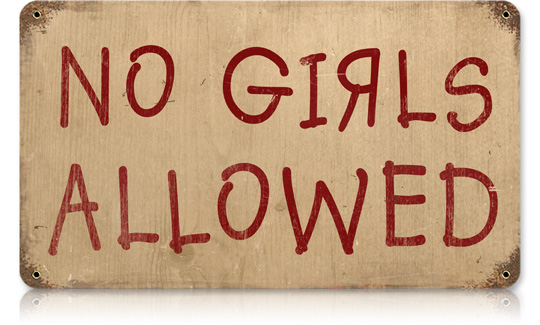
no-girls-signIf you’re a regular reader of Cyborgology, chances are good that you caught the most recent “brouLOL” (yes, that’s like a 21st century brouhaha) over digital dualism and augmented reality. If you’re a careful reader of Cyborgology, chances are good you also caught (at least) one glaring omission in much of the writing featured in this wave of commentary. What was missing?

Ladies, gentlemen, and cyborgs, allow me to (re)introduce you to Jenny Davis (@Jup83) and Sarah Wanenchak (@dynamicsymmetry)—oh yeah, and my name’s Whitney Erin Boesel (I’m @phenatypical). None of us identify as men, and all of us have written about digital dualism. In fact, you may have seen our work referenced recently under some collective noms de plume: “the other digital dualism denialists,” “others on this blog,” “others,” “other Cyborgologists,” “other regular contributors,” etc. If you’re a crotchety sociologist with a penchant for picking apart language (ahem: guilty), it doesn’t get much better than this. During the conversation earlier this month, the named and cited Cyborgologists were (almost) always men—while Jenny, Sarah, and I were referenced obliquely (at best) in an unnamed “other” category. more...

Several weeks ago, I wrote about the “fear of being missed (FOBM).” The flip side of FOMO (fear of missing out), FOBM captures the anxiety surrounding a complex and fast moving online realm in which it is easy to be buried, ignored, and/or forgotten. This anxiety is amplified by the online/offline connectedness, through which invisibility online can lead to neglect offline (personally and professionally). FOMO and FOBM speak to the difficulty of deleting social media accounts, the discomfort of a dead cell/laptop/tablet battery, and the drive to livetweet, status update, tag oneself in pictures, and be physically present for tagable photo-ops.

Soon after posting my piece on Cyborgology, I read Tiana Bucher’s article in New Media & Society about Facebook algorithms and the fear of invisibility. Bucher’s work offers a useful theoretical frame (Foucault’s Panoptican) for FOBM, and an equally good (if not better) term for the phenomena (fear of invisibility). In what follows, I describe Bucher’s piece and its utilization. I then offer critiques of her work. In this way, I hope to further the theoretical substance of FOBM, framing it with the tools suggested by Bucher, and refining it through juxtaposition to Bucher’s arguments.    more...

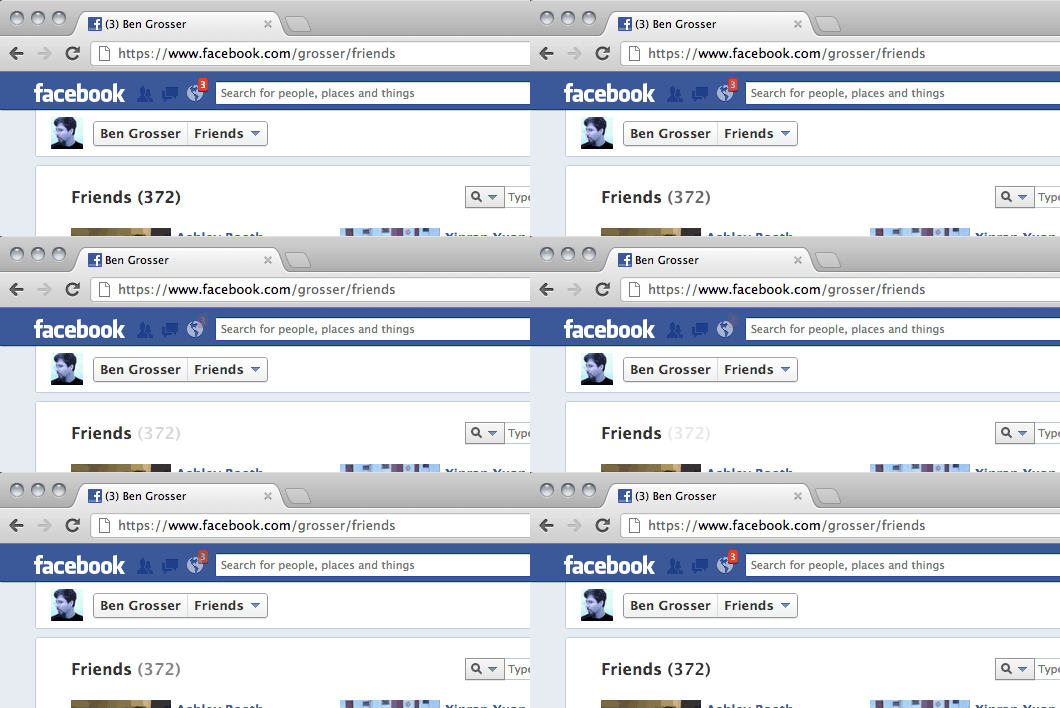
I’ve been meaning to write for a while now about Ben Grosser’s (@bengrosser) project the Facebook Demetricator. If you haven’t seen it yet, the Demetricator is a browser extension that removes all the overt quantification from your experience of Facebook. With Facebook Demetricator installed and toggled ON, it doesn’t matter if 2, 20, or 20,000 people like your most recent status update (for example); when you view that status update, you see simply “people like this.” Visit someone’s profile, and you see that they have “Friends”—not “Friends 450” or “Friends 4,500.” “View all 6 comments” becomes “View all comments,” and “n hours ago” becomes either “recently” or “a while ago.

more...

All your blame is belong to device?

Cyborgology readers, I need your help. I’ve put the post I was writing for today on hold because I’m short a key piece of terminology, and I’m hoping one of you can either a) point me to a good preexisting term, or b) help me to assemble a term that’s a bit more graceful than the ones I can come up with on my own.

The phenomenon I’m trying to describe is one that I’ve encountered a number of times over the past week, and is a theme I identify fairly often in conversations about newer technologies. I describe it below, first generally and then with a couple recent examples. more...

This is the complete version of a three-part essay that I posted in May, June, and July of this year:
Part I: Distributed Agency and the Myth of Autonomy
Part II: Disclosure (Damned If You Do, Damned If You Don’t)
Part III: Documentary Consciousness

Privacy is not dead, but it does need to change.

Part I: Distributed Agency and the Myth of Autonomy

Last spring at TtW2012, a panel titled “Logging off and Disconnection” considered how and why some people choose to restrict (or even terminate) their participation in digital social life—and in doing so raised the question, is it truly possible to log off? Taken together, the four talks by Jenny Davis (@Jup83), Jessica Roberts (@jessyrob), Laura Portwood-Stacer (@lportwoodstacer), and Jessica Vitak (@jvitak) suggested that, while most people express some degree of ambivalence about social media and other digital social technologies, the majority of digital social technology users find the burdens and anxieties of participating in digital social life to be vastly preferable to the burdens and anxieties that accompany not participating. The implied answer is therefore NO: though whether to use social media and digital social technologies remains a choice (in theory), the choice not to use these technologies is no longer a practicable option for number of people.

In this essay, I first extend the “logging off” argument by considering that it may be technically impossible for anyone, even social media rejecters and abstainers, to disconnect completely from social media and other digital social technologies (to which I will refer throughout simply as ‘digital social technologies’). Consequently, decisions about our presence and participation in digital social life are made not only by us, but also by an expanding network of others. I then examine two prevailing privacy discourses—one championed by journalists and bloggers, the other championed by digital technology companies—to show that, although our connections to digital social technology are out of our hands, we still conceptualize privacy as a matter of individual choice and control. Clinging to the myth of individual autonomy, however, leads us to think about privacy in ways that mask both structural inequality and larger issues of power. Finally, I argue that the reality of inescapable connection and the impossible demands of prevailing privacy discourses have together resulted in what I term documentary consciousness, or the abstracted and internalized reproduction of others’ documentary vision. Documentary consciousness demands impossible disciplinary projects, and as such brings with it a gnawing disquietude; it is not uniformly distributed, but rests most heavily on those for whom (in the words of Foucault) “visibility is a trap.” I close by calling for new ways of thinking about both privacy and autonomy that more accurately reflect the ways power and identity intersect in augmented societies. more...

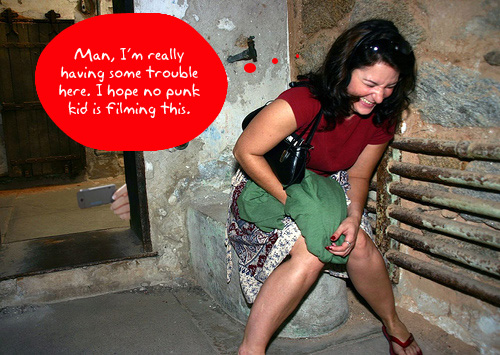
This image is on the Internet. Whose fault is that? (Is it anyone's fault, per se?)

Last month in Part I (Distributed Agency and the Myth of Autonomy), I used the TtW2012 “Logging Off and Disconnection” panel as a starting point to consider whether it is possible to abstain completely from digital social technologies, and came to the conclusion that the answer is “no.” Rejecting digital social technologies can mean significant losses in social capital; depending on the expectations of the people closest to us, rejecting digital social technologies can mean seeming to reject our loved ones (or “liked ones”) as well. Even if we choose to take those risks, digital social technologies are non-optional systems; we can choose not to use them, but we cannot choose to live in a world where we are not affected by other people’s choices to use digital social technologies.

I used Facebook as an example to show that we are always connected to digital social technologies, whether we are connecting through them or not. Facebook (and other companies) collect what I call second-hand data, or data about people other those from whom the data is collected. This means that whether we leave digital traces is not a decision we can make autonomously, as our friends, acquaintances, and contacts also make these decisions for us. We cannot escape being connected to digital social technologies anymore than we can escape society itself.

This week, I examine two prevailing privacy discourses—one championed by journalists and bloggers, the other championed by digital technology companies—to show that, although our connections to digital social technology are out of our hands, we still conceptualize privacy as a matter of individual choice and control, as something individuals can ‘own’. Clinging to the myth of individual autonomy, however, leads us to think about privacy in ways that mask both structural inequality and larger issues of power. more...