Tag Archives: social networking

Are There More Public Apologies Than Ever Before?

YouTube Preview Image

In an interview with Craig Ferguson last week, Jason Alexander called the game of Cricket “a gay game.” It was clear (and you can see for yourself in the video above, starting at the 9 minute mark) that Alexander was equating “gay” with “effeminate” and juxtaposing words like “gay” and “queer” with notions of masculinity and being “manly.” After the show aired, the tweets started pouring in. This tweet by @spaffrath was pretty trypical: (more…)

Augmented Activism: A Tactical Survey (Full Essay)

This is the full Augmented Activism essay. The two parts provide prescriptive tactics for how to incorporate technology in activist work. Part 1 was originally posted here and part 2 was here.

Part 1

Academics usually do not talk about “tactics.” There are theories, methods, critiques, but we -as professionals-rarely feel comfortable advocating for something as unstable or open to interpretation as a tactic. In the latest edition of the Science, Technology, and Human Values (The flagship journal for Society for Social Studies of Science) three authors threw caution to the wind and published the paper “Postcolonial Computing: A Tactical Survey“ [over-priced subscription required]. While the content of the paper is excellent, what excited me the most was their decision to describe their new “bag of tools” as a set of tactics. Kavita Philip, Lilly Irani, and Paul Dourish take a moment in their conclusion to reflect on their decision:

We call our results tactics, rather than methodologies, strategies, or universal guarantors of truth. Tactics lead not to the true or final design solution but to the contingent and collaborative construction of other narratives. These other narratives remain partial and approximate, but they are irrevocably opened up to problematization. (more…)

Augmented Activism: A Tactical Survey (Part 2)

Is this an Oxymoron?

Most of our interactions with technology are rather mundane. We flip a light switch, buckle our seat belts, or place a phone call. We have a tacit knowledge of how these devices work. In other words, we have relatively standard, institutionalized, ways of interacting with familiar technologies. For example: if I were to drive someone else’s car, even if it is an unfamiliar model, I do not immediately consult the user manual. I look around for the familiar controls, maybe flick the blinkers on while the car is still in the drive way, and off I go. Removal of these technologies (or even significant alterations) can cause confusion. This is immediately evident if you are trying to meet a friend who does not own a cell phone. Typical conventions for finding the person in a crowded public space (“Yeah, I’m here. Near the stage? Yeah I see you waving.”) are not available to you. In years prior to widespread cell phone adoption, you might have made more detailed plans before heading out (“We’ll meet by the stage at 11PM.”) but now we work out the details on the fly. Operating cars and using cell phones are just a few mundane examples of how technologies shape social behavior beyond the actions needed to operate and maintain them. The widespread adoption of technologies, and the decisions by individual groups to utilize technologies can have a profound impact on the social order of communities. This second part of the Tactical Survey will help academics, activists, and activist academics assess the roll of information technology in a movement and make better decisions on when and how to use tools like social media, live video, and other forms of computer-mediated communication. (more…)

Sousveillance and Justice: A Panopticon in the Crowds

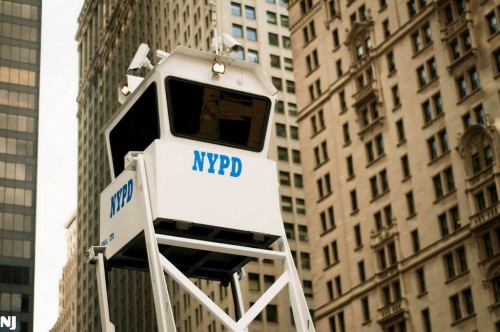
A modern day panopticon. Photo by Nathan Jurgenson.

The first post I wrote for Cyborgology concluded that many of the dominant socio-technical systems in our world look and behave in a similar fashion. The entertainment industry, advanced military surveillance, search algorithms, and academic reference tools are swapping hardware and best practice in such a way that the carrying out of a military invasion, or the Super Bowl begins to look disturbingly similar. Around the time that I wrote that post, USAToday ran a disturbingly cheerful story about police departments’ desire to acquire similar technology. Miami’s police department acquired the  Honeywell’s T-Hawk Micro Air Vehicle (MAV) a few moths later. The only regulations that prevented the MPD (or any police force) from acquiring such technology were FAA regulations about where and how it could be flown. Such acquisitions have gone largely unquestioned by the media as well. In fact, local coverage of the purchase was supportive. A local CBS affiliate led with the headline, “Dade Cops Waiting To Get Crime Fighting Drone Airborne.” This all seems very bleak, but just as powerful actors have increased their abilities to engage in surveillance, the individual has more tools than ever to watch the watchers. (more…)

Social Media and Our Atmosphere of Augmented Dissent

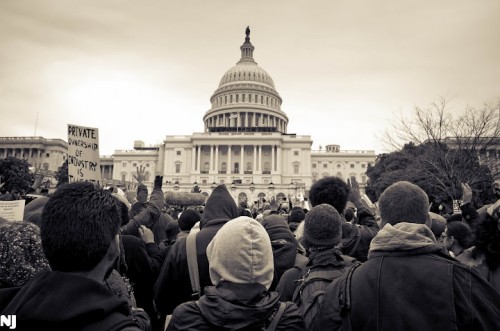
laptops at the #occupy protests

Mass collective action is in the air, on the ground, on the web; indeed, there exists today an atmosphere conducive for revolutions, flash mobs, protests, uprisings, riots, and any other way humans coalesce physically and digitally to change the normal operation of society. [Photos of protests around the globe from just the past 30 days].

Some gatherings have clear goals (e.g., ousting Mubarak), however. there is also the sense that massive gatherings are increasingly inevitable today even when a reason for them is not explicit (e.g., the ongoing debate over the reasons for the UK Riots or the current #occupy protests). For some this is terrifying and for others it is exhilarating. And still others might think I am greatly overstating the amount of protest actually happening. True, we do not yet know if this second decade of the 21st Century will come to be known for massive uprisings. But if it is, I think it will have much to do with social media effectively allowing for the merging of atoms and bits, of the on and offline; linking the potential of occupying physical space with the ability of social media to provide the average person with information and an audience.

For example, the current #occupy protests across the United States (more…)

Love and Breakups at the Time of Social Networks

This post originally appeared on OWNI, 7 March, 2011.

“Robert, I am leaving you.” In the initial moments after, all Robert could do was replay those words in his head until all the tears he could muster had spilled from his broken heart. Once the shock settled, he could throw himself into the comfort of a bottle of beer – or harder alcohol depending on the situation – to drown out his sorrows. Yet the inevitable form of cleansing was obvious, as we’ve all been Robert –  he needed to burn (or at least return to the original owner) the knick-knacks, photos, love letters, and the memories that were attached to those objects. He needed to reject the one who no longer wanted him. This is not an easy step to make, but once this purging has been accomplished then the relationship is truly over.

That was before…and like everything else, yes, it was better before. Now, Robert must also mange his failed love-life in the digital world.  It is nothing groundbreaking that our lives are not just physical, but also virtual. So if we raise the question whether our digital accounts will affect the grieving process of friends and family after out death, the same inquiry can be applied to breakups. Social networks have permanently changed the situation, making breakups more painful. A US marketing agency tried to create “break up with your ex day” on the same day as Valentine’s Day: time to turn the page, unfollow, untag, block, and move on! Wise decision, but breaking digital connections are not the same as breaking ties in real life. The digital world constantly reminds the most desperate and nostalgic of their misfortunes.

Facebook: the heroine for breakups

Lucy* had been dumped, and was too quick to take the decision to cut off her torturer from her Facebook profile. “I blocked him to avoid being tempted to contact him on his status updates. I knew I would post something or send him a message. It’s childish, I know!” Skip to the hater category, a well-known classic in the breakup realm. (more…)