Silicon Valley

Thiel - Girard

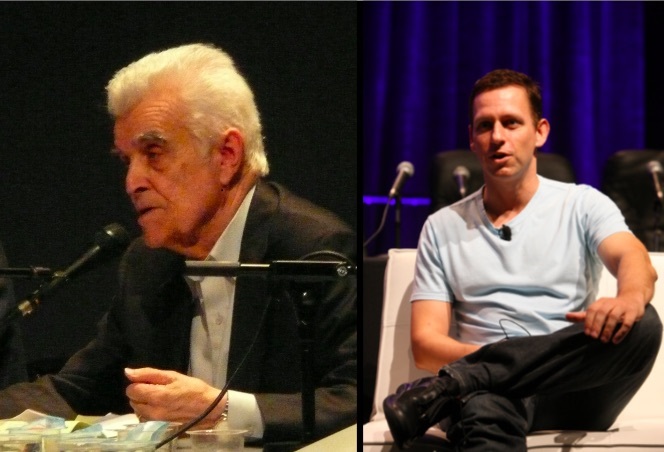
During the week of July 12, 2004, a group of scholars gathered at Stanford University, as one participant reported, “to discuss current affairs in a leisurely way with [Stanford emeritus professor] René Girard.” The proceedings were later published as the book Politics and Apocalypse. At first glance, the symposium resembled many others held at American universities in the early 2000s: the talks proceeded from the premise that “the events of Sept. 11, 2001 demand a reexamination of the foundations of modern politics.” The speakers enlisted various theoretical perspectives to facilitate that reexamination, with a focus on how the religious concept of apocalypse might illuminate the secular crisis of the post-9/11 world.

As one examines the list of participants, one name stands out: Peter Thiel, not, like the rest, a university professor, but (at the time) the President of Clarium Capital. In 2011, the New Yorker called Thiel “the world’s most successful technology investor”; he has also been described, admiringly, as a “philosopher-CEO.” More recently, Thiel has been at the center of a media firestorm for his role in bankrolling Hulk Hogan’s lawsuit against Gawker, which outed Thiel as gay in 2007 and whose journalists he has described as “terrorists.” He has also garnered some headlines for standing as a delegate for Donald Trump, whose strongman populism seems an odd fit for Thiel’s highbrow libertarianism; he recently reinforced his support for Trump with a speech at the Republican National Convention. Both episodes reflect Thiel’s longstanding conviction that Silicon Valley entrepreneurs should use their wealth to exercise power and reshape society. But to what ends? Thiel’s participation in the 2004 Stanford symposium offers some clues.    more...

Image From Jeremy Brooks

The wearable is going through an adolescence right now. Products like Google Glass, Oculus Rift, or the Pebble smartwatch are a lot like teenagers: They’ve come into their own, but still aren’t sure about the place in society. They are a little awkward, have problems staying awake when they need to be, and they attract derision by the New York Times. And just like human adolescence, this phase probably has a horizon. People could warm up to the idea of face computers, battery life will get better, and (eventually, hopefully) the public will learn to ignore Ross Douthat. But for right now, the wearable is in a precarious situtation. Are wearables like Glass relegated to the same fate as Bluetooth earpieces and the Discman, or can they be saved? Is the entire category irredeemable or have we yet to see the winning execution? more...

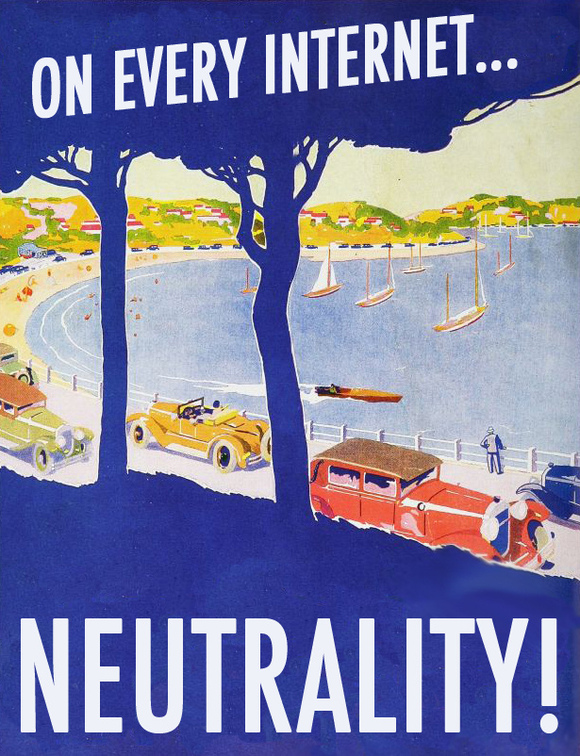
on-every-internetI was working recently on a short essay about net neutrality and, in the process, ended up writing a much longer piece about net neutrality. My aim in writing that longer piece (below) was twofold: I wanted both to demonstrate that net neutrality isn’t too technical and complicated for normal people to understand, and also to trace out how a trio of closely related issues—net neutrality rules, regulatory classifications, and the push to convert all voice traffic to digital—fit together, as well as what their combination might mean for the so-called “open Internet.”

SPOILER: You need to pressure the FCC to adopt strong net neutrality rules, and then you need to do a bunch of other stuff. Net neutrality isn’t enough, and neither Big Telecom nor Big Digital is talking about the pieces that will have the greatest (and most unequal) impact on Internet users.

Without further ado, here’s my attempt at a guided tour through roughly 18 years of Internet-related regulatory history:

more...

fb-privacy-checkup

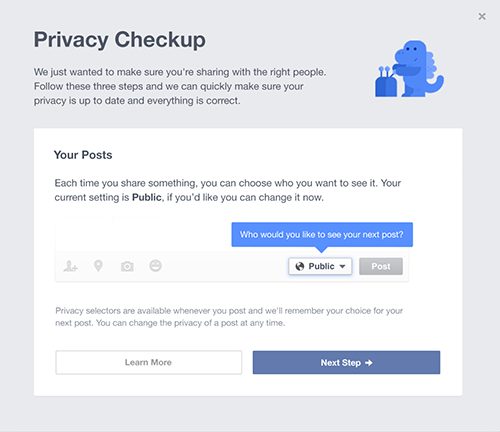
Today, Facebook announced some significant changes in its approach to privacy: New users now start with “friends only” as their default share setting and a new “Privacy Checkup” will remind users to select audiences for their posts (if they don’t, it will also default to “friends only”).

This announcement is significant in that it is the first time that Facebook has ever stepped back its privacy settings to be less open by default. This appears to contradict a widely held assumption that Facebook is on a linear trajectory to encourage ever more sharing with ever more people. Media reports have pitched this as a victory for users, who are supposed to have forced the company to “respond to business pressures and longstanding concerns” or “bow to pressure.” more...

WePay Prohibitions

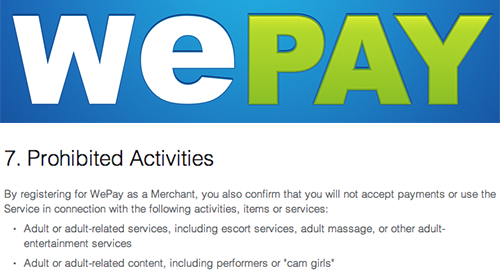
Last week I wrote about how–despite their supposed libertarian principles–Wall Street and Silicon Valley firms (most notably, Chase and Amazon) had embarked on systematic campaigns of discrimination against sex workers, seemingly intent on expelling sex workers from the financial system. I concluded that discrimination propelled by market forces is no less reprehensible and no less deleterious in its consequences than discrimination driven by personal prejudice. And, I argued that we should hold accountable those who let a commitment to profit trump their commitment to fighting discrimination.

This weekend–almost as if to make a spectacle out of how vicious the campaign against sex workers has become–WePay took the unfathomably callous action of cancelling a fundraiser for Eden Alexander, a porn performer who experienced some very serious and acute health issues and was in desperate need of financial assistance to pay medical/personal care bills. Alexander tweeted the cancellation notice that she received from WePay: more...

"Most Downloaded Woman" (ft. Danni Ashe) by Faith Holland
“Most Downloaded Woman” (ft. Danni Ashe)
Art used with permission of Faith Holland*

Over the course of the past few weeks, two major US corporations—Chase Bank and Amazon—have each undertaken campaigns apparently aimed at expelling sex workers from the financial system, despite the fact that this work is completely legal and the compensation is above board.

Social media has be buzzing with reports from porn performers of vaguely worded letters from Chase stating “we recently reviewed your account and determined that we will be closing it.” At the Cybogology-sponsored Theorizing the Web conference, porn performer Stoya described her experience: “I’ve personally had issues with Chase, which is why I was giggling, because they shut down my business account but then didn’t understand why I wanted to close my personal account.” While Chase and other financial institutions (e.g., Paypal, Square, WePay, City National Bank, and J.P. Morgan) have long engaged in ad hoc discrimination against sex workers, Chase’s recent actions are unprecedented in that they appear to indicate a systematic effort to uncover and blacklist anyone involved in sex work. more...

Brendan Eich, the inventor of JavaScript, was CEO of Mozilla for exactly 11 days before stepping down. Image c/o Wikicommons.

Last week Brendan Eich, the newly appointed CEO of the Mozilla Corporation, had to step down amid backlash from his fellow board members, Silicon Valley elites, and the public at large for his $1,000 donation to supporters of California’s Prop 8 anti-marriage equality bill. In the grand scheme of things, a $1000 contribution from a guy that is I-invented-JavaScript-wealthy to a $38.7 million campaign, probably didn’t change much. But the headlines were never about Eich secretly bankrolling Prop 8; it’s been about what kind of person should be allowed to lead the best-known open-source organization that makes the third-most-installed browser on the planet.

There’s lots of people who say that even if you disagree with Eich, this shouldn’t be grounds for him to step down because his beliefs have no bearing on how you build a browser. I deeply disagree, and it isn’t a matter of ideological opposition, but of observable fact: technology always has a bit of its creator in it and technology is never politically neutral. Moreover, I don’t think, as many have claimed, that Eich’s departure was a failure of democracy. In fact I see it as a leading indicator for the free software community’s maturing legal and political knowledge. more...

source
source

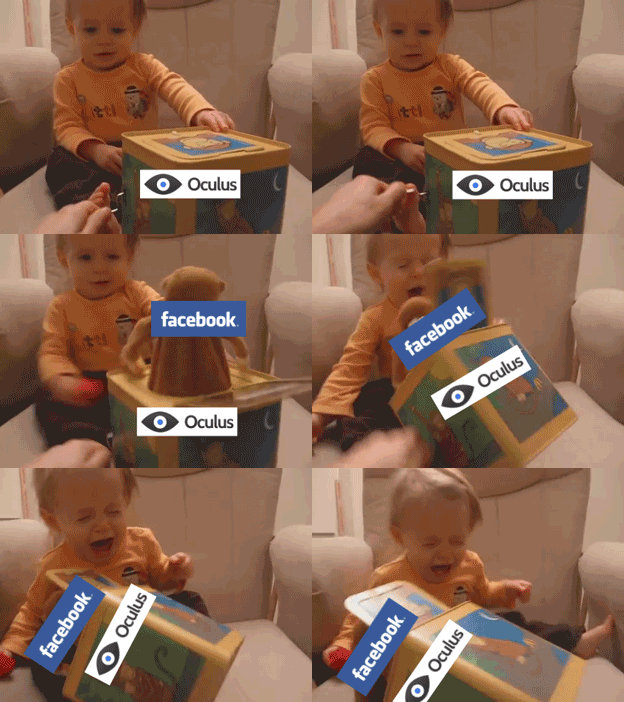
Last week, The Verge’s Adrianne Jeffries (@adrjeffries) asked a really provocative titular question: “If you back a Kickstarter Project that sells for $2 billion, do you deserve to get rich?” After interviewing venture capitalists and the like she concludes that the answer isn’t even “no” it’s “that’s ridiculous.” After speaking to Spark Capital’s Mo Koyfman Jeffries writes, “Oculus raised money on Kickstarter because it wanted to see if people wanted and would buy the product, and whether developers wanted it and would build games for it. The wildly successful campaign validated that premise, and made it much easier for Oculus to raise money from venture capitalists.”

Kickstarter’s biggest innovation is its ability to cut two time-consuming tasks –market research and startup funds– down to a 90 day fundraising window. Companies that choose to use Kickstarter usually aren’t ready to offer equity because that comes after the two steps that Kickstarter is so useful in accelerating. Or, perhaps more honestly, companies opt to use Kickstarter precisely because they want to avoid selling off shares of their company as much as possible. Jeffries gives us a good financial and legal (juridical, if we want to be Foucauldian about it) but that seems like a wholly unfulfilling argument for someone who spent $25 on an Oculus-branded t-shirt. Let’s forget for a moment about what’s legal and normal –those things are rarely moral or fair– and start to compare what happens on Kickstarter to similar (and much older) social arrangements. To start, let’s go way back to the early 1990s. more...

Image by Th3 ProphetMan

I’d like to start off with an admittedly grandpa-sounding critique of a piece of technology in my house: My coffee maker’s status lights are too bright. My dad got it for my partner and I this past Christmas and we threw-out-the-box-immediately-wanna-keep it, but the thing has a lighthouse attached to it.  We live in a relatively small (and very old) place and our bedroom is a small room right off the kitchen. The first night we had the coffee maker I thought we had forgotten to turn off the TV.  We don’t really need alarm clocks anymore either, because when it finishes brewing it beeps like a smoke detector. Again, we love the coffee maker (Dad, seriously we love it.) but sometimes it feels like wearing a shoe that was designed for someone with six toes. more...

We have a two-month break from self-inflicted government crisis, so let’s use it to take a breather, assess the situation, and cast some shade on rich people. Not because it is cathartic (it is), or because it will prevent the next crisis (it won’t); rather, I think studying the contours of the government-shaped hole of the last three weeks can teach us something about how Silicon Valley views public ownership. This is important because we typically use metaphors[1] like “the commons” or “the public” to describe their products. These words imply a sense of trust, if not mutually assured disruption: sure a rich guy might own Twitter on paper but it becomes worthless if everyone stops treating it as a (if not the) center of daily life. What do the people that own these service/spaces think about the de facto collective ownership of their product? more...