Silicon Valley

A rendering of Facebook's new Anton Menlo subdevelopment.
A rendering of Facebook’s new Anton Menlo subdevelopment.

Silicon is a cyborg element. You can find it everywhere, but almost always bonded to something else. Silicon is the second-most abundant element on the planet and yet you have probably never seen it in its pure form. (For the record, it looks kind of like a leftover baked potato wrapped hastily in tin foil.) Entire geographic formations are named after the element, but (and I think this might be a first for naming conventions) those places have largely nothing to do with the extraction or even refinement of that element. Silicon is a prerequisite, a synecdoche for a larger industry that demands we refine and purify this promiscuous metal into a predictable and highly controlled component. True to its namesake, Silicon Valley (not to mention Austin’s lesser-known “Silicon Hills”) is an exercise in refinement. Intricate and eclectic streets are tossed aside in favor of gleaming, modern campuses with strict access control. It is a place where functions are separated so that they may reach the sorts of optimal efficiencies that Le Corbusier promised and Moses tried to deliver. But unlike Moses or Le Corbusier, the planners and corporate patrons of Silicon Valley are making places meant to be freely chosen. more...

che_M_jpg_400x400_upscale_q85

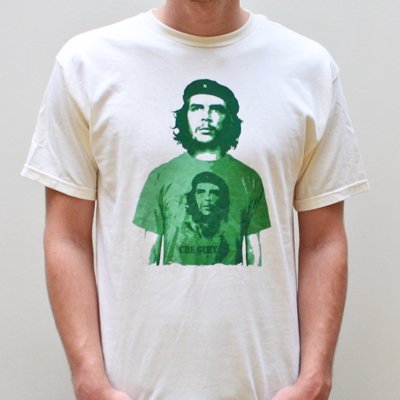
Describing “types” of capitalisms, their components, the central logics they operate by is always a risky game: nothing is ever entirely new, there are always outliers, the different types always overlap, and so on. However, I’d like to speculate very briefly on a specific trend within Silicon Valley capitalism, what strikes me as an anti-capitalism sort of capitalism. I’m speaking of this type of capitalism not as something that is fully realized in reality, but as an “ideal type”, a hypothetical possibility that we can determine if or how much validity it has in illuminating the world–or at least one small chunk of the contemporary economy. Mostly, I’m just musing on a smart, fun piece by Sam Biddle about the rhetoric of Tumblr founder David Karp before Yahoo’s acquisition of the site for one billion dollars.

The rhetoric is familiar for those who follow Silicon Valley and is indicative of a particular type of capitalism. more...

The semantics of Silicon Valley Capitalism are precise, measured, and designed to undermine preexisting definitions of the things such capitalists seek to exploit. It is no coincidence that digital connections are often called “friends,” even though the terms “friend” and “Facebook friend” have very different meanings. And then there is “social,” a Silicon Valley shorthand term for “sharing digital information” that bears little resemblance to the word “social” as we’ve traditionally used it. From “Living Social” to “making music social,” “social media” companies use friendly old words to spin new modes of interaction into concepts more comfortable and familiar. It is easier to swallow massive changes to interpersonal norms, expectations, and behaviors when such shifts are repackaged and presented as the delightful idea of being “social” with “friends.”

But is this “social” so social? Yes and no and not quite. To elaborate, we propose a distinction: “Social” versus “social,” in which the capital-S “Social” refers not to the conventional notion of social but specifically to Silicon-Valley-Social. The point is, simply, that when Silicon Valley entrepreneurs say “social,” they mean only a specific slice of human sociality. more...


Julian Assange, the notorious founder and director of WikiLeaks, is many things to many people: hero, terrorist, figurehead, megalomaniac. What is it about Assange that makes him both so resonant and so divisive in our culture? What, exactly, does Assange stand for? In this post, I explore two possible frameworks for understanding Assange and, more broadly, the WikiLeaks agenda. These frameworks are: cyber-libertarianism and cyber-anarchism.

First, of course, we have to define these two terms. Cyber-libertarianism is a well-established political ideology that has its roots equally in the Internet’s early hacker culture and in American libertarianism. From hacker culture, it inherited a general antagonism to any form of regulation, censorship, or other barrier that might stand in the way of “free” (i.e., unhindered) access of the World Wide Web. From American libertarianism it inherited a general belief that voluntary associations are more effective in promoting freedom than government (the US Libertarian Party‘s motto is “maximum freedom, minimum government”). American libertarianism is distinct from other incarnations of libertarianism in that tends to celebrate the market and private business over co-opts or other modes of collective organization. In this sense, American libertarianism is deeply pro-capitalist. Thus, when we hear the slogan “information wants to be” that is widely associated with cyber-libertarianism, we should not read it as meaning  gratis (i.e., zero price); rather, we should read it as meaning libre (without obstacles or restrictions). This is important because the latter interpretation is compatible with free market economics, unlike the former.

Cyber-anarchism is a far less widely used term. In practice, commentators often fail to distinguish between cyber-anarchism and cyber-libertarianism. However, there are subtle distinctions between the two. Anarchism aims at the abolition of hierarchy. Like libertarians, anarchists have a strong skepticism of government, particularly government’s exclusive claim to use force against other actors. Yet, while libertarians tend to focus on the market as a mechanism for rewarding individual achievement, anarchists tend to see it as means for perpetuating inequality. Thus, cyber-anarchists tend to be as much against private consolidation of Internet infrastructure as they are against government interference. While cyber-libertarians have, historically, viewed the Internet as an unregulated space where good ideas and the most clever entrepreneurs are free to rise to the top, cyber-anarchists see the Internet as a means of working around and, ultimately, tearing down old hierarchies. Thus, what differentiates cyber-anarchist from cyber-libertarians, then, is that cyber-libertarians embrace fluid, meritocratic hierarchies (which are believed to be best served by markets), while anarchists are distrustful of all hierarchies. This would explain while libertarians tend to organize into conventional political parties, while the notion of an anarchist party seems almost oxymoronic. Another way to understand this difference is in how each group defines freedom: Freedom for libertarians is freedom to individually prosper, while freedom for anarchists is freedom from systemic inequalities. more...


Photo: PJ Rey


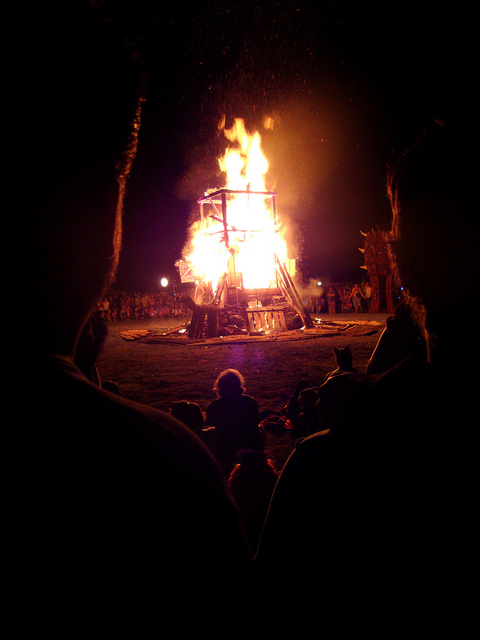
A discussion of Burning Man may, at first, seem out of place on a technology blog; however, as sociologist Fred Turner has previously observed, the ideology of Burner culture is profoundly co-implicated with the prevailing ideology of Web.  It is more than mere coincidence that this particular festival has exploded in proximity to Silicon Valley.  It is also more than coincidence that Google and other tech company virtually shut down during this event.  The week-long temporary city in a desert attracts people from around the world. The community is founded upon the (seemingly paradoxical) principals of “radical self-reliance” and “communal effort.” For a week, Burners collectively construct a festive atmosphere that separates themselves from the institutions and customs of their everyday lives. There is a vibrant gift economy with a focus on the decommodification of goods and services (though, of course, like the Internet, much money changes hands behind the scenes: for infrastructure, transport, illicit ticket sales, drugs, etc.). Everyone is encouraged to participate in all aspects of the community (to “prosume” their surroundings), and in doing so, to reach a better understanding of self. This is all embodied in the Ten Principles of Burning Man. more...

The way in which information is shared in the digital age is headlining the news around many different issues. WikiLeaks is distributing thousands of classified State Department documents; the FFC Chairman is attempting to preserve net neutrality (i.e., the dictum that Internet service providers cannot limit the rate that users access different kinds of legal content); Facebook users are sharing more and more private details of their lives online.  Arguably, the same cultural debate is playing out in all of these cases: Is society best served when all information is free, or are we better off if some information remains private?

Silicon Valley has become a magnet for evangelists of the “information wants to be free” movement, what has come to be known as “cyberlibertarianism.”  Supporters often argue that the free flow of information is fundamental to democracy.  This is, in fact, the justification behind WikiLeaks’ distribution of confidential, proprietary, or otherwise secret information.

However, it is important to note that many of the most high-profile supporters of a transparent society, where information is free, are Internet companies, like Facebook and Google, that seek profit by collecting and sharing information about their users. Alternatively, companies who would benefit from restricting the flow of information (ISPs like, Comcast and Verizon) tend to oppose the principle that information should be free.

Cyberlibertarianism has range of other critics.  Clearly, the government has argued that state interests are threatened by the leaking of information. On a more micro level, many sociologists (including the authors of this post) are concerned that the pressure to constantly share more, and more personal information can be detrimental to individual users of Google, Facebook, and other social-networking sites. more...