

dubstep

You may not be a fan of the wub-wub-wubbing musical genre known as dubstep, but it is increasingly taking center stage in American popular culture. For example, a recent NorthFace advertisement uses it while a snowboarder glides down a snowy mountainscape, Britney Spears  and Rihanna have both incorporated some dubstep into their recent work, teen heartthrob Justin Bieber is rumored to be working on his own dubstep album, and the teaser trailer for the new Mission Impossible film features a distinct wub-wubbing in the background. So what is dubstep anyway? And where did it come from?

Dubstep Goes to College
Dubstep was conceived in the London dance music scene in the late 90s and early 00s. It takes mainly from drum and bass and grime genres, but is influenced by many different styles of music, including dancehall and hip-hop. The heavy influence of grime, the dark elements of drum and bass and the guttural bass lines give it an almost dirty sound. This along with the layer of synthesizers are what people in the scene refer to when they describe the music (or party) as “grimey.”

Dubstep entered the mainstream club scene in 2006 in great part with the release of producer Oliver Jones’ (aka Skream) debut album “Skream,” which took club culture by storm in Europe (Woolliams 2008). The album also became widely popular in the United States EDM (electronic dance music) scene.
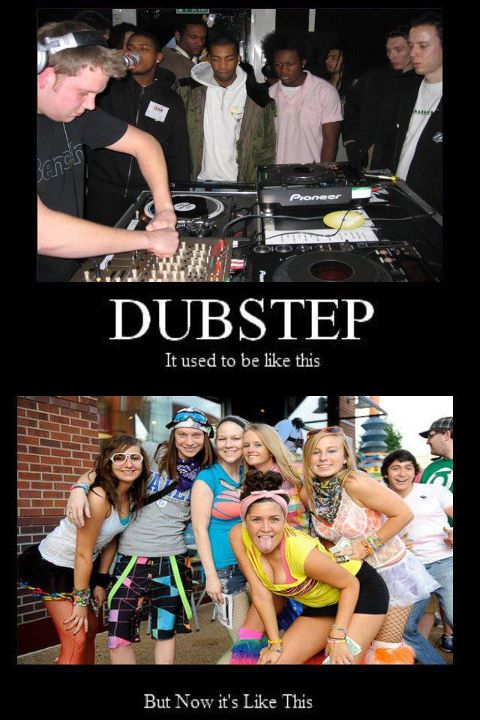
Internet memes like this serve to articulate anxiety about perceived subcultural changes.

more...

Part 2
From Screamo to Brostep: The Case of Skrillex

The popularization of dubstep is further epitomized in the wildly popular, albeit polarizing example of Sonny Moore, former lead singer/frontman of the 2000s screamo band From First to Last. He left the band in 2004 to pursue his solo career only to return in 2008 as the dubstep DJ Skrillex, when dubstep was beginning to “blow up” in American popular music.  He quickly became an internet phenomena, an early harbinger of the recent “brostep” wave of popularization which would later be bolstered by user-generated dubstep videos using footage from the Transformers movies. And at the 2011 MTV Music Awards, he walked away with the award for Best New EDM Artist as a result of his popularity under the stage name Skrillex.

Upon hearing of this award, many in the EDM community were outraged. Why? Because many members of this subculture viewed him as an outsider who solidified dubstep as pop music played on radio and television stations, making the subculture open and accessible to most everyone. Most in the EDM community have never seen him as an organic member of the underground dubstep or EDM subculture. Skrillex is simply the product of mainstream capitalism taking notice of dubstep as a viable market commodity. His popularity and success coincides directly with the most recent wave of popularization occurring in the late 2000s, his five recent Grammy nominations notwithstanding. more...

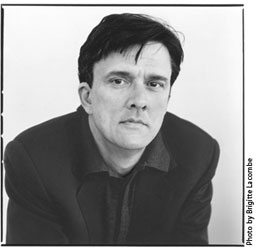
Kurt Anderson, writer, critic, and public intellectual

Kurt Anderson’s recent article in Vanity Fair titled “You Say You Want a Devolution.” contends that the past 20 years have seen a total stagnation in the production of new cultural aesthetics. In other words, the end of the 50s looked nothing like the end of the 70s, but 1989 looks remarkably similar to 2009. Anderson concludes:

We seem to have trapped ourselves in a vicious cycle-economic progress and innovation stagnated, except in information technology; which leads us to embrace the past and turn the present into a pleasantly eclectic for-profit museum; which deprives the cultures of innovation of the fuel they need to conjure genuinely new ideas and forms; which deters radical change, reinforcing the economic (and political) stagnation.

This is concerning, since that means the entirety of our blog is nothing more than the fungal growth sitting upon the neutral technological substrate that we impregnate with decaying cultures of past decades. Tattoos, Facebook, Burning Man, the iPhone, Twitter, sex dolls, wifi, internet memes, reality TV, geek culture, hipsters, video gamesfaux-vintage photographs, and dubstep are all popular topics on our blog, and (along with blogging itself) are products of the last 20 years. Anderson assumes that cultural objects are made possible through technology, but refuses to admit that technologies can also be cultural objects in and of themselves. more...

Popular dubstep DJ Skrillex performing live.

Below is the first of a two-part essay exploring the popularity of dubstep, a musical genre formerly associated with the underground EDM (electronic dance music) scene.
Part 1

You may not be a fan of the wub-wub-wubbing musical genre known as dubstep, but it is increasingly taking center stage in American popular culture. For example, a recent NorthFace advertisement uses it while a snowboarder glides down a snowy mountainscape, Britney Spears  and Rihanna have both incorporated some dubstep into their recent work, teen heartthrob Justin Bieber is rumored to be working on his own dubstep album, and the teaser trailer for the new Mission Impossible film features a distinct wub-wubbing in the background. So what is dubstep anyway? And where did it come from?

Dubstep Goes to College
Dubstep was conceived in the London dance music scene in the late 90s and early 00s. It takes mainly from drum and bass and grime genres, but is influenced by many different styles of music, including dancehall and hip-hop. The heavy influence of grime, the dark elements of drum and bass and the guttural bass lines give it an almost dirty sound. This along with the layer of synthesizers are what people in the scene refer to when they describe the music (or party) as “grimey.” more...