
digital media

silhouette of a man standing alone.

“Have you been on Yik Yak?”

My graduate student friends can attest to the fact that I ask this question of almost everyone at some point. Sometimes more than once, like when you’re excited about something and can’t help but tell the story over and over again to the same audience. Annoying, I know, and I’m sorry to all my friends.

But it’s just because I find Yik Yak absolutely fascinating. I’m drawn to it because, for at least some users, it serves as a sort of technologically cultivated hive-mind therapy session. For the uninitiated, Yik Yak is an anonymous social media app available on Android or iOS mobile devices. Users can post, vote on, and publicly reply to “yaks.” Users collect “Yakarma” based on how many votes their yaks receive and how often they vote on other yaks. Once a post receives more than five down votes it is removed. Rather than following other users or adding friends, Yik Yak shows posts from others within a ten-mile radius of your location, so when you visit the Yik Yak stream you are seeing the anonymous posts of other users in your area. As such, it is particularly popular among college students—a place to gripe about classes you hate, snoring roommates, bad cafeteria food, and attractive people that won’t give you the time of day. Of course, it’s also a place for inside jokes and celebrating particularly rowdy parties, but to be frank, there’s a lot of complaining. more...
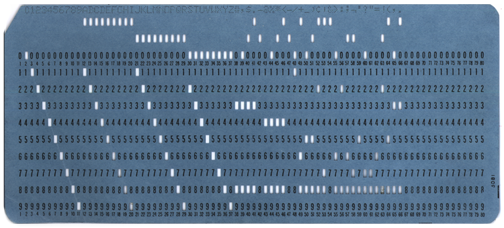

500px-Blue-punch-card-front-horiz

When someone sends a text to my phone, are they any less responsible for their comments than if they had said the same thing face-to-face? If someone says a photo I post is “unflattering” or “unprofessional,” do I feel like this says something about me as a person? Why has it become so common to equate the unauthorized use of someone else’s Facebook account to the violation experienced during rape, that the term “fraping”* has come into popular usage? These are some of the questions I think that digital dualism prevents us from answering satisfactorily. In framing an alternative to dualist thinking, I argue that it is important to account for people’s changing sense of self (hinted at in the examples above). To do this, we must examine the material conditions of subjectivity, or, put simply, how what we are affects who we are.

Interestingly, my argument that we ought to take serious account of people’s changing sense of self closely aligns me with with Nick Carr’s recent counter to the digital dualism critique. In fact, in re-reading his post, I realize that he is arguing for almost exactly the kind of theoretical frame work that I am working to develop. more...

This image is on the Internet. Whose fault is that? (Is it anyone's fault, per se?)

Last month in Part I (Distributed Agency and the Myth of Autonomy), I used the TtW2012 “Logging Off and Disconnection” panel as a starting point to consider whether it is possible to abstain completely from digital social technologies, and came to the conclusion that the answer is “no.” Rejecting digital social technologies can mean significant losses in social capital; depending on the expectations of the people closest to us, rejecting digital social technologies can mean seeming to reject our loved ones (or “liked ones”) as well. Even if we choose to take those risks, digital social technologies are non-optional systems; we can choose not to use them, but we cannot choose to live in a world where we are not affected by other people’s choices to use digital social technologies.

I used Facebook as an example to show that we are always connected to digital social technologies, whether we are connecting through them or not. Facebook (and other companies) collect what I call second-hand data, or data about people other those from whom the data is collected. This means that whether we leave digital traces is not a decision we can make autonomously, as our friends, acquaintances, and contacts also make these decisions for us. We cannot escape being connected to digital social technologies anymore than we can escape society itself.

This week, I examine two prevailing privacy discourses—one championed by journalists and bloggers, the other championed by digital technology companies—to show that, although our connections to digital social technology are out of our hands, we still conceptualize privacy as a matter of individual choice and control, as something individuals can ‘own’. Clinging to the myth of individual autonomy, however, leads us to think about privacy in ways that mask both structural inequality and larger issues of power. more...


Answer: They wield enormous (and terrifying) power, yet  they are ill-adapted to function in a changing environment.

In most corners of society, it’s a become a trope to say that the Internet has changed everything; but online communication is still far from integrated into the norms and practices of the academy, whose pace of change and adaptation is nothing less than glacial.  Anyone familiar with academic careers knows that conventional (read print) journal publications are the be-all end-all criterion in evaluating potential hires—the meaning behind the well-worn cliché: “publish or perish.”

The practice of using journal articles as the sole criterion in evaluating an academic’s productivity is an artifact of an epoch long-passed.  In the age of the printing press, journals were, by far, the most efficient and enduring form of communication.  They enabled disciplines to have thoughtful conversations spanning decades and continents.  They also facilitated the transmission of the knowledge produced through these conversations to younger generations.  In fact, it is nearly impossible to imagine the emergence of Modern science without existence of this medium. Thus, in the beginning, journals become symbolically and ritually important because they were functionally necessary. (While journals were medium du jour during Durkheim’s productive years, he surely would have recognized the reason behind their status in the cult of the academic.) more...