by
davidbanks,
Mar 7, 2013, at 12:33 pm
It’s as if a TED conference smashed headfirst into a hackathon and then fell into an NGO strategy summit. CEOs sit next to non-profit employees and eat boxed lunches as a dominatrix (@MClarissa) presents a slide on teledilonics followed up by a garage hacker-turned-million dollar project director quoting Alexis de Tocqueville. It is a supremely uncanny experience that all happens within the confines of a movie theater (and, later, a sushi bar). This is what one can expect when they attend the Freedom to Connect conference (#f2c) held in Silver Spring, Maryland. The conference is meant to bring “under-represented people and issues into the Washington, DC based federal policy discussion…” I left the conference feeling generally good that there are people out there working to preserve and protect open infrastructures. I just wish that team were more diverse.
(more…)
by
PJ Rey,
Oct 1, 2012, at 02:38 pm

I’ve been thinking a lot about this question lately. I even wrote an essay awhile back for The New Inquiry. But, honestly, none of the answers I come up seem complete. I’m posting this as a means of seeking help developing an explanation and to see if anyone knows of people who are taking on this question.
I think question is important because it relates to our “digital dualist” tendency to view the Web as separate from “real life.”
So far, I see three, potentially compatible, explanations: (more…)
by
Sarah Wanenchak,
May 9, 2012, at 09:24 am
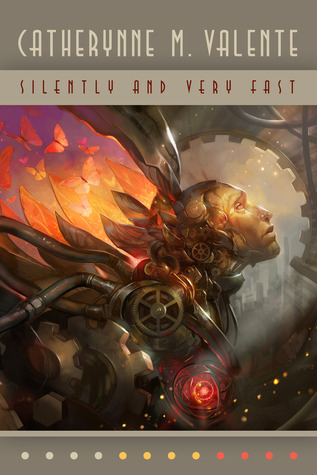
Over the last couple of weeks I’ve put together a two part essay/review-like object that explores how one particular work of science fiction speaks directly to certain ideas of what cyborgs are and what it means to be them, with an eye toward a broader appreciation for how fiction allows for a richer understanding of theory. The full piece is below.

Cyborg writing is about the power to survive, not on the basis of original innocence, but on the basis of seizing the tools to mark the world that marked them as other. –Donna Haraway
Inanna cast down Tammuz and stamped upon him and put out his name like an eye. And because Tammuz was not strong enough, she cut him into pieces and said: half of you will die, and that is the half called Thought, and half of you will live, and that is the half called Body, and that half will labor for me all of its days, mutely and obediently and without being King of Anything, and never again will you sit on my chair or wear my beautiful clothes or bear my crown of being.
You might be surprised, but this is a story about me. –Catherynne M. Valente
Speculative fiction and this blog are not strangers to each other; it’s been written about here before, as a means to understanding how the present has come to look the way it does, and as a means for the imagining of potential futures (also zombies). Indeed, the term cyborg always brings with it a host of connotations firmly rooted within SF, however much it may also describe a current and very real state of being. The important thing to pay attention to here is the power of stories – the ways in which they can serve as a way to do theory in a kind of experimental setting that would otherwise be impossible. In SF – and in fiction in general – we can take the implications of theory and watch them play out, see what they would look like, solidify them in words and images, pick parts of them up and move them around. We can tweak settings and watch other worlds unfold in response.
(more…)
by
Sarah Wanenchak,
Apr 27, 2012, at 12:33 pm

Cyborg writing is about the power to survive, not on the basis of original innocence, but on the basis of seizing the tools to mark the world that marked them as other. –Donna Haraway
Inanna cast down Tammuz and stamped upon him and put out his name like an eye. And because Tammuz was not strong enough, she cut him into pieces and said: half of you will die, and that is the half called Thought, and half of you will live, and that is the half called Body, and that half will labor for me all of its days, mutely and obediently and without being King of Anything, and never again will you sit on my chair or wear my beautiful clothes or bear my crown of being.
You might be surprised, but this is a story about me. –Catherynne M. Valente
Speculative fiction and this blog are not strangers to each other; it’s been written about here before, as a means to understanding how the present has come to look the way it does, and as a means for the imagining of potential futures (also zombies). Indeed, the term cyborg always brings with it a host of connotations firmly rooted within SF, however much it may also describe a current and very real state of being. The important thing to pay attention to here is the power of stories – the ways in which they can serve as a way to do theory in a kind of experimental setting that would otherwise be impossible. In SF – and in fiction in general – we can take the implications of theory and watch them play out, see what they would look like, solidify them in words and images, pick parts of them up and move them around. We can tweak settings and watch other worlds unfold in response.
(more…)
by
PJ Rey,
Feb 8, 2012, at 11:46 pm

Last week, I wrote a piece entitled “There is no Cyberspace,” where I argued the today’s World Wide Web bears little resemblance to the thing that cyberpunk authors like William Gibson imagined as cyberspace. I explained that Gibson defined cyberspace as a “consensual hallucination” and proceeded to argue that the Web was neither consensual nor hallucinatory. I noted that even Gibson himself acknowledges that the cyberspace concept is outmoded—that, rather than being sucked into the world behind the screen, computers have “everted,” overlaying the physical with the digital. I concluded that the term “cyberspace” confounds our ability to makes sense of a social Web that has very real consequences in our lives because it evokes images of fantastical space apart from reality that we can enter and exit at our leisure. The piece received thorough feedback and critique in posts by Mike Bulajewski (on his Mr. Teacup blog) and Jeremy Antley (on his Peasant Muse blog), which has encouraged me to further develop my argument.
My claim that the “cyberspace” misleadingly evokes elements of fantasy left room for possible confusion insofar as I failed to define what I meant by fantasy. Bulajewski, for example, attempted to invert my argument, making a sort of post-Modern claim that “there is only cyberspace” because both our individual psyches (à la Sigmund Freud) and our collective consciousness (à la Emile Durkheim) mediate and interpret experience through the lens of our history, memory, traumas, etc. As Immanuel Kant (and his sociological successor Georg Simmel) explained long ago, there is no access to “real,” unmediated experience—all subjective input is filtered through the pre-existing structures of our consciousness. Bulajewski wants to call all experience “fantasy” because it is historically and culturally relative. Perhaps this is an important distinction in an arcane philosophical context, but I’m rather more concerned with what people actually mean when they say “real” in the context of the Web, as in: “real” life vs. cyberspace. (more…)
by
jeremyantley,
Feb 8, 2012, at 05:11 pm
Reposted from Peasant Muse.

Photo by aagius
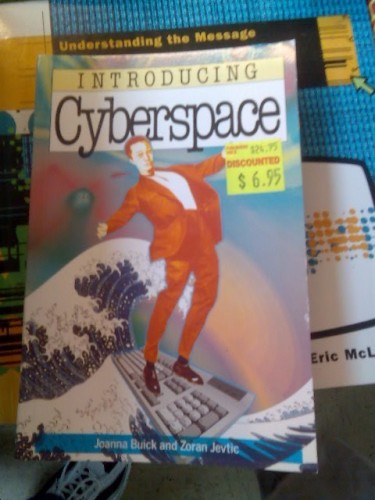
What does the term ‘cyberspace’ mean? Does this Gibsonian construct adequately fulfill the task, currently asked of it by many, of defining the digital/physical realm interaction in terms of its scope and function?
Attempts to frame new social interactions spurred by digital innovations in communication, documentation and self-actualization (just to name a few) generally encounter problems of word choice when describing the effects these advancements bring to our growing conceptions of reality. Literary terminology, often built upon antiquated notions reconfigured to suggest a potential or future state of being, sometimes suits the purpose of analogy when looking at these phenomena. Yet there always comes a time when our understanding of an event or construction of reality demands that we re-evaluate our word choice, lest our future analytical efforts be hindered by its, perhaps, outmoded or misleading operation. PJ Rey and the internet persona known as Mr. Teacup produced just this sort of re-evalutation of the term mentioned above, cyberspace, through two excellent pieces titled ‘There is no Cyberspace‘ and ‘There is Only Cyberspace’, respectively written.
PJ Rey argued that the term cyberspace, first coined by William Gibson in the short story ‘Burning Chrome’ and defined as a ‘consensual hallucination’, is deeply problematic in describing our contemporary social web because the web is neither consensual nor a hallucination. Thanks to the ubiquity of smart phones, pervasive documentary practices (something Nathan Jurgenson calls the ‘Facebook Eye‘) mean that even if someone does not participate in the social web their actions are nonetheless captured by it to some degree, thus shaping our actions on the individual and societal level. Many of us cannot control the degree to which this ‘Facebook Eye’ documents our actions (Could you stop every friend from making comments or posting pictures of your embarrassing moment from last week’s party? What about last year’s party?) making the web far from a consensual space. In many ways, because the web is not consensual it is also not a fantastical or a hallucinatory space either. It is a part of reality- the web is as real as reality itself. Actions taken offline impact online relations and vice-versa, allowing Rey to state that, “causality is bi-directional. We are all part of the same human-computer system.” (more…)
by
davidbanks,
Feb 3, 2012, at 03:42 pm

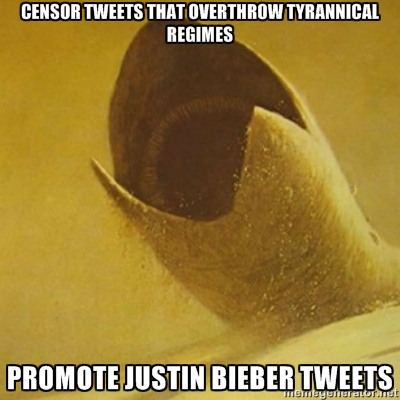
I took the liberty of making a new meme: "Censorship Sandworm". http://memegenerator.net/Censorship-Sandworm
“I must rule with eye and claw — as the hawk among lesser birds.”
-Duke Leo Atreides in Book 1: Dune
Over a week ago, Twitter announced a new censorship policy, stating that it would comply with any “valid and applicable legal request” to take down tweets. The announcement came just as we were still digesting Google’s unified privacy policy and were still debating the (now confirmed) rumors that Facebook was releasing an IPO. Twitter has since been applauded, denounced, and dissected by a variety of scholars, media critics, and business leaders. In this post I will give a brief summary of the controversy, briefly weigh in with a commentary of my own, and conclude with a discussion of what all this means for theorizing online social activity.
(more…)
by
PJ Rey,
Feb 1, 2012, at 12:17 pm

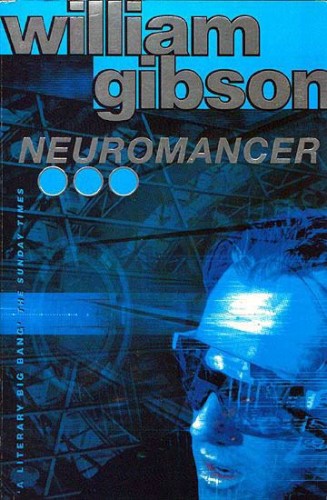
The words and ideas we use to make sense of the Web owe as much to science fiction (particularly, the cyberpunk genre) as they do to the work of technicians or to rigorous scientific inquiry. This by no means a bad thing; the most powerful of such literary works call upon our collective imagination and use it to direct society to prepare for major transformations looming on the horizon. William Gibson’s (1984) Neuromancer was, no doubt, one such work. Neuromancer features the exploits of a “console cowboy” (i.e., a computer hacker) named Case, who travels across a dystopian world serving a mysterious employer. The work is notable for popularizing the term “cyberspace,” which Gibson coined a couple years earlier in a short story called “Burning Chrome.”
In Neuromancer, Gibson described cyberspace as a”consensual hallucination” and more specifically: “A graphic representation of data abstracted from the banks of every computer in the human system. [...] Lines of light ranged in the nonspace of the mind, clusters and constellations of data.” Rather than just staring into a computer screen, hackers “jack in” directly interfacing with these visual representations of data in their minds. The images described here are reminiscent of those portrayed in movies such as Tron (1982), Hackers (1995), and, to a lesser extent, The Matrix (1999). (more…)
by
PJ Rey,
Jul 15, 2011, at 01:54 pm
Nope. It’s not a reference to some long-forgotten 80s movie. On June 23, 2009, former Secretary of Defense Robert Gates signed a memorandum creating US Cyber Command, a separate sub-command unit of U.S. Strategic Command (STRATCOM) headed by a four-star general, (currently, Gen. Keith B. Alexander). And, despite all its digital dualist rhetoric (exemplified by the rampant use of terms like “cyberspace” and “cyber-attackers”), Cyber Command should viewed as a major step toward the augmentation of warfare. With the launch of Cyber Command, the US has quietly moved toward developing new first strike capacities that may, ultimately, prove more strategically important than even the nation’s nuclear arsenal.
While most media coverage has tended to focus on Cyber Command’s defensive postures (e.g., protecting classified data, securing the power grid, etc.), Cyber Command is also developing offensive capabilities to target and cripple other nations’ communication, transportation, and utility grids. This demonstrates that, in the augmented warfare of the future, an effective assault on atoms will also require a simultaneous assault on bits.
Cyber Command’s capacities, however, are far from fully developed. A recent report by the Government Accountability Office concluded that the Cyber Command “has not fully defined long-term mission requirements and desired capabilities to guide the services’ efforts to recruit, train and provide forces with appropriate skill sets.”
Watch CBS sensationalize cyber-warfare and make the digital dualist fallacy of comparing cyberspace to land and sea.