conferences

2890229556_1b90a0ab83_z

“If it weren’t for all of you I would have lost my mind at my job.” Its a familiar refrain that I hear at lots of small conferences and, occasionally, on Twitter backchannels. Its an amazing compliment to hear that your weak tie with someone means so much, but its also an immensely troubling prospect. Hundreds (maybe thousands?) of highly trained professionals have serious misgivings about their professional associations, their home institutions, and maybe even their life’s work. I had heard variations on this theme most recently this past week when I helped out at the (really, really cool) Engineering, Social Justice, and Peace Conference hosted here in Troy, New York. The conference was attended by an array of people: engineers, educators, activists, and social scientists like myself. Some people worked in industry, others in academia, and a significant portion worked for NGOs like Engineers Without Borders. And again, I just want to reiterate: No single person said the exact phrase above, and I certainly don’t want to (mis)characterize any of the attendee’s personal feelings about their jobs or work. Rather, what I witnessed at ESJP is more accurately characterized as a feeling of “coming home.” Think of it as the positive side of the same disaffected coin. This anecdotal trend was in my mind when I read this Seattle Times article about social scientists finding new and inviting homes in tech companies. Are social scientists finding better intellectual homes in industry than in academia? Or am I connecting two totally separate phenomena? Is it just the pay? More to the point: can social scientists do more and better things for the world working in Silicon Valley than the Ivory Tower?
more...

From #whatshouldwecallgradschool titled "Reflecting Back on Grad School"
From #whatshouldwecallgradschool titled “Reflecting Back on Grad School”

Here is a list of skills that, as a grad student at one time or another, I’ve been expected to have with absolutely no offered training whatsoever: more...

Terrific idea from Rebecca Rosen over at The Atlantic.

Below is a partial transcript of the introductory remarks I gave at the Technoscience as Activism Conference held in Troy, New York and hosted by Rensselaer Polytechnic Institute from June 26-28, 2012. The conference was funded by the NSF’s GK-12 Fellowship Program

I almost never read my presentations but we’re short on time and there’s a lot of stuff that I want to share with you and I don’t want to miss anything. Publicly reading an apology for reading in public is an apt metaphor for what this conference is about, or more precisely what it is a response to. When I approached Dr. Ron Eglash about putting on this conference I told him I only wanted to do it if I could make the conference reflect the kind of politics espoused in the presentations. I don’t want to invite a bunch of brilliant people to Troy, who want to talk about democratizing science and technology, and keep them in a single room all day. Troy should benefit from some of your unique experiences, and the people of Troy have done some amazing things that I think the visitors will enjoy and appreciate. more...

Bodies and screens, voices and tweets, hallways and backchannels, experiencing the American Sociological Association meetings this weekend in Denver means stepping into an atmosphere oversaturated with information. The bombardment can sometimes be overwhelming, with more sessions than you can attend and more tweets than you can read. This isn’t going to be a post on why we should use Twitter at conferences, Whitney Erin Boesel already did that more diplomaticly than I could pull off. Anyways, framing it as ‘why do we continue to meet face-to-face?’ would be more interesting for me. Instead, I simply want to argue that there will not be separate online and offline conferences happening, that Twitter isn’t a backchannel and the session room isn’t the front. The reality of the conference is always both digital and physical for everyone whether their noses are buried in a screen, sheets of paper, or staring unblinkingly at the podium. more...

It feels like every time I’m at a gathering of social researchers, within 15 minutes of being there I’ll hear the words “digital world” and “real world” being used to discuss interactions that take place in a technologically-mediated context versus actions that take place in non-technologically-mediated context. more...

The Twitter backchannel in action. Photo by Rob Wanenchak.

Last weekend, I had the double pleasure of presiding over an excellent panel on technology and protest, and having David Banks as my extremely capable Twitter backchannel moderator and Livestream assistant. Both the Twitter backchannel and the Livestream were getting their first serious run as an institutional part of Theorizing the Web, and despite some minor difficulties with mics and cameras, I think they were a clear success.

But the experience of presiding on a panel and then serving as the backchannel moderator for the panel immediately after delivered some interesting revelations regarding what these kinds of technology actually mean for how our conferences work, and for how we engage with and in our spaces of knowledge production.

more...

This is part of a series of posts highlighting the Theorizing the Web conference, April 14th, 2012 at the University of Maryland (inside the D.C. beltway). See the conference website for information as well as event registration.

As Theorizing the Web 2012 approaches, I think it’s worthwhile to consider what the conference itself really means. I mean, yes, clearly it means awesome panels and a fabulous keynote and free pizza, as well as a chance for us to hang out with cool people who we really like. But I think TtW, in both its current incarnation and in the ideals that originally drove its creation, says some important things about conferences as spaces for the production and examination of knowledge.

PJ Rey and Nathan Jurgenson, our intrepid chairs, originally characterized Theorizing the Web as “the conference that we would all ideally want to attend”; clearly, then, there are some things about the conferences that we often find ourselves attending that we wanted to avoid. Last year David Banks highlighted some of these points in his piece on TtW2011’s reflexive nature;

Personally, I am tired of visiting a corporate hotel, adding another tote bag to my collection, and rushing from tablecloth-clad conference rooms to bad catered dinners, so I can make it to a plenary talk about the politics of the discipline. That needs to be over, or academia will stagnate in a pool of its own hypocrisy. Its time for the academic conference to take a reflexive turn. We need to practice what we preach.

What I see driving TtW is more than just putting together a conference that’s fun for all of us. It’s about opening up spaces for the production of knowledge. It’s about making all of this stuff more accessible by being more reflexive about both design and content.

more...


From June 27-29 I will be hosting (throwing?) the Technoscience as Activism Conference in Troy, NY. We are currently accepting abstracts for conference presentations and workshop proposals through March 15th. The conference is sponsored, in part, through Rensselaer Polytechnic Institute’s 3Helix Program funded through the National Science Foundation’s GK-12 fellowship. The conference will focus on community-situated design and look for new approaches that interweave social justice and science/technology. Participants are also encouraged to submit full papers for potential inclusion in a special theme issue of the open-access journal PscyhNology. Conference participants will be expected to participate in both moderated panel sessions on the PRI campus as well as hands-on workshops held throughout the Troy community. There are two goals of this conference: 1) To facilitate the free exchange of ideas across multiple boundaries on the topic of technoscience as activism and; 2) offer an experimental alternative to the traditional role/format of academic conferences. This new experimental format includes active collaboration with the geographically-defined community that hosts the conference. more...


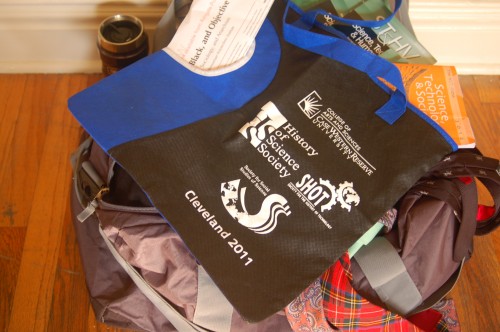
I'm pretty bad at unpacking from conferences...

Unlike my fellow Cyborgologists, who are based in sociology departments, I am working towards a Ph.D in an interdisciplinary field called Science and Technology Studies (STS). The field emerged in the late 60s amongst (and directly influenced by) the environmental movement, the anti-nuke movement, and second wave feminism. Today STS is an established field with departments all around the world. The interdisciplinary nature of the field makes it difficult to have one single umbrella conference, but the closest we get is the annual Meeting of the Society for the Social Studies of Science, or simply “4S.” The conference has panels on a wide variety of topics including, “(Re)Inventing the Internet: New Forms of Agency“, “Evidence on Trial: Experts, Judges and Public Reason“, and “Reproductive and Contraceptive Technologies: Shifting Subjectivities and Contemporary Lives“. There are also two sister conferences that happen simultaneously at nearby hotels: The Society for the History of Technology (SHOT) and the History of Science Society (HSS). While the conference was enjoyable, and the talks were fascinating, I was left wondering if STS is up to the task of changing how we talk about technology, science, and innovation. more...