

conferences

My attention was directed today (via Twitter, appropriately), to this post about the competing ASA Bingo Cards.  I don’t have a lot to say about the deeper meaning of “gentle ribbing” or negativity, whatever you want to call it, in the original card.  However, I do think that the “chronically hip grad student” square was not just, as Nathan Jurgenson asserted, a mainstream culture-embedded dig at hipsters, but also an indication of a general discomfort among less technologically savvy sociologists at the increasing use of technology to augment professional scholarly activities, often though not always by colleagues younger than themselves.

In particular, I suspect that the characterization of Twitter as “like passing notes during a talk, only if those notes were posted on a giant whiteboard behind the speaker so that everybody but her could read them” is quite accurate in terms of how the unfamiliar (and vaguely suspicious) think about Twitter.  Twitter users think they’re better than us, just like those iPad-using hipster grad students, and they’re trash talking about it where we can’t see them. While it makes sense, I think it’s a very misguided analogy.

The critical difference between notes, or for that matter late-night trash talk at the hotel bar, and Twitter is that Twitter creates more...
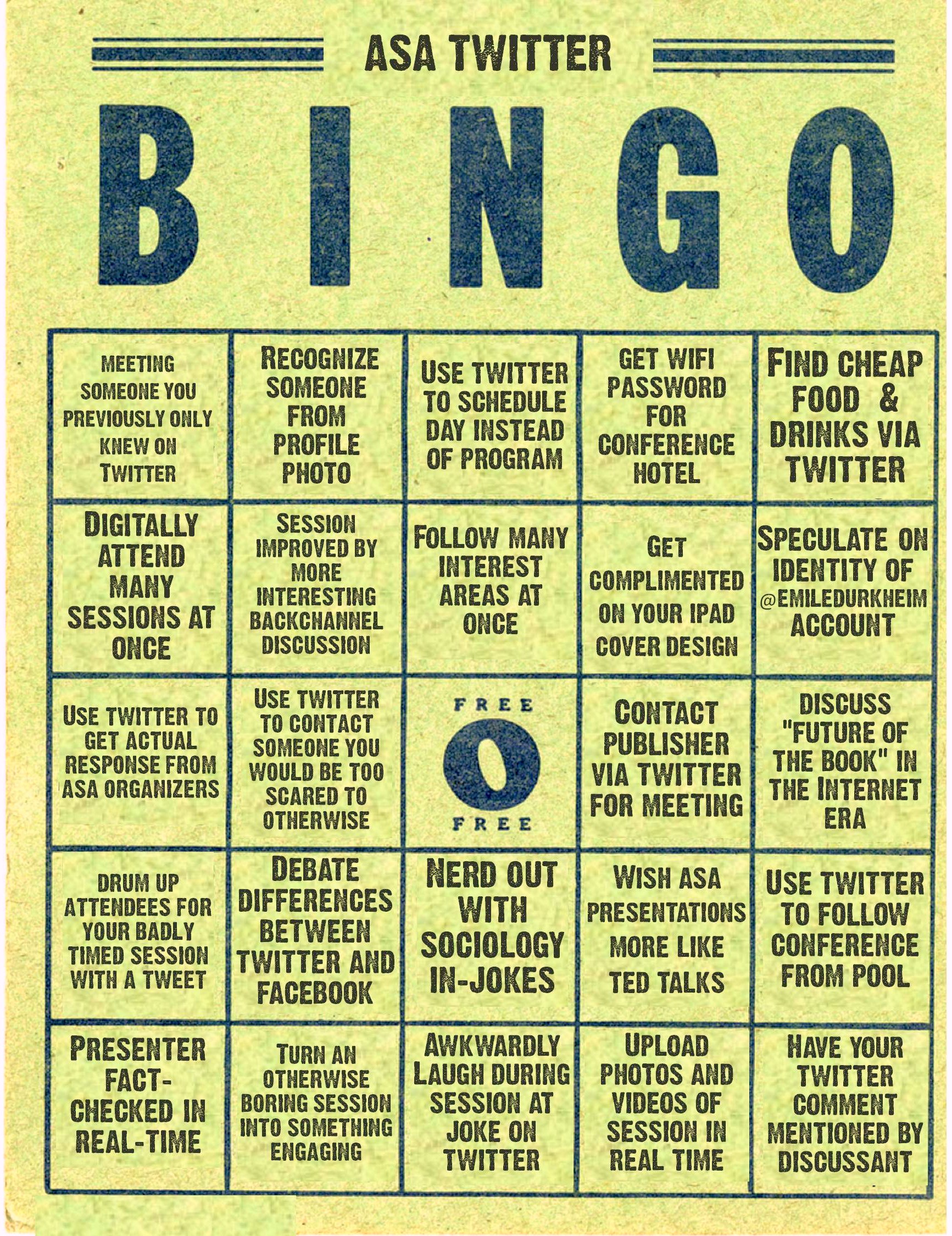
Conference Twitter Bingo Card created by Jessie Daniels and Nathan Jurgenson

There was a popular “bingo card” for the annual meetings of the American Sociological Association held last week in Las Vegas. It poked a bit of fun at sociologists and the meeting itself. Nathan Jurgenson’s reaction was that the card itself revealed much about the sociological discipline and the problems with the annual meetings. He wrote a post here on Cyborgology calling for a more positive bingo card that might be helpful to improve the conference experience rather than just complaining about what is wrong. It is easy to be annoyed, much harder to be constructive.

CUNY sociologist Jessie Daniels responded to this call, and, toegther, we have created a more constructive and useful Bingo card that looks specifically at how to improve a conference by augmenting one’s experience with Twitter.

The card describes how conferences in general benefit from engagement on both the physical and digital levels. Conversations taking place move onto the web, and discussions in the “backchannel” flow back into physical space. In fact, we noted this trend during the Theorizing the Web conference this past spring, calling it an “augmented conference.”

More on Twitter use at the ASA 2011 meetings.

Editors PJ Rey and Nathan Jurgenson introduce keynote speaker danah boyd

This past weekend Cyborgology editors PJ Rey and Nathan Jurgenson treated over two hundred (mostly) young academics to a new kind of conference. In some ways it was like any other conference: some people (me included) did the necessary grousing about waking up early; there were minor technical mangles [mangle of practice]; and there were some awkward glances at name tags as everyone tried to remember the names of their new professional acquaintances. But unlike some of the larger (dare I say, “mainstream”) conferences, there was a palpable sense of ownership over all aspects of the the project. We were doing this for a reason, and it was not to pad our CV’s. It was to play with the medium. We theorized the web, but in so doing, we also reconsidered the purpose of conferences.

more...