brands

The New York Times recently published a piece titled “At Times, Obama and His Cyberself Differ on Tactics” that opens with the passage:

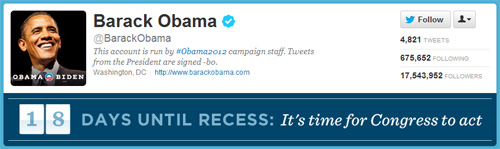
For a moment on Friday, the cyber-Barack Obama was perfectly at odds with the flesh-and-blood version… Speaking to 1,400 supporters at a high school… President Obama voiced his familiar lament that “there is so much negativity and so much cynicism” in politics that he could understand if voters tuned out the election. Minutes earlier on Twitter, he had written, “Why Mitt Romney’s end date at his buyout firm matters,” linking to a blog post about the tempest over his Republican challenger’s departure from Bain Capital.

The article doesn’t really offer any deeper analysis of the topic raised in its headline, but the notion of this sort of technologically-mediated, or even, post-human, presidency is so provocative that it’s worth additional reflection. I can’t begin such a reflection, however, without first critiquing some of the vocabulary used in the article. The article contrasts “cyber-Barack Obama” (or Barack Obama’s “cyberself”) with “the flesh-and-blood version.” This problematically implies that there are two Barack Obamas: the real Obama and the Obama out there in cyberspace (cue creepy space music). Of course, once we even state such a claim, it becomes immediately apparent that it has zero face validity. Arguing that the Barack Obama who signs the messages he personally posts to Twitter with the initials “bo” is different than the Barack Obama out there giving the speeches makes about as much sense as arguing that when I call my mom on telephone, I’m talking to a different person than when I drive over for a visit. more...

On this blog we often talk about the role of the prosumer, or actors that are both producers and consumers and that serve to muddy the longstanding distinction between production and consumption. For example, Jenny Davis and Nathan Jurgenson wrote on prosuming identity online, and how Web 2.0 technologies (especially social media) have allowed for the creation of new identities like transability and asexuality. Similarly, Nathan Jurgenson has written extensively on how social media has contributed to the “participatory, prosumer, dissent” of the Occupy Movement, playing into the much larger atmosphere of augmented dissent that has gripped the Middle East and other parts of the globe for some time now. And finally, Jenny Davis and I have written on the “Jailbreak the Patriarchy” Chrome Application, which allows users to genderswap the content they read on the internet.

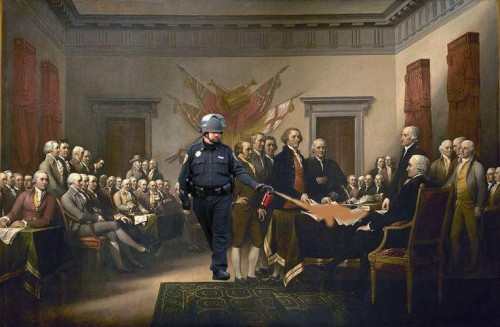
Occupy DC encapsulates our "atmosphere of augmented dissent." Photo by Nathan Jurgenson.

Each of these examples reveals the tight association between social media and prosumption. That is, social media has greatly expanded the role of the prosumer in contemporary (augmented) society. This is because the individual voice is amplified through the digital networks of Web 2.0 technologies like Facebook, Reddit, and Twitter. Just as the Arab Spring and Occupy have changed the conversation regarding participatory democracy, prosumers are continually reworking culture through the creation of memes, identities, and new online content, blurring the distinction between the production and consumption of cultural forms. A great example of the prosumption of culture is fanfiction.

And this brings me to Star Wars. Finally.

This feature-length fanfilm titled “Star Wars Uncut” is a shot-for-shot remake of Star Wars Episode IV: A New Hope, produced entirely from 15 second film clips sent in by fans. Casey Pugh, a 26-year-old web developer from Brooklyn created the film after posting on his blog asking for submissions. These fans each prosume Star Wars as both a brand and a cultural artefact (Bruns 2007) when they rework iconic scenes with a “twist,” allowing for the expression of new cultural forms and greater participatory expression from the larger Star Wars fan community.

The film, which won the 2010 Emmy for Interactive Media, is also an example of what Nathan Jurgenson has called “curatorial media”, where old media forms (eg: print newspapers) are augmented by new crowdsourcing capabilities of social media. The film above is an example of curatorial media because centralized gatekeepers (ie: Casey Pugh himself) selected which film clips to include. He then edited the film shot for shot, splicing together disparate scenes produced by widely different fans around the globe. I myself watched the first 45 minutes of it, mostly because I was curious and also because I was a huge Star Wars nerd as a kid.

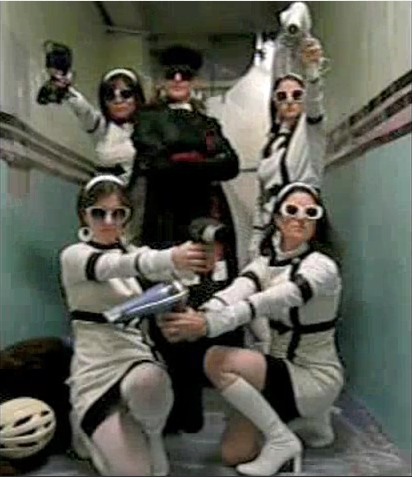
Darth Vader and her stormtroopers.

Although the film clips can be a little jarring at times (especially when jumping from live action to crudely animated MS Paint images and back in a matter of a few seconds), it does serve as a humorous reworking of an extant cultural forms. That is, many film clips reveal anachronistic revisions to the actual film.For example, the entrance of Darth Vader onto the rebel starship (arguably one of the most iconic scenes in the original film), has been replaced by an all female squad or storm troopers, Vader himself briefly appears as a female.

Throughout the film we get several more examples of this sort of literary prosumption (Olin-Scheller and Wikstrom 2010), bolstering my claims that social media and Web 2.0 have allowed for an effervescence of collective cultural production and consumption. Fanfiction has long used extant cultural forms for the creation of new cultural forms, the homoerotic revision of Spock and Kirk’s relationship on Star Trek as but one iconic example.

Homoerotic tension between Kirk and Spock has been a treasure trove for fan fiction revisionism.

Although this film is not the first of its kind, it is a great example of participatory filmmaking. As new technologies continue to incorporate more and more social media capabilities (cell phones, tablets, etc), it is likely that we will see increasingly utility of the term “prosumer.”

With police dismantling Zuccotti Park and other #Occupy encampments throughout the country and impending Winter weather, pundits and activist alike are asking: Does the #Occupy movement have a future? To survive, #Occupy must begin—and, in fact, has already begun—a tactical shift. However, before I attempt to discuss #Occupy’s future, let me first be clear: The #Occupy movement is already a success. Recent months have witnessed a radical shift in mainstream political discourse, where concerns over America’s widening income and wealth gaps now have near equal footing with the deficit-reduction agenda. It has become common knowledge that the top 1% receive roughly a fifth of America’s collective income and control a third of the wealth. More Americans view Occupy Wall Street favorably (35%) than Wall Street (16%), government (21%), or the Tea Party (21%); and, though the country is gripped by a state of general cynicism, more people hold unfavorable impressions of big business (71%), government (71%), and the Tea Party (50%), than of #Occupy Wall Street (40%). Put simply, #Occupy is the most popular (and least unpopular) thing we’ve got. more...

What is it that we exchange when we interact online? Part of my research into the notion of the branded cyborg explores the question of what we circulate in the networks that constitute digital sociality. Different platforms and communities within social media privilege different types of interactions, but two dominant  conceptualizations seem to emerge regularly. One is represented by Marcel Mauss‘ gift economy, the other by Bourdieu’s notions of capital, particularly social capital.

The concept of the gift economy resonates in the history of early web communities like CommuniTree (Stone, The War of Desire and Technology at the Close of the Mechanical Age, 1995) and in the rise of Linux and the Open Source Movement. Mauss (The Gift: Forms and Functions of Exchange in Archaic Societies, 1922/1990, p. 31) argued that gifts are never actually free, but objects of reciprocal exchange, and that “objects are never completely separated from the men [sic] who exchange them.” In a gift economy, then, objects cannot be fully transferred from one owner to another as they can in a commodity economy. Gregory’s (Gifts and commodities, 1982) work on Mauss suggests that the affiliation of the identity of the giver with the object is what compels reciprocation: gifts are inalienable, thus the act of giving creates debt that must be repaid and instantiates an ongoing relationship between individuals.  Gift exchange leads to a social bond and to mutual interdependence. more...

Advertising on social media is more than those segregated paid-for-spaces that display ads paid for by companies (e.g., on the far-right of your Facebook screen). This sort of paid-advertising has been shown to be so highly ineffective that some have predicted it will be the downfall of the social web. However, these predictions do not understand that the fundamental point of the social web (2.0) is that users are prosumers; they are simultaneously both consumers and producers of content. And advertising is no different. Advertisements that we simply consume worked in a consumer medium, like television. However, social media is a prosumer medium, and today we are the ones doing the advertising work of integrating corporate logos and branding into our profiles and news feeds.

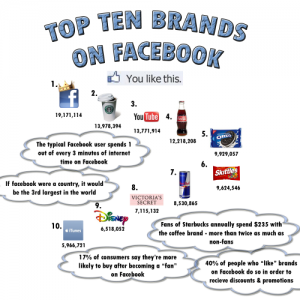
Facebook’s ubiquitous “like” button reflects our modern task of self-presentation (and distinction) based on our taste in just about anything and everything, documented and compared to the various “likes” of any other visitor to your profile (and remember: what someone “likes” may not be what they actually like but what they want others to see that they like). In modern consumer culture, this collection of displayed “likes” will include corporate brands that one identifies with. This might mean clicking “like” on the Starbucks or Victoria’s Secret pages, which then becomes a part of your profile. more...