children

Although many older Americans have had long marriages, the proportions of Americans over age 50 who have been divorced and remarried have increased substantively over the past 25 years. In fact, individuals in the early ‘baby boomer’ cohort (born between 1946 and 1955) have divorced and remarried more often than any other age cohorts. It is not surprising, therefore, that many multi-generational American families include stepgrandparent-stepgrandchild relationships. This is relevant to multi-generational relationships and perhaps to the future care of these stepgrandparents.

In our studies, we have identified four distinct pathways to becoming a stepgrandparent, and we have conducted a series of investigations designed to uncover how these different pathways affect the formation of stepgrandparent-stepgrandchild relationships. In a recent study we interviewed 48 young adult stepgrandchildren, comparing their perceptions of 44 long-term stepgrandparents who joined the stepfamily before these stepgrandchildren were born, with their perceptions of 28 later-life stepgrandparents who joined their stepfamilies when the stepgrandchildren were late adolescents or young adults). A number of these adult stepgrandchildren had more than one stepgrandparent, and we asked about all of them.

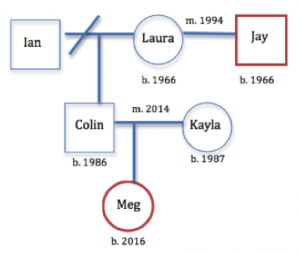
The differences between each pathway have been theorized to result in relationship differences. Long-term stepgrandparents’ are in relationships with stepgrandchildren because they became stepparents when their stepchildren were young – years before those stepchildren reproduced and made them a stepgrandparent. In this figure, Jay is a stepgrandfather to Meg. Jay married Laura in 1994, and Colin became his 8-year-old stepson. As an adult, Colin married Kayla in 2014, and Kayla gave birth to Meg two years later. Jay is a long-term stepgrandfather. As Meg grows up, she will always have had Ian, Laura, and Jay as grandparents on her father’s side of the family (for simplicity, we ignore Kayla’s family tree in this illustration). Jay was a member of Meg’s family long before she was born.


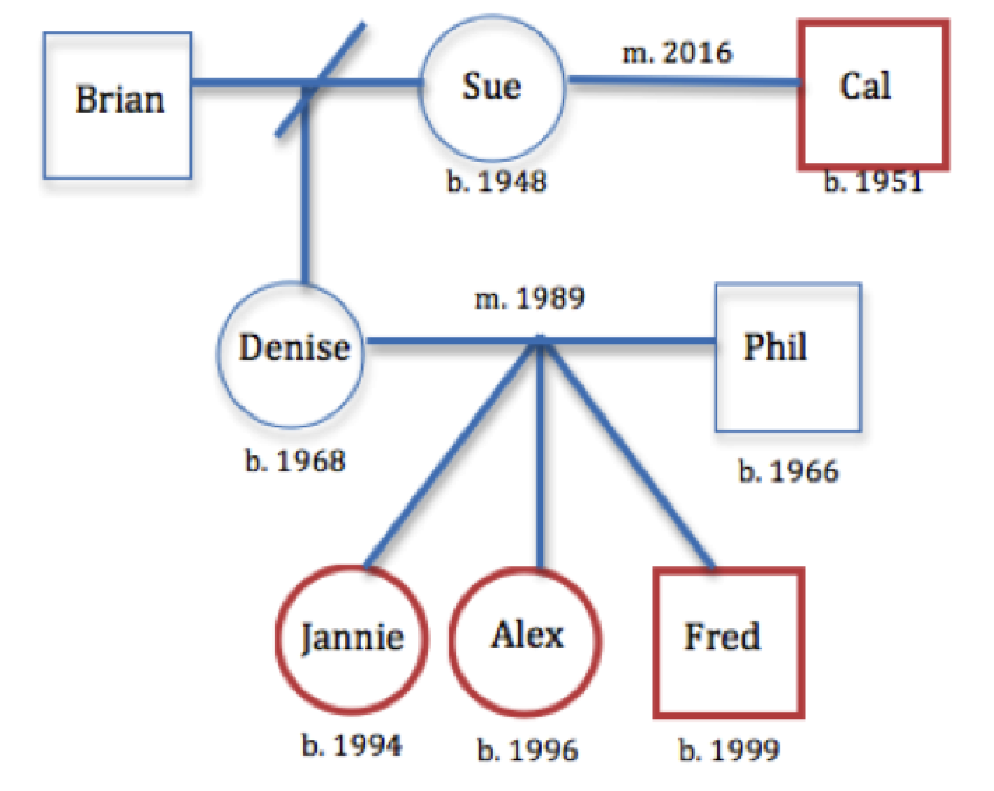
Comparatively, later-life stepgrandparents acquire adult stepchildren and stepgrandchildren following their remarriage to a grandparent; the new stepchildren are often middle-aged parents, and stepgrandchildren are often adolescents or older. The figure is an example of a later-life stepfamily. Cal married Sue in 2016. Sue has a daughter, Denise, who was 48 when her mom remarried. Denise had three children, ranging in age from 17 to 32 when Sue remarried. Those children are now Cal’s stepgrandchildren. Therefore, Cal is a later-life stepgrandfather to Jannie, Alex, and Fred.
 

The structural factors matter in how multi-generational stepfamilies interact and may affect the quality of stepfamily relationships. We discovered from our interviews that long-term stepgrandparents (like Jay) much more closely resemble biological grandparents in their relationships with stepgrandchildren than do later-life stepgrandparents, and they generally are called by family names (e.g., Grandpa, Nana). In large part this is because of conditions associated with the timing of remarriages and the subsequent personal histories that stepgrandchildren have with biological and stepgrandparents. Although the middle-generation influences how the stepgrandparents and stepgrandchildren bond in both long-term and later-life stepfamilies, parents in long-term stepfamilies control the amount of interactions between the older and younger generations more. Both later life stepgrandchildren and the middle generation adults, because they experience the remarriage of grandparents at the same time, concurrently are grieving the past (i.e., after the death of a grandparent) and trying to make sense of the family transitions. Perhaps not surprisingly, In long-term stepfamilies, relationships and kin connections usually have been defined long ago when the middle generation parents were quite young. The stepgrandchildren did not enter the family until long after remarriage transitions. These long-term stepgrandparent-stepgrandchild relationships and their multigenerational families generally functioned like grandparent-grandchild relationships in first-marriage multigenerational families; later-life families and relationships did not.

The stepgrandchildren did not remember a time when their stepgrandparent had not been a part of the family. Similar to findings from previous research, our results suggest that contextual factors, namely the timing of life events and transitions, duration of key family relationships, and opportunities for intergenerational interaction (e.g., co-residence, affinity-building), matter tremendously for if, how, and to what extent, intergenerational steprelationships are developed, maintained, and associated with caregiving and support exchanges, particularly in later-life.

Results from our study suggest that later-life stepgrandparents may be especially at risk for diminished social support, particularly from adult stepchildren and stepgrandchildren. These relationships often did not have enough time to develop before the older stepgrandparent needed care or other help. The later-life stepgrandparent had not had time to do things that bond people together – hanging out, giving gifts and sharing resources, having fun together. As a result, younger generations did not feel a sense of obligation or a need to reciprocate past gifts of the later-life stepgrandparent. The stepgrandchildren and their parents often referred to the later-life stepgrandparent as “grandma’s new husband” or “grandpa’s new wife.” Although stepgrandchildren’s thoughts and feelings about long-term and later-life stepgrandparents are worth exploring and shed light on complex family processes, we are unable to draw conclusions about the experiences of middle-generation parents or stepgrandparents. Because individuals experience family transitions differently, and these transitions, in turn, inform kinship ideologies and family interactions, more research is needed to glean the perspectives of family members from multiple family roles. Analyses of qualitative data garnered from multiple perspectives (e.g., biological grandparents, biological parents, stepgrandparents) would offer additional insights about family transitions and relationship trajectories. Data from more diverse multigenerational stepfamilies would also add to our knowledge base, as most of our respondents self-identified as White and ‘middle-class.’ Moreover, some stepgrandchildren were reporting on relationships with deceased stepgrandparents. Although the degree to which the death of stepgrandparents influenced stepgrandchildren’s narratives about their family relationships remains an empirical question, it is possible that interviews about dead relatives may differ in important ways from interviews about living relatives. Finally, family relationships and dynamics, including roles/rules, symbols, and language, are likely to vary across cultures, yet we are unable to speak to the influence of culture on intergenerational steprelationships given the cultural homogeneity of our sample.

This study has moved beyond describing stepgrandparenthood pathways to exploring underlying processes in intergenerational relationship building. Relationship quality among stepgrandparents and stepgrandchildren may vary widely, regardless of pathway. We have illuminated here the dynamics by which these distinct types of intergenerational stepfamilies diverge. Researchers and practitioners who work with older stepfamilies can utilize this knowledge to better think about, work with, and support stepgrandparents in later life. For researchers, knowing about pathways to stepfamily status (i.e., “How did they get here?”) provides hypotheses or assumptions to explore. In future studies of stepgrandparents, we encourage researchers to consider and attend to structural pathways, as the variability of stepgrandparent “types” is often an overlooked, yet important, distinction. For practitioners, understanding if, how, and to what extent stepgrandchildren’s relationships with stepgrandparents impact both upward and downward exchanges of social support, particularly as stepgrandparents age, can be useful in working with families to create care plans for older adults in later-life. Issues of who will care for frail stepgrandparents can only be addressed effectively by an understanding of the diversity of multigenerational stepkin relationships. Moreover, understanding pathway implications to stepgrandparenthood can enhance science and practice with older step-couples. Our findings illuminate expectations about new partner involvement in family life following transitions such as death, divorce, and remarriage.




Lawrence Ganong is a Chancellor’s Professor of Human Development and Family Science and Emeritus Professor of Nursing at the University of Missouri. Marilyn Coleman is a Distinguished Curator’s Professor Emerita of Human Development and Family Science at the University of Missouri. They have studied post-divorce family relationships and stepfamily relationships for over four decades. They may be reached at ganongl@missouri.edu and colemanma@missouri.edu

Years ago, when interviewing a woman in a study of stepfamilies, I (Coleman) was struck by comments she made about her ex-stepdaughter. This woman had helped raise the girl from early childhood (age 2) into early adolescence. The father of this girl had physical custody of her because the child’s mother suffered from a drug addiction. The stepmother I interviewed and the father of this girl had divorced when the stepdaughter was 12 or 13 and the woman never saw the child after that. In the interview, the former stepmother shared through tears that after the divorce her ex-stepdaughter had called and written several letters begging her to get in touch, but she had not, she told me, because “it didn’t seem appropriate.” This was during an era when divorced couples generally were expected to sever all ties and not cooperate with each other in any way – after all, the thinking went, if the couple could get along well, then why had they divorced? When remarried couples divorced, children nearly always went with the biological parent and often never saw or interacted with their stepparent or stepsiblings again. This “clean break” of stepfamily ties after divorce may have seemed “natural” and “normal” to many adults – after all, stepparents were neither genetically nor legally related to stepchildren, but to some stepchildren and stepparents, such as the woman I interviewed and her ex-stepdaughter, these breaks were emotionally painful because they ended long-term family relationships. For example, the stepmother I interviewed had raised her stepdaughter for a decade and was likely an important figure in the girl’s life. The former stepmother’s comment that getting in touch with her stepdaughter “didn’t seem appropriate” nagged at me for years before our research team decided to explore what we called “ex-steprelationships.”

Ex-step kin are not rare. In the United States, about one-third of children will spend part of their childhood living with a stepparent. The divorce rate among remarriages is higher than that of first marriages, so a lot of these children will go through multiple family transitions. Maintaining ties with ex-stepparents could help children in terms of resources, relationships, and emotional stability. Our legal systems, however, generally do not recognize rights or responsibilities for ex-stepparents after a divorce. Without legal precedents, ex-stepkin are left on their own to figure out their postdivorce relationships. To explore this phenomenon, we launched a series of studies in which we interviewed former stepkin (stepchildren, stepparents, and stepgrandparents) using grounded theory methods in which we asked open-ended questions and let the study participants tell us what was important to them.

In the first study, we interviewed 41 young adults who had been stepchildren and who had experienced a parent’s remarriage breakup. Our questions focused on their experiences with former stepparents both before and after the divorce. We found three perspectives about ex-stepparents from stepchildren, which we labelled claimed, disclaimed, and unclaimed. About 25% of the young people we interviewed continued to claim their stepparent as kin after the divorce. Another 25% had claimed the stepparent as kin during the remarriage but cut all ties with them after the divorce (i.e., they disclaimed the stepparent). Finally, about half had never claimed the stepparent as kin (i.e., the unclaimed).

The ex-stepchildren who continued to claim their stepparents and those who had claimed them during the remarriage and disclaimed them after divorce had spent a lot of time with the stepparent when the remarriage was going well. During the remarriage, they felt close to their stepparents and considered them to be a family member if not a parent.

The ex-stepchildren who still claimed their stepparents as kin after divorce got help from parents in doing so. Their parents either encouraged them to stay in touch with ex-stepparents or were neutral about it, and thus did not discourage them from doing so. Those who had half-siblings from the dissolved remarriage were more likely to stay in contact with ex-stepparents than those who did not. The former stepparents were open to continuing to be in a relationship with them and did what they could to keep lines of connection open. Some ex-stepchildren waited until after the post-divorce flames and hostility had died down before becoming involved again with their stepparent. One man waited five years before reconnecting with his stepfather, and they rekindled a very close relationship. The ex-stepchildren who continued to claim their stepparent after the remarriage ended said that they continued to receive support from their ex-step in the forms of help with college expenses, other financial help, and the kinds of assistance young people seek from parents and parental figures (e.g., advice, emotional support).

The ones who disclaimed their stepparents, did so almost immediately after the end of the remarriage, often because of loyalty to their biological parent. Some said they cut off ties with the stepparent because their parent had revealed negative information about the ex-stepparent. These disclaiming ex-stepchildren took the side of their biological parent, and although it often was emotionally painful for them to do so, they quickly and decisively cut off ties to their ex-stepparents. These young people felt sad about the losses they experienced as a result of this divorce, and they often were still angry at the stepparent, whom they generally blamed for the divorce.  In some cases, ex-stepchildren wished they could resolve some of their feelings and wanted to reconnect with the ex-stepparent, but did not know how to make this happen, and even felt ambivalent about whether it should or not.


The last group of ex-stepchildren, who had never claimed their stepparents as kin, was older when their parent remarried, the remarriage was relatively short, and the stepparent and stepchild had spent little time together. Some stated they had always disliked the stepparent. These ex-stepchildren felt no sense of loss and some were even relieved after their parent’s divorce from the stepparent. They had made no attempts to connect with their stepparent after divorce and neither had their former stepparent tried to contact them.


We were encouraged in this study that none of the ex-stepchildren thought that it was inappropriate to continue these stepfamily ties. Some of the claiming ex-stepchildren in our study noted, however, that a lack of social norms and expectations for the ex-steprelationships after a remarriage ends made them unsure at times about what to do. Maybe these young people and their stepparents and parents are creating new norms, but the absence of guidelines or social support is unfortunate, at least for some ex-stepchildren who claimed their stepparents as parents during the remarriage; ex-stepchildren who continued to claim stepparents as kin cited many advantages to maintaining those relationships.


Lawrence Ganong is a Chancellor’s Professor of Human Development and Family Science and Emeritus Professor of Nursing at the University of Missouri. Marilyn Coleman is a Distinguished Curator’s Professor Emerita of Human Development and Family Science at the University of Missouri. They have studied post-divorce family relationships and stepfamily relationships for over four decades. They may be reached at ganongl@missouri.edu and colemanma@missouri.edu

BR: You introduce the term “genetic strangers.”  Can you define it for us, and explain how the families you studied embodied the term?

RH: We use the term ‘genetic strangers’ to describe people who share genes but who do not know one other … or even that the other exists.  Genetic strangers are not relatives until a relationship is created.  In fact, the core of the book is about whether and how strangers become relatives … and what happens to the meaning of family as a result.

In Random Families we refer to “donors, donor siblings and their families as ‘genetic strangers’ as a way to bind together something that usually connotes familiarity with something that symbolizes the opposite.”  In the conventional heteronormative view, there is nothing more intimate than blood ties (i.e., shared genes). As single mothers and two-mom families joined the ranks of heterosexual parents who needed gametes to create a baby, those gametes often came from commercial sperm banks.  The rise in markets for sperm and/or eggs means that more children share half their DNA with strangers.

The donor sibling networks we discuss in Random Families are modern strangers in a modern world — a world in which we interact with people we do not know well and may never have met before.  Think about the Internet, especially Facebook groups or our own FB page that often includes people with whom we do not share space or time. The internet extends our acceptance of strangers whom we believe can provide us with a sense of connectedness or belonging, information and perhaps even intimacy. Donor sibling networks are a special case of people who may have randomly purchased the same donor; and after finding each other they might try to turn that strangeness into some form of kinship.

BR:  According to your evidence, there are distinct eras in the history of the emergence of families connected by donor siblings.  Can you identify these eras and how the experience of creating familial networks differs between them?

RH: Those are important questions because they point again to the distinction between stranger and relative.  The first successful pregnancy with donor sperm began nearly six decades ago. But because donors were anonymous it didn’t make sense to talk about networks, even if multiple offspring were probably created in the earliest days.  It wasn’t until much later that this made sense, particularly with the rise of the internet, which increased the availability of information and made it much easier for people to connect by means of Facebook and web sites such as Ancestry.com and 23andme, for example.

That’s why we distinguish different eras in donor-conceived networks based on the kind of genetic information available and by the ease of access to that information.

The first era of donor-conceived networks begins in the 1980s with lesbian couples and single mothers (straight or queer) who pioneered the formation of these families by using smaller commercial sperm banks in two important hubs – San Francisco and Boston.  In contrast to the anonymous sperm marketed by the large, often national, sperm banks, these smaller banks offered identity-release donors.  The parents felt that nurture – how they raised their children – would trump nature. They told their child he or she had a “father” whom they could meet when they turned 18.  If at age 18 children wanted to connect, they could ask the bank to relay that desire to the donor.  Surprisingly, it was usually the donor who fostered connections between their various offspring as they came forward.  The child almost always expanded family to include these new relatives and conventional terms, such as father and brother/sister were also likely to be used. The donor was a good guy who kept his promise and arrived to meet his genetic offspring. The offspring met as a sort of afterthought.

The second era begins in the 1990s with parents who purchased anonymous donor sperm only to have anonymity stripped away with the growth of the internet and online networks.  These nuclear families fully expected to raise their children with disclosures about the sperm donors, but they expected that family lineage would come from the parent(s) and not through paternal (donor) kin. The growth of the internet and the ease with which people could access internet sites changed all of this. Registries emerged as independent sites and then banks offered these registries as opt-in features. Parents (for the most part mothers) were startled to learn about this possibility to connect with other families who shared their child’s genes.  Parents would register and usually they did not discuss their decision to do this with their children. They wanted to check out these strangers who lived all over the country before telling their children. Once parents were satisfied, they told their children they had “half siblings.” Children were surprised. Sometimes these relationships moved offline to a face-to-face meeting and sometimes the children became close to these new siblings.  Counting these networks as extended kin took time as these unscripted relationships slowly developed.  Parents might have orchestrated those first “reunions” when children were adolescents or teens. In the book we compare two networks from this era. Both have anonymous donors; but the donor in one network decides to reveal his identity which represents a likely possibility. Moreover, the kids in these two networks react differently to meeting their donor siblings. As these networks expanded, intimacy between such a large group of children became problematic.  Like other kinds of large organizations, the networks fragment into smaller groups that sometimes resemble high school cliques.

The third era of donor-conceived networks begins with children born after 2003. The distinguishing feature is that children born in this era would grow up with donor siblings as commonplace. These parents had toddlers when registries first began, and they connected early on with their child’s donor siblings.  Unlike the earlier era when kids were surprised that they had donor siblings, these kids saw their half-siblings more like cousins who visited once or twice a year. Sometimes children formed close ties to one or two other children in the group. These networks are larger from the start (as more parents decide to locate a child’s half siblings). There are no large gatherings with all the members. Families are most likely to meet regionally with a smaller group.

Finally, we feature a network of younger parents whose children are under five and who knew about donor siblings when they purchased gametes. It is not the newness of the internet or registries that emerges among this group. Instead, these parents, whose children are too young to understand the idea of donors and donor siblings, question whether they can find a new kind of kinship organization. They don’t want to make assumptions about the relationships within the group and how their children might feel when they are older. They hope that by providing memories of gatherings their children will want to define those relationship with each other in the future or, at the very least, they will have each other to talk to about being donor conceived. For these parents the donor sibling network is more like other interest groups or forums they belong to where they can share information that they hope will benefit their child. This new period (maybe not an era) represents kinship revisited.

Since consumer demand for identity release donors increased over these eras the people we interviewed with children born after 2000 are more likely to have this kind of donor. Yet, when the children eventually can have contact with their donor (if their child wants this) these last two networks imagine a donor who is willing to offer information. He is not the “father” who arrived in the late 1980s.

BR:  In many of the narratives, you write about how individuals, and nuclear families, come to reassess the relative power of nature versus nurture in children’s development. Please explain how children come to think of nature versus nurture in their experiences as they met genetic family members.

RH¨ We made a point of interviewing children (ages 10 to 29) because we anticipated that at an early age they would have to puzzle through distinctions like nature versus nurture that are loaded with meaning for families, as well as for children.

But to be fair to the kids, it’s important to put “nature versus nurture” into context first.  That is, for all the public discussion of genetics and all the information available about individual genetic makeup (e.g., from services like Ancestry.com and 23andme), there is huge ambiguity about the meaning of genes for parents, let alone for children.  Even in the scientific community there is no consensus about the heritability of many human qualities – like intelligence, musical ability or sports.  So, when we interviewed kids it was important for us to listen carefully to the way they gave meaning to genes.

In most instances, parents set the foundation for kids’ understanding of nature versus nurture, usually with their first conversations about a child’s origins or birth story. Donor is a hollow concept to a child.  Parents fill in the concept, but always with reference to their preferred way of talking about family. A discussion about inherited traits and characteristics is how we locate children in a family system: “Your curly hair is from me, or musical ability from your grandmother.” If they have a donor’s profile, parents usually reference bits of information that factored into their selection of a donor (e.g., “He is an astronaut” or “wants to become a lawyer”, or he “reads a book a day” or “he likes mountain climbing”). Over time, parents and children collaborate in inventing both the donor and the child’s genetic inheritance.

However, for donor-conceived children nature versus nurture really becomes relevant – and complicated – when donor siblings are located. When half-siblings first meet, they quickly discover shared traits, starting with physical resemblances. It’s important to note that children who share a donor are primed to find similarities with their half-siblings.  The experience is often powerful and, not surprisingly, talk about genes and heredity takes center stage.

Donor-conceived children described a real tension between nature and nurture – if not immediately, then over time as they transformed genetic strangers into relatives. Kids who had no siblings within their nuclear family often took great delight in meeting children who were like them, especially since their parents encouraged the contact.  But even with parental encouragement some kids felt they should downplay the importance of genes – because putting genes at center stage implicitly distances them from the family they’ve always known. This is most pronounced in families with a non-genetic parent.  On the other hand, they could not deny the fact of physical resemblance and the often- eerie feeling that occurred when they discovered unexpected similarities like sense of humor and musical ability.

With time and distance, a more nuanced view about nature and nurture seems to emerge.  Kids assimilate the new information and arrive at workable definitions of siblinghood, for example.  They make a point of preserving a central role for non-genetic parents, such as talking about deeply-ingrained preferences for food, music, or esoteric matters that they shared with their non-genetic parents.  Talk about genes is tempered by a more sophisticated understanding that they can belong to their parents while acknowledging that they share some things with a donor and their donor siblings.

Cover of new book by Rosanna Hertz and Margaret Nelson


Rosanna Hertz is Class of 1919 50th Reunion Professor of Sociology and Women’s and Gender Studies at Wellesley College.  Barbara J. Risman is a Distinguished Professor of Sociology in the College of Liberal Arts & Sciences at the University of Illinois at Chicago.  She is also a Senior Scholar at the Council of Contemporary Families. In this blog Professor Risman interviewed Professor Hertz with three questions about her new book, co-authored with Margaret K. Nelson, Random Families: Genetic Strangers, Sperm Donor Siblings, and the Creation of New Kin.  (2019, Oxford University Press).

Tey Meadow has a new book  Trans Kids: Being Gendered in the 21st Century  that looks at transgender and gender creative children with supportive parents.  I recently had the opportunity to interview Tey about this fascinating new research.

What was the most surprising aspect of your ethnographic work?   Was there something you reported in the book that you hadn’t expected to find but did?

Two things surprised me about my research. First, there was no hypothesis I could make about what kinds of families would be most likely to support or facilitate gender nonconformity in their kids that held true. Some of the most radically supportive families were deeply religious, or from ultra-conservative, rural areas. And some politically liberal families in major urban centers were among those who struggled the most. The notion that there is any sort of monolithic gender culture in any of these areas is far too simplistic an idea to encapsulate the complex and competing desires and emotions these families experienced.

I was also surprised and heartbroken to learn how vulnerable some families were to violence, harassment and censure, even by the state, for simply allowing their children to be gender nonconforming. I detail a number of these stories in the book. Families with children of color, gay and lesbian-headed families and those with pre-existing relationships of surveillance with the state were the most acutely vulnerable, even in socially liberal areas. I met parents who faced false accusations of sexual or emotional abuse, or temporary custody loss and threats of physical violence; many who were too terrified to participate formally in the research, but desperately wanted other people to know this was happening. While media attention on these topics is on the rise, so too is a pernicious backlash that is worth our attention, as well.

One of the most surprising things for me reading this book was the complicated relationships between the social movement organizations founded by parents to advocate for their children and the LGBTQ social movements run by and for LGBTQ folks.  Can you explain that somewhat for our readers?

The contemporary moment for trans children simply would not be possible without the interventions of older LGB-and especially-T activist communities. The adults who pushed for visibility and acceptance at a time when being trans was unthinkable outside of tabloid journalism, who struggled to control the terms of their own engagements with psychologists and physicians, who fought the state for the right to be recognized in their affirmed genders, all of their work set the terms by which parents could recognize children as trans and secure their rights to live openly.

But the political movement around transgender children now is largely a cisgender movement, a vicarious movement of parents and adult allies, who don’t necessarily connect the worlds of these children to the idea of trans that came before. Today’s trans kids will have earlier access to transition than their predecessors, and will, as the reach adulthood, have to decide whether or not their identify with those earlier movements, or whether they want to live outside of them. Some parent I met found the imagery of earlier transgender rights abject, worried that their children would be forced to live marginal lives, or simply felt that the world had changed so much that earlier trans people’s experiences were no longer instructive. Some of these parents chose to limit their children’s access to trans adults, or to carefully curate that access, selecting out the transpeople they felt offered the most assimilable genders for their children to emulate.

I detail this at length in the book and the novel questions it raises for these communities. Trans children whose parents have access to early medical transition will be able to pass unnoticed in most situations and will have greater latitude to disidentify with trans identities and communities. How they negotiate these new questions and options will be fascinating to watch.

What is the most important societal implication of this research project?  Are there specific social policies that your evidence about transgender children and their families suggests local or state governments should implement in the near future?

This is a crucial national policy moment for trans kids, as it is for many vulnerable populations. There are republican-sponsored bills in several states that directly target these youth in ways that could be catastrophic. For example, a piece of legislation that was recently introduced in Ohio, would force school teachers and administrators to “out” youth exhibiting gender nonconforming behavior at school to their parents, even if they know that doing so would be harmful to the child. This is an unprecedented intervention into family life that could have devastating consequences for youth with unsupportive parents.

On a smaller level, my work with children and families showed me how deeply concrete policies can shape institutional cultures. Schools with well-articulated expectations for climate, with curricula that incorporate gender diversity (or at the very least don’t exacerbate it), with teacher and administrator populations that are themselves diverse, create the best learning environments for trans and cisgender students alike. Organizations around the country have compiled useful resources for educators who want to bring their schools in line with best practices in this area.

Tey Meadow is an Assistant Professor of Sociology at Columbia University. Barbara J. Risman is a Distinguished Professor of Sociology in the College of Liberal Arts & Sciences at the University of Illinois at Chicago.  She is also a Senior Scholar at the Council of Contemporary Families.

Reposted from Psychology Today

Tammy Duckworth is the first senator to give birth while in office. And she did so with great fanfare and a demand that her breastfeeding infant be able to accompany her to the Senate floor. The mayor of DC adopted a baby, and almost immediately began juggling motherhood and politics, with barely any time away from the public eye. Millennial mothers are running for office and  advertising their breastfeeding babies in campaign photos. Women are demanding that their status as mothers, with babies, be accommodated. It’s about time.

And yet, why now?  Professional women have been in careers for over 50 years. What is new now?  A sociological concept of “the economy of gratitude” helps explain these newly vocal demands by today’s mothers. The demands of employed mothers have definitely changed since the 20th Century. Women like me, middle class white baby boomers who fought to join the ranks of the professionally employed, were happy that we had broken into the boys club. We were grateful to be there. As Gloria Steinem so aptly explained, we wanted to be the men we were supposed to marry. We wanted was to influence the world, to make our own way, to be independent. In my generation, we wanted to be someone in our own right, not somebody’s wife, but to be that somebody. To do that, we put up with sexual harassment, lower wages, and the mommy wars. We were breaking new ground for married middle class women, who had been raised to be wives. My parents wanted me to train to be a nurse or a teacher just, as they would say, “in case your husband ever leaves you.” With that kind of parental ambition, I was grateful to have fought to carve out a life that included my work and my family. I felt lucky to have escaped the domestic life my mother and her friends lived.

Today’s young mothers, Millennial women, are not grateful for being allowed to be in their jobs, to be somebody. They take that for granted, thanks to their grandmothers and mothers who fought those battles. In my new book, Where the Millennials Will Take Us: A New Generation Wrestles with the Gender Structure (Oxford, 2018), I interviewed 116 Millennials and nearly all of them, including very conservative “true believers” in gender differences, expected women to spend their adult lives in the labor force, whether or not they were mothers. There is simply no endorsement for the idea that in heterosexual marriage husbands are breadwinners and women wives. And the quantitative data agree. There is almost no one left that doesn’t believe women should have equal rights in the public world of politics and work.

So today’s young mother doesn’t feel any gratitude, as we did, for being allowed into the workplace. And the daughters of working class women and women of color have always had role models who were both mothers and workers. So nearly all American women today take it for granted that paid work is the responsibility of women and men, mothers and fathers. Women just presume they have a right to be at work. Thank goodness for that! Today’s new mother has usually been in the workplace for several years, and is used to competing with men as equals, knowing, of course, that she’s more than equal since women are held to higher standards and presumed incompetent until we prove otherwise. Motherhood now comes with a shock to many successful women. For the first time, perhaps in their post-feminist era lives, the rules are so clearly, so obviously, stacked against them.

We have no male/female job listings but we still have schools that dismiss small children at 3:00 pm, and workplaces that presume workers are available full-time during the day and 24/7 online, with just a few weeks off per year. Such school hours clearly presume children have one parent (read mother) at home. And workplaces that reward workers who have no competing care-taking  demands are affirmative action programs for (usually) white men with wives. The next step in feminism is to create a world where men, as well as women, have moral and practical responsibilities for caring for other people. Perhaps then our society will begin to root out the patriarchy upon which it has been built, and workplaces will begin to realize that all workers also have someone to take care of, if only themselves.

But for now, let’s hear this generation of Millennial women roar. Let’s applaud as they demand our workplaces accommodate women’s role in reproduction, so that infants can breastfeed while their mothers rule the world. But this too is only one more step forward. Let’s hope in the near future their husbands — maybe that’s daydreaming, perhaps instead it will be their sons — will lead the charge for paid parental leave for all Americans, to allow fathers and mothers more time at home with infants, so no one has to bring their baby to the office. Such radical change may just take generations but no one ever promised that the feminist revolution would be easy.

Barbara J. Risman is a Distinguished Professor of Sociology in the College of Liberal Arts & Sciences at the University of Illinois at Chicago.  She is also a Senior Scholar at the Council of Contemporary Families.

In preparation for the Council on Contemporary Families’ March 2 Annual Conference, Conceiving Families in the 21st Century, the Council asked speakers and CCF Senior Scholars to submit recent research related to the facts and dilemmas of the legal, medical, and social creation of families. The result: Unconventional Wisdom, vol. 7 (out today!) is a highly readable, non-technical survey with fifteen research updates, edited by Joshua Coleman and Stephanie Coontz. Psychologist Coleman and historian Coontz edited the first edition of Unconventional Wisdom in 2007. Eleven years later, the CCF’s new report concludes with a focused, annotated resource list of recent trends and useful facts related to reproductive health and policy.

Coleman, who with Adina Nack (California Lutheran University) is co-organizer of CCF’s upcoming conference, notes that, “Technology, medical advances, health policies, and social change have shaped the new frontier of reproductive health care. Those who receive and provide services face new possibilities and uncharted risks.” As Unconventional Wisdom highlights, the concepts and realities of sex, gender, sexuality, parenthood, and family in the U.S. reflect increasingly complex and inclusive definitions.

For example:

·      As reported by Mary Ann Mason (University of California-Berkeley), a 2013 international study determined that five million babies had been born from assisted reproductive technology. Hard figures, not to mention outcomes for surrogates and infants, are hard to track, with dire consequences for all, including the children who are created. Professor of Law Lisa C. Ikemoto, notes that global businesses evade restrictions enacted by governments to move ova, sperm and embryos, infertility specialists, egg donors and surrogate mothers across national boundaries.

·      Research shared by Caroline Sten Hartnett (University of South Carolina) shows that categories of “intended” versus “unintended” pregnancy don’t capture how women think of their births.

·      A less-considered way of making families includes those who are not having children: Amy Blackstone (University of Maine) advances information about how well those families are doing.

·      Not all can rely on families to advance for well-being. Rutgers (Camden) sociologist Joan Maya Mazelis’s brief highlights community organizations aimed at helping impoverished people with no family to help out.

·      What does college debt have to do with making families? Arielle Kuperberg (The University of North Carolina-Greensboro) reports on how debt influences how and when women (but not men) have children.

Background data to support fresh stories

This year, Unconventional Wisdom also features an annotated list of sources with research highlights from each study, produced by CCF intern Selena Walsh Smith (The Evergreen State College). Topics covered in this section include: studies that show how difficult life is for mothers and children when the pregnancy is experienced as unintended; the benefits of contraception; racial disparities in infertility and maternal mortality; how the U.S. has the highest infant mortality rate among 19 of the world’s richest countries; and other facts about the gains, losses, and gaps in reproductive and child health.

Below is the full table of contents for this easy-to-use report.

Reproductive Tourism: Opportunities and Cost….2

New Babies of Technology: Where is the Voice of the Child?…. 2

Banning Surrogacy Can Be Harmful to Women and Children…. 3

Women in Affairs: Cheating to Save the Marriage…. 3

10 Common Questions of Intended Parents through Egg or Sperm Donation…. 4

Adoption: Are Genes More Powerful Than Parents?…. 4

Women’s Experiences of Intended and Unintended Births…. 5

Reproductive Health Services in the U.S.: Too Much or too Little?…. 5

Where the Millennials Will Take Us: Gender Policies among Young Adults…. 6

LGBTQ Grief over Miscarriage and Failed Adoptions Increased by Discrimination…. 6

More People than ever are not having Babies and They’re Doing Just Fine…. 7

The Opposite of a Shotgun Wedding – Getting Pregnant and Moving Out…. 7

Not Everyone can Rely on their Families when they are Desperate, and for Poor People, it Matters…. 8

Student Loans are Changing our Families in Surprising Ways…. 8

If You’re Infertile, Why Use Condoms?…. 9

U.S. Reproductive Health and Policy Facts…. 10-14

Intended and Unintended Pregnancy – 10

Benefits of Contraception; Consequences of Unintended and Unwanted Births – 10

Infertility and Miscarriages – 11

                 Maternal Mortality – 12Infant and Child Mortality Rates -13

Gains, Losses, and Gaps in Reproductive and Child Health 13-14

Picture by GDJ via pixabay

Social institutions powerfully impact how children move throughout the world—even if the institution is indirectly affecting them. Such is the case with parental incarceration and its effect on children and their transition to adulthood. And, of course, education is a major site of indirect inequalities. The research article, “Paternal Incarceration and Children’s Schooling Contexts: Intersecting Inequalities of Education Opportunity,” by Anna R. Haskins, describes the type of schools that children with incarcerated fathers attend. Her article highlights the ways in which mass incarceration has transformed schooling in the United States. What are the types of schools that children with incarcerated fathers attend? Who exactly teaches at these institutions? How do those learning conditions compare to the learning conditions of children with fathers who are not incarcerated? Haskins’ new study answers these questions.

The article uses data on children’s early elementary environments from a longitudinal birth-cohort sample of urban families. Specifically, The Fragile Families and Child Wellbeing Study is the longitudinal study that follows 4,898 children and their parents. A reminder of how this amazing data set was established: Data were collected from twenty large U.S cities between 1998 and 2000. Marital and non-marital births were randomly sampled within hospitals across cities. Mothers were interviewed in these hospitals 48 hours after the child was born, and the interviews for the fathers took place soon after. After these interviews, there were five additional follow-up waves of phone interviews that took place when the child was approximately 1, 3, 5, 9, and 15 years old. Specifically, these waves included interviews of the parents, in-home assessments of the child and their home environment (starting at wave 3); and when the child was 9 years old and had entered what the other called “formal schooling”, this was around wave 4, a teacher survey a large range of educational assessments, and administrative data from the child’s elementary school were collected.

And what we already know: Having an incarcerated parent already creates a disadvantage across a range of social, economic, behavioral and health outcomes. Therefore, since these students are possibly but in lower-income schooling, some research has demonstrated that schools that serve predominantly low-income and minority families disproportionately employ teachers with lower levels of education, nonstandard certifications, and fewer years of teaching experience. It was found that Black and Hispanic children in the Fragile Families Study are more likely than whites to experience paternal incarceration. Specifically, for Blacks, this reaches 57 percent by year nine, Hispanics at around 40 percent and Whites at nearly 30 percent. This means that nearly two-thirds of the Black children in the sample have had a father incarcerated at some point by the time they are only nine years old.

Focusing on the profile of the schools attended, there are significant differences in the types of schools and teachers at schools where children with incarcerated fathers attend. Children with incarcerated fathers by age nine are significantly more likely to attend a school that receives Title I funding. Title I funding is for schools with high rates of poverty. Their schools also have higher percentages of the student body eligible for free or reduced-priced lunch, larger concentrations of minority students, and more students in their classroom repeating the current grade. These are all indicators of poor school quality and show that children who have not had incarcerated fathers attend higher quality school systems. In addition, per the study, children with incarcerated fathers are significantly more likely to be in public school, but less like likely to have white teachers.

But, what is unique about this study was that even though prior research found that lower-income schools employ teachers with less experience—this research didn’t exactly find that. Interestingly enough, none of the teacher quality indicators, such as years of teaching experience, highest level of education, or elementary certification, differed between the paternal incarceration groups, nor did class size or school reports of student-teacher ratios. In other words, the teachers were up to the task, but the context the children lived in made things especially difficult for them.

Pertaining to schooling and behavior, there was strong evidence that showed children that experienced paternal incarceration attend schools in neighborhoods with more disorder, harsher disciplinary climates, and lower rates of a positive school climate, as reported by teachers.

So, what does all of this mean for children with their fathers separated from them and trapped behind bars? Paternal incarceration not only impacts children’s transition at home—but it also dictates their overall schooling experience. Set aside their behavior, paternal incarceration has a heavy correlation to the type of school they go to compared to their peers without incarcerated fathers. When reading this research, we find a serious the impact of just having one parent, the father, incarcerated—think about what this can do to a child if it was both of their parents. The transformative experience a child has to go through, not just in their home but at their school, should speak loudly about the enormous costs of hyper-incarceration in the U.S.

Tasia Clemons is a Senior sociology major at Framingham State University, an Administrative Resident Assistant, and a CCF Public Affairs Intern.

Picture by hvz_westfalen_de via pixabay

Deferred Action for Childhood Arrivals (DACA) has protected many young undocumented immigrants from deportation. This program has been highlighted in the media and has been discussed nationwide – why? Because President Donald Trump has determined to remove it. Although this decision impacts immigrants individually, we also want to focus on immigrant families. I had the opportunity of interviewing Luis H. Zayas, Dean of the Steve Hicks School of Social Work at The University of Texas at Austin, regarding the impact of the removal of DACA on immigrant families. Zayas’ research focuses on Hispanic families and children. This is what he had to say about the DACA decision:

TC: On September 5, President Donald Trump announced he was ending DACA in six months—that means March 5, 2018. Perhaps Congress will legislate for DACA, perhaps not; but there is much uncertainty that accompanies this process, and it seems like it creates an added hostile environment for many. What impact do you see this having on immigrant families?

LZ: I see this having a significant impact on immigrant families. I mean, we are talking about the ruptures that could happen in countless families if DACA is not extended. We are talking about kids who are Americans, for all intents and purposes, and who will be subject to deportation. That’s simply going to be a very painful thing for many people.  And it will cut across generations because some young adults with DACA status are the parents of U.S. citizen-children.  What will become of those Americans?  It also will be hard for the government to enact a policy of deporting due to the very fact that that it means deporting and displacing millions of children, millions of parents, and families.  Logistically, that will be virtually impossible.  If this Administration has to round up the hundreds of thousands of DACA youth and millions of their undocumented parents and siblings, it will have to create detention centers and processes.  It will be a nightmare for the undocumented, for government officials, and for taxpayers.

TC: I know you study depression and Latinx teens. Can you tell us more about how the threat to DACA is affecting teenagers — especially Latinx teenagers?

LZ: I haven’t studied [DACA teens] directly so I don’t have data.  But I have spoken to DACA youth and I know it’s been very difficult for them, and students here [in Texas] and across the country are really feeling betrayed: First, they trusted the government by signing up for DACA. Now they’re feeling that the information they gave can be used against them. They’re promised one thing, and this President is taking it away from them. There is a real sense of instability, but I haven’t been able to speak to enough of them directly to be able to make an informed judgement about their situation or their mental/ psychological condition. But I can tell you that the psychological and emotional harm inflicted on their siblings who are citizen-children is almost bottomless, and it is immoral

TC:  How can people/groups/organizations help?

LZ:  I think each of us has to be able to help in our own way. In other words, we can’t do it all. One person just cannot do it all. There are people who are clinicians and practitioners who can help advocate for their clients. They can teach DACA clients how to advocate for themselves and they can use their experiences with clients to show the harm that can be done. If we collect as much as is possible and bring it together, we’ll make a difference. Those same clinicians can write to newspapers and contact their representative in Congress and apply pressure and say, “Look I treat these DACA youth and I’m serving these kids and their families and this is what you’re doing to them.”

University officials have been doing a lot to protect DACA students and so they too can continue to do that and talk to people who represent [their university]. Big institutions will have an impact on the thinking of Congressional representatives in their area both at the state level and at the federal level. In addition, there are those of us who do research–we can speak up and I think researchers have to have the capacity to translate their research into information that can be understood by the general public. It can’t be all of the scientific jargon. One has to break down the information so that way it is understandable to the average person, the average Member of Congress, the legislative aide, and people like that. It is really about what each of us do, and if each of us does something, I think we can really get this administration to back down from the stance that they have taken. And I think it’s beginning to show that people from both parties– Republicans and Democrats–want to protect DACA. I think that’s a good sign.  There are 17 state attorneys general suing the Administration to prevent it from rescinding DACA.  They need our support.

The removal of DACA is a call to step up. We may believe that we are unable to help when the government is the one enacting the policy, but we all have a voice. We are capable of advocating for those who are being deported—these are our peers, our classmates, and our friends. The elimination of this program is a very painful thing but it is painless to stick up for the people who are having their rights taken away from them. The families who are hurting from this deserve the support from a country in which they have spent their time building their lives, building families, and building homes.

Tasia Clemons is a Senior Sociology major at Framingham State University, an Administrative Resident Assistant, and a CCF Public Affairs Intern.


Picture by Creative Commons via pixabay

The United States has the highest imprisonment rate in the world. Although the rates of incarceration have essentially leveled off since around 2002, the United States lead the world in imprisonment: 2.2 million people were incarcerated in 2015. This mass incarceration is a affects prisoners, their children, and their relatives and loved ones. In fact, at least 2.7 million children in the U.S. have an incarcerated parent.

New research by Kristin Turney and Yader R. Lanuza explores the consequences of parental incarceration on children and their transition to adulthood. What makes this research unique is that it considers the relationship between parental incarceration and the issue of “launching” or “transitioning” into adulthood. Transition to adulthood, only conceptualized as a life stage in recent years, has been a focus for thinking about how to get stable adults in the workforce and in the habit of building families. Prior research has made it clear that incarceration reduces family income—during incarceration as well as after it. There’s instant and lasting collateral damage: It disrupts parental relationships and damages the mental health of both the children and romantic partners. How can we reduce inequality? This research helps to focus on entrenched social processes of inequality that mass incarceration yields.

Their study uses data from the National Longitudinal Study of Adolescent to Adult Health to investigate the relationship between parental incarceration and the transition to adulthood, collected in four waves between 1994 and 2008. Turney and Lanuza identified 10,937 respondents who had a parent who had been incarcerated at any time between age 0 to 17. They were able to compare these youth to others who had not had that experience.

Thanks to the rich data set, they were able to look at seven indicators of adulthood for the affected youth.

  1. The respondent feels older than others his or her age (compared to feeling younger and feeling neither older nor younger).
  2. The respondent feels like an adult all of the time (compared to most of the time, sometimes, seldom, never
  3. The respondent has his/her own residence (and does not live with parents, in another person’s home, etc.)
  4. The respondent is not enrolled in school
  5. The respondent is employed full time (working at least 35 hours per week)
  6. The respondent has ever been married
  7. The respondent has at least one child (measured by affirmative responses that the respondent ever had a live birth, for women, or that the respondent’s partner ever had a live birth in the context of their relationship, for men.)

The differentiations were intriguing. Children whose dads had gone to prison were different from others in the feeling questions—like feeling older—and the behavioral ones. In essence, they were systematically quicker to transition to adulthood. Specifically, respondents who experienced paternal incarceration were more likely to report feeling like an adult all of the time, to have lived on their own, to not be in school, to have married, and to have had a child.

As for moms who went to prison, respondents who experienced maternal incarceration were also more likely to report feeling like an adult all of the time; more likely to not be in school; and more often had a child. The point: The many markers of transition to adulthood were more common among children whose parents had been incarcerated. They had to grow up faster—and without supports or a safety net that might assist in education, full time work, or pacing family life.

Parental incarceration accelerates the pathways to adulthood, and adds significant stressors to that already difficult transition. These youth have parents who have enormous disadvantages in the job market when they get out of prison, which follows their loss of income while they are in prison.

High imprisonment rates in the United States are not just alarming to note for the individual placed behind bars, but for the transformative and significant consequences it has on their children.

Tasia Clemons is a Senior sociology major at Framingham State University, an Administrative Resident Assistant, and a CCF Public Affairs Intern.

Happiness Gap Findings Screenshot

A briefing paper prepared for the Council on Contemporary Families by Jennifer Glass, University of Texas; Robin Simon, Wake Forest University; and Matthew Andersson, Baylor University

June 16, 2016

Many people now know that parents in the United States report being less happy than nonparents, but there is considerable disagreement about why parents pay a “happiness penalty,” along with conflicting reports about whether this is true in most contemporary cultures. To explore these questions, our team, with support from the National Science Foundation, examined comparative data from 22 European and English-speaking countries. We utilized two well-respected surveys (the International Social Surveys of 2007 and 2008 and the European Social Surveys of 2006 and 2008), confining ourselves to data prior to the global recession in order to avoid confusing reports of happiness in a period of relative prosperity with reports taken in a period of economic stress.

The good news is that parents are not doomed to be unhappier than non-parents. Our results indicate that the parental “happiness penalty” varies substantially from country to country, and is not an inevitable accompaniment of contemporary family life. In fact, in some countries, such as Norway and Hungary, parents are actually happier than non-parents!

The bad news is that of the 22 countries we studied, the U.S. has the largest happiness shortfall among parents compared to nonparents, significantly larger than the gap found in Great Britain and Australia.

But why are parents so much less happy than the childfree in the U.S., when other countries show different patterns? This is a somewhat complicated question to answer because of cultural differences in people’s definitions, standards, and self-reports of happiness. People in the U.S. tend to say they are pretty happy overall: On a scale from 1-10, Americans hover in the 8-10 range. People in France tend to rate their levels significantly lower – in the middle of the scale from 5-7. We aren’t sure if this means the French are truly less happy than Americans, or just don’t think it is appropriate to use the extremes of any scale.

Accordingly, we focused on the differences between parents and nonparents in the same country, or the relative effects of parenting. What factors are associated with parents being less happy than nonparents, given their country’s overall average level of happiness? Is it levels of unplanned parenthood or perhaps larger overall family sizes that depress parental happiness? Perhaps countries with more unexpected births and larger families end up with more parents who are unhappy and stressed-out. We checked out this hypothesis, but our data revealed that these factors were relatively unimportant in understanding why parents are less happy than childfree individuals in many countries.

So maybe parental happiness gaps are related to the differing costs — in time, money, and energy — of raising children in the countries we studied. We looked at several specific government policies that we thought would make a difference in the lives of employed parents – the duration and generosity of paid parenting leave, the number of annual paid sick and vacation days guaranteed by law, the cost of child care for the average two-year old as a percent of median wages, and the extent of work schedule flexibility offered to parents of dependent children. We also constructed a summary policy measure, combining all these, to differentiate countries with good parental policy “packages” from countries with weak parental policy “packages.” We gathered this policy information for all 22 of our countries, along with their Gross Domestic Product and their fertility rate, to make sure that our findings were not simply reflecting the effects of living in a richer country versus a poorer one.

What we found was astonishing. The negative effects of parenthood on happiness were entirely explained by the presence or absence of social policies allowing parents to better combine paid work with family obligations. And this was true for both mothers and fathers. Countries with better family policy “packages” had no happiness gap between parents and nonparents.

Furthermore, the positive effects of good family support policies for parents were not achieved at the expense of nonparents, as some commentators have claimed might be the case. The policies that helped parents the most were policies that also improved the happiness of everyone in that country, whether they had children or not. Policies such as guaranteed minimum paid sick and vacation days make everyone happier, but they had an extra happiness bonus for parents of minor children.

The same pattern held even for policies such as subsidized child care, which one might assume would only benefit parents. Countries with cheaper out-of-pocket costs for child care had happier nonparents as well as parents.

Another striking finding was that giving money to parents in the form of child allowances or monthly payments had less effect on parental happiness than giving them the tools to combine employment with parenting. Many European countries have child allowances in varying amounts, but few of these policies had a significant impact on the relative happiness of mothers or fathers compared to nonparents.

There were a few differences in what increased the happiness of fathers compared to mothers. Fathers’ happiness was slightly more sensitive to money policies (child care costs, specifically), and mothers’ happiness was slightly more sensitive to time policies (especially paid sick and vacation days). But these differences were minor. The most important predictor of higher relative levels of happiness for parents was the presence of family policies making it less stressful and less costly combine childrearing with paid work. And such policies seemed to increase the happiness level of childless individuals as well.

Jennifer Glass is the executive director of the Council on Contemporary Families. She is in the department of sociology and the Population Research Center at the University of Texas, Austin. Robin Simon is in the sociology department at Wake Forest University, and Matthew Anderson is in the sociology department at Baylor University. For comment, please contact Dr. Glass at 319-621-6304.