
children

A new study of Quebec’s recent non-transferable parental leave for fathers demonstrates just how effective this generous benefit is in getting fathers more involved at home. With new benefits, fathers increased their participation in parental leave by 250 percent. In households where men were given the opportunity to use this benefit, fathers’ daily time in household work was 23 percent higher, long after the leave period ended. Background and details of economist Ankita Patnaik’s innovative study are provided in this briefing report, prepared for CCF.

This briefing is based on a study by Dr. Ankita Patnaik. The original paper is available here and is forthcoming in the Journal of Labor Economics. This research was funded by Cornell University.

more...

Photo via VelvetTangerine, Flickr CC.

One of the consistent findings of sociological research in recent decades has been that couples who had a child before getting married had substantially higher odds of divorcing than couples who married first. This held true even when researchers controlled for other factors that tend to distinguish such couples from those who marry directly—education, family background, race and ethnicity. But considering the tremendous increase in premarital cohabitation and childbearing over the past quarter century, and in light of new evidence that many other longstanding “laws” of marriage and divorce have been overturned (e.g., see “It’s Not Just Attitudes: Marriage Is Also Becoming More Egalitarian”; Are Individuals Who Marry at an Older Age Too Set in Their Ways to Make Their Marriages Work?), we set out to investigate whether this particular sociological “rule” still applies. more...

the way we never wereAnother Quarter Century of Family Change and Diversity

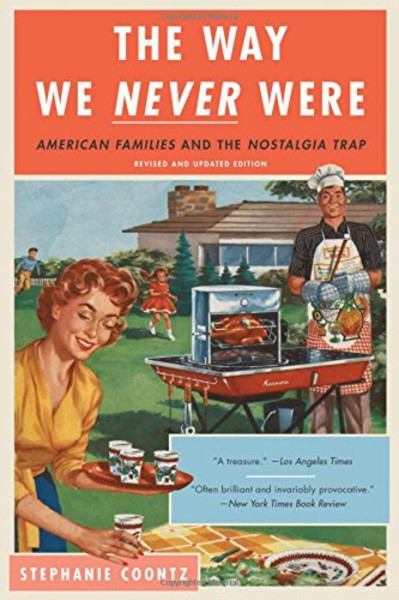
Editor’s note: In 1992—the year the U.S. presidential campaign erupted into a culture war over family values—Stephanie Coontz published The Way We Never Were: American Families and the Nostalgia Trap. The title itself offered the pithy concept, and the book demonstrated that diversity and change have always been hallmarks of American family life: “Leave It to Beaver” was not a documentary. This week (March 29, 2016) Coontz released a substantially revised and updated edition of The Way We Never Were. Below, she provides a brief review of ten things that have changed for the better in the past quarter century, three that have stayed the same, and two that have gotten worse.

In 1992, political leaders and pundits were predicting that changes in family forms and gender roles were leading America into disaster. Were they right? 

  1. Whatever happened to the Super Predators? In the early 1990s criminologists were predicting “a blood bath of violence” unleashed by “tens of thousands of severely morally impoverished juvenile super-predators” – all supposedly a result of rising rates of unwed births. But between 1993 and 2010, sexual assaults and intimate partner violence reported dropped by more than 60 percent. According to the FBI’s Uniform Crime Reporting Statistics, the murder rate in 2013 was lower than at any time since the records began in 1960. Since 1994, juvenile crime rates have plummeted by more than 60 percent, even though the proportion of children born out of wedlock has risen to 40 percent.
  1. How about crack babies? In the 1980s and 1990s, newspapers headlined an epidemic of “crack babies” in the inner city, with kids permanently damaged by their mothers’ use of crack cocaine during pregnancy. This led to a wave of punitive legal actions against such women. But follow-up studies have since revealed that children from the same high-poverty areas who had not been exposed to cocaine in utero were equally likely to have developmental and intellectual delays as babies born with cocaine in their systems. As I documented in The Way We Never Were, the big risk to these children was the pollution, violence, and chronic stress of deeply impoverished and neglected communities – including lead poisoning damage that was going on for years before it hit the headlines in 2016 because of the disaster in Flint.
  1. Did career women start “out-sourcing” their children’s developmental care? As women gained more high prestige jobs in the late 1990s, that’s what many experts feared. In fact, however, even as mothers’ work hours increased, their child-care hours increased too, while fathers’ child-care time tripled. Today, both single and working moms spend more time with their children than married homemaker mothers did back in 1965.

more...

Photo by cvrcak1 via Flickr

Fifteen years ago, the going wisdom on cohabitation was that marriages preceded by living together were more likely to fall apart—that news is out of date. Several pieces from CCF share more current work on cohabitation, including the key observation that cohabitation itself is no longer associated with more or less risk of divorce in any subsequent marriage. Other recent pieces cover cohabitation and housework, childrearing, and remarriage.


J.K. Califf, Flickr.

One of the consistent findings of sociological research in recent decades has been that couples who had a child before getting married had substantially higher odds of divorcing than couples who married first. This held true even when researchers controlled for other factors that tend to distinguish such couples from those who marry directly—education, family background, race and ethnicity. But considering the tremendous increase in premarital cohabitation and childbearing over the past quarter century, and in light of new evidence that many other longstanding “laws” of marriage and divorce have been overturned (e.g., see “It’s Not Just Attitudes: Marriage Is Also Becoming More Egalitarian”; Are Individuals Who Marry at an Older Age Too Set in Their Ways to Make Their Marriages Work?), we set out to investigate whether this particular sociological “rule” still applies. more...

Our Youngest Learners: Who Are They and Where Are They Learning?

Every year since 1971, the National Association for the Education of Young Children (NAEYC) has sponsored a weeklong celebration of young children, their teachers, and their families (Week of the Young Child; April 12-18, 2015). This year’s theme is Celebrating Our Youngest Learners.

1971 was a year that seemed to promise a giant leap forward for young learners. The Comprehensive Child Development Act (CCDA), an amendment to the Economic Opportunity Act of 1964 (EOA) Reauthorization, would have provided every American family access to developmentally-oriented child care on a sliding-fee-scale. In September the bill was debated and passed by both the Senate and the House, and on December 2 a final version was adopted by both houses, to be sent to then-President Nixon. But on December 9 President Nixon vetoed the EOA Reauthorization and along with it the CCDA, declaring that the government would not sponsor “communal child-rearing.”

Despite the continued increase in maternal employment and decades of research showing that quality child care benefits children, families, and employers, the US has made almost no progress since the defeat of the CCDA in 1971. U.S. child care continues to falter because its policy goals are not aligned with the needs of contemporary families. One part of the system provides high quality, no-cost early education to children from low income families. The other part functions to support parental employment and is far less well-regulated.

Either way, finding affordable, convenient, and high quality child care that covers parent work schedules and meets children’s developmental needs is a real challenge for most families. Early education programs typically run for only part of the day. The cost of full-time child care rivals that of college tuition in most states. And aside from the federal standards for Head Start programs, regulation of safety, health, and quality varies widely from state-to-state.

Today’s Youngest Learners: What Distinguishes Them and Their Families?

more...

A report and commentary prepared for the Council on Contemporary Families.

A set of tables released by the U.S. Census this month provides new evidence of how much the structure, composition, and life-course of American families have changed over the past 55 years. Poverty figures in the same report show that having two parents may help in keeping children out of poverty, but by no means guarantee it. And other research shows that the relationship between income and family structure goes both ways: People who are well above the poverty line are more likely to get and stay married.

In 1960, according to Census figures from that year, nearly 90 percent American children lived in two-parent families, with only 8 percent in mother-only families. A miniscule 1 percent resided in father-only families, and 3 percent lived either with grandparents, other relatives, or in other arrangements (Census, 1960).

By 2014, according to figures newly released by the U.S. Census Bureau (CPS ASEC, 2015), almost a quarter of American children (24 percent) lived in a mother-only household, a 300 percent increase since 1960. Four percent lived in a father-only household, still a small percentage but a four-fold increase since 1960. Another 4 percent were living either with grandparents or in other arrangements. Just 68 percent of American children were living in two-parent families. more...

This paper is part of the Council on Contemporary Families’ Online Symposium “New Inequalities.”.

Contrary to popular opinion, growing instability in American families, reflected not just in divorce rates but falling rates of marriage and high rates of unwed motherhood, is not caused by people abandoning traditional concerns for children’s well-being. It is a class issue caused by the growing gap between the job options, resources, economic stability, and personal safety nets available to college-educated Americans and less-educated workers. The authors explain.
–Stephanie Coontz

For the past two decades, countless media reports have claimed that we face a crisis in Americans’ commitment to their children, as falling rates of marriage, high divorce rates, and soaring numbers of non-marital births have affected millions of children. Contrary to popular opinion, this crisis is not caused by people abandoning traditional concerns for children’s well-being. It is a class crisis caused by the growing gap between the job options, resources, economic stability, and personal safety nets available to college-educated Americans and less-educated workers. more...

The following is a re-post in honor of the 50th Anniversary of the Civil Rights Act. Click any chart or figure to expand.

Latinos are increasingly driving the demographic fortunes of the United States. Between 2000 and 2011, the number of white children in the country declined by 4.9 million, a decrease of 11%. Blacks and American Indians and Alaska Natives also saw their child populations decline. The nation’s total child population, however, increased by 1.7 million in the same period, largely due to the growth in the Latino child population. The number of Latino children rose by 5.1 million during this period (Figure 1), an increase of 42%. The number of multiracial and Asian and Pacific Islander children also expanded, but much less than the increase of Latino youth.

By 2060 it is projected that the proportion of white children will fall from 53% in 2012 to barely a third—just 33% (Figure 2). Latinos will have replaced whites as the nation’s largest child population, comprising almost 40% of the total. The black share of children is expected to decrease slightly from 14% to 13% during the period. The remaining 16% of children in 2060 will be largely Asian and multiracial youth. more...