religion

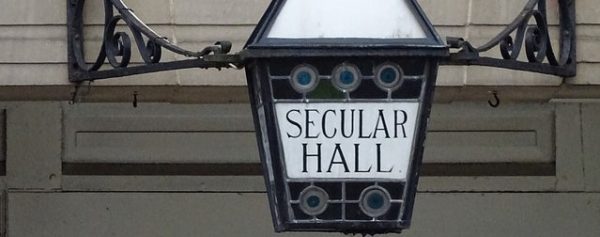
Secular Hall Lamp, Leicester. Photo by Chris Hoare, Flickr CC

President Trump recently signed an executive order that removes the financial threat churches face when their leaders publicly support a political candidate. While many argue that the order is largely symbolic and too narrow to mean any real change, others think it went too far, and the order has sparked discussions about the proper place of religion in what many see as an increasingly secular country. Long-standing discussions among social scientists about the meaning and measurement of “secularization” help put Trump’s order in context and reveals the complexity of religion’s role in American society.

At its most general, secularization is defined as the process whereby the political and/or societal significance of religion and its institutions wane slowly and religion becomes differentiated from the secular public spheres of social and political life. But the way religiosity is measured in studies of secularization matters. For example, while many have pointed to a decline in church attendance, or behavior, in both the U.S. and Britain as indicators of secularization, others argue that this trend has not resulted in a loss of religious beliefs.
Social scientists typically measure religiosity using the “3 Bs” approach — belief, belonging, and behavior. This approach accounts for the different ways that religious individuals hold religious beliefs, belong to and identify with specific religious belief systems and denominations, and enact those beliefs and belongings through behaviors like prayer, religious service attendance, and fasting. Individuals can combine the “3 Bs” in a multitude of ways, and while some “believe but don’t belong,” and others “belong but don’t believe,” an increasing number of individuals eschew religious beliefs, belongings, and behaviors entirely.
Similarly, scholars have identified multiple “levels” of secularization: religious decline, differentiation of secular and religious spheres, and the privatization of religion. While the traditional conceptualization of secularization assumes that each level is linked, some argue that each is a distinct process and that one does not necessarily lead to the other. Trump’s recent executive order is a step towards the deprivatization of religion in the U.S, where religious groups are stepping back into public life and engaging in political and social debates more than they have in the past. But this deprivatization can and is happening alongside trends of religious decline, as the U.S is also seeing increased religious disaffiliation among younger generations.  
Photo by William Garrett, Flickr CC

Trump’s rise to the presidency still has many people wondering why large numbers of whites with low to moderate incomes voted for a candidate who supports policies that are likely to have a negative impact on them. In other words, how is a millionaire real estate developer from New York City seen as an average Joe and a champion of white workers? Two prominent sociological explanations involve the racist attitudes of whites’ and feelings of anger and abandoment in economically struggling rural communities.

Racially coded, and racially explicit, language is particularly powerful for tapping into white Americans’ feelings of displacement, loss, and resentment. Sociological research suggests that racialized attacks on “undeserving” immigrants and people of color who benefit from government “handouts” provide a target for anger and a rationale for why white working class communities are struggling economically (while ignoring the privileges that go along with whiteness). Thus, the emotional appeals of racist and xenophobic campaign rhetoric can contribute to lower income people voting against their economic self-interest.
Much of the public commentary about white working class voters has focused on folks in cities and industrial sectors, but another important population to consider is rural residents. People in rural areas are disproportionately white, are struggling economically due to declines in commodity prices, and are confronting rapid demographic changes. Rural citizens, especially white men, perceive their religious and nationalist beliefs as being looked-down upon by liberals, and they draw on a strong rural identity when they describe feeling ignored and abandoned by politicians and elites who devalue their lifestyles. They see the government as creating policies that favor cities and help undeserving minorities and state bureaucrats, all while ignoring rural people. Thus, conservative politicians like Trump have tapped into people’s anger and resentment through emotional appeals to masculinity and male dignity, American nationalism, and Christian morals.

For more on why working class whites voted from Trump, see here, here, and here.

Photo by The Kingsway School, Flickr CC

From climate change to stem cell research, public discourse in the United States is highly divided about the legitimacy and authority of science. Depending on your views, it’s easy to dismiss the other side as uninformed or uneducated, but sociologists know that views about science are more complicated than that.

Despite common misconceptions that climate change skepticism is linked to education, trust in science has only a small correlation with educational attainment or scientific literacy.
Rather, distrust of science is closely linked to political and religious affiliations. Conservatives have the lowest level of trust in science; this holds true even among highly educated conservatives. As for religious folks, studies find that it is not necessarily that religious people completely distrust the scientific method, but rather they reject science’s influence on issues they see as a moral concern.
However, research cautions against thinking about trust in science as simply a liberal versus conservative binary. A recent study offers a more complicated analysis, arguing that a third perspective defies this binary. This group, labeled “postseculars,” have more complicated views — they often trust science in certain domains, but distrust it in others, reflecting a much more complicated picture of how cleavages in social, political, and economic attitudes influence public opinion of scientific authority.
Media Missionary Day, San Diego, 2008. Pamla J. Eisenberg, Flickr CC

The recent U.S. presidential election has everyone thinking about the role of media and religion in political life. From fake news to mainstream media spectacle, both the left and the right have been criticizing American journalism. White evangelical Christians also overwhelmingly broke for Trump, despite concern that he was not particularly pious himself. The intersection of politics, media, and religion is clear, but what can research tell us about how they interact?  Some of the best work suggests we can learn a lot by making an unexpected comparison: the role of religion and politics in the media in the United States and Africa.

First, political leaders across the globe use religious media in similar ways. Religious programming and discourse in the media creates new ways for people to use religion to signal their social status. Politicians in both the U.S. and countries like Nigeria have harnessed the power of these shows and their large audience numbers as a tool to publicly cultivate their spiritual image by integrating administrative goals with images of divine will.
Second, religious leaders also use secular media outlets in similar ways. The political economy of the media both in Africa and the U.S. means that secular media organizations are willing to broadcast religious programs because they garner large audience numbers. Additionally, religious leaders embed themselves in the elite, administrative networks that run secular media outlets, political groups, and academic organizations to disseminate their messaging to both religious and non-religious audiences. This also means that religious media personalities are firmly ensconced in today’s globalized media and public culture that is characterized by a focus on media icons, spectacle, and a penchant for dramatization.
Studying media as a central category across different international cases provides fresh perspectives on religion, citizenship, authority, and political engagement.
Screenshot via getreligion.org.

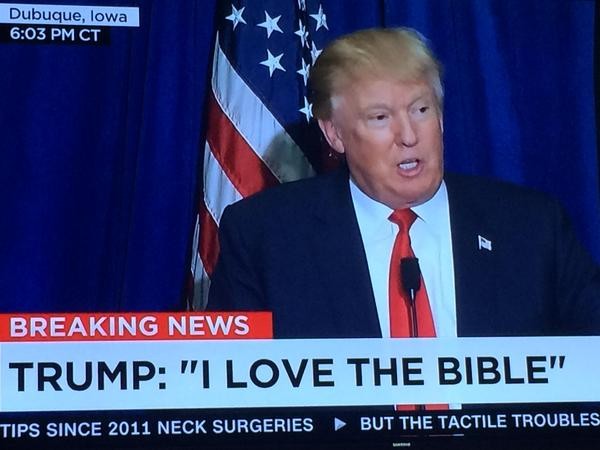
At this week’s Republican National Convention, Donald Trump will accept the party’s nomination for president. Social scientists explain Trump’s primary success by looking at his supporters, especially at their racial biases and class grievances. The nomination is still surprising, though, because Trump has managed to win reluctant support from party leaders, influence the GOP platform, and gain traction among Evangelical Christians (despite not seeming all that pious himself). Sociological research on political parties and organizing show how an unlikely leader can win institutional favor even when they seem to clash with the individuals who run the show.

How is Trump winning over party elites? We often think about political parties as groups of savvy leaders who design the system to keep themselves in office (and challengers out). A longstanding sociological take, however, shows how parties represent deep divisions in the public along race, class, and ideology. This means that emerging public interest groups can and do swing party politics, such as the Democrats’ shift toward a civil rights agenda or the rise of the Tea Party coalition among Republicans.

And how did a man quoting “Two Corinthians” win over leaders in the Religious Right? This group’s political influence doesn’t just come from the pulpit. Instead, shared beliefs allow lay leaders to build networks among influential people in government, business, and entertainment. Much of their success comes from “unobtrusive organizing”—the way the networks, in turn, work within existing power structures to acquire political influence. Thus, the Religious Right can fall in line with a candidate who does not seem to fit their public agenda if it means even more power and access behind the scenes.

Photo by Helen Cassidy, Flickr. https://flic.kr/p/6mghmy

In case you missed it, new fossil evidence suggests that a creature known as the “Siberian Unicorn” may have lived alongside humans some 29,000 years ago. Perhaps that eccentric fellow you’ve seen in the aluminum-foil hat wasn’t so eccentric. In fact, research suggests an openness to phenomena like UFOs, unicorns, and elves is downright normal.

Consider how Scott Draper and Joseph O. Baker describe a wide variety of people across different religious subgroups who all believe in angels. Folklore-phenomena can provide people with emotional comfort and compelling stories.
Such narratives can be transposed across many belief systems and subcultures. Quite a few people believe chasing spirits is a spiritual experience, as discussed by Marc Eaton in his examination of ghost hunters and “paranormal investigators.” Other research looks at the popular pursuits of Bigfoot and alien crash sites.
Sociology has always shown how belief in the paranormal, the fantastical, or the spiritual is a social process (consider founding father Durkheim’s pivotal Elementary Forms of Religious Life). Influential scholars, such as Percy Cohen, who tackled the sociology of myth from a functionalist view, and Richard C. Crepeau, who describes how sport myths and “heroes” help sharpen a society’s moral and aesthetic values, show that the paranormal isn’t losing popularity.
Photo by Jennifer Boyer, Flickr CC. https://flic.kr/p/bFDYuM
Photo by Jennifer Boyer, Flickr CC.

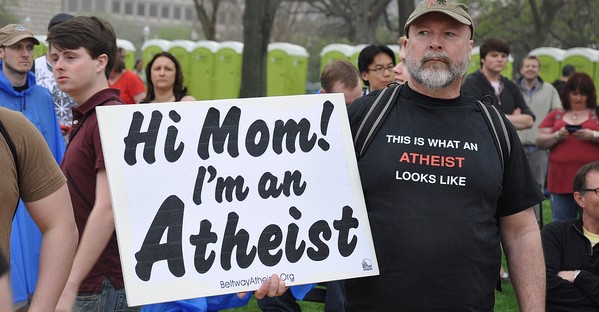
A recent study by the Pew Research Center suggests that “Nones”—people who are unaffiliated with any organized religious institution or belief system—now make up the single largest religious group in the Democratic party. Organizations like the American Atheists launched the #AtheistVoter campaign, and members of this growing voting bloc assembled at the recent Republican presidential debate in Iowa, questioning the candidates’ ability to represent non-religious Americans and demanding they “Keep Your Theocracy out of Our Democracy.” Sociologists of non-religion detail how the Nones are increasingly diverse, and their social and political agendas sometimes conflict.

The history of non-religious and atheist politics in the U.S. is one of constant tension. The non-religious take varying stances on the role of religion in social and political life, and the movement has had to balance “accommodationist” approaches to religion in the public sphere that support religion as a social good and “confrontational” approaches that position religion as a danger to democracy and progress.
Tensions among the Nones can be a barrier to success as a cohesive political group, but their diversity can also be an advantage. Secular groups often define “the secular” differently depending on the context, which allows for a wider net to be cast over the variety of individual, non-religious identities. This enables more inclusive political agendas.
Elvert Barnes, Flickr CC

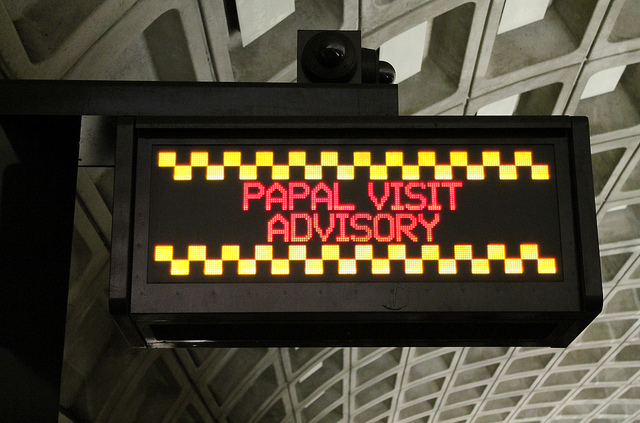
Since his election in March 2013, Pope Francis has gained attention for his efforts to refocus the Catholic Church on issues of social justice. His recent visit to the U.S. was met with acclaim from religious leaders and political liberals, but also sparked consternation among cultural and political conservatives. U.S. Rep. Paul Gosar (R-AZ), a Catholic himself, boycotted Francis’s address to Congress and accused him of adopting “socialist talking points presented to guilt people into leftist politics.”

The cultural divisions within American Catholicism exposed by Pope Francis’s visit are not new. While Gosar may be more vocal than most conservative Catholics, his protest reveals a split between interpretations of the Catholic faith that have been simmering for generations.

Mary Ellen Konieczny shows that the narratives American Catholics use to construct their religious identities have profound political consequences. Some congregations use the language of community to structure their worship, while others structure their activities around the concept of family. In parishes where community talk is dominant, social justice is usually the focus of ministry, but in congregations where family is the main narrative, concerns about personal and sexual morality get more attention. Neither model is more Catholic than the other: both types of congregations draw upon doctrines and use ritual practices central to the Catholic tradition. Hence, the variation Konieczny observes has less to do with texts or doctrines than with the ways people interact in group settings.

The ideological divide in Catholicism also has historical roots in the relationships between the papacy and states. Gene Burns argues that as European states liberalized in the 19th century, Popes struggled to retain political influence for the church. Attempts to engage questions of poverty were seen as intrusions into government affairs, but through discussions of personal morality, the Church could carve out a space where its authority still dominated. As a result, the Church’s ideological emphases turned toward sexual morality and family issues, while sociopolitical concerns grew peripheral.
The postwar period saw a revitalization of Catholic religious activity in the politics of economic justice. Jose Casanova shows how the Solidarity movement in Poland and letter-writing campaigns among American nuns after Vatican II helped to steer church activity back toward social justice work, and John O’Brien charts the influence of labor activist-priest George G. Higgins on Catholic social thought in the 20th century.

Pope Francis’s return to social justice issues does not necessarily make him a “liberal” pope. We might better view him as interested in returning the Catholic church to a language of social justice, firmly rooted in Church history, despite being obscured by previous Popes’ focus on other issues.

Photo by Seth Capitulo, Flickr CC.


In mid May, the Pew Research Center released its Religious Landscape Study, using a sample of over 35,000 people to analyze the religious composition of the U.S. population. Some findings got significant media attention, especially one showing that an increase in the number of religiously unaffiliated Americans coincides with a sharp decline in mainline Protestant and Catholic identification. Commentators disagree about what the results really mean; The Huffington Post announced that “America is Getting Less Christian and Less Religious,” while The Atlantic countered American religion is “complicated, not dead.”

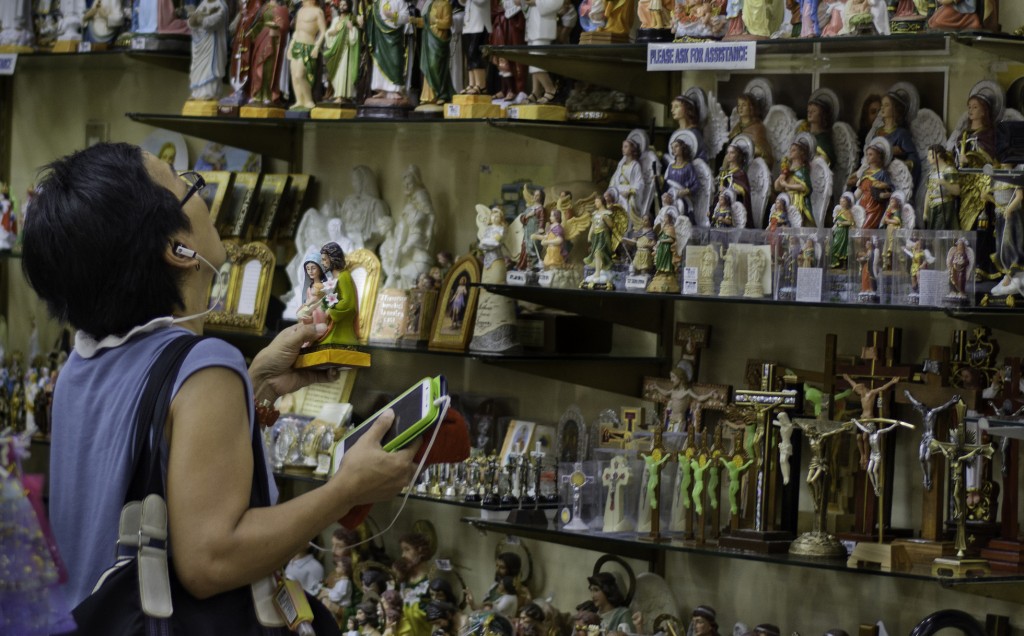
Religion scholar Peter Manseau articulated a more nuanced take in the New York Times Sunday Review. He writes that since many of the religiously affiliated still believe in God or pray occasionally, the real trend is a move away from organized religion and toward more personal, private forms of spirituality. In this view, the story of religious change in America today is increasing pluralism, not declining religiosity. But is private, churchless spirituality really the same thing as religion? A small share of the unaffiliated population does fit into the mainstream culture of religious pluralism in the U.S., but this ignores the unique impact of both the decidedly nonreligious and the unique political causes of disaffiliation.

Individualism pervades the American religious landscape, from strict Catholic churches to urban Buddhist groups. Congregations rely on individualistic language and practices to develop religious commitments, and while this can lead to both progressive and orthodox forms of religious expression, it also contributes to the politicization of religion. Michael Hout and Claude Fischer argue that politicized religion repels many Americans, especially younger ones.
While many of the unaffiliated do believe in God, pray, or otherwise demonstrate some type of spiritual concern or commitment, but these “unchurched believers” comprise less than half of the unaffiliated population. Chaeyoon Lim, Carol MacGregor, and Robert Putnam find that only about 30% of the unaffiliated retain some aspects of religiosity, standing “halfway in and halfway out of a religious identity.” Their numbers are exceeded by atheists and agnostics who are decidedly nonreligious.

Indiana’s recently passed Religious Freedom Restoration Act (not to be confused with the 1993 Federal RFRA), faced widespread public controversy and brought a number of high profile boycotts against the state. The law allows private businesses to use the free exercise of religion as a defense in court should they face a lawsuit for discrimination, raising concern about whether businesses are allowed to discriminate against clients on religious grounds. Similar laws are under debate in other states, while in Madison, Wisconsin, officials have signed the first legislation that includes the “non-religious” as a legally protected category. The laws illustrate the importance of religion in shaping social and political issues in American lives.

While religion often works as an inclusive, community-building institution, it also has the potential to reinforce existing social boundaries and inequalities. Cultural and historical contexts shape the ways that religious beliefs are interpreted, and in the American context, religious beliefs are often used to exclude religious and sexual minorities.
Even if these laws are repealed or amended, these social boundaries underlie deeper issues in the workplace. Despite being prohibited by the Employment Non-Discrimination act, audit studies find discrimination against religious minorities and openly gay men in the hiring process.

For more on this issue, check out our post from last year: Religious Freedom and Refusing Service.