culture

Most of the buzz around Hillary Clinton and Carly Fiorina’s candidacies are about getting into the White House as the first woman president, but what will life be like if one actually makes it?

Just winning the election won’t make politics more female friendly. Studies show that when women enter male-dominated fields, they find it difficult to work in an arena designed by men for men. For example, some jobs involve networking in masculine spaces like bars and golf courses that traditional and symbolically exclude women. When they hit the glass ceiling or find themselves undervalued, many women attribute limited opportunities or personal difficulties at work to problems with individual sexists or difficult personalities rather than a gendered workplace structure. However, restructuring the work environment to center more on teamwork than individual success may help women by giving them more contact with others at work, thus weakening gender stereotypes, providing more networking opportunities, and leading to more promotions.
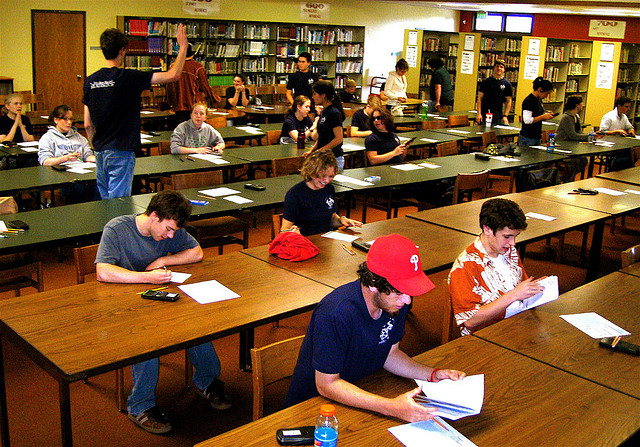
Students take the AP Statistics test. Photo by Adrian Sampson via Flickr.


As senioritis infects graduating classes across the U.S., one group of students is denied the thrill of the “senior slide”: those enrolled in Advanced Placement courses. These students look forward to a grueling gauntlet of 3-hour exams on topics ranging from Computer Science to Studio Art to Chinese Language and Culture. The tests are rigorous, cumulative assessments of each student’s mastery of an entire year’s worth of class content, and they have extremely high stakes. College Board, the organization that creates and scores the exams (as well as the SAT), claims high AP scores help students “stand out in the admissions process.” While these tests only seem to target elite, high achieving students, they also impact educational processes school-wide.

AP classes are a source of inequality in educational attainment. Minority and low-income students are more likely to attend schools offering fewer AP courses. Even when courses are available, these students are also more likely to be underrepresented in them relative to their more affluent and white peers.
Policies aiming to increase AP courses at underprivileged schools may be one way to narrow the gap, since parent/student demand and school officials’ response in more affluent districts are likely driving the difference. The proportion of upper-middle class students at a school is an excellent predictor of both the number of AP courses offered and the number of students who enroll.
AP tests weren’t always used in college admissions. They were originally designed to allow high-achieving students to place out of introductory courses and into more advanced college work. Only in recent years have they become an important indicator for college admissions boards.
AP testing culture affects all students, no matter where they’re tracked. In most cases, tests change curricula by narrowing content to tested subjects, fragmenting content area knowledge into test-related pieces, and increasing teacher-centered instruction. However, certain types of high-stakes tests can encourage curricular content expansion, integration of knowledge, and cooperative learning.

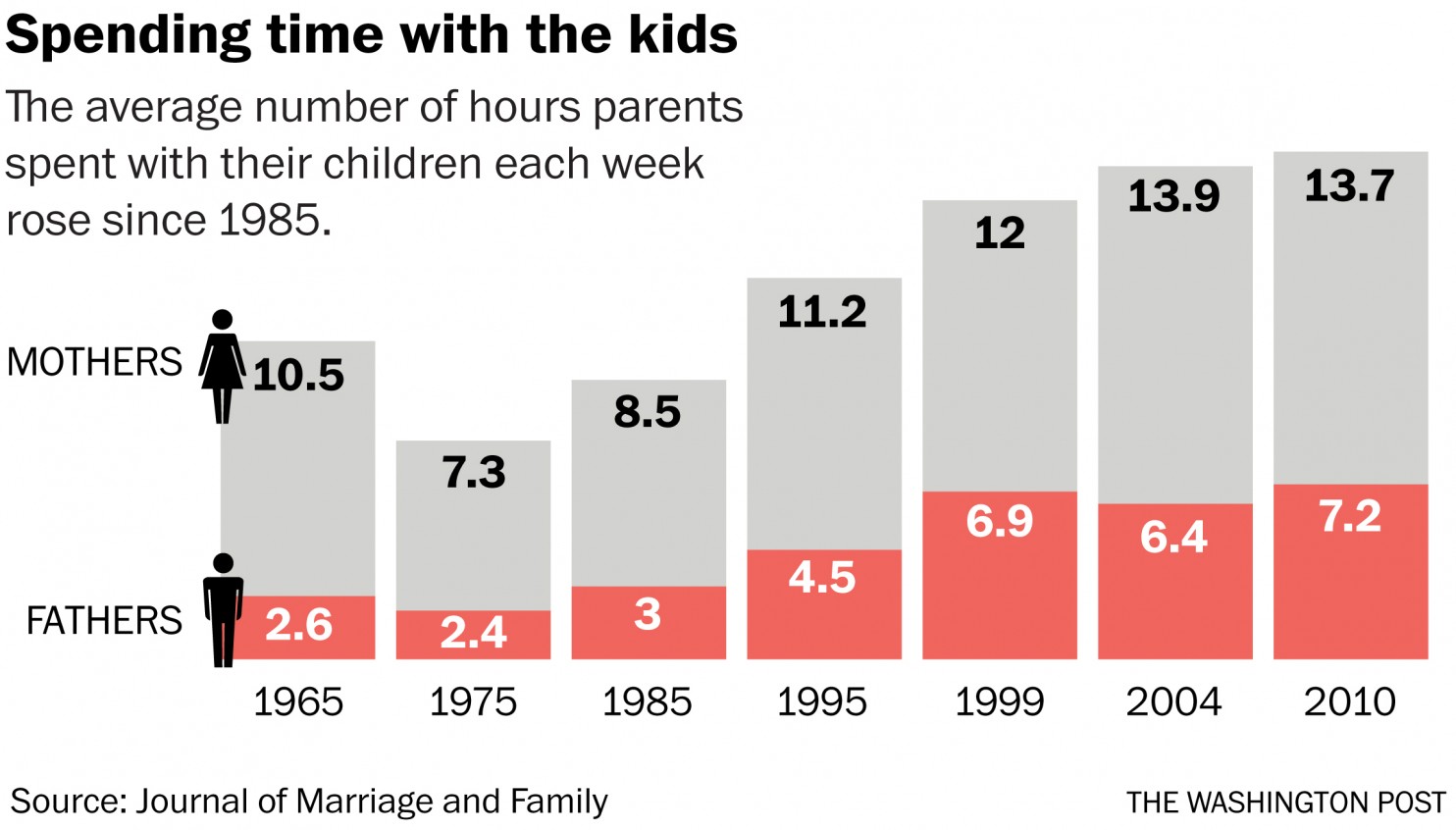
WaPo graphic


A recent scholarly article in the Journal of Marriage and Family by Melissa Milkie, Kei Nomaguchi, and Kathleen Denny (first covered in the Washington Post) has sparked a plethora of commentary in the news media, including several critiques by Justin Wolfers of The Upshot, and a convincing response by the authors in the Washington Post. Using high-quality time use data from a national panel study, Milkie, Nomaguchi, and Denny found that the overall amount of time mothers spend with either adolescents or younger children does not matter for their children’s behaviors, emotions, or academics. What do sociologists know about the impact of parenting time on children’s wellbeing?

First, the kind of parenting time matters. Time mothers spend engaging with children makes more of a difference than the time mothers are available to or are supervising their children. So being long on love but short on time isn’t a bad thing. Engaged maternal time is related to fewer delinquent behaviors among adolescents, and engaged time with both parents was related to better outcomes for adolescents. Other studies show too much “unstructured” parental time, such as watching TV together, may actually be worse for some children under age 6, and that the quality of parent-child relationships factors in. Family dinners contribute to fewer depressive symptoms and less delinquency among adolescents, but only when parent-child relationships are strong.
Why did this finding spark such a media response? In part, it’s because society believes ideal mothering means spending lots of time with children. Many parents strive to attain this ideal, but many working mothers who cannot attain it must redefine their definition of a “good mother” to fit with work responsibilities. Still, working mothers today spend more time with their children than employed mothers in the past.


For more on the original article and the critiques, see Sociological Images.

California is facing record drought, water restrictions, and threats of wildfires. The solution seems simple—just find more water through increased pumping or desalination—but these quick fixes ignore deeper questions about how we turn public necessities into commodities and determine who can lay claim to natural resources. These issues can lead to cultural conflict, but struggles for water can also renew solidarity across different social groups.

Sociological case studies remind us that professional environmental responsibilities to the land, its residents, owners, and governments change over time and through particular institutional cultures. Power and inequality shape who is exposed to environmental problems and how we address solutions.
Water conflicts also bring up commodification—the way we turn public necessities like water and health into market goods. Research on commodification examines everything from how the water industry actively competes with the tap to how insurance markets change the culture of life and death in the United States.
Water resources—even when scarce—do not inevitably lead to conflict. Environmental concern is not only high in affluent nations; even in places as tense as the Middle East, local activists regularly use the environment to bridge cultural, political, and religious tensions.

Rebecca Farnum is a 2012 EPA Marshall Scholar researching for a PhD in Geography at King’s College London, where she explores environmental conflict and cooperation around food and water resources in the Middle East and North Africa. She has an LLM in International Law on environmental and human rights law, an MSc in Water Security and International Development, and undergraduate degrees in anthropology, interdisciplinary humanities, international development, and international relations.

Indiana’s recently passed Religious Freedom Restoration Act (not to be confused with the 1993 Federal RFRA), faced widespread public controversy and brought a number of high profile boycotts against the state. The law allows private businesses to use the free exercise of religion as a defense in court should they face a lawsuit for discrimination, raising concern about whether businesses are allowed to discriminate against clients on religious grounds. Similar laws are under debate in other states, while in Madison, Wisconsin, officials have signed the first legislation that includes the “non-religious” as a legally protected category. The laws illustrate the importance of religion in shaping social and political issues in American lives.

While religion often works as an inclusive, community-building institution, it also has the potential to reinforce existing social boundaries and inequalities. Cultural and historical contexts shape the ways that religious beliefs are interpreted, and in the American context, religious beliefs are often used to exclude religious and sexual minorities.
Even if these laws are repealed or amended, these social boundaries underlie deeper issues in the workplace. Despite being prohibited by the Employment Non-Discrimination act, audit studies find discrimination against religious minorities and openly gay men in the hiring process.

For more on this issue, check out our post from last year: Religious Freedom and Refusing Service.

ISIS recently announced they “will conquer Rome, by Allah’s permission” in a video that showed the murder of 21 Christians in Libya.  Not long after the video’s release, Italians offered cheeky travel advice to the militant group via Twitter, using the hashtag “#We_Are_Coming_O_Rome.”  Tweets warned of traffic jams and tourist traps at landmarks like the Trevi Fountain, while others humorously applauded ISIS’s “vacation” choice.  But is laughter the best medicine for international threats? 

Jokes are a way for societies to cope with threats.  People use irony to lessen their anxieties about an unsettling situation without seeming paranoid.  Humor also give status by discrediting those with strong anxieties and giving the joker an air of nonchalance. 
Ethnic jokes also draw symbolic boundaries between who does and doesn’t belong.  These jokes reinforce the moral values of the in-group by characterizing outsiders’ unacceptable behavior. Framing is key in being playful with something political—those involved in the interaction need to have shared beliefs and the joke needs the right context.
However, humor is a double-edged sword as evidenced by the events that followed the Charlie Hebdo cartoons earlier this year and the Jyllands Posten depictions of Mohammad in 2006. Targeting a minority group reinforces stereotypes and masks the diversity of individuals within the group. When a member of the dominant culture “punches down,” with an ethnic or racist joke, the audience is more likely to be judgmental of individual members of a minority group.

Between social media, television, Internet, and yes, even newsstands, a person has to work pretty hard to not hear about new and noteworthy events. Avoiding spoilers in Game of Thrones or the winner of a major election is nearly impossible without a retreat into the wilderness. Now, with passing of one of America’s most prominent journalists and media critics, David Carr, the news has taken a self-reflective turn. We took some time to review the research on how journalists don’t just report the truth—they make it.

Mainstream news provides the general public with information about current events. Choices about what to cover direct attention and influence public opinion, but these choices aren’t always at the center of the action. For example, social movements get more coverage when they appear as formal, professionalized organizations rather than confrontational, volunteer-led groups. It’s news agencies that frequently affect whether a movement is seen as serious and effective or a disorganized bunch of crackpots.
Network ties and framing strategies within the media also change who gets coverage. Insider self-promotion helps draw attention to stories about social problems, and the old “15 minutes of fame” rule only applies to newcomers. Once celebrity is established, that notoriety has staying power.
Good journalism relies on emotional storytelling, but this isn’t because readers are passive consumers of salacious media. Instead, most are “news omnivores” who learn about events through multiple sources and recognize that even “objective” journalism has an angle. With so much happening in the world, stories that help make meaning and emotional sense out of basic information tend to engage readers.

To understand the way Americans feel about and experience this “Crazy Little Thing Called Love,” music is probably the first—but worst—place to look. A quick search for “American songs about love” results in “Love Hurts,” but also “Love Will Conquer All.” Further, “Love Takes Time” and “Love Runs Out,” but “Love Is Forever.” How to untangle this mixtape? Sociologists and their research show some of the reasons Americans are so “Crazy in Love.”

Some sociologists have pointed to a somewhat linear evolution in the way love is experienced in America. They argue there’s been a move away from love as a permanent obligation to love as an individual choice that only lasts as long as it is beneficial for everyone involved.
Others argue a more complicated evolution. Ann Swidler finds that people go back and forth between the romance of “love at first sight” and love as permanence to seeing love as fragile and requiring hard work. Swidler proposes this tension is largely due to the demands of marriage as an institution: the ideals of marriage fit the romanticized version, but the realities of a relationship fit better with more realistic conceptions. So, most Americans hold both views at the same time.
Modern Americans’ increasingly individualized form of love fosters more democratic relationships and increased gender egalitarianism, though it can also lead to increased anxiety about love and relationships. Eva Illouz believes American culture promotes love as “difficult and painful,” offering advice from Cosmo quizzes to sex therapists to self-help books. Combined with the rise in for-profit online dating sites and the ubiquity of advertisements encouraging us to demonstrate love through consumption, Illouz says we’ve come to a “commodification of love,” where you have to work, and often pay, to find and keep romance.
For more on the sociology of love (and whether sociologists can fall in love), check out this great piece at Sociology Lens.

Charles Blow recently devoted his Times column to relaying the news that his son, a junior at Yale, was racially profiled and detained at gunpoint by campus police. Blow mentions that he was glad he had had “the talk” with his son—how to deal with police as a black man:

This is the scenario I have always dreaded: my son at the wrong end of a gun barrel, face down on the concrete. I had always dreaded the moment that we would share stories about encounters with the police in which our lives hung in the balance, intergenerational stories of joining the inglorious “club.”

When that moment came, I was exceedingly happy I had talked to him about how to conduct himself if a situation like this ever occurred. Yet I was brewing with sadness and anger that he had to use that advice.

Blow is not the only parent to impart such advice—recall New York Mayor Bill de Blasio’s controversial comment about advising his biracial son in dealings with police. Poor, middle-class, and even rich and well-known* parents of children of color advise their children on how to stay safe—to thrive, they must survive.

Scholars call how parents talk to their children about racial discrimination and how to cope with it “preparation for bias,” and it is just one practice among several that comprise ethnic-racial socialization.
Sociologist Patricia Hill Collins powerfully conveys how this work is done by black women sharing child-rearing responsibilities within woman-centered networks.
And these lessons seem necessary: Black adolescent males report repeated negative interactions with police and black mothers report constant worry about the well-being of their sons, who they believe are profiled and targeted by both police and other citizens.
Parents emphasize racial barriers and protocol to prepare their children for racism, often using role-playing to demonstrate how to reduce risk in reacting (or not reacting) to discrimination.

*For his part, Blow’s son acknowledged his own class privilege in having his experience so widely publicized, a statement his father shared on Twitter.

Volunteering_SVG

As the holiday season draws near, Americans are gearing up for one of their favorite holiday traditions – volunteering. A time when one is supposed to “spread good cheer,” the season consistently brings a spike in volunteer activity. News outlets all over the country are urging us to “show your gratefulness this holiday in a truly meaningful way” and “take stock of those in need of a hot meal or a warm coat” before we turn to our own celebrations. While it’s not surprising to see such spikes around this time, as American culture encourages such behavior and you can’t swing a turkey without hitting a flyer or advertisement seeking volunteers, what about the rest of the year? What motivates volunteers when spreading good cheer gives way to a busy new year full of work deadlines, weight loss goals, and taxes?

Psychologists point to individual-level motivations such as a desire to express one’s humanitarian values and gain a better understanding of an issue or a community as strong motivators for volunteerism. However, these motivations don’t lead people to volunteer for just any cause. Persuasive messages and feedback from leaders of volunteer groups, as well as how well the group and its goals fit with the volunteer’s goals, are also major factors.
Sociologists show how social factors such as the racial heterogeneity of a region and the availability of organizations to volunteer for are also important when considering why people volunteer. They find that people who don’t volunteer in one place may be more likely to volunteer when they move somewhere else, pointing to factors like the amount of racial segregation, income inequality, and religious diversity in an area. These findings show how simply valuing volunteering as an individual is usually not enough, but that larger social and structural factors are at work.

For a great piece on who volunteers after environmental disasters, see this Reading List post.